A cooperative, or co-op bundle, on itch.io allows you to collaborate with other developers to offer a collection of games from multiple accounts at a single price for any period of time. Any developer on itch.io can organize and publish a bundle. Just like games on itch.io, you maintain complete control over how it’s managed.
If you're trying to sell a bundle of just your own games, you can do that with the Sales & Promotions feature on itch.io. It is not necessary to create a co-op bundle unless you are combining content from multiple accounts.
Creating and publishing a co-op bundle is done in multiple stages. A single itch.io account must act as the host and create the bundle on their dashboard. For the purpose of this guide, we'll assume that you're the host unless otherwise specified.
Locate the Co-op bundles section within the promotions area of your dashboard and click on Create a new co-op bundle to begin. After creating the bundle you can continue to edit every field, including the participating projects and revenue split, up until the first participant approves the bundle. Once a participant approves, most fields are locked to prevent changes while the remaining participants review it.
The following fields are locked once at least one participant has approved the bundle:
The following fields can freely be changed, even during the duration of the bundle:
Why are some fields locked? — During the approval period, we don’t want participants to have any surprises about the promotion they are about to join. In order for the participant to confidently decide to join the bundle they need to see the final arrangement of the promotion. If you need to change locked fields before the bundle is published, you can reset participation, described below, to unlock the bundle at the cost of requiring every participant to approve again. In some rare cases itch.io staff may be able to assist in making changes to bundles that are already live.
Due to the complex nature of consolidating payments for multiple accounts, prices are specified in USD. VAT will be automatically applied if required.
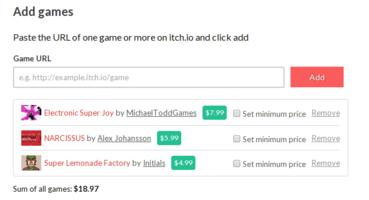
Adding projects — Projects are added to the bundle by pasting itch.io URLs into the form. In addition to individual project URLs, you can paste the URL of a jam or a collection to add every project inside it (up to 750 projects per URL). Drag the projects in the list to control the order they are displayed in on the bundle’s page.
Revenue split — Each participant’s share of the bundle’s earnings is set with a relative weight: their cut is proportional to their weight relative to the total of all weights, so the weights don’t need to add up to any particular number. Presets are available to give every participant an equal share, or to weight each participant by the number of projects they contributed. Participants are limited to the owners of the projects in the bundle: a revenue recipient without a project in the bundle, such as a charity, must be manually added by itch.io staff.
A bundle cannot commence until all the participants have reviewed and accepted it. Once every participant has given their approval, you, as the host, will receive an email notification that it’s ready to be made public.
For the participants to approve the bundle, you need to send the bundle’s URL to each participant. Since the first approval locks the bundle’s contents, wait until you're satisfied with the bundle’s configuration before sending the URL out. This URL isn’t publicly accessible and can only be accessed by accounts that are participants of the bundle. They will be able to view the draft page of the bundle to review the duration and conditions. They must click the approve button to confirm their participation.
For bundles that involve revenue splitting among multiple paid recipients, each recipient must have an account that is eligible for the itch.io payout system. Bundle payments cannot be split for accounts that are using the “Direct to you” system. If an account on “Direct to you” accepts payments through a bundle, they will need to complete account onboarding for payouts in order to claim their balance. Please confirm with your participants that they are eligible for itch.io payouts.
Note: We do not send notifications to participants when you create a bundle to avoid spam. Please only include participants in your bundle who you are in contact with and who you believe will accept it. Do not add random pages to the bundle in the hopes that they will join, as it’s likely they won’t. A single participant’s rejection will prevent the bundle from being publishable.
If you wish to host a bundle with open submissions, please refer to the information below about using the Jam system to facilitate these submissions.

If you need to change locked fields after a participant has approved, you can reset participation from the bundle’s edit page. Resetting participation returns every participant other than the host to pending, unlocking the bundle so you can edit its projects, dates, prices, and revenue split again. Every participant will have to approve the bundle again before it can be published, so verify the bundle’s configuration before sending the URL out to avoid asking your participants to re-approve.
Resetting participation is only available before the bundle has been published for the first time.
After you're satisfied with the details of the bundle, and all participants have approved the bundle, you are free to publish the bundle. The bundle can be published before the start date, and the URL to the bundle will become publicly available. Between the start and end date the bundle will be purchasable.
A publicly available bundle is eligible to show up on itch.io’s bundles page.
Just like any other purchase on itch.io, an account is not required to purchase a bundle, but the buyer will be given an option to register and attach their purchase.
Since every participant must approve before a bundle can be published, a single unresponsive participant can hold up the entire bundle. To protect against this, you can check Allow pruning participants that don’t approve when setting up the bundle. Because pruning changes the deal participants are agreeing to, the option is locked alongside the bundle’s contents once a participant approves, and participants are shown a notice about it when reviewing the bundle.
With pruning enabled, the bundle’s edit page provides a tool that removes all pending participants, along with their projects, in a single step. Pruning is only allowed when the pending participants' projects make up no more than 15% of the bundle’s projects, ensuring the bundle the remaining participants approved stays substantially intact. This also means pruning can never remove anyone from bundles with fewer than 7 projects.
Keep in mind:
itch.io lets you set individual game prices for bundle participants. The revenue splits will be proportionally adjusted based on the number of games that are included at the purchase price.
On the bundle’s review page the host and participants will be able to see each tier and exactly what the split will be.
When someone buys a bundle, itch.io normally generates a download key for every project at the moment of purchase. This approach doesn’t scale to the largest bundles on itch.io, like the community charity bundles that put hundreds of projects into a single purchase: a library orders of magnitude larger than normal causes technical and usability problems, and buyers of bundles that size generally don’t want every included project added to their library. Instead, bundles containing more than 15 projects defer key generation so buyers can pick and choose which projects to add. This happens automatically; there is no setting for it on the bundle form.
Deferring keys changes nothing about what the buyer owns. The bundle’s download page lists every project included at the buyer’s purchase price, and itch.io generates a project’s download key the first time the buyer claims it from that list.
Whether you're hosting, participating in, or have purchased a large bundle, keep in mind:
Note: It’s not necessary to run a third-party script to “claim” every item in a large bundle. Everything in the purchase is already owned, and mass-claiming has only downsides: it floods your library, can subscribe you to product update emails for every claimed project, and can degrade the performance of the itch.io app and library page, slowing down access to the games you regularly play.
As the host, you can view the bundle’s analytics page from your dashboard to follow how it’s performing. The analytics page shows the bundle’s total earnings with a cumulative earnings graph, the list of purchases, and a graph of the bundle page’s views over an adjustable date range.
You may have seen some of the larger bundles that itch.io has hosted where we have an open submission period for participants. Utilizing our Jams functionality, you can create a public page to collect and curate submissions that can be converted into a bundle. Here’s an overview of how that works:
Create a “jam” page for your bundle: Visit https://itch.io/jams/new to create a jam page dedicated to collecting submissions for your bundle. Please include as many details about the bundle as possible on this page so potential participants understand what they are submitting to. If you know the dates and price of your bundle, please include them in the description.
Set up the submission period: Utilize the jam’s submission period to establish a specific time frame during which anyone can submit their game or project to be considered for the bundle.
Utilize “Custom fields” for additional information: “Custom fields” will require submitters to include additional information in a structured way. For example, if you have price tiers, you can ask them to indicate their desired tier.
Curate submissions: As the host, it is your responsibility to curate the submissions. Use the “disqualify” tool provided to manage the eligibility of each submission for the bundle. Entries that are disqualified will not be included in the final bundle.
Create the bundle from the jam: After curating, paste the jam’s URL into the project URL field on the new bundle form to import every entry, up to 750 projects. Disqualified entries are excluded automatically. Use the revenue split presets to give every participant an equal share, or a share weighted by how many projects they contributed, then adjust individual participants as needed. We recommend enabling pruning so unresponsive participants can’t prevent the bundle from publishing.
Use the jam’s “email” tool to contact submitters: All participants of the bundle must approve the final bundle from the bundle’s page. Use the “Email” tab on the jam’s edit page to share the link of the bundle to every submitter. All participants must approve of the bundle before it can be set live.
Prune non-acceptees if necessary: In case there are participants who are unable to accept in time for the bundle, they can be removed without involving itch.io staff. If you enabled pruning when creating the bundle, you can remove all pending participants from the bundle’s edit page, as long as their projects make up no more than 15% of the bundle (see the pruning section above). For larger changes, reset participation to unlock the bundle, remove the unresponsive participants' projects yourself, and send the approval link out again.
Adding late submissions: While the bundle is still unlocked, you can paste the jam’s URL into the bundle’s edit form again to pick up new entries; projects already in the bundle are skipped. Once the bundle has been published, its contents can no longer be changed.
The bundle form’s jam import is limited to 750 projects. If your bundle is too large for the editor, please contact support and they can manually synchronize a jam to a bundle. You can create an “empty” bundle for staff to fill by visiting https://itch.io/bundle/new?allow_empty.
Please note that to collect earnings from a bundle on itch.io, the account must be eligible for itch.io’s payouts system. Accounts that are not eligible may be pruned from the bundle by itch.io staff if necessary.
You may have seen some bundles on itch.io where many members of our community have come together to participate in a bundle where all proceeds are donated to a charity.
Here are some of the larger bundles we've helped host that utilized open submission to collect funds a charities:
We're here to help facilitate these kinds of bundles, but we ask that you collaborate with our team to ensure we understand the needs and risks associated with the bundle before a large amount of money is collected.
Use the Jams feature to organize submissions as described above. Please include as much information as possible in the jam to ensure that participants understand what they're getting into. This information should include the charities involved, the duration of the bundle, and the estimated price. You can also utilize the jam as a method to gauge interest among participants.
Every charity (or monetary recipient) must be manually onboarded into the itch.io system to be able to receive payments. Because the bundle editor limits participants to accounts with projects in the bundle, the charity must also be manually added to the bundle’s participants by itch.io staff. We request that they are informed about the event before the bundle starts so that any necessary due diligence can take place for all parties involved. As the host, please reach out to them to initiate the discussion. The results of your jam should give you an estimate of how many participants you have and how much you could potentially raise to help them understand the potential impact of the bundle.
Ensure all monetary recipients are fully onboarded for payment into the itch.io system before you begin collecting money for the bundle. Do not initiate the bundle with your personal account as the recipient for payments unless you are prepared to accept full responsibility for the distribution of earnings collected on your account.
Understand the different payout modes so you can get an idea of how the charity will be paid. For bundles with a single recipient, we can often configure “Direct to you” payments so that the charity can immediately collect raised money. Otherwise, payments will be subject to our rules for payouts. In cases where a very large amount of money is collected, itch.io may need to delay the distribution of collected earnings for several months to allow balance adjusting events to settle. When we take on liability for large payouts, for the security of our platform, we do not rush the transfer of funds. We understand that sometimes charity bundles are hosted in reaction to tragic events currently happening in the world, please keep in mind payout timelines when designing your bundle to ensure we can meet the needs of the event.
Inform itch.io when you intend to publish the bundle and seek approval from our team. Certain backend settings may need adjustment for the bundle, particularly if it is of a large size, to prevent any reliability issues with the delivery of the bundle contents. Generally, for larger bundles priced lower, we will disable all access to External (Steam) keys to prevent participants from having to generate an unrealistic number of keys. We're more than willing to host bundles comprising well over 1,000 projects, but it’s crucial that we are kept informed to ensure no issues disrupt the success of the event.
If you have more questions, please contact our team, include the text “Charity Bundle” in the subject of your message so that it may be prioritized.

