The little bit of research I got suggests that while sprites have this strange lag, controls have built-in drag-and-drop. That's really strange, but hey, it's worth a shot.
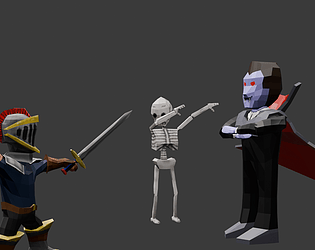
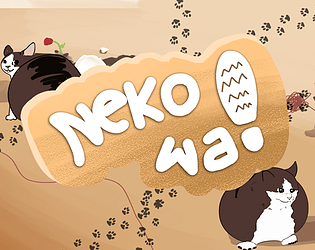
The artwork in this is quite impressive, even if it seems slightly departed from the theme.
The UI has a responsiveness issue that I've encountered before. Maybe by upping the physics tick rate, it can work a little better, but the truth is, I haven't solved it myself.
A faithful recreation of the classic shmup genre. The added Evasion button is a potential nice extra touch. My one issue is the height of the game screen matches my screen height, so I would have preferred the game screen to either be slightly smaller, or go into fullscreen.
I feel you on that one. We run primarily 3D on the team, and web builds have unpredictable behavior when given a 3D program to embed. If we want to get the best technical development we possibly can, desktop versions are our best bet.
I want to get to a point where I can tell the team that we're gonna do a netcode project and have it be a plausible endeavor. The game idea I've been holding onto this entire time is rooted in that particular technical area.
It's actually quite original to bring about a strategy that says "spawn many bubbles and spread them around so they hit things more than they hit you". The chaos that forms from the challenge can require a level of management that I don't normally utilize for such a simple task.
There was a rework in controls midway through specifically because it was so hard to control. It was originally going to be like piloting a plane, and there was such great concern that we changed it. I think the one area that we could improve for control is the ramp, though tripping over yourself for a bad launch from time to time is kind of fun in-and-of itself.
I got to 240 before a nuclear explosion sent a rock straight through.
This is one that stresses you out by way of the thought process demanded under pressure, making it kind of exhausting to play. It is a solid presentation, but as a game, you'll get addicted to coffee pretty quick.
While download version is recommended, the game does play fine if you give it time to cache the shaders.
Camera could use a limited elevation adjustability tweak so you can angle it towards the ground. It's just slightly straining on the eyes, not really a big deal.
I put ゼテラキシス in your leaderboard. Obviously, the font wasn't ready to handle that, and for a jam game, I wouldn't expect it either. I just thought it was funny to do at the time.
It probably would have helped us to create an option to use head pointing or plane pulling (non-inverted/inverted) controls. I think an assumption was made there, which is not a shared assumption, so I'll have to think about that in the future if we run a plane-control game in the future.
I am happy you could really start to enjoy it after getting rockets. It's a big win for us that the game holds your attention enough for you to push on and get the rockets.
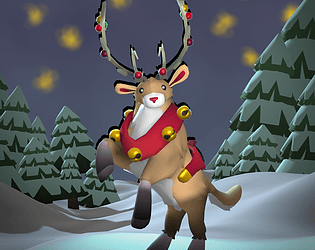
My favorite moment in testing was ramming the reindeer into a tree so that he whipped across the map. Thinking about it now, it really emphasizes how much force you're playing with.
I believe the problems you face are very much a consequence of the browser. I normally hedge against having a browser-playable version because 3D games, even if they work, will have problems. Unfortunately, we struggled to get Mac export working on time, so we needed the browser version just to clear basic requirements. While we seem to have eventually managed a working Mac version, it is simply too late to make the correction now.
The control scheme should have been made clearer, and our failure to clean up a lot of the debug details really hurts our overall polish too. I'm sorry about how much it hurt your experience.
I'm a KnM user, and unfortunately, right trigger doesn't seem to translate to right click.
Found a minor bug with menu: Esc Down will close the menu, but Esc Up will open the menu.
Ultimately, I found the game fun enough to struggle for a little bit on a tougher level before giving up. The complaints I have are tiny little fixes on an otherwise good presentation.
It's a runner, alright. Being able to use only the mouse to play, however, is always a big win for accessibility. Otherwise, it is a well-presented product.
Both of our games seem to have similar caching issues. Need to load things at least once for our shaders. I wasn't nearly as aware of it as you were, though.
Other than that tiny hiccup, though, you have a very strong entry, likely to elevate the GWJ for the future.
The mac export gave us a lot of trouble due to our use of a terrain plugin. According to Git, it is a C#-based plugin, but according to our users, it's been converted to c++. Regardless, it has forced us to run the alternative web upload and has also caused our submission to be late.
I'm very happy that you were able to enjoy the game in spite of these problems.
In games with such a demand for precision, the timer works better like a speedrunning tool. It is rather difficult to get the hang of the jump, so a structure similar to Getting Over It may work better.
From what I could tell, right mouse didn't do anything. I could select food sources and say how many bugs to towards them, but nothing else. Meanwhile, there's an enemy growing without contesting me for resources.
Tooth and Tail may interest you, as it possesses a unique Flagbearer control method. It is still a rather brutal RTS, though.
It's all in the details. It looks like you were going for a visually stylistic fight scene, and if fights are expected to take time, visual appeal becomes very necessary. I would equate what's going on here to the sport of Boxing.
The high rate of random encounters comes three fold: a high tick rate, a probability that's not low enough, and a lack of immunity after each fight. To understand when the probability becomes unacceptable, you need to think about the probability of how many ticks would it take to reach a low probability of avoiding the encounter, which would be (9/10 ^ x). So, 0.9 * 0.9 = 0.81. Then, we say 0.81 * 0.9 = 0.729. The pattern would keep going until the probability becomes so low that you almost guarantee an encounter.
I think there is value in this exercise, as it will give me the chance to use the translation functions of Godot. However, I think where you:ll ultimately find real value is in the process of learning Kanji.
Also, I:m using the Kana Keyboard instead of the normal Romaji method. I believe if you:re typing にほんご、これはとてもはやいほうほうです。
Making the sizes different turned out to be a real difference-maker in the difficulty amping up, even though the speed was the lever used between opponents.
However, between having to squint and the use of this white backdrop, it's a little hard on my eyes.
Still, for what it was trying to be, it's well put-together.
Someday, I'm going to do a typing game myself, but I'm make it cheatable: "かなキボードでタイピングできれば、はやいできます!"
For now, it's a typing game. I tried on hard twice and got 9 each, and then tried easy and got 44. The words getting in the way of each other slowed me down more than anything else.
A runner as a visualized soundscape. Huh...it kind of reminds me just a little bit of Thumper.
I could see this being a minigame played on mobile that sells really well. On a long commute by public transit, that's honestly all you want to do is drift off. When I was on public transit, it was nothing but sudoku.
I was annoyed by the high rate of random encounters, especially one coming up right after I was done with one.
Watching the two things fight has a certain appeal to it, but there's a long way to go before it hits the mark. For now, I think it's a good bit of practice.
My strategy was temps, syringes, and x-rays. After a few runs trying to get the hang of it, I had everything under control.
This game would benefit a lot from a story, similar to...what was it...doll factory, I think. Unlock endless run by having a story to tell. Alternatively, every bug, through the inspection process, might have their own story, or their own quirk. It would be an extra thing to make the game something special. Like Jorji Costavo from Papers Please.
It's a classic top-down stealth game. Not a bad way to do your first jam.
Something's strange about the audio slider. It does not smoothly adjust the audio, but instead jumps to various volumes. To correct this, use the slider's _value_changed() signal and use the audio server's set_bus_volume(master, linear_to_db(value)) function.
An honorable showcase of fidelity and smoothness to be expected from a proven veteran of GWJ.
A nitpick I have is that the picker interface, in my opinion, works best when the bugs are in very separate places. A good example of this use-case is Goodbye Deponia, in a section that has you control 3 clones operating in separate environments.
I'm curious of the resources you have used and what you did yourself.
It is very well executed. My one nitpick is that you can hear the UI's selection sound when mousing over the selections of the original menu while reading how-to-play.
I am sorry to say, but due to the confusion of the controls as well as a screen lock when attempting a retry, it could not pass muster.
The Shoot Power minigame seemed to not work correctly. I think you're supposed to get a certain amount of power based on the fill of the bar, but the hamster appeared to shoot with the same power whether the bar was full or empty.
Ambitious to run a physics-dependent system for your first run. You will go far as you get more practice.
This is the kind of game where details and fidelity matter a lot.
There is a similar game where you do a lot of watching: Do Not Feed the Monkeys. It's a puzzle game with lifestyle management thrown in, where you find the solutions to various situations by watching as much as you can.
I would expect this to be #1 for theme, based on the purity of the experience.