Indie game storeFree gamesFun gamesHorror games
Game developmentAssetsComics
SalesBundles
Jobs
TagsGame Engines

Thaluna.Dev

34
Posts
12
Topics
15
Followers
A member registered Aug 10, 2025 · View creator page →

Creator of

Recent community posts

## RTX 5000 Series (Blackwell GPUs)

Due to upstream framework limitations, GPU acceleration for built-in OCR

(PaddleOCR / MangaOCR) is not yet available on RTX 5000 series GPUs.

### Recommended setup:

  • OCR Device → CPU
  • Translation Device → CPU
  • Use Ollama for GPU-accelerated translation (recommended)

Ollama uses its own runtime and works correctly on RTX 5000 GPUs.

---

## Non-ASCII Windows Usernames (Cyrillic, Arabic, etc.)

Thaluna now automatically detects non-ASCII usernames and switches to:

C:\Users\Public\Thaluna

No manual action is required.

---

## Diagnostics

If you experience crashes or OCR issues:

  • Use the **Diagnostic build**
  • Attach console output or logs when reporting issues
(1 edit)

Hi! Honestly, those logs were a goldmine, thank you so much for sending them. We finally caught the culprit.

Good news first: the path issue is officially dead. I could see in the logs that Thaluna successfully switched to the safe path: C:\Users\Public\Thaluna. So the Cyrillic username problem is gone for good 👍

The only thing left is your GPU. Since the RTX 5060 is so brand new (Blackwell), the current OCR engine just doesn't know how to talk to it yet. That's why you're seeing those "fatal kernel" errors , it's trying to use tools that don't exist for your card.

Here’s how to get it working right now:

  1. Grab the latest Diagnostic build I just uploaded to Itch This one includes an additional fix:
    Manga Mode now correctly respects the OCR Device setting and will stay on CPU instead of trying to use CUDA automatically. This prevents unnecessary GPU initialization on very new GPUs like the RTX 5060.
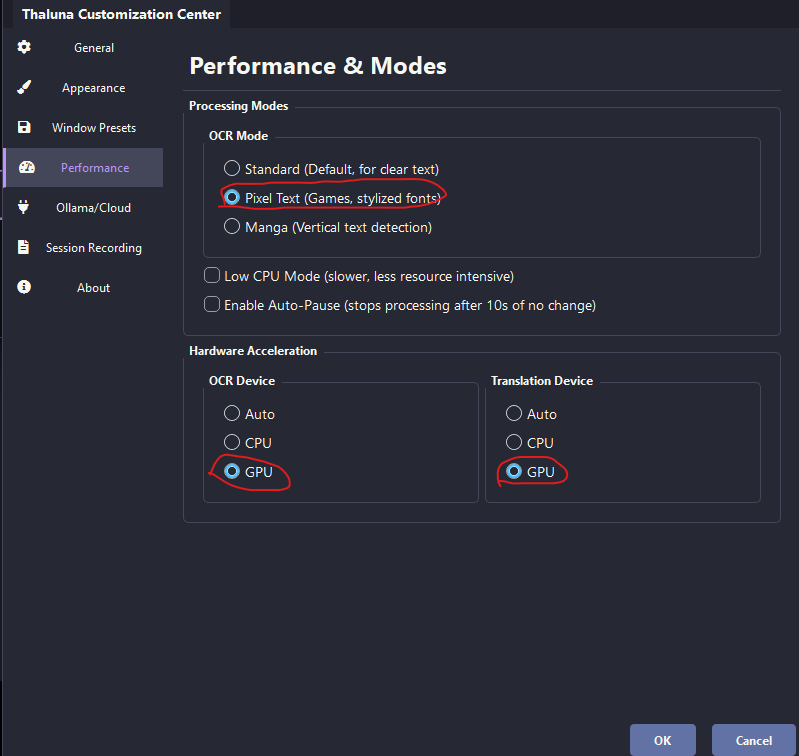
  2. Force it to CPU: Go into Settings -> Performance and set both OCR Device and Translation Device to CPU.
  3. Save and restart.

If the UI gives you any trouble, you can just open Thaluna_internal\config.json and manually change both devices to "cpu".

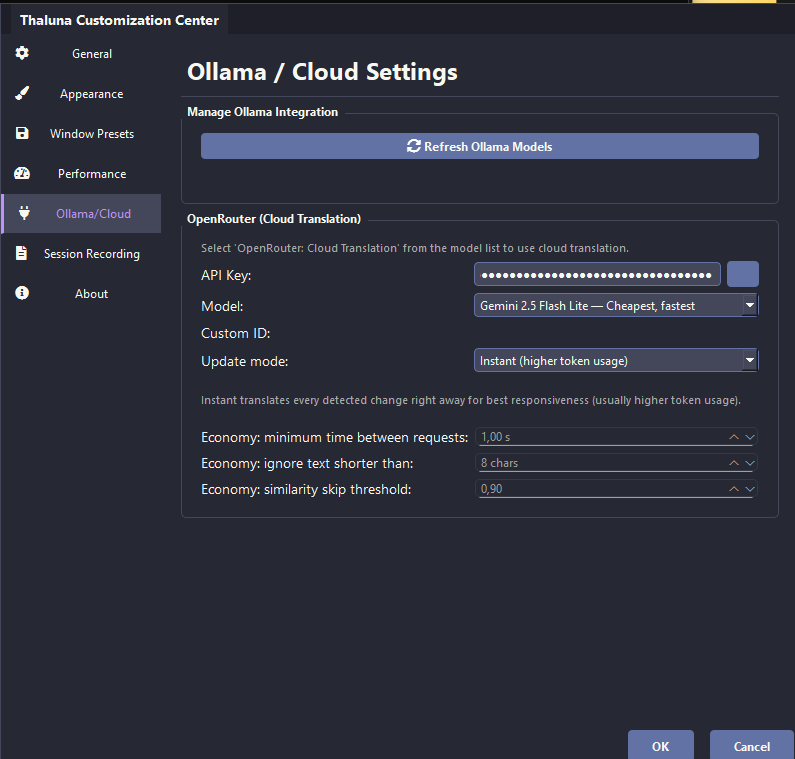
Since CPU translation can be a bit slow, I really recommend using Ollama. Your 5060 is a beast, and Ollama will use it perfectly for translation, even if the OCR is stuck on the CPU for now. I made a quick guide on how to set it up here:

  • https://www.youtube.com/watch?v=_9PjiXKfxUY

    Give it a shot and let me know if it finally starts reading text for you.

  • Hi!
    Thank you so much for the detailed logs — they were extremely helpful. We finally pinpointed what’s going on.

    There are two separate issues happening at the same time:

    1. Non-ASCII Windows username (primary cause)
    Your Windows username contains Cyrillic characters (Антон). Unfortunately, PaddleOCR has a known issue with non-ASCII usernames on Windows. The path gets corrupted internally (Антон → AHTOH), which causes PaddleOCR to fail when loading its models.

    To fix this, I’ve updated Thaluna to use a safe system path that does not include the username:
    C:\Users\Public\Thaluna\
    This completely avoids the path corruption problem.

    2. RTX 5060 (Blackwell) GPU — too new for PaddleOCR
    Your RTX 5060 uses the Blackwell architecture (sm_120). The current PaddleOCR / CUDA build does not support this GPU yet, which is why you see repeated sm_120 / kernel errors. This is a limitation of the OCR engine, not your system.

    How to run Thaluna successfully right now

    1. Download the Diagnostic build again
      I’ve just uploaded a newly updated Diagnostic build that includes the username path fix.
      Please re-download the Diagnostic version from the same Itch page (older diagnostic builds won’t include this fix).
    2. Set OCR Device to CPU
      Go to Settings → OCR Device → CPU
      GPU OCR will not work on RTX 5060 yet.
    3. Translation Device behavior (important)
    • If you use built-in translation, it must also run on CPU
    • If you want fast translations, use Ollama instead
    1. Use Ollama for fast translation (recommended)
      Ollama works perfectly on modern GPUs like RTX 5060.
      I recommend using the Gemma3:4b model.

    Step-by-step guide here:
    https://www.youtube.com/watch?v=_9PjiXKfxUY

    After downloading the updated Diagnostic build and switching OCR to CPU, please try starting the app again.

    If anything still fails:

    • Let the Diagnostic version open (CMD window will appear)
    • Copy the console output
    • Paste it here

    Thanks again for your patience — your report genuinely helped improve Thaluna for users with newer hardware and non-ASCII usernames.


    Hi!

    No worries at all 👍

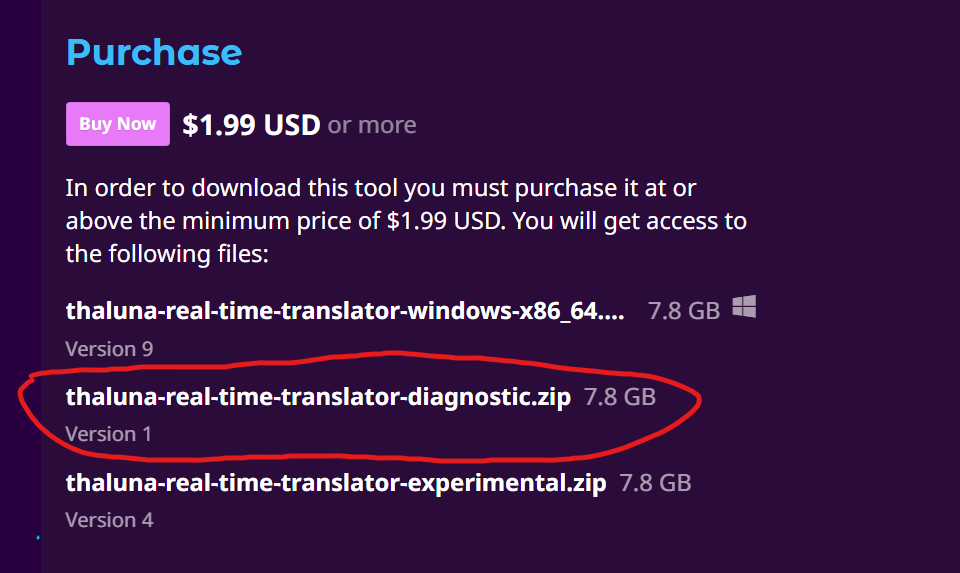
    The Diagnostic build is on the same download page, just listed as an additional file. You don’t need a separate link.

    Here’s how to find it:

    1. Go to the Thaluna download page (where you normally download the app).

    2. In the list of available files, look for:
      thaluna-real-time-translator-diagnostic.zip

    It’s listed alongside the main version.

    Once you run the Diagnostic version:

    • A visible CMD console window will open together with the app
    • All startup logs and errors will be printed there

    If it crashes or shows errors, please click the console window, press Ctrl+A to select everything, then Enter to copy it, and paste the output here.

    This will let me see exactly what’s happening on your system.

    Hi! No worries, this kind of issue is usually fixable. Once I see the logs, I’ll know exactly what’s going on.

    I’ve prepared a diagnostic build of Thaluna specifically for troubleshooting this problem.

    Important:
    The diagnostic version launches with a visible CMD console window.
    All error messages and logs will be printed directly in that console, not saved to a file.

    Please download and run the Diagnostic build.

    When you start the app:

    • Keep the CMD window open
    • If any errors appear, copy the entire console output and send it to me

    Additionally, please make sure you have the required Visual C++ Redistributable installed (needed by PaddleOCR):

    After installing it, restart your PC and try the diagnostic build again.

    If the issue persists, please send:

    • The full CMD console output
    • A short description of what happens (for example: crash on startup, error message, missing files, etc.)
    (2 edits)

    This thread is a hub for model recommendations and real-world feedback from both the development side and the community.

    If you're unsure which model to pick for your setup, start here:

    🔹 Developer's Top Pick

    • gemma3:4b – The best overall balance for most users. It’s fast, smart, and highly recommended as your baseline.

    🔹 Share Your Results

    Hardware and use cases vary wildly, so there is no single "perfect" model. Your feedback helps everyone!

    When replying, please include:

    • Model Name: (e.g., gemma3:4b, llama3:8b)
    • Target Language(s): (Which languages are you testing?)
    • Your Hardware: (CPU, GPU, and VRAM/RAM)
    • Use Case: (VN, anime, gaming, etc.)
    • Priority: (Are you chasing raw speed or maximum quality?)

    ⚠️ Disclaimer: Thaluna is an independent project and is not affiliated with, endorsed by, or partnered with Ollama. Furthermore, Thaluna does not bundle or distribute any Ollama models within the application. Users are responsible for their own local model management.

    Have a question about Quick Translator? Ask away! This section is for anything related to everyday usage.

    Post here if you are unsure about:

    • Real-time Streaming: How the "writing" effect works or how to adjust it.
    • Language Support: How to add or switch between target languages.
    • Model Manager: Questions about downloading or deleting AI models.
    • Performance: How to make the translation faster on your hardware.

    ⚠️ IMPORTANT:

    • Found a Bug? Don't post it here! Use the [Bugs / Issues] section so I can track it properly.
    • 📥 Check Ollama: Most "it's not working" questions are solved by starting Ollama first!
    (2 edits)

    📝 Bug Report Template :

    Please fill out the information below. It helps me find the bug faster

    1. What is the problem? (Describe what happened. Did the text disappear? Did the AI stop writing mid-sentence?)

    2. When did it happen?

    • [ ] Right after launching the app
    • [ ] While downloading a model in the Model Manager
    • [ ] During real-time translation (Streaming)
    • [ ] When clicking "Copy" or changing languages

    3. Model & Ollama Status

    4. System Specs

    • Windows Version: (e.g., Win 10/11)
    • RAM & GPU/CPU: (Important for AI performance!)

    📂 How to find your Log Files

    If something went wrong, the log file has the answer. Please attach it!

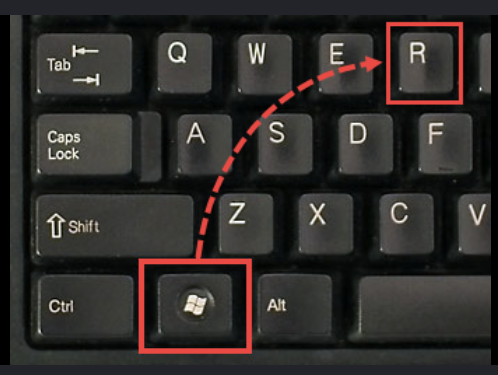
    1. Press Win + R on your keyboard.
    2. Paste this path and hit Enter: %LOCALAPPDATA%\ThalunaTextTranslator\logs
    3. Find the file with today's date (e.g., app_20260201.log).
    4. Attach the file to your post or paste the error text here.
    Note: Logs are automatically deleted after 7 days to keep your system clean. 

    ⚠️ Requirement

    Ollama is required. Thaluna Quick Translator is a local AI tool. If Ollama is not running in the background, translation will not work!

    (4 edits)

    📝 Bug Report Template :

    Please fill out this form to help me track down the issue.

    1. What happened? (Describe what you were trying to do. Did it crash during a specific file?)

    2. Model & Ollama Status

    3. System Info

    • Windows Version: (e.g., Win 10/11)
    • Hardware: (e.g., 16GB RAM / RTX 3060)

    📂 How to attach Log Files

    If the translation failed or the app crashed, I need your logs!

    1. Press Win + R on your keyboard.
    2. Paste this path and hit Enter: %LOCALAPPDATA%\ThalunaSRTTranslator\logs
    3. Find the file named app_YYYYMMDD.log with today's date.
    4. Attach the file or copy the error text here.
    Logs are auto-deleted after 7 days.

    ⚠️ Requirement

    Ollama is required. This app translates subtitles locally using AI. If Ollama is not active, the "Translate" button won't do anything!

    Use this section for general questions about using Thaluna SRT Translator.

    Post here if you are unsure about:

    • How SRT translation works

    • Supported subtitle formats (.srt)

    • Choosing the right translation model

    • Translation speed and progress behavior

    • Whether a result or behavior is expected

    IMPORTANT:

    • ❌ Do NOT report bugs here

    • 🐞 Use the Bugs / Issues section for technical problems

    • Please check existing threads before posting

    This is a free local tool, focused on simplicity and offline use.

    Hi! No worries about your English

    Yes, this is possible. In many cases this happens when the game is running in exclusive fullscreen.
    Thaluna works best when the game is in windowed or borderless window mode.

    You can quickly check this:

    • Start the game

    • While the game is running, click on the Thaluna window so it has focus

    • Try translating text again

    If translation starts working after Thaluna gets focus, it means the game is blocking screen capture in fullscreen mode. Switching the game to windowed mode should fix it.

    If Thaluna works in other games but not in this one, it’s very likely a fullscreen or emulator-specific limitation.

    Regarding NDS / emulator games:
    It can work, but results depend on:

    • emulator rendering method

    • fullscreen vs windowed mode

    • font and visual style used by the game

    If the translation works but the text recognition is inaccurate, you can try enabling Pixel OCR / Artistic OCR mode in settings. Some games use stylized fonts that are harder to detect in standard OCR mode.

    Give it a shot and let me know if it works!

    (1 edit)

    # 💰 Refund Policy & Eligibility

    Thaluna is a one-time purchase software. Before purchasing, please review our refund guidelines to ensure a clear understanding of our support and return process.

    ### 🔍 Try Before You Buy (Free Demo)

    A **free demo version** is available and **strongly recommended** before purchasing the full version. The demo allows you to verify:

    * Basic OCR functionality in your specific environment.

    * Real-time capture behavior and overlay performance.

    * General compatibility with your system and display configuration.

    *By purchasing the full version, it is assumed that the demo was either tested or intentionally skipped.*

    ---

    ### ✅ Refund Eligibility

    Refunds are handled on a case-by-case basis. You may be eligible for a refund if:

    1. The issue is **reproducible** and confirmed to be caused by a defect in Thaluna's code.

    2. Necessary **diagnostic information** (logs or screenshots) was provided for troubleshooting.
    3. The issue **cannot be resolved** after reasonable support attempts.

    ### ❌ Refunds will NOT be issued if:

    * **No logs or screenshots are provided** (we cannot fix what we cannot see).

    * **The issue cannot be reproduced** on other systems.

    * **The problem is caused by local system configuration** (e.g., antivirus interference, third-party overlays, or missing Windows dependencies).

    * **Specific OCR Mode Issues:** If one mode works (e.g., Manga OCR) while another doesn't (e.g., Paddle OCR), it confirms that Thaluna’s capture system is functional. Such issues are usually tied to local dependencies (like missing C++ Redistributables). **A refund will only be considered if you provide logs and we are unable to resolve the issue through support.**

    * **The request is based on personal expectations** or comparisons to other tools.

    * **The software was purchased for a short-term task** and a refund is requested shortly after.

    ---

    ### 💡 Important Technical Notes

    * **OCR Nature:** Accuracy depends heavily on fonts, rendering methods, and system configuration.

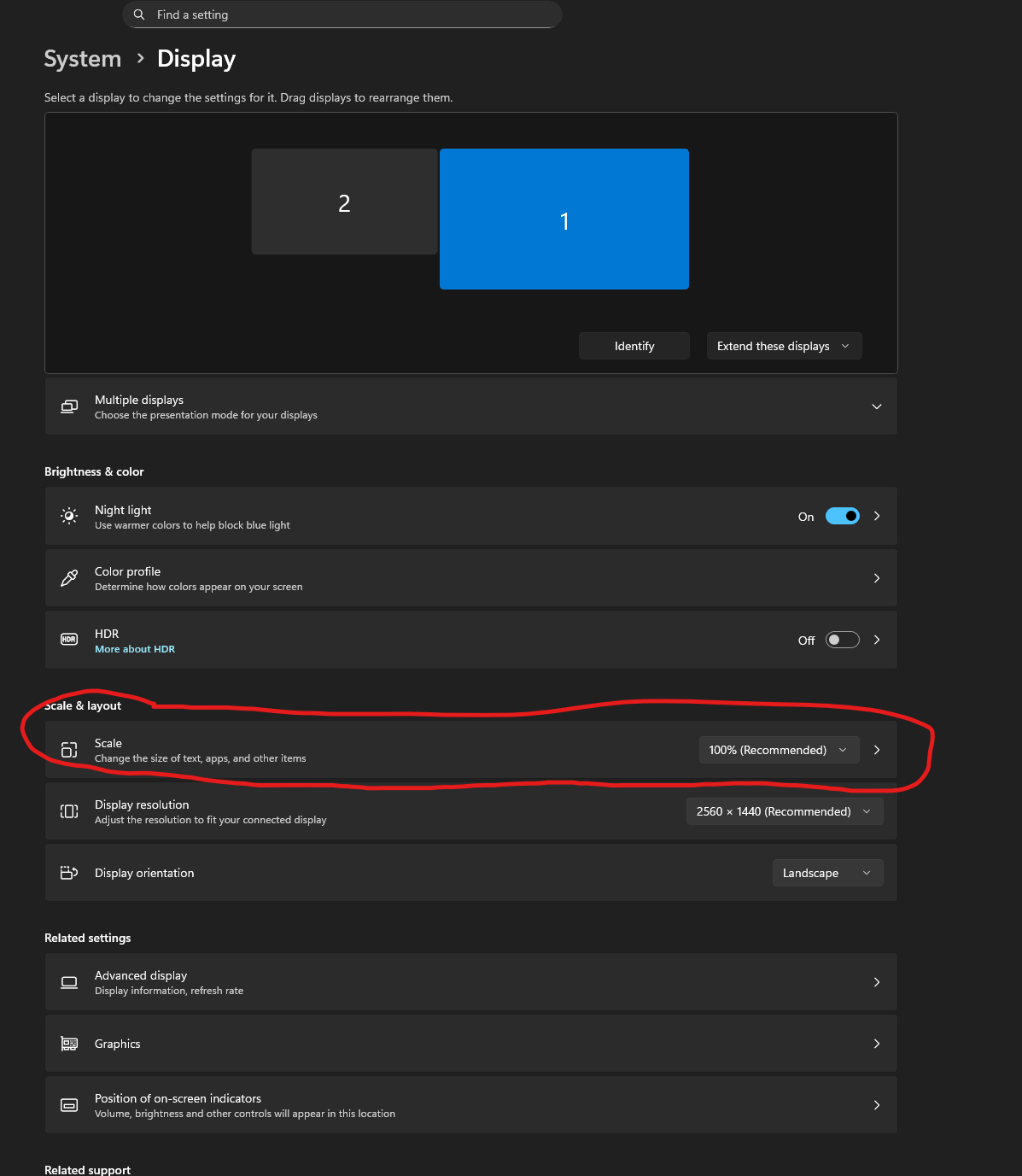
    * **Requirements:** For optimal performance, ensure **Windows display scaling is set to 100%** and the capture overlay is placed correctly over the text.

    **If you encounter any issues, please open a support thread first.** I am committed to helping you get the software running perfectly, provided we can work together to diagnose the problem!

    (8 edits)

    🛠 Help & Troubleshooting – Read before posting

    ⚠️ IMPORTANT: Windows Display Scaling For best OCR accuracy and real-time capture compatibility, Windows Display Scaling MUST be set to 100%.

    • How: Right-click Desktop → Display Settings → Scale → 100%
    • Symptoms: Scaling other than 100% causes misalignment or empty OCR results.

    🧩 Startup & GPU Issues

    • Missing DLL / ImportError: Install Microsoft Visual C++ Redistributable (x64).
    • NVIDIA GPU: Make sure your drivers are up to date from the official NVIDIA website.
    • Note: Restart your PC after installation.

    ⚠️ OCR or Translation Is Incorrect / Broken If OCR reads text incorrectly, shows garbage, or does nothing—especially on RTX 5000, AMD, Intel GPUs, or very new hardware—follow these steps:

    Step 1: Force CPU mode

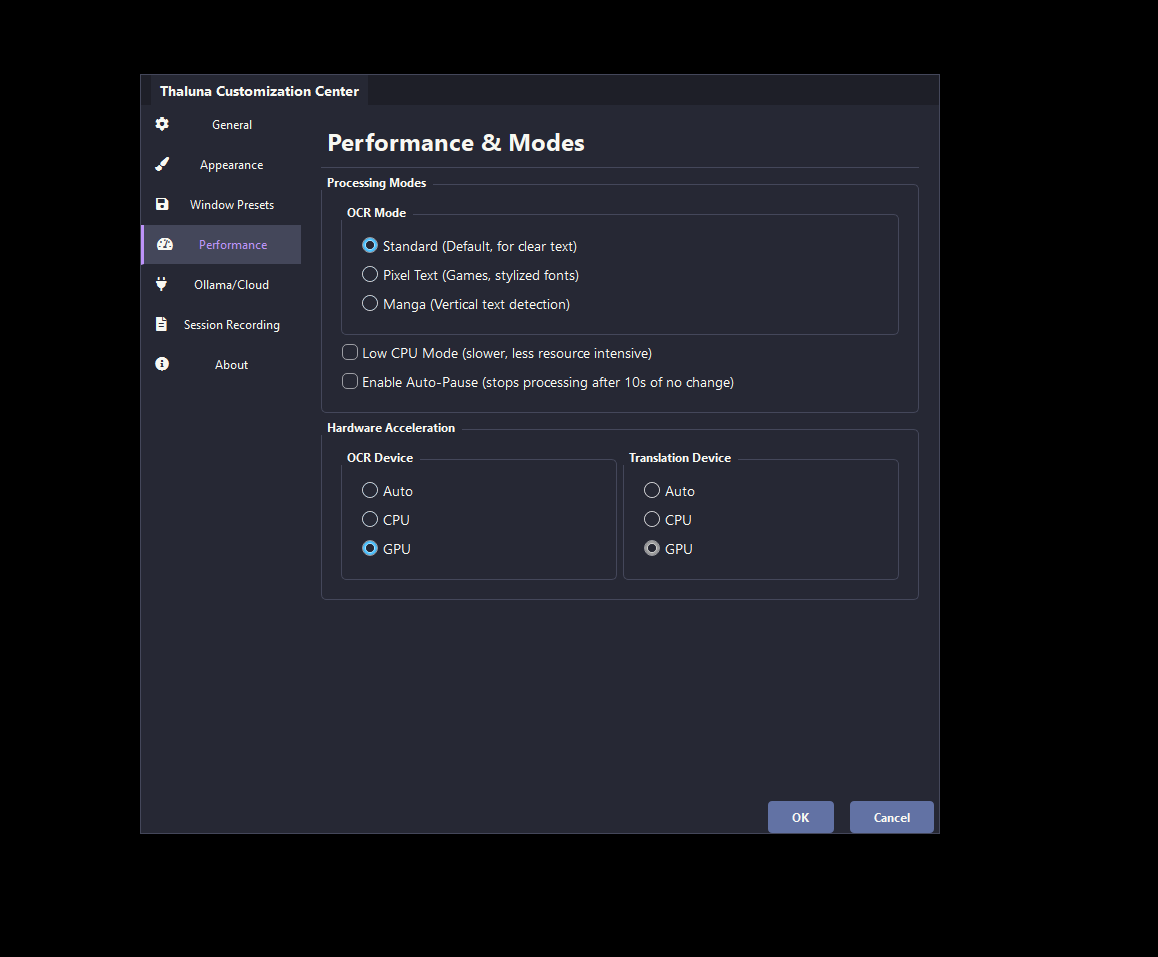
    1. Go to Settings → Performance → Hardware Acceleration.
    2. Set OCR Device to CPU.
    3. Set Translation Device to CPU.
    4. Restart Thaluna and test again.

    Step 2: Faster & Better Translation (Recommended) If CPU translation feels slow:

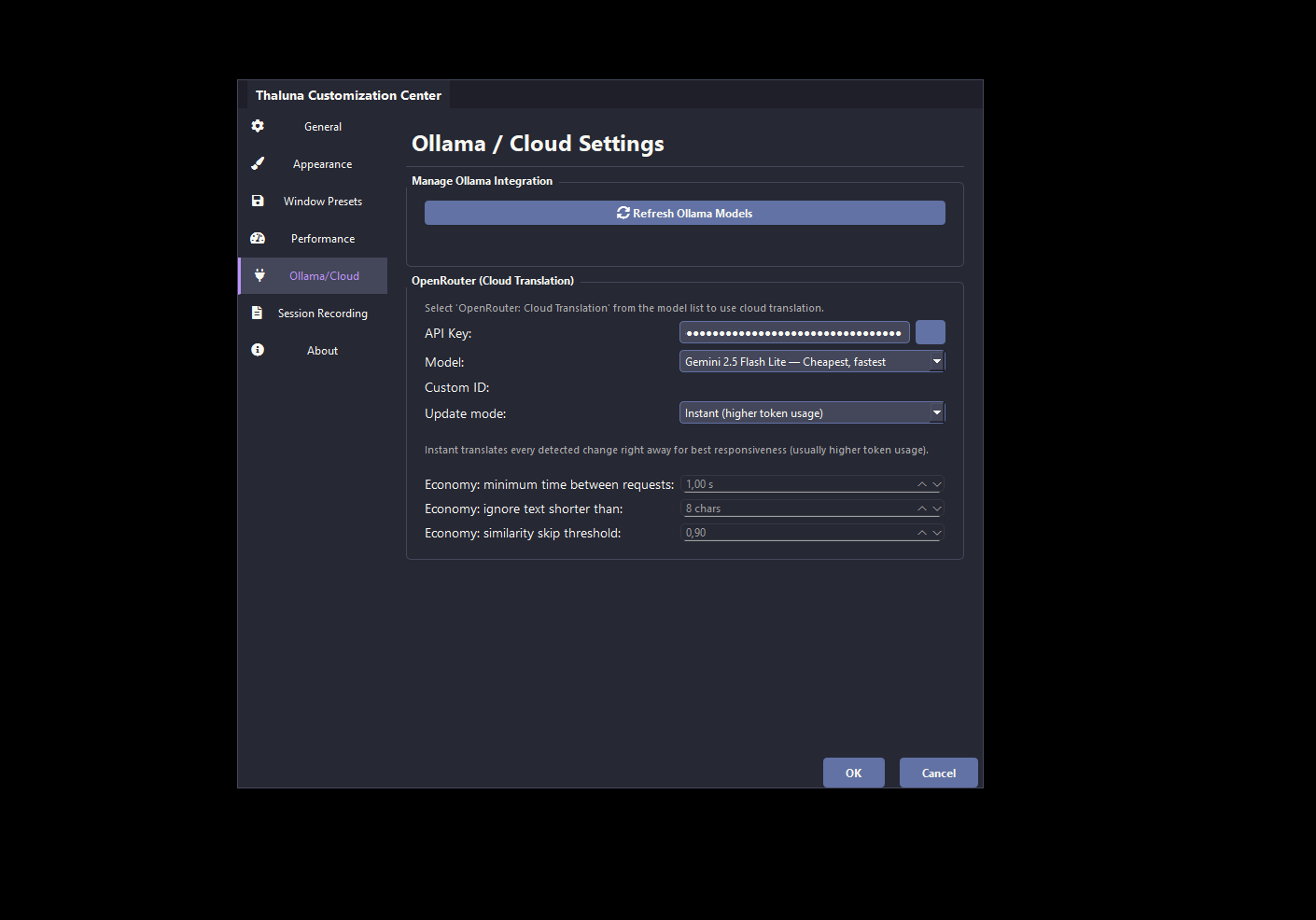
    1. Install Ollama.
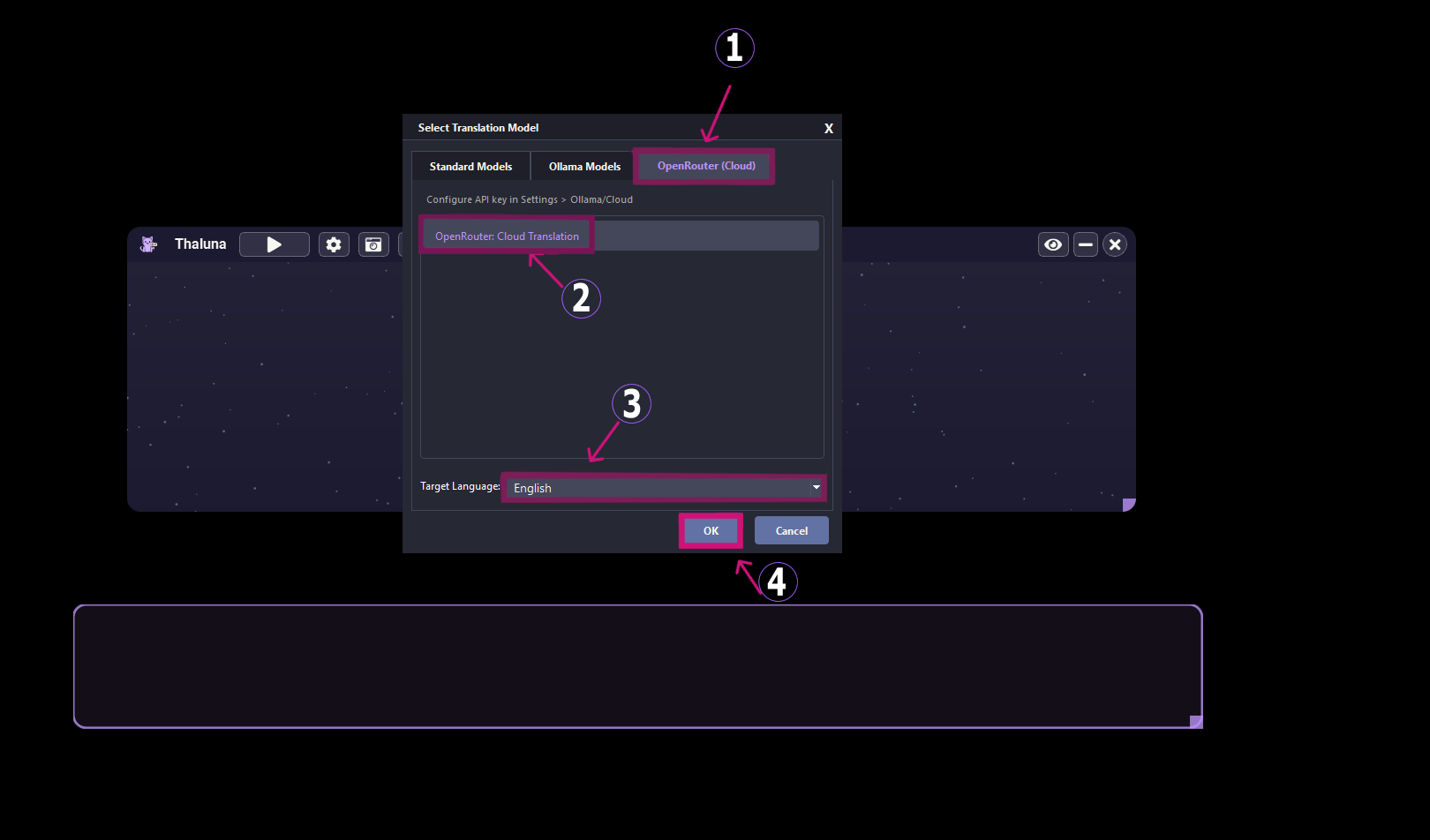
    2. Select an Ollama model inside Thaluna.
    • Note: Ollama will automatically use your GPU if available, even if the Translation Device is set to CPU.

    🧪 Diagnostic Build & Bug Reports (MANDATORY) For crashes or OCR failures:

    1. Use the Diagnostic build.
    2. When an error occurs, click the console window.
    3. Press Ctrl + A, then Enter.
    4. Paste the full console output into your forum post.
    • Bug reports without this output may be closed.

    ⏳ Performance & Initial Setup

    • First Launch: Startup may take longer while models are prepared.
    • Ollama Models: If you see blank bubbles, restart Thaluna.
    • Hardware Note: Running OCR on CPU and translation via Ollama is the most stable setup.

    📸 OCR Tips & Usage

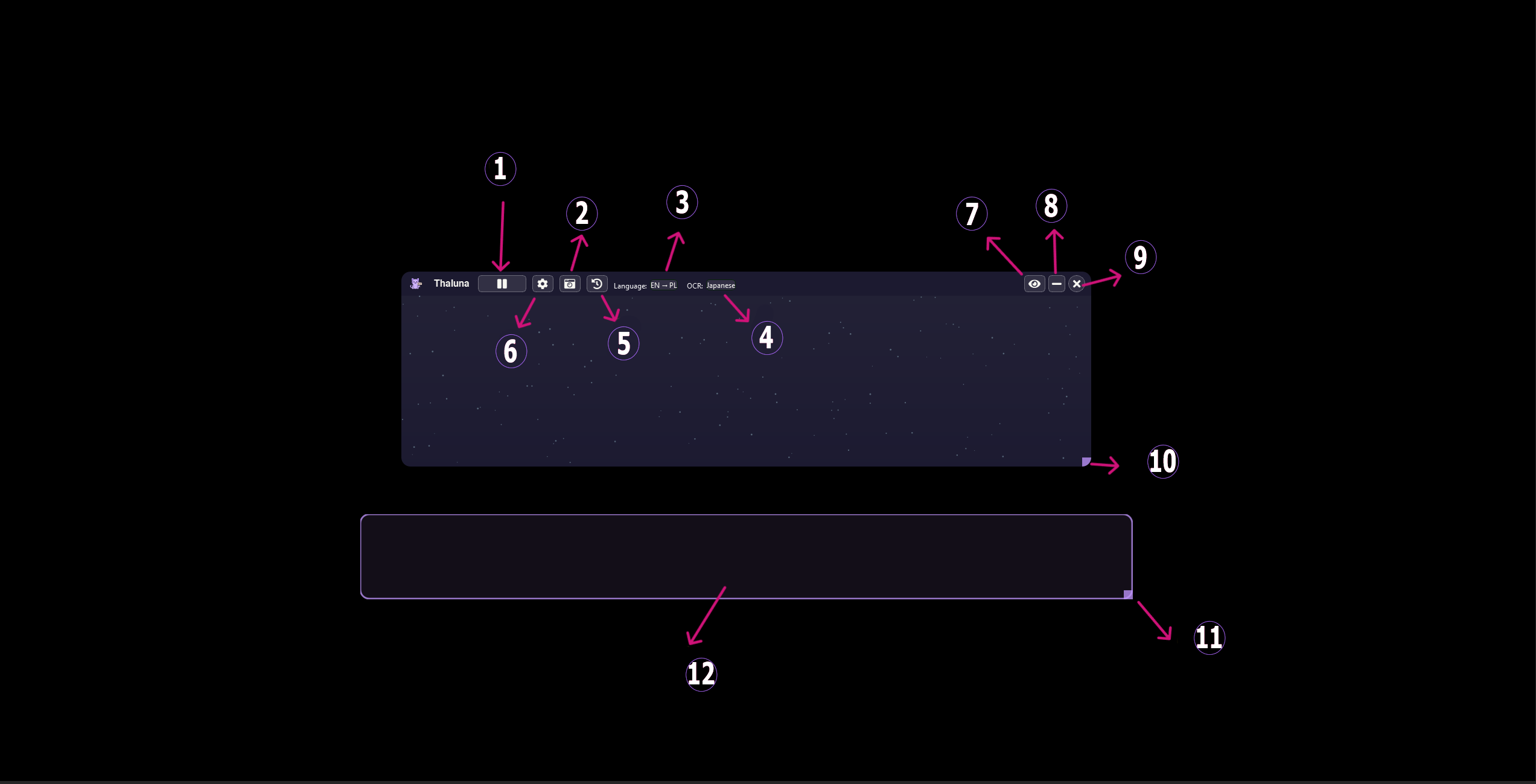
    • Pink Overlay Box: Real-time mode only translates text inside the pink box.
    • Manga / Pixel OCR: Use these only for vertical or stylized text.
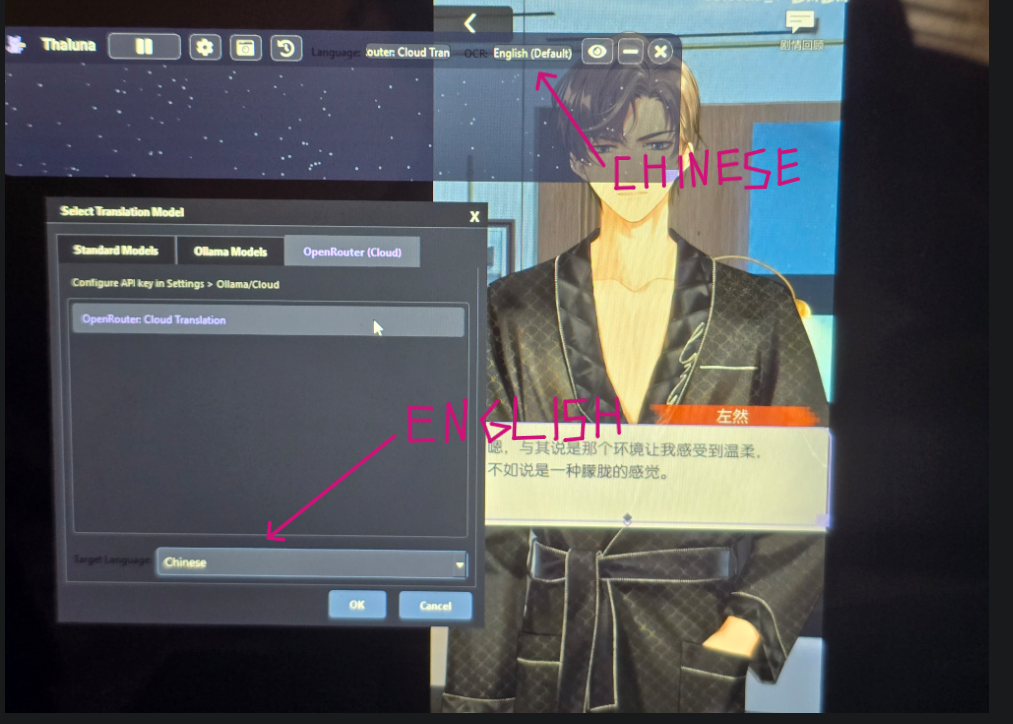
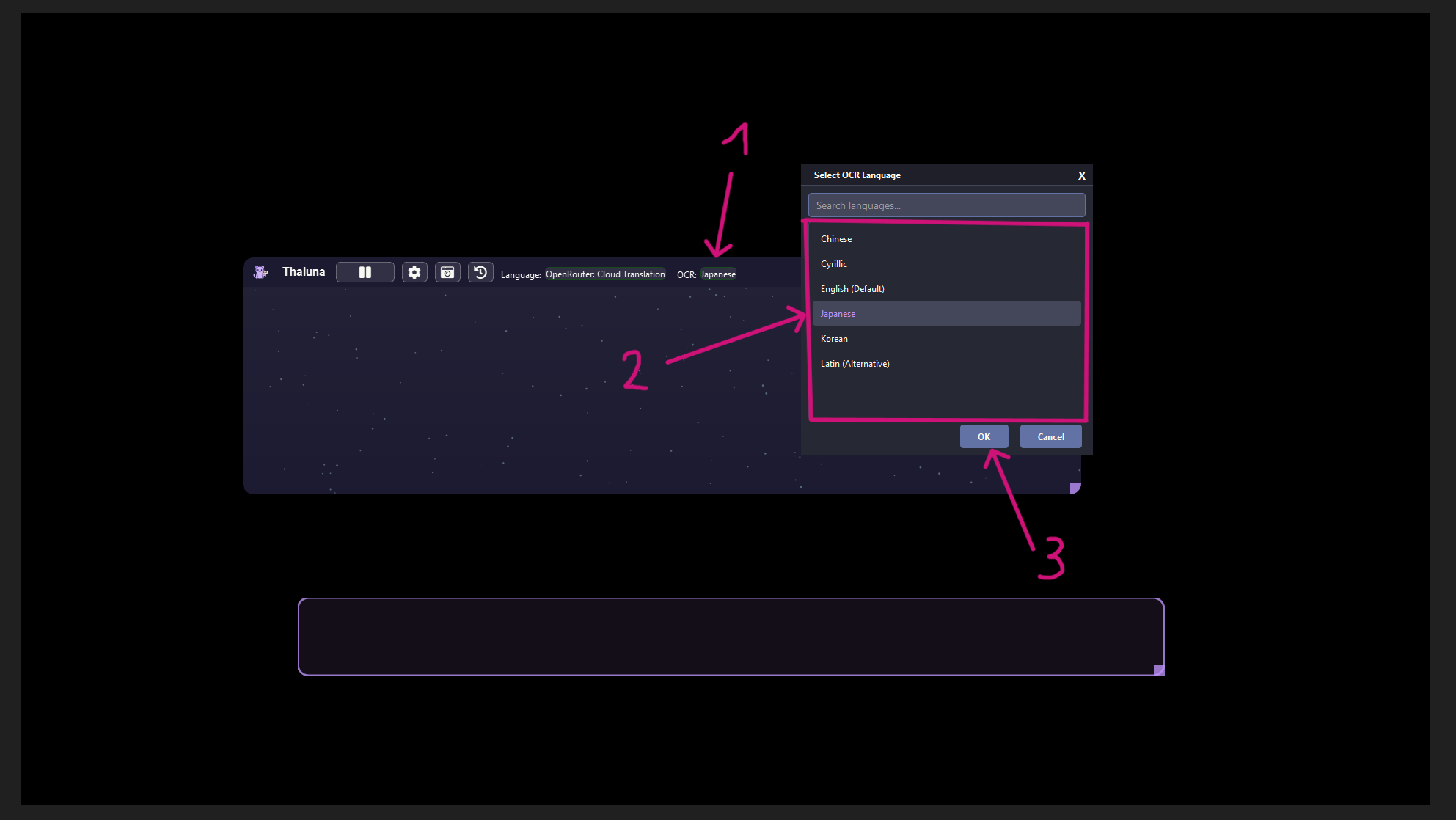
    • Matching Languages: The OCR language must match the on-screen text.

    💰 Refunds For refund eligibility, please refer to our Refund Policy Thread.

    (3 edits)

    # ❓ Questions & Usage Help

    Use this section for **general questions** and help with using Thaluna.

    **Post here if you are unsure about:**

    * OCR modes (Standard, Manga, Pixel, etc.)

    * Translation models and language selection

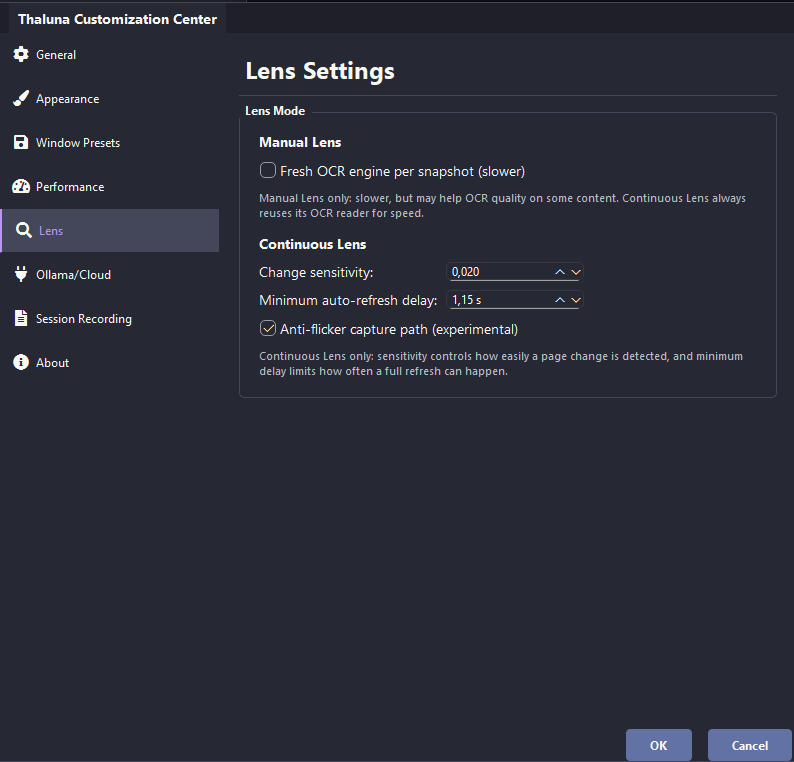
    * Lens Mode vs Real-time Mode

    * Performance settings or recommended configurations

    * Whether a behavior you see is "expected" or normal

    **❗ IMPORTANT:**

    * Do **NOT** post bug reports here. Use the Bug Reports section for that.

    * Make sure you are using the **latest version** and check existing threads before posting.

    (9 edits)

    🔧 Bug Reports / Technical Issues

    Please create a NEW THREAD to report a bug. Do not post reports under existing threads unless you are experiencing the exact same issue. If you are unsure about settings or usage, please post in Questions & Usage Help instead.

    🐞 Bug Report Template

    To diagnose issues efficiently, logs and screenshots are mandatory. Reports without sufficient technical information may be closed. Please copy and fill out the template below in your new thread:

    1. Thaluna version: Stable / Experimental
    2. Windows version: (e.g. Windows 10, Windows 11)
    3. CPU & GPU: (Your hardware models)
    4. Target Context: (Language on screen / Game or App name)
    5. Mode: Real-time / Lens / Manga OCR
    6. OCR language & Translation: (From → To)
    7. OCR device: CPU / GPU
    8. Translation device: CPU / GPU
    9. What happens?
    10. Details: Describe exactly what you see on screen.
    11. (Briefly describe: Nothing happens / Empty box / Error message)

    🔧Required Files

    To properly diagnose issues, you MUST use the Diagnostic build of Thaluna.

    1️⃣ Diagnostic Console Output (REQUIRED)

    • Download and run the Diagnostic build (listed alongside the main download).

    • A CMD console window will open automatically.

    • When the problem occurs:

      1. Click the console window

      2. Press Ctrl + A, then Enter

      3. Paste the full console output directly into your post

    ⚠️ This is the primary and required diagnostic information.

    2️⃣ Log Files (ONLY if Diagnostic build cannot be used)

    ⚠️ Use this ONLY if you cannot run the Diagnostic build
    • Standard users:

      %LOCALAPPDATA%\Thaluna\logs\ 
      
    • Users with non-ASCII Windows usernames:

      C:\Users\Public\Thaluna\logs\ 
      

    Attach the most recent .log file.

    3️⃣ Screenshot (REQUIRED)

    Provide a screenshot showing:

    • Thaluna running

    • Real-time mode enabled

    • The pink OCR overlay box placed over the text you want to translate

    ❗ Why this is required

    Without Diagnostic console output, issues cannot be reliably identified.
    Reports without console output or screenshots may be closed.

    Thank you for helping improve Thaluna.

    (1 edit)

    Technical support and bug reports have been moved to the forum to keep everything organized and easier to troubleshoot. Bug reports require logs or screenshots to be actionable. Reports without sufficient technical information may be closed. Please choose the appropriate section below.

    (3 edits)

    Thanks for the detailed testing.
    Without logs or screenshots, I can’t take this any further.

    So far, this is the only reported case where real-time translation shows absolutely no output.

    To continue, I need both:

    • Console logs from the latest Experimental version while using Standard / Real-time OCR mode
      (either a screenshot or copied text pasted here — whatever is easier)

    • A screenshot showing real-time mode active, with the pink box placed over the text and nothing being translated

    Without these two, I’m not able to diagnose or help with this issue.

    Thanks for getting back to me. Since the basic setup looks correct, I’d like to do one final, focused check to understand exactly where the issue is happening on your system.

    I’ve just pushed a new update to the Experimental version, so please make sure you update it first before testing.

    Please go through the points below and send whatever information you can.

    1. App state

    Is the app paused?

    Look at the Thaluna window, is there a pause icon visible?

    Try clicking the play button or pressing the pause hotkey.

    2. System information

    What is your exact Windows version? (e.g. Windows 10, Windows 11)

    What CPU and GPU do you have?

    3. OCR & translation setup

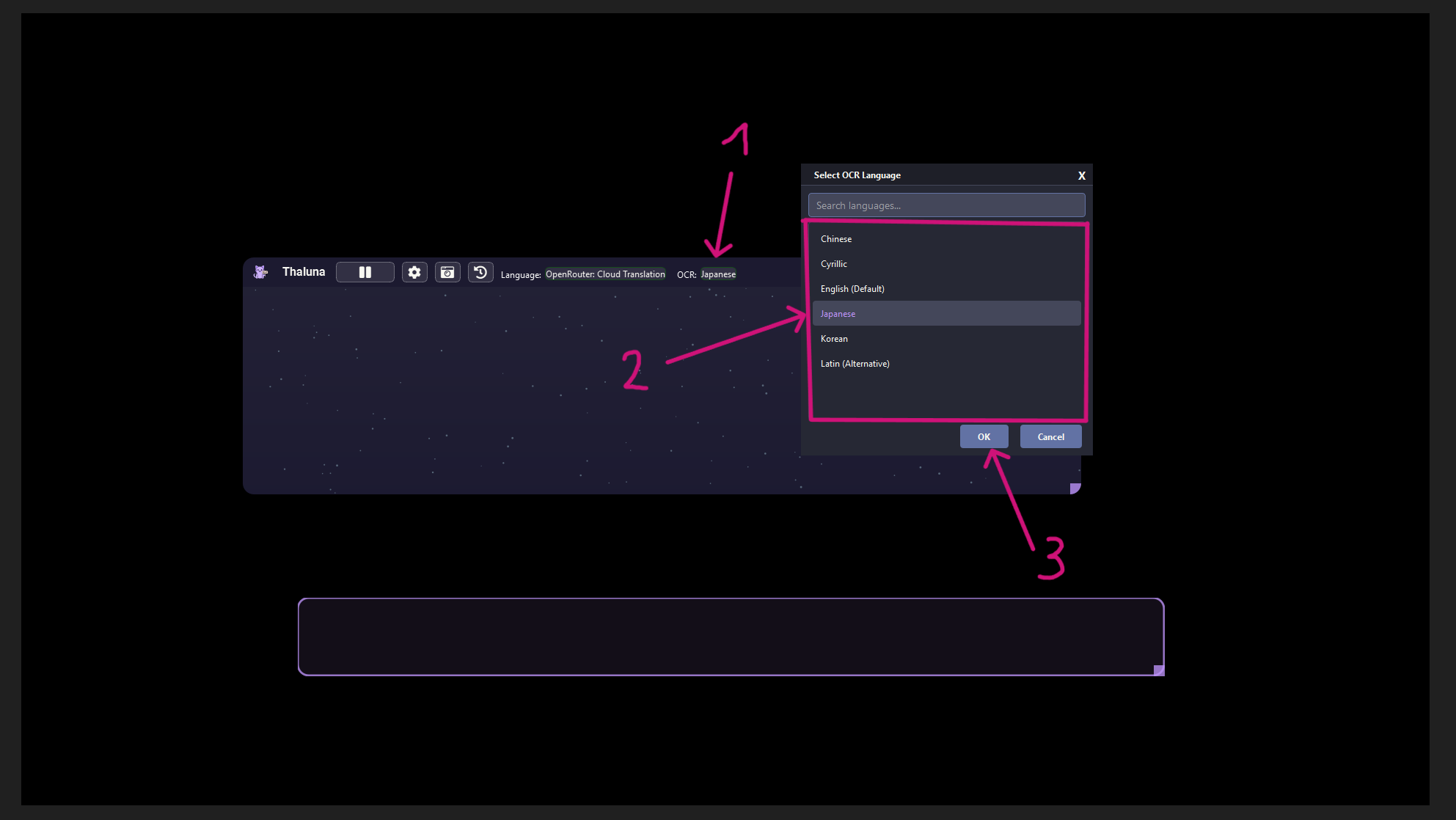
    What OCR language did you set? (Japanese, Korean, Chinese, English?)

    What language are you trying to translate from and to?

    Does the selected OCR language match the actual text you are trying to capture?

    What translation model are you using? (e.g. Japanese → English — which one exactly?)

    Which device is selected for OCR? (CPU or GPU?)

    Which device is selected for translation? (CPU or GPU?)

    4. Mode & capture behavior

    Are you using Lens Mode or Real-time Mode? Does the issue happen in both?

    In Real-time Mode, are you moving the transparent pink overlay box directly over the text you want to translate?

    (The text must be inside the pink box not in the settings window or elsewhere.)

    Try switching to Manga OCR in settings, does it work then?

    5. Display scaling

    Right-click Desktop → Display Settings → Scale

    Is it 100%, 125%, or 150%?

    Please try setting it to 100%, then test again.

    6. What exactly happens when you try to translate?

    Nothing at all?

    Empty translation box?

    Garbage / incorrect text?

    Any error message?

    7. Console output

    The Experimental build shows runtime logs automatically.

    Please try translating something and send a screenshot of the console window with logs.

    Hey, just a heads-up: my previous reply below includes instructions for testing a newly updated experimental build.

    Could you please try that version and let me know if the issue still occurs

    Hey!

    I just pushed a new fix to the experimental build that should handle a rare OCR edge case. Could you grab the experimental version from itch.io, update it, and give it another shot?

    If it’s still acting up, we might be looking at something specific to your system setup. If that’s the case, could you help me out by answering a few quick questions?

    Basic:
    – What’s your Windows system language? (Arabic, English, Polish, etc.)
    – Does your Windows username contain any non-Latin characters? (Arabic, Chinese, emojis, etc.)
    – Where did you install Thaluna? (full folder path)

    About the issue:
    – When you test it, does Thaluna not translate anything at all, or does it translate something but the output is mostly incorrect / gibberish?
    – Is the OCR language set to match the text you’re trying to capture?

    If you can check this (diagnostic):
    – Press Win + R, paste %LOCALAPPDATA%\Thaluna and press Enter.
    – Do you see a .paddleocr folder there?
    – What’s its approximate size? (Right click → Properties, around 80–90 MB)
    – Is any antivirus active that might be blocking files? (Windows Defender, Kaspersky, etc.)

    If there’s any error message, a screenshot would be very helpful.

    Thanks for sticking with me on this, let’s first see how it behaves after this update.

    Hey, thanks for letting me know about this. Sorry it's acting up.

    I'm looking into it now. Looks like there might be an OCR issue causing some wonky translations here and there. Working on sorting it out, should have an update for you soon. I'll ping you when it's ready to test.

    Appreciate you flagging this!

    Hey! Thaluna's got two OCR modes that could work for you here:

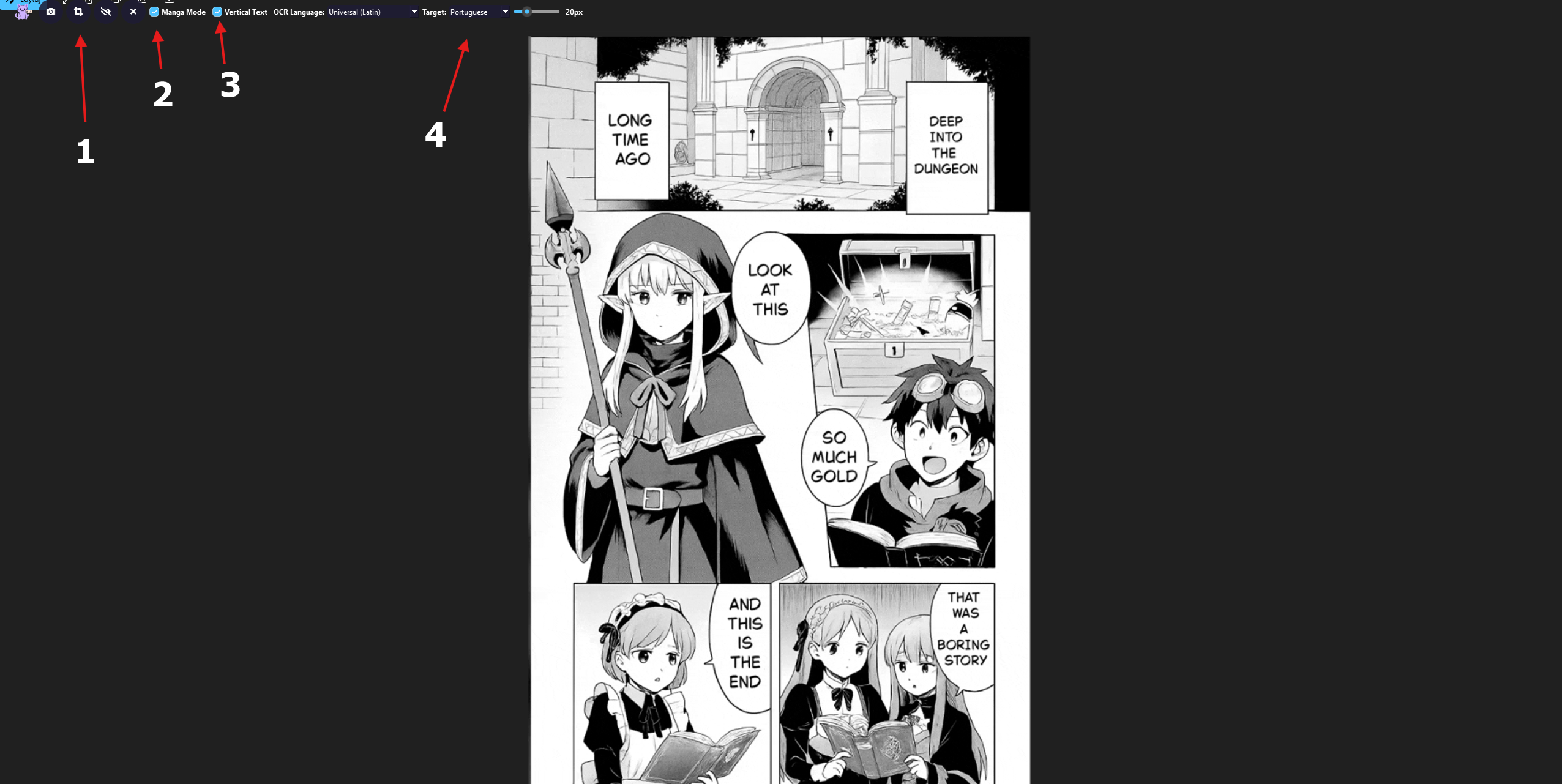
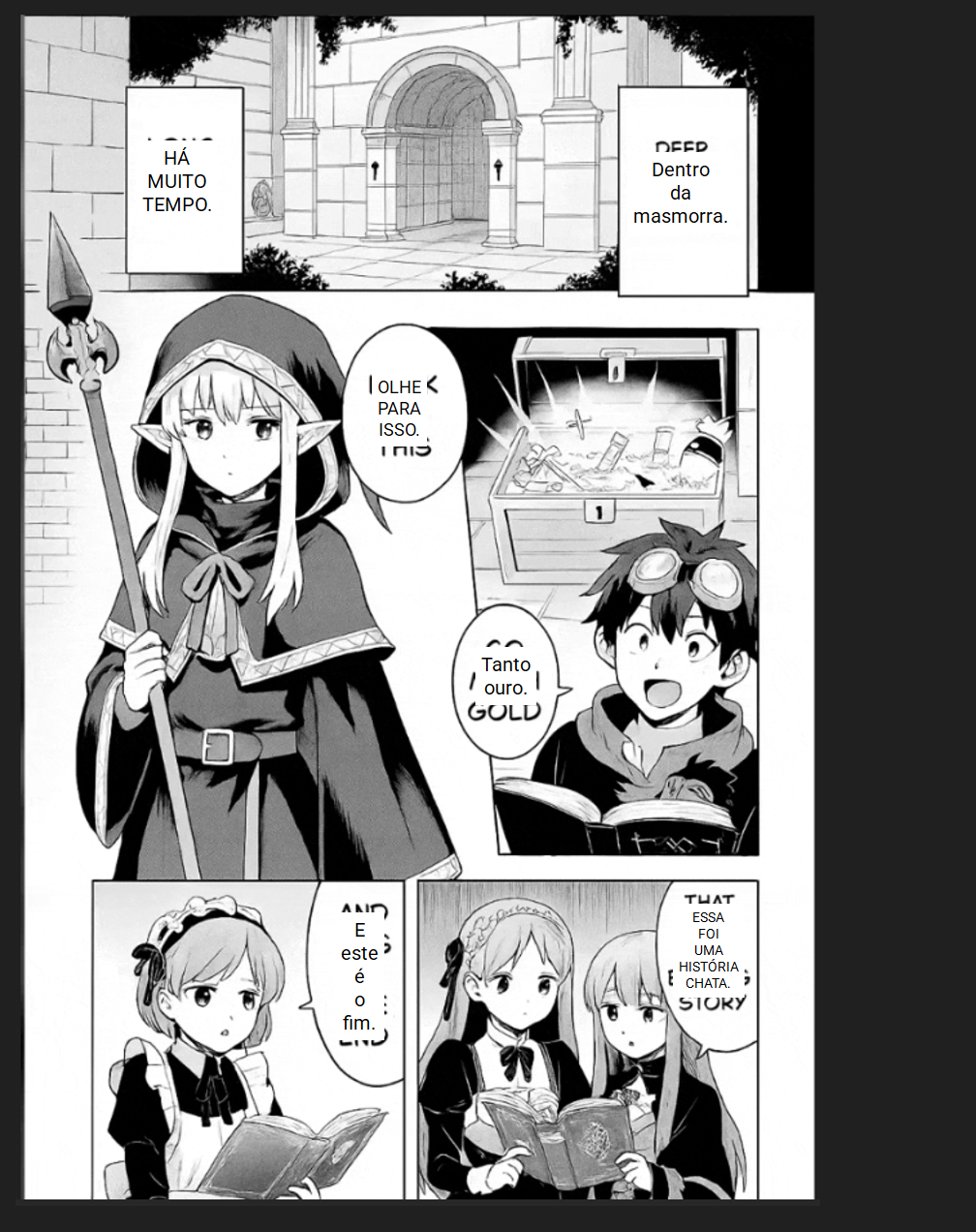
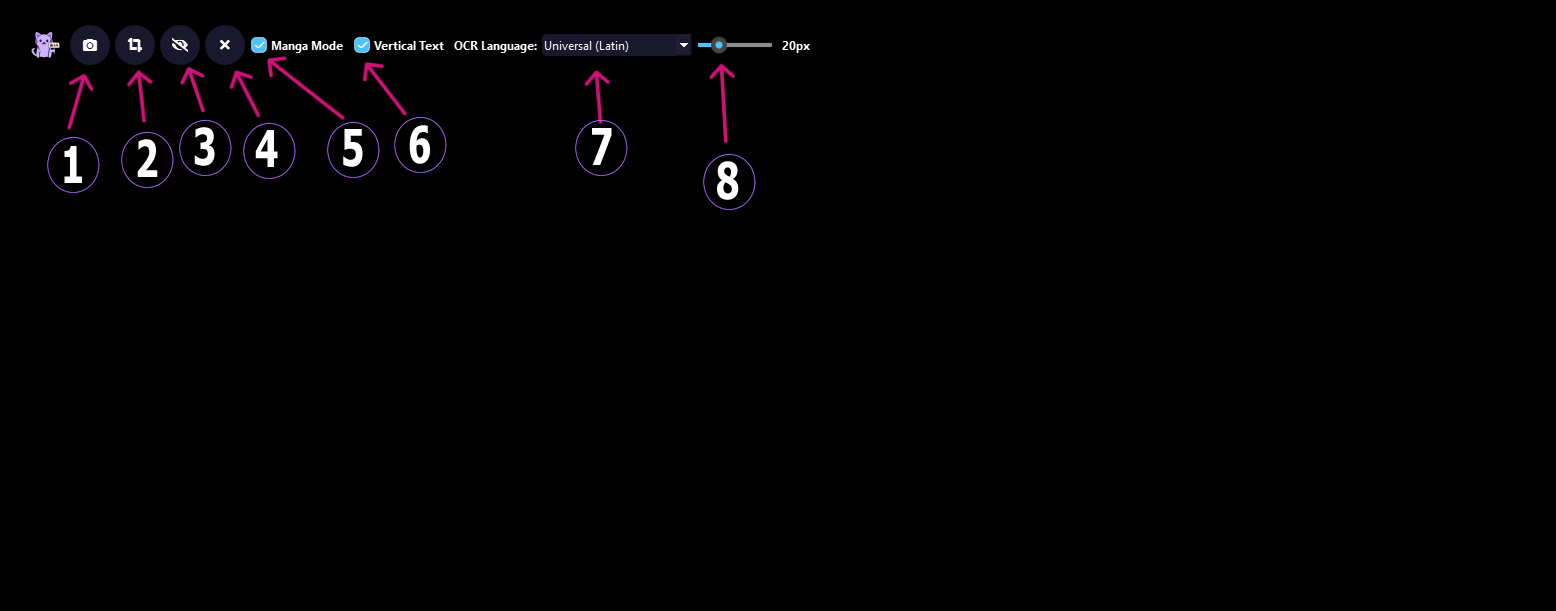
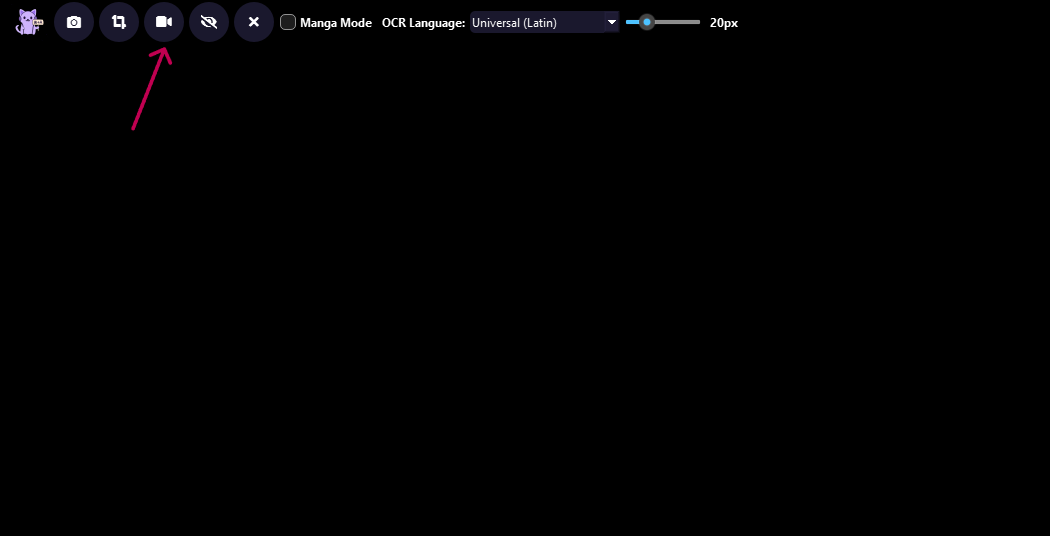
    Snapshot/Lens mode – handles vertical Japanese text pretty well. In this mode, you can either capture the full screen (which will include things like the taskbar and window titles) or manually select a specific area with your mouse. Manual selection is usually more accurate since you're choosing exactly what text you want to capture. Just make sure to enable manga mode and vertical Japanese text in the settings, and set the OCR language to Japanese for this mode to work properly with vertical text.

    Manga OCR mode (you'll find it in settings under Performance OCR Mode) – check the Manga (vertical text detection) option. This switches the real-time OCR to focus more on vertical Japanese text. Keep in mind this setting only affects real-time OCR and doesn't impact Snapshot mode. The catch is you'll need to position and move the OCR window manually. While you're in the settings, you'll also find Hardware Acceleration OCR Device where you can switch from CPU to GPU for better performance.

    I've got some short videos on my YouTube channel showing how both of these work in action.

    For Ollama models – from what I've tested, the Gemma family works best with Japanese VN text, especially Gemma 3:4B. With your RTX 5090 you can definitely try larger models if they're available. Just remember that OCR and LLM models are separate things – you can't change the OCR engine itself, but you can swap out the Ollama model that translates the recognized text.

    Hope that helps!

    Hi! On first launch the app may take a while to start, depending on the system.

    Please make sure you’ve fully extracted it from the ZIP before running the .exe and give it a bit of time on first run.

    Hi! Thanks again

    I want to help you solve this as quickly as possible, so I just need a few small details:

    1️⃣ Windows Display Scaling

    What scaling are you using in Windows?

    • 100%

    • 125%

    • something else?

    (High scaling can sometimes affect OCR.)

    2️⃣ Does Snapshot Mode work normally?

    When you select text manually with Snapshot Mode,
    is the translation correct?

    This helps me see whether the problem is Real-Time OCR or the game itself.

    3️⃣ Small test

    Could you try putting the Real-Time window over a simple Japanese webpage (like Wikipedia JP)?
    👉 Does it translate correctly there?

    If yes, then the issue is specific to the way the game renders text.

    That’s all I need for now — thank you again for your patience! 😊

    Hi again!

    I’ve just released a hotfix update that improves OCR/translation synchronization and fixes several UI issues.

    Please download the latest version to make sure everything works correctly on your side.

    A small clarification regarding the Pixel / Artistic Text OCR mode:

    Even though Thaluna supports this mode, please be aware that artistic or hand-drawn fonts used in some games can produce inconsistent results.

    This is normal behavior for ALL OCR engines — when fonts are stylized, the model can interpret shapes differently on each pass.

    So even if the line is read correctly once,

    the same screenshot may produce a slightly different result next time.

    It depends on how the artistic shapes are interpreted.

    I tested your screenshot here and it works correctly, but different games and unique font styles can still cause unpredictable OCR outputs in Pixel mode.

    If you ever get weird results, switching briefly to:

    Standard OCR,

    then back to Pixel,

    or changing OCR language temporarily

    usually forces a clean reset and fixes the issue.

    Let me know if the new hotfix solves your problem!

    Hey!

    Thanks again for the report — I tested the same Japanese sentence on my side and I was able to reproduce the issue.

    It looks like the OCR + translation pipeline didn’t fully refresh after switching languages, which can cause unstable output or repeated text.

    Here’s an easy temporary fix:

    Switch the translation model to any other one (for example EN→PL or EN→EN).

    Switch the OCR mode to a different one just for a moment.

    Then switch everything back to your preferred setup:

    Translation: Japanese → English

    OCR: Japanese

    This forces a full internal reset, and after doing this the translation should work correctly again.

    I tested the same line using the standard Japanese OCR mode and it worked fine after resetting it this way.

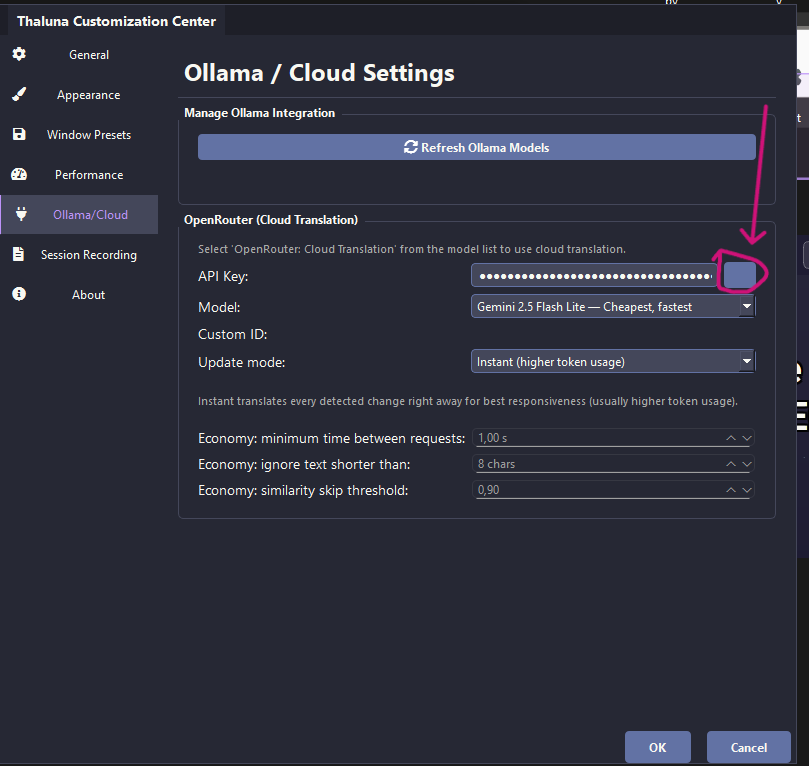
    If you want higher-accuracy translations, models from Ollama (like gemma3:4b) generally give better JA→EN results than the default built-in model.

    For this game, please switch from Pixel Text OCR to the Standard Japanese OCR mode — that’s the one I tested and confirmed working correctly.

    I’ll patch this behavior in the next update so the workaround won’t be necessary anymore.

    Thanks again for helping improve the app!

    Here’s the result I got on my side after the reset on ollama

    Oi! 
    Obrigado por entrar em contato e avisar sobre o problema. 💜
    Analisei o erro e ele não é causado pelo Thaluna, mas sim por uma biblioteca ausente no seu Windows.

    Para corrigir, basta instalar um pacote oficial da Microsoft chamado Visual C++ Redistributable — é o mesmo usado por muitos jogos e programas.

     Siga estes passos:
    1️⃣ Acesse a página oficial da Microsoft:
    👉 https://learn.microsoft.com/en-us/cpp/windows/latest-supported-vc-redist


    2️⃣ Na página, procure a seção chamada “Visual Studio 2015, 2017, 2019 e 2022” e clique no link X64 (para Windows 64-bit) para baixar o instalador.
    3️⃣ Execute o instalador e, quando terminar, reinicie o computador.

    Depois disso, o Thaluna deve abrir normalmente.
    Se ainda tiver problemas, me avise aqui — terei prazer em te ajudar!

    ¡Hola! 😊 Gracias por probar Thaluna.

    El traductor debería funcionar sin configuración inicial, pero hay algunos pasos importantes:

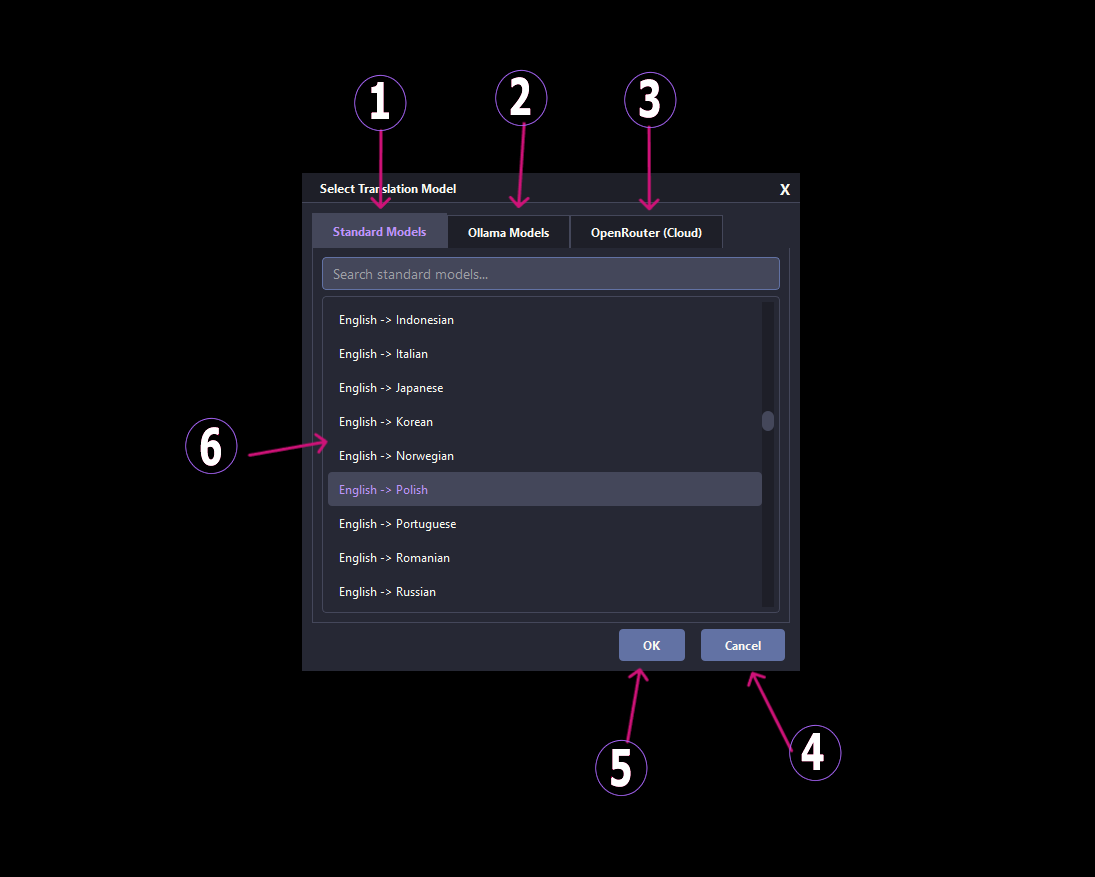
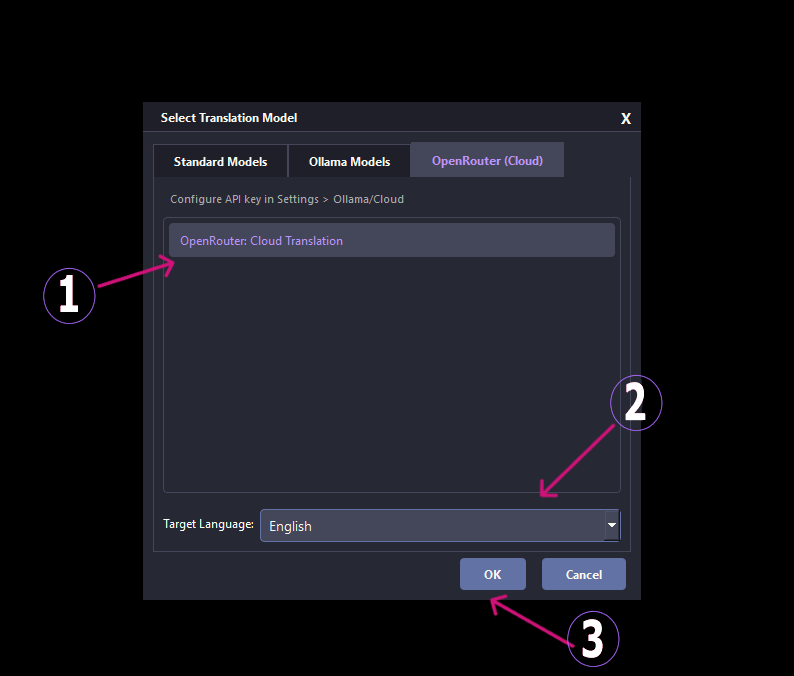
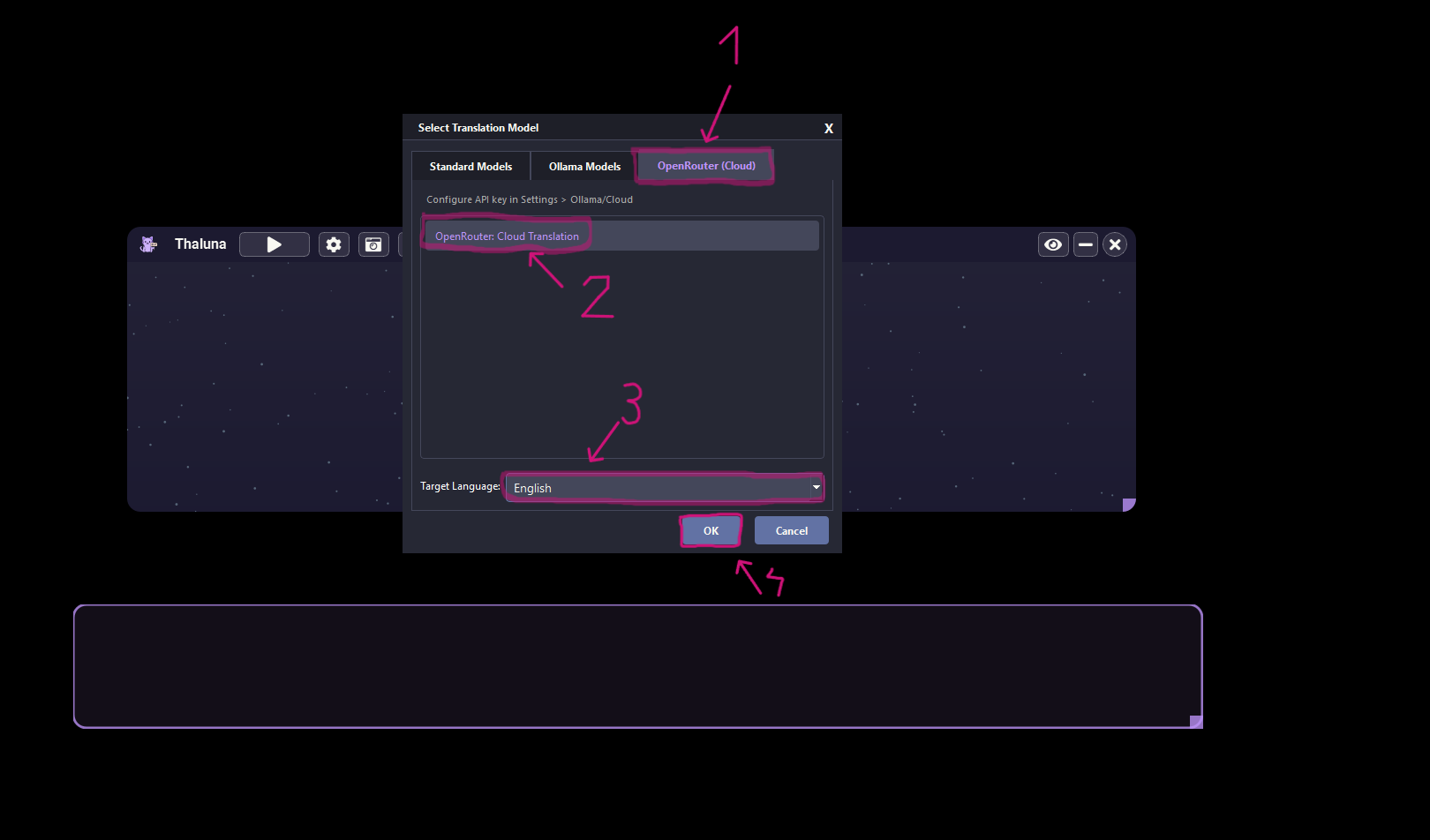
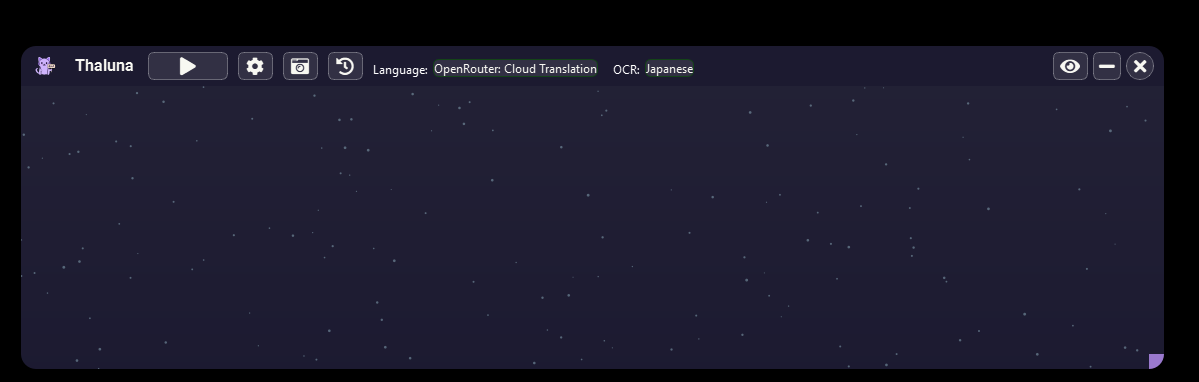
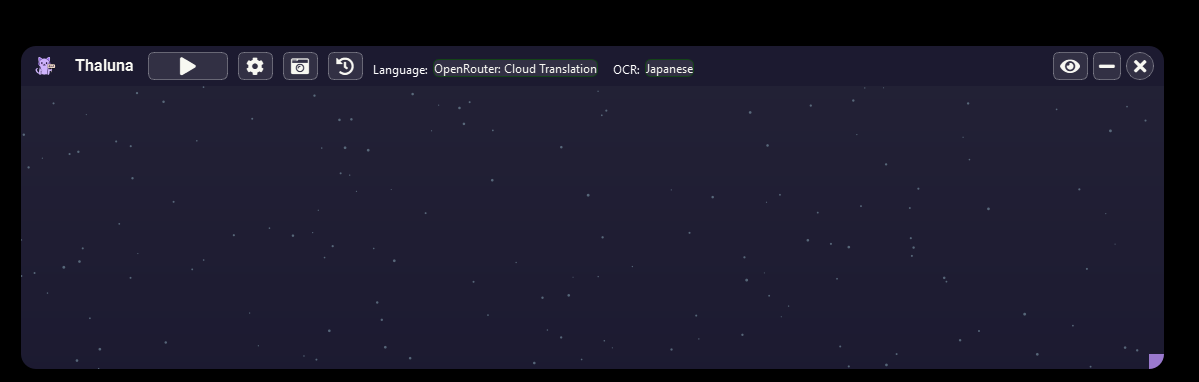
    1️⃣ Selecciona el modelo de traducción correcto (por ejemplo “Japanese → English”).
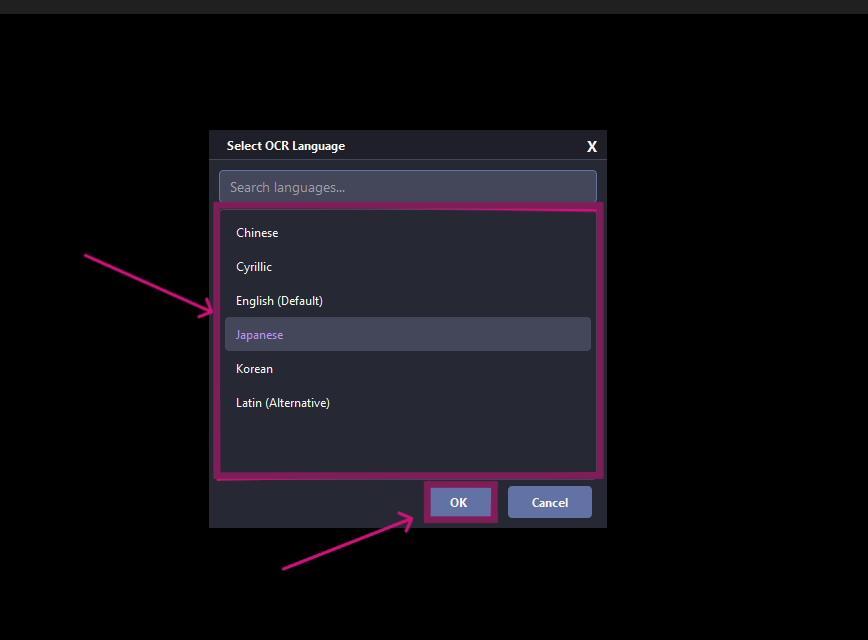
    2️⃣ Elige el idioma OCR del texto en pantalla (por ejemplo “Japanese”).
    3️⃣ Asegúrate de que la traducción no esté en pausa (si ves ▶️, haz clic para iniciar).

    Ten en cuenta que el primer inicio puede tardar un poco más de lo normal, ya que Thaluna necesita inicializar algunos procesos en segundo plano antes de empezar a traducir.

    Si después de un rato aún no traduce, intenta reiniciar la aplicación o mover ligeramente el marco de captura.
    También puede que el equipo sea demasiado lento para el modelo seleccionado, aunque esto es poco común.

    Si el problema continúa, por favor envíame una captura de pantalla y te ayudaré a resolverlo.

    The issue you reported has been fixed in version 2.2 — Thaluna now automatically switches to CPU if GPU initialization fails.
    You can simply re-download the latest version and it should run fine👍

    Hey! 😊 Thanks for reporting this.

    That error happens when Thaluna tries to use GPU acceleration (PaddleOCR-GPU) but CUDA/cuDNN isn’t available on your system.

    This is already fixed — the next patch will automatically switch to CPU mode instead of closing the app.

    For now, you can fix it manually:
    1️⃣ Go to the folder where Thaluna is installed.
    2️⃣ Open the subfolder _internal.
    3️⃣ Find the file config.json.
    4️⃣ Open it with Notepad.
    5️⃣ Find the line "ocr_device": "cuda" and change it to "cpu".
    6️⃣ Save and restart Thaluna.

    After that, it’ll work normally 

    Thanks a ton for testing all that, really appreciate it 
    In my case Gemma 3:4B actually worked fine for translations, but yeah, it can vary a lot depending on the text/setup. Super curious how DeepSeek will work for you!

    Hi,

    Thanks a lot for your feedback 💜 

    I think I see what happened. In Lens Mode the OCR engine is designed for horizontal text, so if you’re working with vertical Japanese it can give messy input to Ollama models. That’s why things didn’t line up.

    For vertical manga, the real-time mode with Settings → OCR Mode → Manga (Vertical Text) works much better. It won’t auto-box everything perfectly, but you can move the capture box between bubbles and it should give cleaner results. If it’s horizontal text, Lens Mode should already be fine.

    I also plan to improve Lens Mode so it handles vertical Japanese properly in a future update — it’s definitely on my list.

    By the way, when you said it “can’t seem to play nice with any Ollama models,” did you mean the translations came out as nonsense, or just random characters? That info would help me a lot to confirm if OCR was the real issue.

    Thanks again for using Thaluna, and for taking the time to share your experience. Feedback like this really helps me improve the app, and I’m happy to hear you’re using it for manga.

    (1 edit)

    Thank you so much for the kind words!  Thaluna currently works on Windows, but I’ll see what I can do about a Linux version down the line.

    Hi everyone! 👋  

    I always wanted to enjoy visual novels, anime and manga without waiting for translations.  

    So I built **Thaluna** — a small offline tool that translates on-screen text in real-time.  

    ✨ With Thaluna you can:  

    - 🎮 Play visual novels  

    - 📺 Watch anime  

    - 📖 Read manga  

    🌍 Supported languages:  

    - Japanese / Chinese / Korean → English  

    - English → Polish, German, Spanish & French  

    - (and chained: JA/ZH/KO → EN → PL/DE/ES/FR)  

    You can try the **free demo** (20 translations per day), or get the full version for unlimited use.  
    Maybe it’ll help someone else too 💜  
    I’d be really grateful for any feedback 🙏 — even small comments help me improve Thaluna and make it more useful.

    🔗 [👉 Thaluna on Itch.io]   https://thalunadev.itch.io/thaluna-real-time-translator