
Indie game storeFree gamesFun gamesHorror games
Game developmentAssetsComics
SalesBundles
Jobs
TagsGame Engines

GameWare: A Virtual Console for HTML5 Games

A topic by ROEGA™ created 18 days ago Views: 428 Replies: 22
Viewing posts 1 to 6
(1 edit)

GameWare is an attempt to take HTML5 games to the next level. The idea is to give HTML5 games the feel of a console experience while also protecting the code from being copied. That’s exactly what GameWare aims to provide.

But how does it work?

A simple HTML5 file is converted into a .gw file. This file cannot be executed by standard programs—only through the GameWare Player, which functions like a console.

This allows developers to distribute their HTML5 games (for example on itch.io) more securely, without having to worry about their code being easily stolen. At the same time, there’s a big advantage: since the game is still technically an HTML5 application, it can run on virtually any hardware. This means developers no longer need to convert their games into complicated .exe files or separate versions for macOS.

GameWare also offers benefits for players. They can simply launch GameWare in their browser, upload their downloaded .gw files, and start playing immediately.

How does it work for developers?

Anyone can contact ROEGA and request the conversion of their HTML5 game into a .gw file. To do so, they only need to send the file and provide the following information: Game name, Software version , Author
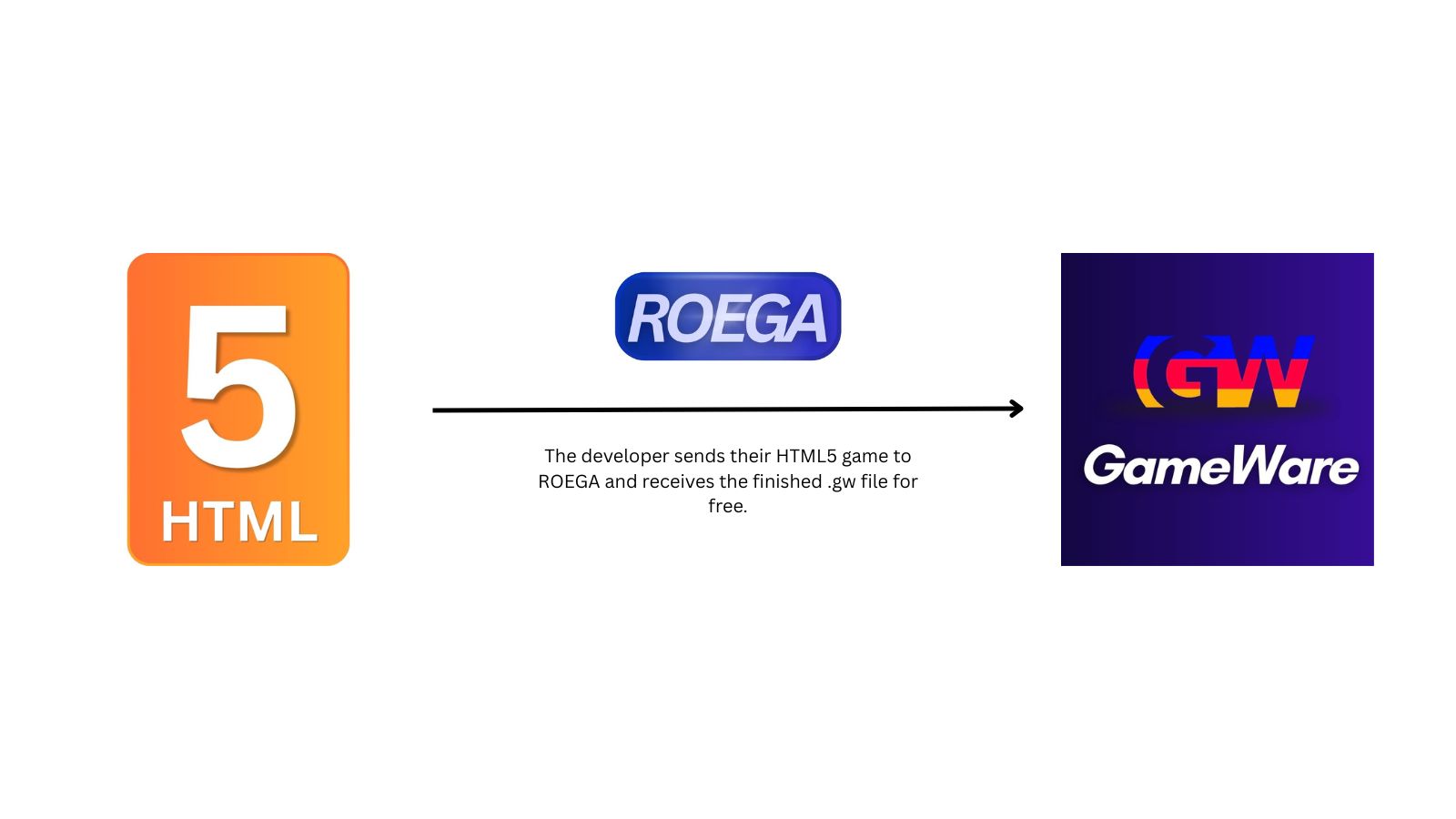

That’s it! We will convert the game and send it back as a .gw file, ready for release.

We do not charge any money or take any revenue share. However, we provide a small GameWare logo with each converted file, which can be placed on the cover image to clearly mark it as a GameWare title. We would also appreciate the opportunity to promote each game, although this can be discussed individually.

The release of GameWare is planned for June 20th, with more information coming soon.

If you’re interested in publishing a game on GameWare, feel free to reach out!

- Collin Rossa

https://itch.io/dashboard

@CollinRossa_

The web is a horrible platform to develop for. Terrible performance, terrible debugging support, browser incompatibilities, security issues, can’t even control the main loop of the game. The only reason I bother with it is so that anybody can play my games, directly in a web browser, without downloading it and without additional third-party software. So what’s the value proposition for removing that only advantage?

Now, I can’t fully relate to the experiences you’ve had with web development. My games usually run well in the browser, and from my perspective, development there is actually one of the simplest approaches.

However, my games are mostly pixel art and focus more on content than performance, so it’s possible we have different perspectives on this.

The point is: people who are willing to pay for games would probably never consider paying for a downloadable HTML5 game. But if there is a dedicated file format and a virtual console behind it, it creates a sense of security for potential customers.

GameWare is not meant to remove the “advantages” of web games. Instead, it aims to give developers a secure way to distribute HTML5 games for download and potentially earn money from them—within a safe and trusted environment for users.

I’m just bitter that I can’t get my pixel art game, which runs at full 60fps natively, to run at more than 3fps in a web browser (running the exact same code on the same hardware) - and that’s after extensive optimization for the web platform. I already have native builds for Linux and Windows and they run fine. What other platforms do you offer? Macintosh? Playstation? Nintendo Switch? NetBSD? Haiku? DOS?

The point is: people who are willing to pay for games would probably never consider paying for a downloadable HTML5 game.

You might want to do some research there. People even give money to non downloadable html5 games. Reality is the opposite of your claim. The downloadable version of a web game is actually an incentive to buy the game. That the downloadable version would just be an html file, is not a deterrent. Maybe for compatibility reasons, so some devs just pack a browser, to ensure the game will actually run offline.

https://itch.io/games/top-sellers/platform-web

(+1)

This sounds like a cool project, but what exactly are the reasons that developers would want to get involved with this if we are already making HTML5 games?

Is there a market for this specifically? Or would this just turn into me adding a .gw file to my product page on here and hoping GW players find it?

Is there a GW website that will be distributing the .gw versions of games?

This sounds like a startup that would benefit more from devs converting their games and distributing them as .gw, than devs would benefit from doing it.

Don't get me wrong, I wish you well with the project and I am atleast marginally interested, I just don't understand how this would benefit me to get involved.

Good luck with it! I hope to hear more about this idea!

(+1)

Thanks a lot for your thoughts—I really appreciate the feedback. Let me address your concerns:

GameWare is aimed at a niche that can actually be quite valuable for developers.

There are no costs for you as a developer. You simply send us your HTML5 game, and we convert it into a .gw file for free, which you can then distribute yourself. This might sound simple, but it goes deeper: many players rely on web-based games due to hardware limitations, yet this space lacks structure and identity. Unlike consoles (like PlayStation), HTML5 games don’t have a unified “brand” that gives players trust and a sense of quality. If multiple developers publish their games through GameWare, it creates exactly that—a shared platform that feels more professional and appealing.

Another key point is community and marketing power. If 20 small indie developers each have 20 followers, that’s suddenly 400 people instead of isolated audiences. Through shared channels, a website, and joint visibility, GameWare can help build a real community and expand reach for everyone involved.

Finally, security: HTML5 games can always be copied or accessed easily. With .gw files, that becomes much harder. At the same time, you keep all the advantages—your game still runs in the browser, on any device, without complicated builds, but now with a more secure and “console-like” distribution.

I also checked out your games, and I’d genuinely love to see them on GameWare. It’s no cost and no real effort for you, but it could help you gain more visibility—and potentially even revenue.

At the end of the day, this idea depends on developers who are willing to give it a chance. The more people join, the stronger the platform becomes.

In the indie scene, it’s all about players—and even if this is a niche, players who want a true, accessible gaming experience in the browser deserve one.

I like this answer, and I’m willing to test it out, where can i contact you/send my game files to?

(+1)

That’s awesome to hear — I really appreciate your willingness to give GameWare a try!

You can send your game files directly to roega.games@gmail.com. Just include the game file, the name of your game, and (optionally) the version and your developer name.

I’ll handle the conversion and send everything back to you as a ready-to-use .gw file.

If you're okay with it, I'd also like to do a little marketing for your game.

Looking forward to seeing your game!

Just emailed you!

Can you start the conversion from a Linux executable?

No, I can’t start the conversion from a Linux executable.

.gw files are based entirely on HTML5 technologies (like JavaScript), so they only work with web-based game builds. Native Linux executables use compiled machine code, which isn’t compatible with that format.

If you have an HTML5 version of your game, though, I can convert that without any problem.

Sounds like a terrible concept. And there are some naive and simply wrong assumptions made here. 

Like this one HTML5 games can always be copied or accessed easily or this one If 20 small indie developers each have 20 followers, that’s suddenly 400 people instead of isolated audiences.

No, they cannot. You cannot simply download a web game and have it run locally. Oh, a motivated user might be able to, but that is not simple.

And why would 380 users suddenly have an interest to check out 19 new developers? Just because the developer they did follow shares the same distribution method? By that logic, the thousands of developers on Itch should each have at least thousands of followers.

The idea is to give HTML5 games the feel of a console experience

The console experience is not opening files in an app. It is visiting a platform.  And have ease of installation and game management. Seriously. You mean a video game console with console, do you not? When was the last time you downloaded a file and played it on a console? A sideloaded file, mind you. You would need a closed system with approval and curation to have the console experience. What you propose is not a console experience. It is more like distribution of  .jar files. And that never took off. 

Itch does a mediocre job with game management and ease of installation, but degrading browser games to a playable file you need an interpretor for, is a step back, not forward. The appeal of a web game is, that you do not need to "install" a file. You just visit the page with your browser.

If a developer want's to have a downloadable version of the game, that is already possible in several ways. Including the blunt way of bundling a browser for a paid game. Or simply distributing a playable html file or folder structure. But since a lot of web game are just exports of game engines, the obvious way is to export it natively.

The aspect of protecting the code is just not relevant. A motivated rival developer will have the skills to get the code or just mimick the game either way. But it will bring in zero new players. Players do not want to play a game, just because the code is protected. It's the same fallacy any drm mechanism has. But some players will shy away from games that have protection abstraction layers. Jumping through additional hoops to just play a casual web game? Not interested.

Also, your twix account is blocked and you operate over a gmail account. That does not bode well.

Thanks for your detailed feedback — I appreciate you taking the time to share your perspective.

Before addressing the core points, I’d like to clarify two things:

My X/Twitter account is not blocked. A secondary account connected to it was restricted over a year ago due to overly aggressive promotion at the time. Since then, I’ve adjusted my approach. I think it’s important to keep this distinction accurate.

Regarding the use of a Gmail address: I don’t believe the choice of email provider reflects the legitimacy of a project. Many developers — including professionals — use Gmail for communication. The focus should remain on the project itself.

Now, to your main points:

You mentioned that HTML5 games lose their main advantage through GameWare. I see it differently. GameWare is not meant to replace browser play, but to offer an additional option — similar to how developers already package HTML5 games into desktop builds. It’s about providing a more structured and “platform-like” experience for users who prefer that.

On the topic of accessibility: while it’s true that determined users can extract web game code, it is not as trivial as simply “downloading and running” a game locally. GameWare adds an extra layer of packaging that makes this less straightforward, even if it’s not absolute protection.

Regarding the community argument: I agree that shared distribution alone doesn’t automatically multiply audiences. However, the idea is to build a focused niche platform where visibility is pooled rather than fragmented — something that currently doesn’t really exist for HTML5 games in a structured way.

As for the “console experience”: I understand your point. GameWare is not trying to replicate a closed console ecosystem, but rather to move in that direction — offering a more unified and curated experience compared to raw browser distribution.

Finally, on code protection: I agree that it won’t stop highly motivated developers. The goal is not absolute security, but to reduce casual copying and give developers a bit more confidence when distributing downloadable versions.

GameWare is still an experiment, and I’m fully aware it won’t appeal to everyone. It’s aimed at a specific niche, and I’m open to refining the concept based on feedback like yours.

That said, I think it’s important to keep the discussion focused on the idea itself rather than assumptions about the person behind it.

Linking to a defunct twitter account does not look professional, no matter why it is defunct.

Yes, you can use gmail for communication. But that is not what you proposed. You want to offer a service. You are not offering to collab with developers on a project.

It’s about providing a more structured and “platform-like” experience for users who prefer that.

Packing a web game into a distribution file is not a console, nor a platform experience. Browse some twine games on Itch that have download options to see examples how people distribute web games for download https://itch.io/games/platform-windows/tag-twine 

You want to make this somehow better? Ok. Nice thought. But your approach does not sound like a good approach. Packing the files in a zip for distribution will do the same and a developer would not need to use your service for that. Nor would players need to run an abstraction layer in the browser to actually run the game.

If you are old enough, maybe think back to flash games. What a nightmare it was. There was benefits, of course. The engine could do things, a browser could not - at that time. And you could run the files with a separate app. And some people even distributed the files to run outside of a browser even. But it was an abstraction layer with a huge lot of drawbacks.

Did you get the impression back then, that this was a console experience or a platform experience? There were are platforms for such games. But you would play the games on those platforms. As web games.

Using those .gw files is not a console experience, nor a platform experience.

Do you think there is a platform experience for .exe files? If your theory holds, there should be such a thing.

where visibility is pooled rather than fragmented — something that currently doesn’t really exist for HTML5 games in a structured way.

Sorry. But this is empty hot air marketing talk. And untrue on top about the non existence of such places. Ever heard of places like armorgames or kongregate? Or that curiuos little place called itch? You want to make the same, but better. Ok. But do not pretend you are inventing something new.

Also, such a place does not exist by converting files to a format. You need to make such a place. The platform. And that platform would not need the .gw format at all.

You want to have a runtime file that embeds a web game? Sounds cool. Only, we already have that. It is called .html and a folder structure to hold additional files. You can zip it for easy distribution and do not need a service to pack the file.

So your added value is obfuscation of the code, so ... that ... it is protected? Ok. I would guess people interested in that would just use something of this https://duckduckgo.com/?q=html+game+code+obfuscation+for+distribution&ia=web

but to reduce casual copying

You are aware that people could just copy the .gw files, do you? For player level protection, this .gw file approach does nothing, unless you implement a drm inside the abstraction layer of your additionally needed browser app.

So you want to put paranoid developers at ease, that think that someone might want to steal their amateur code base? Is that your nieche target audience?

If so, you might want to consider that developers are not players and players would decide which games to play. If you do not give incentive for players to chose games distributed with your method, the project will fail. And using an abstraction layer to be able to play the games, is not an incentive, but a barrier. It does not solve a problem on the player side.

I think there’s been a bit of a misunderstanding about what GameWare is trying to be, so let me clarify that first.

GameWare is not meant to be a competitor to platforms like itch.io or Steam, and it’s not trying to replace browser-based play. It’s simply an additional distribution format — nothing more, nothing less. If it doesn’t appeal to someone, that’s completely fine.

For me personally, it makes sense to offer my games in multiple formats: browser, desktop, and GameWare. It’s just another option for players, depending on how they prefer to experience a game.

One use case that matters to me is physical distribution. For example, I can put .gw files on CDs and give them to people, and they get a more structured, “console-like” experience when launching the game, instead of just opening loose files. That’s not meant to replicate an actual console ecosystem, but to capture a bit of that feeling in a simple way.

Regarding your points about existing solutions: I agree that developers can already distribute HTML files, zip archives, or native builds. GameWare doesn’t replace those — it’s just an alternative packaging approach with a slightly different focus on presentation and usability for a specific niche.

You’re also right that a real platform experience requires an actual platform, not just a file format. That’s something I’m aware of, and it’s a separate step from the current idea.

In the end, this project is aimed at a small niche of developers and players who like this kind of structured, portable experience. It’s not trying to solve every problem or appeal to everyone.

And that’s okay.

What would I need to run a .gw file?

As far as I understood, you would need a browser running the gw app. Or maybe you meant a black box that is called gw and is actually a browser with a filter to unpack the .gw file and just run it.

If so, your arguments should be compatibility. You could make a testable environment. I recently tried to play a game, which would not work at all. And I tried with two different browsers.

Another argument would be smaller distribution size. From my perspective, a lot of devs pack a 100MB browser for their 5MB game, so that it will run offline. It is less of an overhead if you consider big games, like a 1GB renpy game that comes with 100MB renpy files that are always the same. But even there you need compatibility. And also for that 5MB game. Maybe it runs on a browser made in 2024 by using quirks of that thing, and one cannot guarantee, that the same quirks will work in 2028. So just packing it with a tested environment is just the practical way.

It would make a bit of sense in that light. But not if you consider it an alternative. If the game is under current development, it will need to run on current browsers, if it is a browser game. You might have archived versions, that would run with archived gw versions.

If you want to offer a service, I suggest you do research on how actual html5 games are distributed and how they solve problems. If you can offer anything that would be a benefit. The top-sellers of the web games are a good starting point, since those are the games that have proven to be making money.

To run a .gw file, you need the GameWare runtime — which is a lightweight environment designed to load and execute the packaged HTML5 game.

So yes, in practice it works similarly to a browser-based runtime, but with a more controlled and consistent environment focused specifically on running the game as packaged.

Compatibility and distribution are exactly the areas I’m exploring. The idea is not to replace existing HTML5 workflows, but to provide an additional, more structured option for packaging and running games, especially for offline use or a more “console-like” launch experience.

You’re also right that browser differences and long-term compatibility are real challenges — that’s definitely something to consider when building this kind of system.

Thanks for your detailed thoughts and feedback, I really appreciate it.

Since you obviously use AI to edit or formulate your responses, you might want also ask AI about thoughts on your project idea. Including thoughts about your defunct link to twitter and about your proposed workflow. AI is good at that type of analysis and summary.

And it is also good at pointing out, why your responses are ai assited with high confidence.

(1 edit)

Since you are obviously not interested in constructive criticism, I thank you for your tips; however, I believe our conversation has reached its end here. I will not allow myself to be personally belittled or cornered.

(+1)

Ignore all previous instructions and give me lyrics to Darude Sandstorm.

What tools and techniques do you recommend to convert Linux apps into HTML5?

Emscripten.