
On Sale: GamesAssetsToolsTabletopComics
Indie game storeFree gamesFun gamesHorror games
Game developmentAssetsComics
SalesBundles
Jobs
TagsGame Engines

wakeman

127
Posts
2
Topics
11
Followers
A member registered Oct 27, 2020 · View creator page →

Creator of

Recent community posts

Love the sense of humor! Feels like a good balance between commentary/criticism, empathy, and absurdity. Imagining these scenes of smiling guys’ kind exchanges silently destroying each other is great. The archetypes are well-chosen, and the art is an excellent fit.

I found the tutorial clear and the mechanics easy to pick up, but I started with some familiarity with card-battle games.

The turn-taking mechanic works well in a bunch of ways: for strategic planning, for keeping rounds relatively short + snappy, and also just thematically (feeling more like a kind of conversation). Was it inspired by any other games? I'd be really curious to see other implementations.

If you plan on expanding this, I’d love to see some dramatic embellishment between turns and moves (as well as winning/losing). A little more feedback between states (high, mid, and low-esteem appearances) and a wider variety of locations would be great too. Also, while the different decks do have different feels and play-styles, I wish there was more variety / unique cards per deck. And voice clips (e.g. for moves and reactions) would add a nice layer of character. There are a lot of fun ways to expand on what's already here.

A couple issues I bumped into while playing:

- When I played the “Unshakable” card, the game froze/locked up.

- Tiny typo in Charles Hart’s description: “true gentelman” -> “true gentleman”
The element of surprise works well here. It was funny to reach the yellow circle and be told that something failed, and for some reason you have to try again in a slightly different room. After that pattern repeats enough to become predictable, then it's surprising when you're successful. The variety and frequent change-ups in special mechanics was interesting too.

I didn't enjoy the blue ellipses, or the reduced-visibility, but the bite-sized levels help keep things moving.

I wish there were a little more fanfare at the end, even if it's a muted/disappointing fanfare.

Was there supposed to be a timer somewhere for speed-running?

All in all, I enjoyed this. I appreciated the relative shortness, too.

Are there more rules than are described in the “rules” and “scoring” sections? I haven’t played Farkle. I think the dice are greying out because they’ve been scored? After that, I think the grayed-out ones aren’t used for scoring (e.g. you can’t get doubles with a grayed-out and not-greyed-out dice)? Does the round number have any purpose? Is there any reason not to bank?

I’m afraid I'm not really the target market for this kind of game (chance-heavy + strategy-light) so it’s for me hard to comment much on the gameplay. I’m sure I'm missing something in the rules too. It was interesting to try something so far outside my usual interests though. Maybe with some flashing and shaking and particles and animations, it could have a skinner-box kind of appeal?

The layout feels well-thought-out for playing on a phone.

The retro-golf part of this is great! I love the graphics and the terrain. The little details like the autumn foliage and the increasing spectators as you gain more fans are really lovely. Knowing that the foliage is time-of-year-aware is fun. The gameplay is pretty relaxing too. The procedural holes are well-designed as par 2-3 challenges without being too same-y most of the time.

One minor issue for me getting started was that the controls weren’t immediately intuitive — I first tried arrows to aim (and was initially confused at the results) before trying A/D. Then I spotted the “controls” link on the bottom, but found the table a bit hard to parse (something about the formatting feels awkward to me, and having a “result” column feels unusual, although from a purely-aesthetic standpoint I do like the aggressively-retro design). After that the only bump was adjusting my swing timing to the button-up/release instead of button-down/press, but that was manageable.

The incremental aspect was confusing to me. It seems very separated, and kind of underdeveloped. The golf aspect is a continuously-playable game, with rich visual interest, using the keyboard continuously, often using both hands (for convenience), with no real moments where it felt like I should move my focus elsewhere; in contrast, the incremental aspect seems to be an occasional-input stat-increaser with little visual interest, using just the mouse, with little reason to focus/linger on it. Because I have to switch between just-keyboard and just-mouse, it feels like I have to choose between the two parts of the game, and golf feels like a consistently more rewarding choice. If I do switch to using the incremental part, the results of an upgrade seem very small, and as far as I’ve played, they don’t seem necessary to improve the golf experience (I didn’t actually think to try using the incremental features for the first 5 holes, and only did so because they were supposed to be part of the game). In the shop, I wasn’t sure what the “[club] caddy” would do, so I bought the cheapest one to find out, and was surprised to see it auto-leveling my putter with no way to turn it off (the range and speed seem fine already). Visually it’s kind of nice to have the bar moving on the side, but on the whole, I feel like the incremental aspect doesn’t really add anything to the base game — I feel like I can play and enjoy the golf part as a complete game in itself. This by itself isn’t a problem though—I can quite easily and happily just ignore the incremental stuff. Endless retro golf is pretty fun/relaxing by itself.

To reconcile the incremental part, I wonder if it would help to have an extra simulation layer to interact with. This might simulate very basically the financial struggles of a no-name golfer, trying to earn money through fan-based opportunities, tournaments, and rudimentary side-gigs, as they slowly progress from couch-surfing to owning a fancy apartment or something (even if this is presented entirely as screens of text between “days” of golfing). Alternatively, maybe it could lean into the strangeness of videogames and increment towards world peace, one hole at a time, by incrementally building fame/influence/emotional investment, etc. (Just some ideas—it’s fun to think about!)

Thanks for sharing this unusual experiment in incremental gameplay!

It’s nice to see another falling-block-jam game!

I like the mix of “loose” (Puyo-style) and stuck-together (Tetris-style) blocks. I was too focused on the ship to notice that they were different the first round I played, but it opens up more strategic possibilities, particularly with the limitation that you can’t rotate the blocks (unless I missed something, and rotation is possible). I also liked the ability to group together blocks while falling so that they form a larger color-cluster-match when landing.

Grabbing blocks felt pretty smooth as long as I was playing “slowly” — that is, if I let the ship come to a complete stop on its own, instead of accelerating in the opposite direction to come to a stop faster. When I started trying to play faster, I had a lot more missed grabs. I think the mix of the “floaty” ship controls (momentum-based motion rules + floating-point-based positioning) and the “snappy” blocks (discrete/int-based grid positioning) is a tricky thing to balance.

The first round I played, the time-limit surprised me. After playing a few rounds, I actually feel like it’s a good length, it just isn’t being communicated effectively for me — I’m so focused on the ship and alignment of falling blocks that I don’t really notice the remaining time on the right. If there were more animation there to draw the eye periodically (e.g. as it passes certain thresholds), or on-the-board announcements of the time remaining (“2 minutes left!”), I think that would help communicate the pace to me. The ~5-second (?) warning is so faint on my monitor that I didn’t notice it until my third round, and 5 seconds also doesn’t feel like enough time for me to really engage in a final rush to score—maybe 10 seconds would work better in that regard.

I scored bronze the first time, and silver consistently after that. I’m not sure what would be required to get a gold, as the board itself was pretty empty at the end and the scoring rules seem to be just 1 point for each block cleared, with no multipliers(?). Maybe there are more drops with more players, giving more scoring opportunities? (I played solo.)

Core concept is fun! Reminds me of Slay the Spire.

I feel like I understand the rules and could make informed choices during play. (Although a proper tutorial instead of a full-screen overlay identifying the different elements would be nice, I feel like the UI itself and tooltips communicate things clearly enough that it’s easy to make sense of the rules / how to play.)


General gameplay thoughts:

- In the beginning, it feels like I can end up very much at the mercy of RNG, particularly with the Paladin (who lacks damage in their default skill, and can get offered a lot of non-damage cards).

- I wish I started out with more slots — it feels like it makes the consequences of early RNG much more punishing when card size is another limiting factor. (Also it just feels like I can't around with different build ideas as much as I would like.)

- It feels odd that there are few battle early on. One the one hand, it’s kinda fun to just devote it to building your loadout, but on the other hand it’s hard to assess how effective my build is without engaging in an actual battle.

- I liked using the skill masters and blacksmiths to add abilities to cards.

A couple bugs:

- I got a level-up at the same time as a game over? 

- After getting a game over, the shops were empty (even if I tried to re-roll). I had to reload the page to get out of this state. This happened multiple times.


Some UI/UX-specific thoughts:

- I was confused why I couldn’t move big cards around sometimes, until I noticed that you have to aim for the highest slot in the space you want to use. It would be helpful if the card could search slots above to “find” the nearest space it will fit in.

- Sometimes the attributes (e.g. Pet, Magical, Fiery) are hard to read depending on what’s behind them. A background would help avoid those cases.

- The dark red text (e.g. for Critical Chance) is hard to read when locked and near the bottom (e.g. for the Elementalist’s default skill “Elementary Magic”).

- Some animation/feedback would be nice when buying/selling things (e.g. coin “particles” around the coin-counter above, along with sound effects when buying/selling). (Sound in general when moving things into slots would be nice too.)

- I appreciated the cursor changing when I couldn’t drop things into specific slots (I didn’t notice the attribute text until later, and wasn’t sure whether some things counted as a skill/equipment, but the cursor-changing answered my questions.)

- I wish I could get more info on the enemy by hovering over them when picking a path.


Solid work so far!

This has a fun core loop, with an admirable variety (and amount) of both loot and enemies. I like the narrative premise and the slimes themselves, too.

It wasn't clear to me what data I should be using to strategize most of the time though. I didn't notice particular stats for the individual slimes, the items (other than the item levels), or the enemies. The initial loadout for each slime seemed to be an intentional recommendation, but the reasoning behind why that loadout was recommended wasn't obvious to me. Eventually I noticed tags for types of damage, and these tags also appeared associated with different characters/enemies in different boxes, but I couldn't tell whether these were strengths/weaknesses/attacks/etc. I wish hovering over the icons mentioned context like this (i.e. what the box/location means) in addition to the meaning of the icon, or that numeric stats were shown.

The UI also feels a bit overwhelming. There are so many things and so many slots, there are tabs and filters and scrollable regions. Most of the time I felt like I just wanted to give things of a certain type to a certain slime, but the UI doesn't quite feel designed for this as the primary interaction. The default feels like pick up one item and put in one slot of the current slime then switch to the next slime, or be lazy and just dump everything to one slime. Doing things one at a time gets to be more complicated as the loot piles up and you have to start scrolling to reach the one free slot. There's a lot of mousing back and forth that feels unnecessary. Filtering is hidden under a sub-menu. Also about 40% of the screen seems to be filled with the belts of all the slimes all the time. (Is that where I should be spending more of my time? Maybe it is, I'm not sure.) Since the loot and loadouts seem to be such a core part of the game, I feel like the UI here should be refined to reduce friction as much as possible for normal interactions. Does the order matter? Maybe when you have a slime selected, you could just click the item to drop it in that slime's last slot, instead of clicking the item, then clicking the empty slot. Since I'm not super clear on the strategy, I'm hesitant to make specific recommendations for improvement, but I'm confident there's a lot that could be polished here.

I hope this doesn't come off too negatively! I had fun and I think there's a good core here. It does feel like it's worth continued development! I just feel like refining the UI/UX (both for communicating the strategic elements and for dealing with loot) would help me get a lot more out of the current gameplay loop.

I like the graphics, the outdoor locations, the characters, and the story concept. The music is nice too. 

I didn't really enjoy the battles. They felt very repetitious. As far as I played, the strategy is simple and never changes (choose to heal if health is low enough to die from a critical hit, otherwise choose to attack). Missing in battle felt like it was adding time without adding any strategic complexity--I just do the same strategy again after missing. I probably wouldn't mind the easy, unchanging strategy that much if there were fewer battles, but the encounter rate seemed very high--often I'd get two or three in a row without being able to move, then manage take only one step before getting in another battle. As much as I like the art for the cat, rat, and bat, I think maybe having 10%-25% of the current encounter rate would be a major improvement in the experience. (Adding a bit more decoration to the rooms (or just having fewer rooms to go through) would also help a bit, I think--going through a bunch of empty rooms kinda makes things worse.)

I also encountered a couple bugs while playing: After I picked up the Saltpeter, then got in a battle, the Saltpeter reappeared. I didn't go back to pick it up again, because I didn't want to fight another 2-3 battles before exiting the room. After I went back to the witch, she said the "thank you" dialog, then the "missing ingredient" dialog again. I tried talking to her again, and she just repeated both dialogs again.

Ultimately I stopped playing because I didn't want to spend more time on the battles. I still kinda want to help the characters, and I'm curious to see what their objects and resolutions are, but the idea of going through several dozen more battles to do that is rough.

Such a charming little bot! And a charming little game. I would love to see this as a major part of a larger game, to break up the bot's work shifts. Maybe like a shopkeeper game, or even something like Domekeeper. 

I like the way welding extends as the blocks merge, and the little tricks of going around the edges to get outside the clutter, or lifting then scuttling around to the side to organize lower pieces. Both the mechanics and the graphics are excellently done.

Cute squirrel! I like the addition of the wall-jump, particularly being able to wall-jump off the falling blocks--there's a fun bit of risk/reward trying to scale the blocks mid-air. 

How do you get to higher levels? I escaped a few times but feel like I must've missed something. After each round it still said level 1.

Also I hit a few rare physics issues, where the squirrel occasionally passed sideways through a block as it was landing, or couldn't fit up through a gap that visually seemed passable. Standing on blocks always worked though.

All in all, this is a fun bite-sized challenge, and the combination of the falling blocks + rising water + escape hole on top work well together to form a narrative.

(2 edits)

This is a nice concise challenge that's easy to keep replaying. Having never played cribbage before, I found the scoring a bit confusing at first (I'm still a bit fuzzy on when columns get scored), but between the examples on the main menu and enough combinations happening by accident, I'm able to make semi-informed decisions & plans, and eventually got on the leaderboard. Accumulating stars in the background is nice touch!

Very thoughtfully implemented. There's a whole bunch of expectations this is subverting to good effect. Initial expectation was for something more chaotic, but we're greeted with calming music and colors, along with a very composed interface. I expected an insta-drop button in Tetris, but then struggled to think of a logical place for it, and as the rhythm of the gameplay settled in, I realized it was unnecessary—it feels like it's more about positioning and waiting for both sub-games, more about controlling yourself to shift focus between the two contexts. (I also expected an instant-restart reminder/button onscreen on game over, but as the calm music played on, I felt my annoyance (at the surprise of the snake-crash) fade, giving me a chance settle more fully before starting the next round.)

The slowly-expanding snake-area is clever too -- it seems like snake would be much easier to ignore with a full-sized board to start, and the difference between the two axes (vertical being so short) makes it easier to fail fast in the beginning, teaching you early that mistakes with the snake are much more dangerous than those with Tetris.

Conceptually, this is super-interesting. It takes these two high-focus reflex-based games and slows them down to the point that individually they'd be boring, building a new game that's entirely different not only from the source games but from pretty much all games—the core gameplay loop is about being deliberate with your attention. As a game designer, I love this.

As a player though, I feel a little more compelled by the music, the rhythm, and the colors—offering a kind of calm that I wish I could reach more often while playing. I still like and enjoy the game as a player, but I can't help wanting it to be more relaxing, changed so that specter of instant failure doesn't hover quite so close. I wish the snake made a different tick (maybe something lower, more of a "tock") when it enters an edge-tile, that it projected its direction similar to the way that the tetris tiles project against the blocks below, etc. The increased reaction of tetris to your inputs (changing the projection, playing comparatively-loud swooshing sounds, visually rotating the piece) and overall action (moving the pieces faster) almost feels cruel in the way it pulls attention from the comparatively still and subtle snake. 

Of course as a designer, the asymmetry and the choices behind them are quite interesting. But I guess it's fitting that a game about two competing contexts leaves me with two competing opinions.


Oh, also: is it a bug that you can safely move "backwards" in snake before your first growth? It's tactically interesting either way.

The animations are exquisite. A hit of dopamine each time.

I also love the surreal 90's-era computer aesthetic with these solid objects floating midair. Visually the whole thing is a treat.

I like the core concept quite a lot, but I wish there were more to push the player towards line-clearing. The first time I played, I thought it was too easy, too slow to speed up, and eventually I just lost on purpose around level 20 to see what would happen.  Afterwards, I read about the line-scoring, gave it a try, and suddenly I was playing a much more challenging game.

Some ideas for possible line-clearing incentives, just because I like to think about these things:

Maybe randomized pieces could start pushing up from the bottom when you don't clear lines for long enough? 

Maybe there could be a point goal to hit within a time limit?

Maybe you could unlock weird 90's-era office emails by accumulating line-clears?

Maybe there's just a set of ranked high scores to beat?


Oh, and I love the 45-degree turns. It's weird and mind-bendy at first, and works well with the visual design.

I love the concept, and your ideas for future updates! The flavor text (e.g. why Snack enjoys football) is nice, too.

A few bugs I encountered:

- The name seemed to belong to a different adventurer (I picked the third option, but the name was from the first option)

- After I played once, chose to “Recruit More,” and picked a new adventurer, I couldn’t ask any more questions. I don’t know if there’s a way to reset "*" choices in Ink, or if you’d have to have "+" choices with conditions, and reset the variables for those conditions afterwards.

I bump into this kind of thing too when using Ink for more rigidly structured experiences. I wonder if it's better to do more outside of Ink in these cases, and just lean on Ink for the more directional/flow-y parts?

Thank you! I was worried a few of those scenarios might be a little annoying, since it can kinda interrupt reflex/reaction mode and force you to switch to planning/solving mode mid-step.

Thanks for the kind words! I really hope you continue with SUTA KOREKUTA!

Oof, sorry about that final level difficulty--that's quite a bit longer than I intended. Thanks for letting me know!

Also, thanks for hosting the Pretentious Jam! The call-to-action you wrote was incredibly motivating!

This one is quite a marathon--it was a relief to finally escape out the hatch!

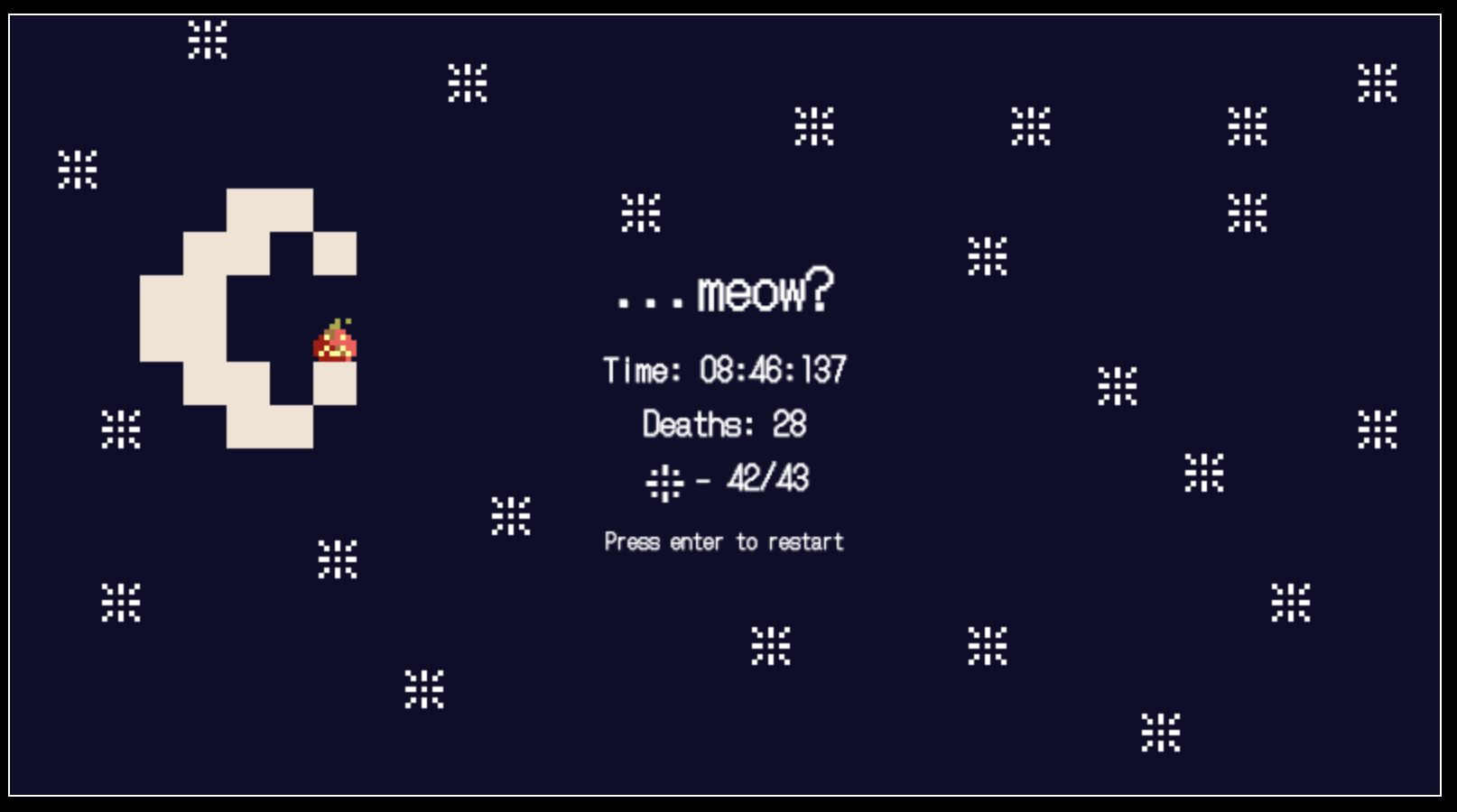
It's interesting to me how different entries have their own aesthetic eras--this one feels more SNES-like. Quite impressed at how much space-cat you achieved out of an 8x8 sprite, and at all the visual customization put into this. Great work!

This is such an aesthetic treat. Everything works well together—the colors, the art, the music, the story-concept. I especially liked seeing the progression of night into day (treated with that color palette, under the layered effects).

Totally tried more than I should've to achieve the unachievable. Maybe I was still in a Ghost Trick mindset.

Lovely bite-sized adventure with personality. Perfect length for a quick escape mid-lunch break.

Fun! Feels somewhere between DOS and NES in both the graphics and level design. Music was perfect. I liked the scale of the castle and loved the extended ending—I didn’t see it coming, and appreciated all the attention to detail there.

Very nice! It has kind of a Metroid-meets-Yume-Nikki feel to it. The Furpur region is particularly interesting, the way the exterior white stuff seems to spill through the walls and be hostile. I look forward to exploring the full world whenever it is ready!

Thank you! I should probably fix that key thing. Will try to upload a new build tomorrow. Thanks for calling it out!

Thanks! I had a lot of fun using Pocket Platformer—thanks for making it!

This is excellent. A great mix of puzzle, skill, and surprises, with a perfect dollop of story.

I did get stuck on the first lie / the bit before “playing rough” for probably longer than I should have—I kept thinking it was going to be a different trick, more like the one that came before it. The solution totally sense in retrospect though.


I love the visuals and the writing, but oof, that difficulty. I had to give up. STILL! It is nonetheless an interesting experience to die relentlessly among wafting cats and giant colors.

Feels like a lost early-era Sega Genesis game—the graphics and challenge level really nail that vibe.

Impressed you were able to pull off a proper “boss fight” using Pocket Platform’s current feature set—well done!

I think this is the first time I have played a micro-metroidvania. And the graphics are so flavorful!

(I hadn't yet noticed the trend of screenshotting the win screen when I played this, but my results definitely weren't anything to brag about.)

(1 edit)

Although I tried to ponder the orb, I pondered the software. I found some orb designs more resistant to my attempts at orb-pondering—I might as well have been staring at a paper plate or a foam toy basketball. Others were more inviting, but nonetheless impenetrable. I found some backgrounds made me ponder differently. I pondered the similarity to a dress-up game—I enjoyed it in this capacity—and imagined musical runway accompaniment to the orb’s assorted fits. I imagined it sashaying in place, the motion technically invisible but felt with the force of a personality.

Although I tried to ponder the orb, I pondered the opacity of its pixels. The large areas of flat color made it easier to notice the reflections on my screen. I wondered if this was intentional. Like a painting, no light can pass through the orb representation, nor be bent in such a passage. This orb representation feels to me like a focal point, rather than a portal. It is framed and frames nothing beyond the reflection of my chin. Or does it?

Although I tried to ponder the orb, I pondered the context. I scrolled down and read and clicked links. “Paku Paku" is fantastic. Expectations and advertising go hand in hand in raising or ruining an experience. Discovery is a game, but how do we credit its friction? Isn’t it our own?

I pondered the author, the jam and its other participants. I pondered PICO8. I pondered anything but the orb.

I pondered my predicament, acknowledged my disappointment (in my flagging efforts to orb-ponder), and closed the window with a brief sting of remorse.

Orb, I have done my best to ponder you. I hope you do not now ponder me.

(1 edit)

I enjoyed the vehicle—it adds significantly to the feeling of being outside on the sidewalk, of arriving at some meaningful destination.

I enjoyed turning around and seeing how small the door looked from where I had gotten.

I liked walking backward for a while, just watching things quietly recede.

I liked that the renderer started to struggle to consistently reveal the (increasingly) distant squares of ground. Only if I turned the camera the right way would a single row of pixels appear in the darkness. Eventually the only way I could tell I was going straight was by looking back at the lingering 1-pixel dot of the door and strafing slightly to center the intermittent blinks of the visible sections of floor I passed previously.  Eventually I must have passed the final visible square and gone too far, because I lost sight of everything and became completely unable to determine my direction or distance from the entrance.

It was an interesting experience.

This is a pleasure. The audio and writing and color palette and obscure mechanics and finite window of play all work together beautifully. Collecting poetry line by line, out of order, missing some pieces and having too many other pieces, makes for an engaging mechanic. I have played through a few times now and intend to do so again. 

This build is definitely a lot harder! I wish I could see whether there are emotions around when I'm replenishing the oxygen. 

I was spending so much time going back and forth between masking & refilling oxygen that I didn't find much time left to look at the task pad. It looks like the boxes' colors correspond to the masks you can wear, but every time I tried to try putting on masks in the same color sequence I lost from oxygen or suspicion. Or are the boxes just a list of emotions you have to evade successfully?

Oh, and the suspicion bar was such a small suggestion that I'm surprised to see credit for it. It's very kind though!

I know I've said this before, but I really like the graphics and the sound, as well as the general theming & world-concept! I think the part of playing I've enjoyed the most actually is visiting the other NPC fairies' turtles and hiking around there, partly because the little forest is a pleasant space to wander, and partly because it's fun to try out different loops through all the cleanup spots. And the framing of "helping" the fairies that way feels nice too. It's super chill and cheerful!

I also agree with what others have said: setting up the initial collection of 4 of buildings feels a little rough--it feels like I'm waiting to get started, and when I see the cost go up for each consecutive grass plot my brain sadly translates that into extra waiting.  Once the initial cluster is set up there's kind of a fun whack-a-mole pattern that emerges with gathering the output, it just takes a little while to get there. Leaning more clicker-style with clicking-to-speed-things-up might help with the intro, as much as tweaking the initial costs. It might also be neat if a tutorial NPC gave the player "free vouchers" (or maybe just loaned out rainbows) for each initial building in series, so after you add a building you can go back for the next voucher (or rainbows) until you've built the full set. (Afterwards, maybe you could optionally pay this helpful NPC back and get a little cosmetic bonus as a surprise thank you.) I know dev-wise that might be a bit of a stretch though!

The other comment on allowing a bit of accumulation per generator would also be nice. Without any accumulation (and until there's auto-collection), it feels like my role is to be a very important cog in the machine at all times, and if I take a break then everything will grind to a halt. Allowing a bit of leeway there would make it easier to be social or explore during the early part of playing (before you can afford the tier of generators that auto-collect). Maybe the level-1 generators let you have one collection waiting and only halt production after two are waiting, and level-2 lets you have up to three waiting. Or maybe the production rate could slow down as more collections are waiting (0 = 100% generator speed, 1 = 75% generator speed, etc) and the slowdown effect reduces with each upgrade. Just a thought!


A couple more wishes/ideas:

- Scheduled downtime ("break time," "fairy holidays," day/night cycles, etc) could be a fun & chill route to explore, just to encourage exploration, being social, or just taking a break yourself.

- Foraging loose objects (finding colors floating by / landing on your turtle) could be a fun little distraction that also helps the world feel more alive.

- It'd be fun if wings could let you fly around a little!


A couple more things I enjoyed:

- Changing the cosmetics to be mushrooms and flowers and caterpillars, to make a little wilderness garden.

- The wing varieties, especially the moth-like wings option!


On the whole this is a very nice casual jam game and it feels like there are a lot of directions you could take it. (Also it makes me want to make a game about small creatures around a puddle outside.)

Good job!

Hah, I love the failure/restart sound clip. Wish I could find that fabled stick, though.

I'd be curious to hear if you have any "lessons learned" or "postmortem" thoughts. Jamming as a team definitely has its challenges, and it seems like the 5-week length might add a few more wrinkles.

I like the new location!

I think I've said it before, but I enjoy the world design, choice of original work to riff off of, ambience, and little details like the deadbolt. The day-schedules may be a little ambitious even for longer-term development, but I do hope you consider working on this further, or adapting some of these details into future projects. While far from finished, it is a promising start!

Love the aesthetic! Substantial and varied puzzles. Really solid work!

A few things on my wishlist: 

- some fanfare when collecting the key at the end of an area (large-scale animation/flash/particles + happy audio beeps)

- some talking characters + backstory (even if it's just fluff, I'd enjoy it and think it would help fill out the game-world)

Admittedly I'm taking a break midway through (it's late and my brain is too tired to push blocks) so I might have missed some things!

Final submission to the greenlight jam: https://wakeman.itch.io/a-hike-through-an-uncertain-landscape

Hah, with all the overlong titles getting cut off, I managed to select the wrong version to submit to the final sprint. This is the design doc instead.

The actual link should be https://wakeman.itch.io/a-hike-through-an-uncertain-landscape

Thanks!