(rorschach voice) no
sraëka lillian
Creator of
Recent community posts
really interesting to get a peek at all the ideas that didn't make it into the final version, it really hit me while reading this how much a mid-development game is still like a hydra of potential that's getting its heads pared back. i have a weird tendency to think of game designers in the abstract as mostly filling out a defined space with stuff, even though in my own experience defining the space is no less than half the job. i guess i never managed to fully apply what i know about my own experience to other people. the questions of course are all very familiar, worrying about what reads and what moves you too far from the original vision. every day im new again i suppose
i would say i parsed this more as a game about navigating the dark than about using sound specifically to do so, i think in my own experience, the visual representations of sounds were more central than the sounds themselves, and tools representing vision more central than ones representing sound. i would say my main skill were memorization, augmented by the echo visuals and "feeling the walls", which is implemented visually/sonically but experienced more like touch. that feels right to me, it lines up well with my own sense of what navigating in the dark in real life feels like, and i agree that without the unlimited free peeking at bells/start of level, the game would have been much longer and more arduous than would have felt appropriate for the jam, so i think the calls you made here were 100% right. but i guess i'm confirming your last worry (is that rude of me?) about moving away from the original vision of using sound to navigate in the dark. i think you did! but it was toward a more holistic or multisensory experience of navigating the dark and i think that's a lot richer and more natural than limiting it to sound alone. so it was a worthwhile departure in my opinion
lastly real quick ill say once again how much i enjoyed the lightness of the tutorialization and the faith you placed in the player. felt great feeling lost at first and putting the pieces together for myself
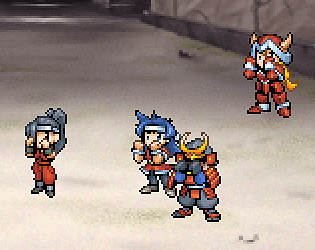
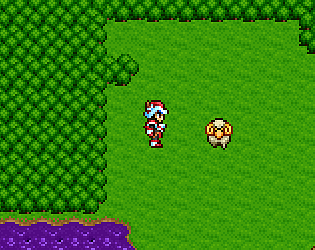
thanks for playing! there's something of kind of unglamorous about froak, it's probably not very fun to use a character who can only attack, but their consistency lends them a specific and very tangible form of power. it reminds me a little bit of rudo from phantasy star ii, whose guns deal fixed damage, making them the strongest fighter against high defense opponents and the weakest against low defense ones. i really love this role, but maybe i should investigate ways to make them a little more dynamic. you could make a similar critique of the osteopath, who can feel a little more like a healing reservoir than an actual character, the way they mostly just defend in battle.. both would probably benefit from an environment where you *choose* to bring them out of a larger pool of contrasting characters
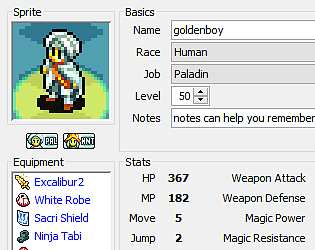
fun and very cute. it brings me great joy to see people making helen-likes of any size, and although the balance feels a bit loose (is sworeld not a strict improvement over shield?), it's fun to fiddle around with a new toolset and the concise length and gentle difficulty encouraged me to replay it for a better score. my best time yet:
.
.
.
.
.

yay im glad it hit, the way i kept fucking around with this one i was worried it would feel overtuned and overly rigid. hp is a really interesting stat that feels weirdly subtle in practice, i guess as long as it feels like you have "enough" hp that it's not a constant liability, having very high hp doesn't feel like much of an asset. i think it's because in most games the limiting factor in how long you survive is your healing resource supply. it'd be a fun challenge to center a game around the goal of making hp feel really important as a stat, but as im learning it can take kind of a lot of data points to make these contrasts really pop.... shit though, maybe it doesn't have to. that could be another challenge, too
i wanna make it to 50 sketches this year sooooo bad.... i'm planning to take a couple weeks off later this month but that means getting a few sketches ahead of schedule in advance, or (less desirably) making up for it later. there's probably a healthier way to go about it, but i'm hoping that i can hustle just a liiiittle bit longer and then get some good recuperation in, and that that will be enough to get me through to the end of the year
there's a big difficulty spike at the vampire, could that be what you mean? from there on it becomes a little less about running around dodging encounters and plundering as many treasures as you can, and more about figuring out how to use your huge gear collection to nullify boss threats and deal tolerable damage to them.. i liked the balance of that part of the game, but it definitely starts putting different and rather significant demands on players
that's so funny, i usually go out of my way to make sure you CAN'T just run from everything. normally i would have tested more thoroughly, but in this case i tried running from a couple battles, it didn't work out well, shrugged and went "seems fine". i deserve this outcome (especially after yuki-onna lmao) and i'm grateful to have peers who will play my games in this way and call it out when i've left a hole in my design. bravo and thank you lol
hey, long time no see! thanks a bunch for playing and sharing your thoughts. i agree with you about the pacing of battle and you're right to peg it as an engine limitation. in the final version i'm hoping to edit the easyrpg player source code to speed up battles, since it's been a recurring critique.
as for the conflicting "genres".. i see the issue you're describing. a nebulous ruleset that you have to feel out through play is inevitably gonna be a messy process and needs to cut players a little slack so you're not asking them to replay every fight for a better score immediately after learning it. but i love attrition and dislike isolated battles, so rather than (say) add healing between fights, i'm inclined to just make battles easier so their threat is cumulative, and rather than having to perfect your approach to every battle, you're looking for smaller avenues of improvement across multiple encounters.. believe it or not i just don't like puzzle battles that much
between the story, and the story-related mechanics, and the fights themselves and the economy there's a ton going on in this one. it's interesting to get a combat-focused one. i'm usually pretty critical of lock-and-key battle design but i'm pretty impressed with this version of it. two reasons why. one, the way you subtly set up the expectation that every fight has a skill that "solves" it, and that that skill won't be of much help in other fights - and then play with that expectation - makes for a pretty involved process of learning and hypothesis-testing. as soon as i feel like i've gotten a grasp on how things work, you start throwing some curveballs (like the fight with cassius where all your "used up" stat-dropping skills work again, which is one of my favorites). when i DO find the right skill, it feels pretty good to abuse it, knowing that it i won't be able to just trivialize every subsequent fight with it. if you're gonna make me rote check all my skills one by one to see what works, it goes down a lot easier if the skill that DOES work works really well and i get to feel strong and clever for figuring it out. i could see this process becoming tedious in a longer game, but i think it fits a gauntlet of this size very nicely.
the other thing i dug about it is the narrative resonance of like, your relationship with lance continually giving you the power you need to keep going forward. the first time i got a choice, i picked the first option, learned disarmer, and assumed the other options would give me different skills. but nope - you have to choose the answers that honor your relationship with lance to actually draw strength from it. it's simple, but very evocative. and again, well suited to the short length of the game. in a longer story, picking the "obvious" "right answer" and getting the skill that wins you the battle could get old fast. but you need to do it two or three times before the pattern even becomes apparent, meaning the number of times you make the right choice consciously expecting to get the key to the next fight out of it is 1-2. and by the time you get to the last fight, you don't even have to make a choice, you just get the skill and you know it's gonna be the key, and it is. it feels so right, it's confident and unpatronizing storytelling that trusts the player and doesn't drag on any longer than it needs to. i also appreciate you resisting the temptation to like, go *bigger* for the last lance interaction and have a more complicated challenge, and instead removing the challenge aspect altogether... it's very good. nice nice nice stuff