



Well, I at least had fun making it. 😉
pvande
Creator of
Recent community posts
> Editor makes my Mac show the spinning beach ball when placing portals.
Curious. I’ll spend some time looking into editor performance soon.
> Player start location is not updated when you move the start zone.
Hmm… By design, the player’s *current* position isn’t changed when you move the starting point, but it should reset to the starting point whenever you “restart”. If it’s not doing that, there’s definitely something in g behaving strangely.
> Player also feels like it moves a little fast [for platforming…]
Yeah, that’s something I’ve gone back and forth on. I wanted to imply that the game was appropriate for speedrunning, and to make the challenge about something slightly more than just route memorization, but I’m not entirely happy with how easy it is to accidentally slip off the edge of platforms. The game was also not really tuned for controller play, so that’s probably not ideal. Something else to put on my list of refinements…
> Here’s a simple level I created:
I look forward to checking it out!
I'm sorry to hear that the editor didn't work for you! I have had a couple reports that it wasn't usable on machines with older GPUs, and possibly with issues on Windows… Regrettably, I hadn't had time to do any cross-platform testing before launch, and it shows.
Thanks for taking the time, and I'm glad you enjoyed it! I also hope you'll give DragonRuby a try — it's a lot of fun. :)
Thanks so much; I'm glad you enjoyed it!
There are definitely jam limitations at play here (e.g. the character art, the soundtrack), and if I were to build this out further I very likely would explore additional movement and thematic abilities. The lock and key scheme I went with here is definitely scraping the floor of what can still be considered a Metroidvania, and while I'm generally happy with how the experiment played out, the sense of growing more and more capable and powerful over the course of the game … just doesn't land. For really large stages, I suspect that lack would be felt even more severely.
Still, if you haven't played around with the stage creation tools in the game, I do recommend giving them a try — it can be a lot of fun to explore what's really possible within the current set of constraints. :)
Thanks so much!
On the “Metroidvania feel” front, I knew that cutting so many “traditional” aspects was going to be a risk. Without boss fights, mobility enhancements, or strength progression, some signals that many folks look for get lost. On the other hand, with the simple mechanics I did choose, I managed to build something exploration-driven, non-linear, with gated progression and required backtracking — plus support for speedrunning and the tools for community-built stages. (There’s a second stage I’ve referenced in some other comments where I’ve also played around with environmental storytelling within these constraints.)
All that said, I’m glad you enjoyed it even if it didn’t ring as a Metroidvania to you, as I really enjoyed making it. 😁
This was fun! Faithful to the NES, but with a few modern design conveniences that don't upset the balance too much. The variety in the game is fantastic, especially given the timelines you had to work with. Unfortunately wasn't able to finish it, since I got softlocked into a wall when passing through zones about 1.5 hours into my playthrough. (A quick glance at my inventory suggests I may have been just two items away.) This came after another instance where I nearly softlocked when I approached a zone transition from the water side and couldn't progress without the ability to open yellow doors, and couldn't regress without a dash jump (which I was unaware was an option).
I could echo the desire to have somewhat faster movement, and more frequent save points (I hadn't realized there *were* save points until my second attempt), but my "biggest" complaint is about how you're cheating in more simultaneous colors than the NES could show ... so given that, it seems fair to give you your well-deserved kudos.
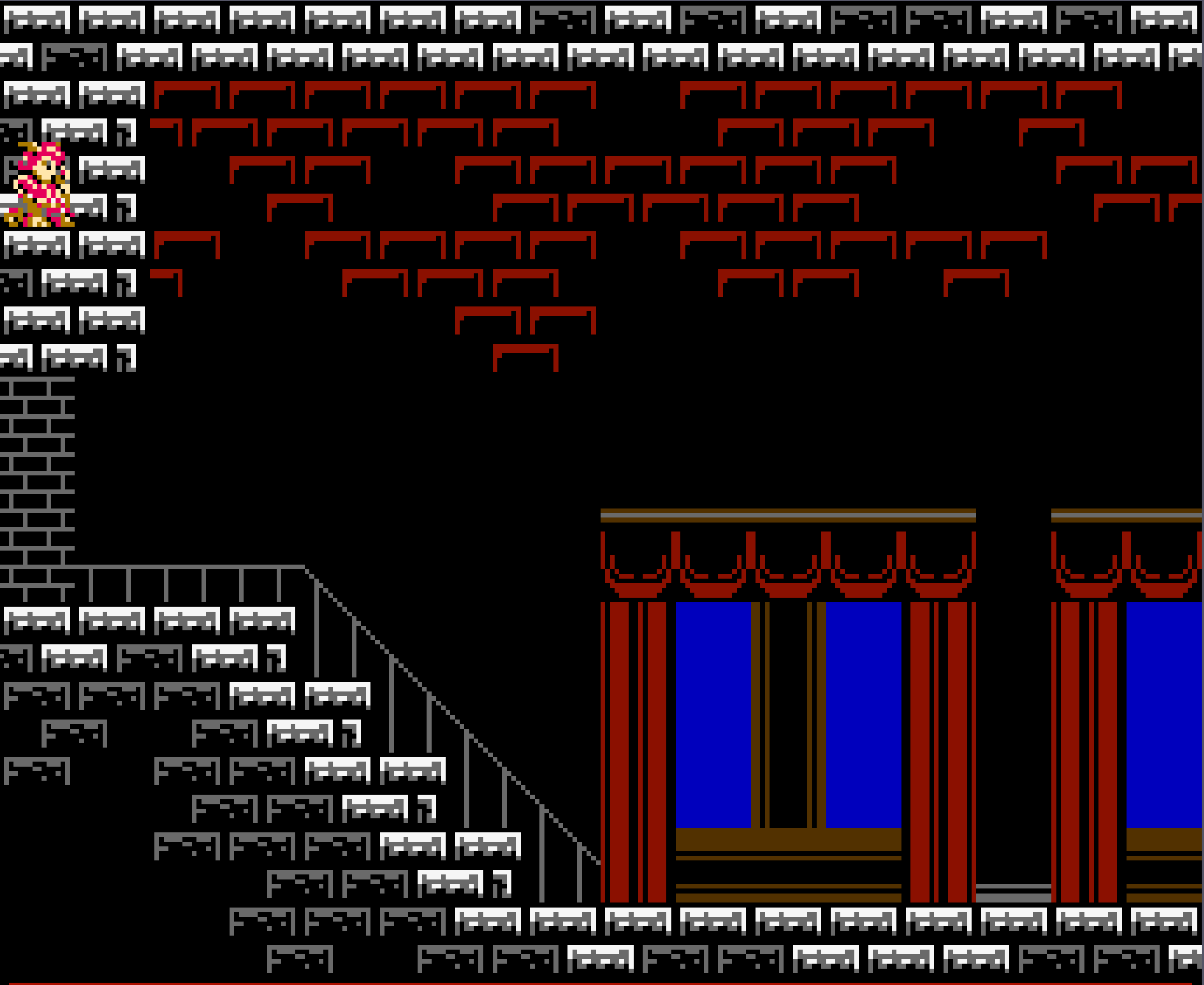
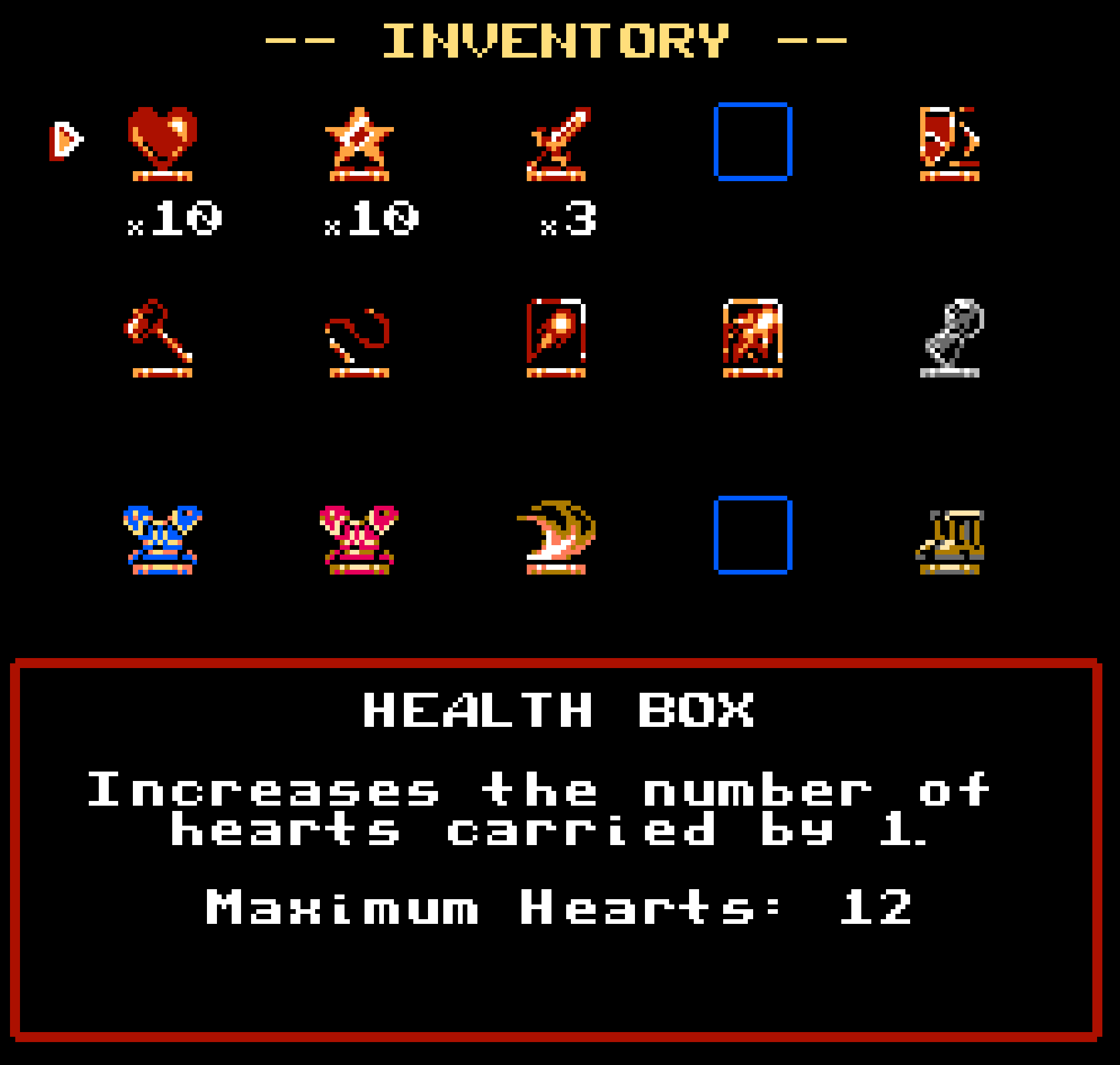
This was fun! Faithful to the NES, but with a few modern design conveniences that don't upset the balance too much. The variety in the game is fantastic, especially given the timelines you had to work with. Unfortunately wasn't able to finish it, since I got softlocked into a wall when passing through zones about 1.5 hours into my playthrough. (A quick glance at my inventory suggests I may have been just two items away.) This came after another instance where I nearly softlocked when I approached a zone transition from the water side and couldn't progress without the ability to open yellow doors, and couldn't regress without a dash jump (which I was unaware was an option).
I could echo the desire to have somewhat faster movement, and more frequent save points (I hadn't realized there *were* save points until my second attempt), but my "biggest" complaint is about how you're cheating in more simultaneous colors than the NES could show ... so given that, it seems fair to give you your well-deserved kudos.


No worries! I’m sorry to hear that it was still a bit much. I’d considered providing the ability to browse multiple map layers from the pause screen, but the implementation was cut for simplicity and time…
I appreciate that you were willing to come back and give it another look; if you’re willing to give it one more shot, “Into the Hive” might be a little simpler (somewhat clearer zone themes, more wayfinding hints), and it might be helpful to know that the canonical key order for “A Good Start” is YBVIOR. On the other hand, if you’re content that you’ve given my game its fair shake, I understand completely, and thank you for the feedback. 😁
The UI swap is basically how I interpreted it; I figured that the only thing I was missing was the Soul, and that I probably needed Beacon support to … do the thing that seems to come next. Neither factor significantly diminished my enjoyment, and I went in knowing that I probably wouldn’t be able to actually complete the game in-browser. 🙂
On a Mac, so I had to play the browser build.
I nearly ended up bouncing off the early game, as I just couldn't seem to find a path forward across the treetops (and being disoriented by the kill plane), but as I started making progress things did eventually get better. All told, I collected 12 bolts and 3 of what the UI told me were Souls, but the last piece continued to elude me. Still, glad I played!
I'd love to hear more about what you feel is missing — from my perspective, the game has accomplished everything I set out to do, and more. The visual style could be a bit more coherent, and the sound design isn't quite where I want it to be. Movement is still a little ways off feeling ideal too, I suppose...
I've definitely gone back and forth about the mobility upgrades. On the one hand, they open up a lot of additional level design space, and they can really aid in the feeling of growing more powerful as you play. On the other hand, I had hoped from the outset that I could build something that felt like a Metroidvania even without that common trope. That said, if I take this game any further, I probably will end up adding a handful of mobility upgrades to the level editor for folks to play with.
Thanks for giving this a play!
Thank you! I've heard similar feedback about difficulties wayfinding from others — to that end, there _is_ an in-game map of the current layer on the pause screen, and I've explored some level design options for differentiation in "Into the Hive". Did you get a chance to explore anything beyond the introductory stage?
Thanks again!
Into the Hive / 08F76307
So very glad to hear that you and your son enjoyed it!
As pertains to the subtleties, the details are really there to promote [some level of] immersion. From a game designer’s perspective, I’d love to hear what was working and what wasn’t, but if you weren’t being pulled too far out of the game by anything, I’d wager they were doing their job. 🙂
It occurred to me this morning that I had made one concession here, which I had intended to take further: making the NPCs carry things.
As it is, there are a small handful of outward signals:
- When starting to make a soup, the NPC always begins by grabbing a pot and putting it on the stove.
- When taking out the trash, the NPC will carry a trash bag around until they take it outside.
- The doorbell will always ring before an NPC goes to answer the door.
I had plans to incorporate a variety of other accouterments into their workflows, less as a signal of intention but as another layer of realism that brought life to the "house". The pieces that did get added feel really successful; I just ran out of time to add more.
(I also had plans to allow NPCs to pick up and move the stools so they wouldn't get trapped, and more generally allowing tasks to be interrupted-and-resumed later (e.g. if the stove became blocked in the middle of soup making), but that would also necessitate putting back whatever they were currently carrying, and better pathfinding logic in general. Ultimately I had to draw a line between what I could get implemented well for the deadline and what I wanted to get done… As another example, it was originally planned that you would have to jump up onto a stool to reach the upper cupboard, fridge, and cookie jar — but doing so would leave stools in positions that blocked NPC jobs, and while it was cute, it made the already difficult gameplay more challenging, so it got cut … except for the jumping on stools code.)
I had wondered whether folks would make an effort to build a parent trap… ;)
Intention signaling is one of those things that I had to think seriously about.
On the one hand, the game is playable without it, and you can learn through observation and repetition what the routines are and approximately how long they last (at least with enough certainty for the fraction of a second you need to escape). It's a little disappointing when someone spontaneously turns around and spots you, in the Nethack "rocks fall and you're not wearing a helmet" kind of run-ending way, but when you've just managed to duck around a corner, or weave in and out of rooms just avoiding detection, that same risk drives excitement.
Signaling intention just in time (i.e. as it changes) doesn't actually help avoid any of the "spontaneous detection" scenarios, and at best gives you visibility into where the NPC is pathfinding to. How useful that is may be a reasonable subject for debate, since it's a reasonable blind spot for me.
On the other hand, if NPC intentions were signaled in advance, it's a lot easier to know whether you're going to be safe before you even move. It's not an inherently bad thing, but it does replace hard-earned knowledge with free information, and reduces the challenge of the game substantially closer to "can I move around well?". Given that the game is only just compelling with its current balance of movement and discovery, I fear that adding signaling would lead to higher scores and broader appeal but lower satisfaction overall.
Always happy to entertain the discussion, though! :D
I'm looking forward to see where this game goes from here. I've loved the concept from the beginning, and the execution hits on many levels, but I feel like there's a lot of trial-and-error in the current implementation around finding a build that scales properly to confront the next challenge, and the numbers aren't always intuitive. (I also made it through several runs before I discovered that I could upgrade my power plants…)
Really fantastic elements of polish, and a great concept!
Don't let Mimi's sweet appearance fool you — they are hungry.
I loved the simple evasive gameplay, and the hunter/hunted dichotomy was fun to play with, too. I wished at times that everything moved just a little bit faster, but the game is a brilliantly cohesive whole that works really well. The addition of partner mechanics also helps add depth and complexity (though I'd be curious to see more puzzles in the future where the solutions were cooperative rather than individual).
I did occasionally notice goblins enter buggy states (e.g. walking east, but watching north and south on alternating frames), occupying the same space (making it frustrating to try and eat only one of them), and detection was often less dangerous than might be expected, but I view all of those "issues" to be well within scope for a game jam, and they generally don't detract from the charm of this game.
A super cute game with a story rivaling the (good) nonsense of a Saturday morning cartoon. The individual arcade games were surprisingly skill-based (with one exception I can note), simple enough to pick up quickly, and just sticky enough to be annoying when you have to walk away to jump into a garbage can…
I felt as though evading the manager was a bit underemphasized overall (I hadn't picked up that I would need to until after he caught me a couple of times), and the consequences of being caught were too minor for me to notice, but I ultimately still enjoyed the game, and look forward to seeing if this concept gets developed further!
Such a simple premise, but well executed and very fun! The difficulty ramps up slowly enough that you have a feel for the game before it gets out of hand, and the art style adds to both the aesthetic and the challenge.
The only potential negative I might note is that the later levels may slightly overstay their welcome, but that's a difficult balance between being long enough that players can demonstrate their accomplishment and being short enough that they will stick it out to the end.


