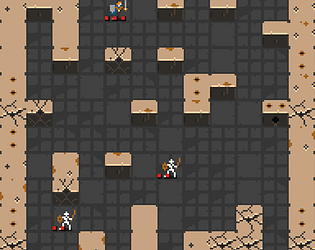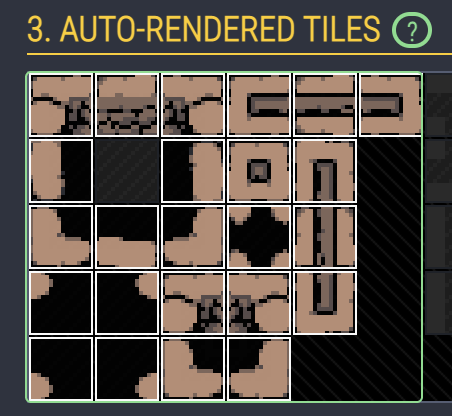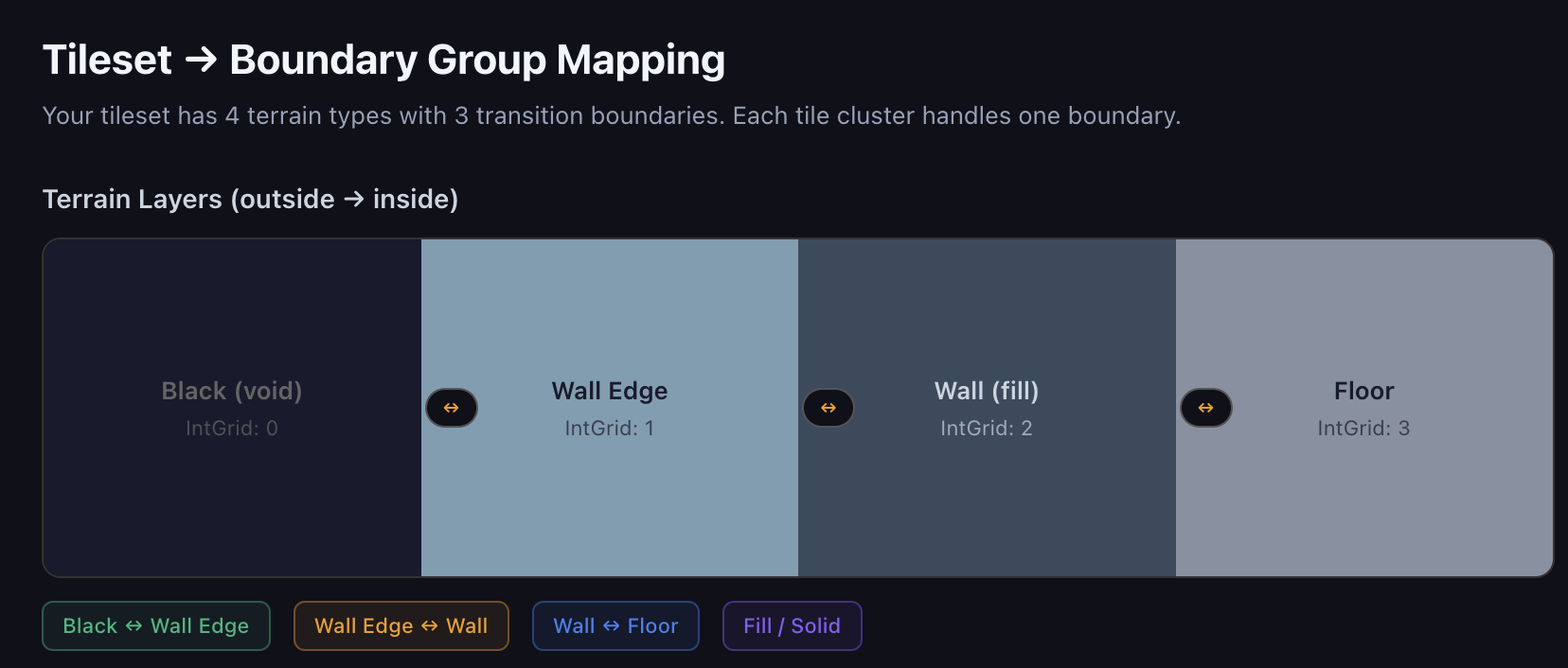
So well done, can't wait to see more top down environments from you.
joeyismusic
Creator of
Recent community posts
Not sure what language you plan to write in but you can create an aracde-like roguelike in about a day with this tutorial: https://nluqo.github.io/broughlike-tutorial/
The hosts have said they encourage participants to plan ahead, start the design docs, sort out your assets, use libraries… etc.
I’ve done just that. I have a game concept and have used AI to do things like take sprites in a sprite sheet and create meta data about the sprites. Etc.
But the game itself is still my idea, my concept, and how I want it to play out is something I’ve architected alone. All that’s left is to wait for the start date and get to work
I can imagine people think of vibe coding a game to be someone letting AI decide all of this. In my case, it’s not.
But absolute proof would be to just stream all your work to verify you made the game. I’m trying to figure out WHAT part of this process is the most respected. Is it physically writing the code by hand like by line? Is it the game design? Is it both?
Removing AI from the equation, the supportive nature of allowing libraries even begs this question. I mean with rot.js, you can have a game in like 50-100 lines.
So what is the official stance on AI involvement in the development process?
1. It’s impossible to even type text into any modern device without AI auto correcting you or making suggestions
2. AI is factored into tons of tools. Before the current AI boom, intellisense was basically AI and coding assistance
3. Lots of opinions here but would love to cling to moderated rulings. AI is a useful sounding board, creative collaborative partner, and all in source of knowledge.
4. Most google searches even are an AI generated response.
So the question is, will people be penalized or even disqualified if they’re using AI during the challenge?
thanks.

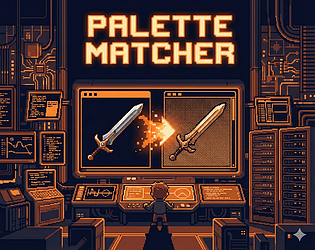
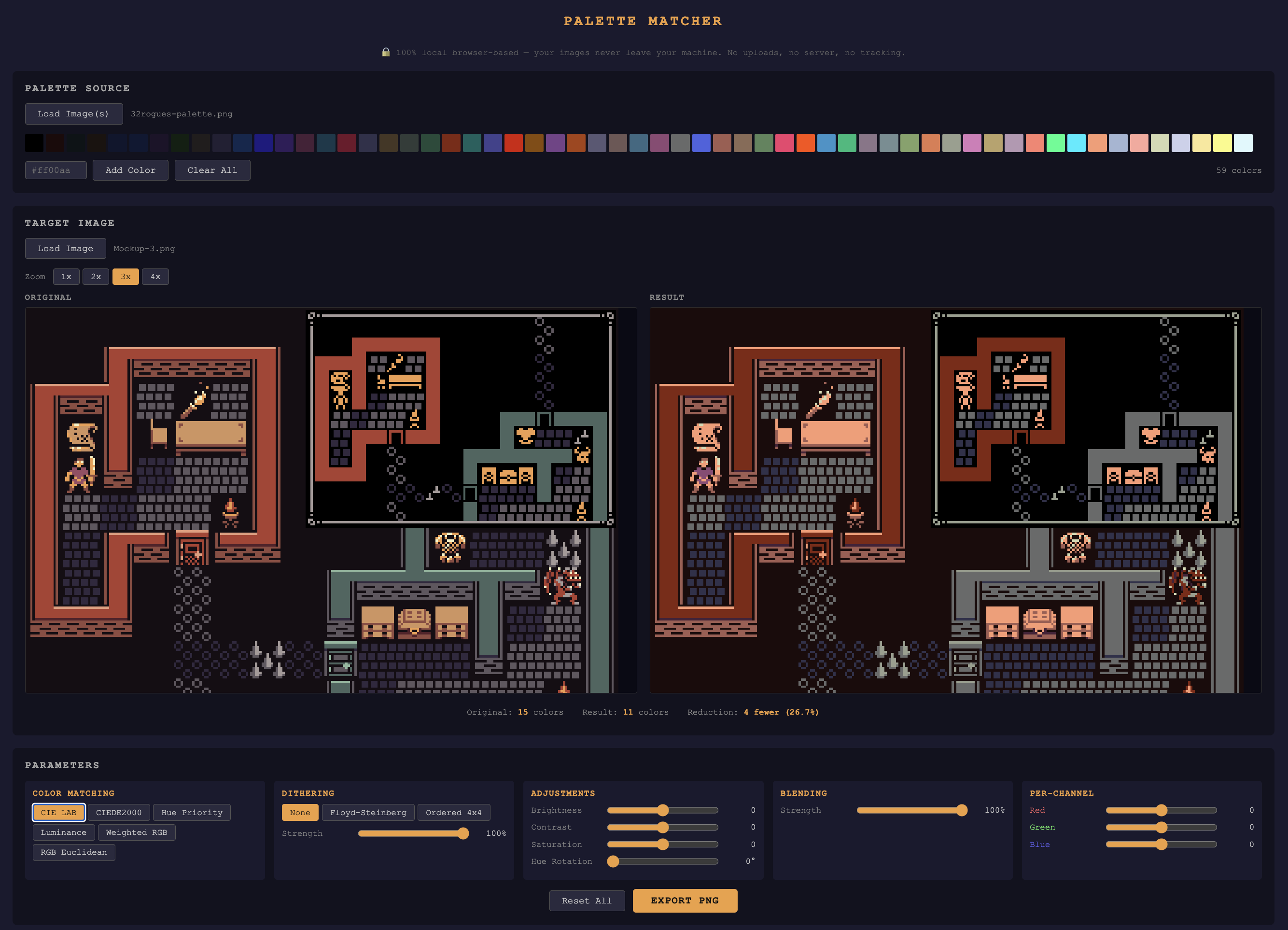
Hey everyone — I just released Palette Matcher, a browser-based color remapping tool built for pixel artists and game devs.
The problem it solves: if you've ever mixed sprites from different asset packs in a project and everything looks like a color clash, this tool lets you take one palette and force another image to match it. No manual recoloring, no Photoshop — just load, tweak, and export.
How it works:
- Load one or more images as a palette source — it extracts every unique color
- Load a target image you want to remap
- Pick a matching method, adjust dithering/brightness/saturation, and preview the result side-by-side
- Export as PNG
There are 6 different color matching methods (CIE LAB, CIEDE2000, Hue Priority, Luminance Only, Weighted RGB, RGB Euclidean) that all produce noticeably different results depending on your art. Floyd-Steinberg and ordered dithering are included too, plus a full adjustment stack with per-channel controls.
A trick worth knowing: load the same image as both source and target, then lower the saturation. The result stays within the original palette's exact colors — no new indexed colors introduced. Great for making muted or darkened sprite variants without breaking your color budget.
Privacy: everything runs 100% locally in your browser. Your images never leave your machine. No server, no uploads, no tracking. It's a single HTML file — works offline, zero dependencies.
It's name-your-price (including free). Would love to hear if it's useful to anyone else working with multiple asset packs or limited palettes. Happy to take feature requests too.

All this and more has been fixed and improved since submission but according to the rules - the work had to be done within the timeframe of the jam. It’s unfortunate that I could not complete my vision in time and this is basically an incomplete (although somewhat working) submission. Thanks for playing! I certainly had fun getting my feet wet and participating.
Since the rules don't really discuss what type of combat is required, I'd say you're free to implement whatever makes sense for the game you want to create. But, that said, I'd aim more towards the idea that this game jam is leaning in the "traditional roguelike" direction. The host of the jam even embeds an animated example of gameplay which really exemplifies what a desired game submission might look like.
I am interested in the idea of adhering somewhat strictly to the concept of a traditional roguelike simply because I've actually never built one. I find it to be an interesting challenge to take on and to do something I would not do otherwise.
I wanted to just recommend a step by step tutorial for creating a traditional roguelike that I truly believe anyone with a computer and a tiny bit of interest in game development can get started with their creation for this game jam. I'm simply recommending it because it has helped me out a lot with getting into the genre.
Check out the Broughlike Tutorial by Jeremiah Reid: https://nluqo.github.io/broughlike-tutorial/index.html
You can play the finished game here: https://nluqo.github.io/broughlike-tutorial/completed/stage8/index.html
Anyone with a computer, text editor, and basic image editor can create a completely finished traditional roguelike from scratch with no dependencies, libraries, or other tools.
Best of luck to everyone in the game jam!
I think it's well agreed upon that 3D does not fall under traditional roguelike standards. However, as the main page states:
You are challenged to create a game that features gameplay that is:
Turn-based, focusing on strategic thinking over quick reflexes.
Run-based, with no meta-progression (the player loses all tangible progress after each run).
Subject to permanent consequences (the player cannot freely roll back mistakes).
Impacted by Procedural Content Generation in a meaningful way.
Focused on the development of A character, or a party of characters (no abstract puzzle or "god" games).
So that leads me to believe 3D is welcome? But probably wouldn't earn any brownie points from people "expecting" a traditional roguelike...
The theme is whatever you want if it follows the above.