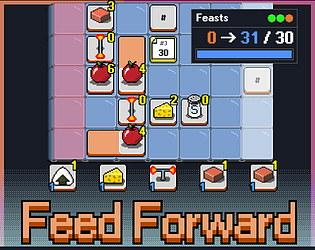
Thanks for playing! Glad it clicked. Discard and draw pile are there mainly to display the tiles in each pile like a deckbuilder. You cannot otherwise actively draw or discard during a turn. At then end of your turn, played and unplayed tiles go to the discard pile. You draw from your draw pile, and if the draw pile runs out the discard pile shuffles back in.
Cold Fry
Creator of
Recent community posts
Nice, cool art style! Really digging it.
Was able to go to that last break room. Not sure if the guy dreaming about their bonus and second pool had anything to do with that level. I liked all the random things that would cause people to move around. And even the random things that had no effect, like turning on the computers. For some reason, despite being the first, easier "no-hint" level, the situation with the coffee machine stayed with me.
Got to level 25 but couldn't beat it after the longest time! I tried to do a single spring bounce from the very top but keyboard + mouse coordination proved difficult for me. Doing repeated bounces after falling regularly was more doable but I'd often fail the last or second last bounce. Spring sometimes would shift to the right if I landed from sunny view to rain view. If I landed in sunny view it was fine. Wondering what the "intended" solution is; I could see the single ambitious jump as a speed run option.
Procedural leg animation is a nice touch, reminded me a bit of Rain World.
Completed all three puzzle types, all levels! The concept is interesting: puzzles built around visual perception. The scrolling layer puzzles and the animated gradient puzzles had this moment of my eyes adjusting to see the individual components, almost like those magic eye posters. I once built a game that was an abstract spot-the-difference game, and a sort of similar mechanic applies there: cross your eyes and the differences pop out.
I found the difficulty pretty gentle overall: once I figured out the trick for each puzzle type, the remaining levels went quickly. Harder variants could be interesting, maybe patterns that are closer together in appearance or composites that are harder to decompose. The kaleidoscope puzzles were the most visually intricate but the easiest to solve for me.
Thanks for playing, and for 30 minutes -- really glad it hooked you!
The early game boredom is super useful feedback. Scrap and Apple (and Basic Burner) don't really pose interesting enough puzzles or questions when that's all you draw.
On the damage calculation/display, I'd love to track that down. Could you describe what you saw? Was it the hover tooltip on the forecasted number, or the red number that pops up when an order is resolved?
Art, UI, SFX juice, polish are outstanding. The shop with different pool modifiers is an interesting mechanic. I didn't manage to beat the first era after a couple of tries (likely a skill issue) but could see the depth underneath. A bit more onboarding on how merging works and what the different set tiers mean would help. Impressive scope for a prototype.
Weirdly endearing. The garden soundtrack is great, what is it? I would love to listen to it out of game too! Art style reminds me of those 90s PC games, high density pixel art. The real time water decay is both cute and slightly stressful, I made a profile and got worried about my plants. But you can always sell them for a quick buck. I wasn't always sure what the underground icons/nutrients did but enjoyed being surprised by which flower I got. I think leveling up changes which plant you grow? I was getting dandelions, then after leveling up it switched to tulips. The growing itself is simple but the garden layer gives it legs.
Played for almost an hour, got to to level 11 after being stuck on level 2 for a while. The core mechanic is really clever. Placing buffs mid-sim was cool. Art is clean and consistent, and easy on the eyes. Main feedback: a restart button/hotkey would be huge (watching a losing sim after your last buff is placed is painful), and knowing how many levels there are would help motivation. Really impressive how much mileage you got out of a simple concept.
Solved level 1, but level 2 is giving me a very hard time! Probably me being stupid. I'm now trying to place a buff after pressing play instead of before to bait either red or white (probably white, right? For the speed boost?). A quick "restart level" feature would be very appreciated.
Really liking the art, cool mechanic.
Nice dungeon aesthetic. Slime art especially is cool. Controls written on the ground at the start is a good onboarding choice.
I played several runs and found I could skip combat entirely and just run for the key. Enemies are slow enough and don't deal contact damage, so there's no pressure to fight. The parry mechanic exists but I never needed to try it. I think tightening enemy speed or adding contact damage would give the combat systems a reason to exist. I managed to get runs down to maybe 20 seconds because I think there are 2, maybe 3 possible key spawn locations.
Also the camera tracking made me a bit dizzy. A small buffer zone around the character before the camera moves might help.
Good foundation for a dungeon crawler.
Core loop is tight and fun. The gold-drop mechanic from killed adventurers where you decide whether to prioritize pickups over kills adds a nice decision layer. Clean pixel art, units and grid are readable and distinguishable almost instantly.
I found the first turn confusing (skeleton pawn or adventurer pawn? mistake on my part!) but after that everything clicked. Main feedback, which might also be me missing a UI element: I wasn't sure where to see a unit's health and attack damage, and merging/leveling up units wasn't obvious in terms of what it actually changed. Some stalemate situations also felt a bit odd where enemies would walk into my attack range so that I could clear them.
But once I got into the rhythm it was genuinelyl fun. Got killed at the last (10th out of 10) room from the captain (leader?) unit. Sharp difficulty spike compared to the previous nine rooms.
Thanks for playing and the detailed feedback!
Orders aren't purely random, but drawn from a fixed pool of pacing schedules (some front-loaded, some backloaded, marathon single order, etc.) with appetite scaling by level. Some shortfall is expected but the HP provides a limited buffer.
On which columns contribute: any consumption counts toward the next upcoming order. Once an order clears, the accumulated feed resets. So all columns up to and including the order's column (back to the previous order) should count. For tiles larger than 1x1, what matters is which column the food cell is on.
For espresso, it does both: +1 energy per turn and base feed of 3 toward the order. Might have been positioning of the "food"/espresso cell. Definitely a UI clarity issue I need to fix, and add to the tutorial.
Appreciate the kind words on the polish and SFX!
Cool game, core loop is solid. Move-then-attack rhythm feels good, and there's a lot of variety on offer with the shop/upgrade system so you really feel the build is developing after waves.
I had two sessions. First session I bounced because I couldn't parse exactly what was happening. Second time it all clicked. The main thing I was missing was the "schedule" style system of moving and planning with the attack cooldowns. Glitch system is a cool addition to the auto-attack base and adds a nice layer of active decision making.
Grid/attack art is nice, and especially the pictures drawn for the artifacts were super nice and fit with the retro/arcade game style! Wireframe UI style is clean. CRT-like shader and "synthwave" background set a good vibe.
Fun and super hard! Finished level 1 and got a bit into the jello level. Gives me Animal Well vibes.
The "hidden" mechanics are great: holding jump for longer bubble bounce, holding sprint for bubble spit distance. Expands what you can do with a simple mechanic.
I would have loved a persistent save mechanic. I wanted to come back to it later but couldn't cloes the tab without losing progress. But maybe that's part of an intentional arcade-style choice. And I fumbled some inputs with the keyboard layout. Probably a skill issue though.
Cute characters, clean pixel art, and the checkpoint system is appreciated.
Thanks for playing and for the detailed feedback!
You nailed the main thing I'm working on. Right now it's just "hit the number" each round, but I'm building customer types that change the rules per round: conditions on what's consumed, underfeed/overfeed punish/reward variations. These might be the gimmicks you were searching for. Relics are on the list.
Feast UI and duplicate shop tiles (agreed they feel bad) noted as well.
I'll drop a comment here when the update's live if you want to revisit!