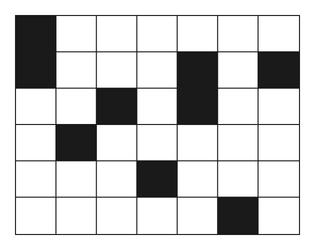
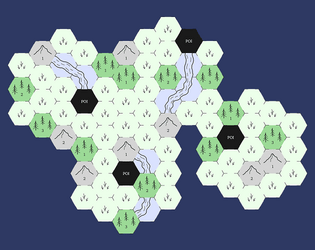
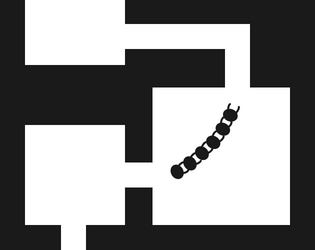
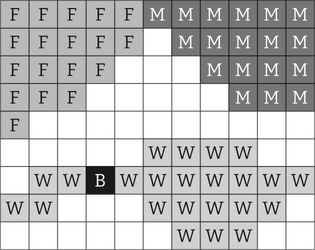
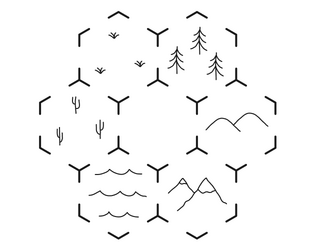
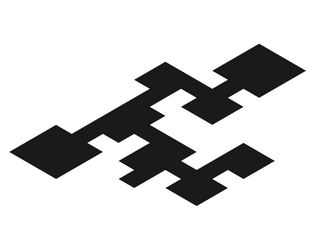
Can you tell me more about the hex map in the first photo on this page?
Anthony Hobday
Creator of
Recent community posts
Thanks for the question. The number next to "d20" in the enemy details section matches the number you'll find for that enemy in the "Enemies (in d20 order)" table. It's only there if you e.g. roll on the enemies table, get a 7, and want to make sure the enemy you find in the enemy details section is the same once (since it'll say "7" in its d20 box).
If you roll on the enemy table and then look up the enemy by name, you can ignore the d20 number.
Does that make sense? Let me know what you think of the game.
I've just published my first paid game, after 30+ free games. Thought I'd take a swing at something a bit more polished.
It's a dungeon crawler where your party of three heroes make their way around a labyrinth, and aim to defeat the final boss to win the game.
The combat is based around rolling a pool of dice and assigning each number to a hero depending on what action you want them to take. A nice mix of random and strategic.
https://ahobday.itch.io/labyrinth-of-a-mad-god
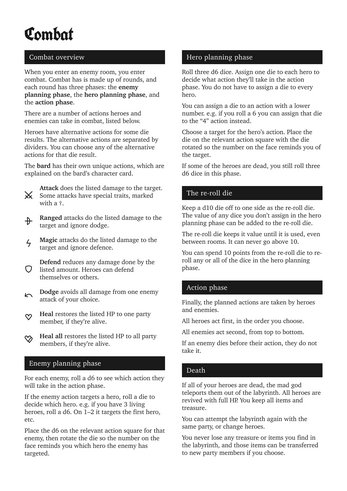
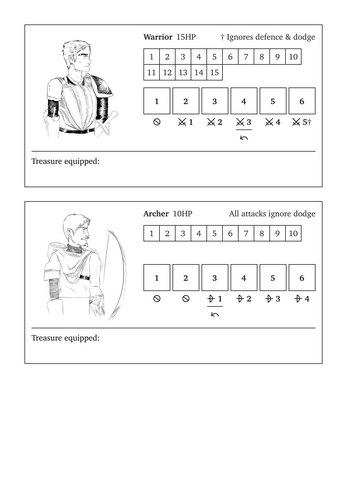
Each successful hit applies your current damage amount. By default that's 1, but e.g. the "Strength" offensive effect applies +1 damage per hit. So each hit would do 2 damage.
An attack which does 2 hits would do 4 damage if you had the "Strength" effect, in that case.
On stun/bleed: I think all of the effects are written accurately for their effects. So e.g. bleed adds damage per hit if you roll any [6] for a given attack (e.g. if I attack twice, and only get a [6] in one of those attack rolls, the bleed effect only applies for the hits from that attack, not any other attack roll I do).
But e.g. "Stun" makes the enemy skip their next attack, and that doesn't stack or anything. No matter how many successful stuns you get on your turn, they'll only skip their next attack, not the one after that etc.
Yeah, here's an attempt to explain it:
By default, on the player's turn, you get 1 attack. An attack is an attempt to hit.
If it's successful (you roll the target number), that 1 attack does 1 hit.
The "Haste" effect gives you one more attack per turn.
Now you have 2 attacks. You roll for each attack separately, so each has a chance to be successful or not. If either of the attacks is successful, it does 1 hit.
The "Flurry" effect gives you +1 hit on a successful attack.
If you had both Haste and Flurry, you'd have 2 attacks. If one of the attacks was successful you'd hit 2 times. If both were successful you'd hit 4 times.
Does that make sense?
"+5" on an item name means 5 more damage per attack, not per hit. e.g. if you only attack once but the attack does 3 hits, you'd get +5 damage total, not +15, because the bonus is per attack. (There are some effects that let you attack more than once in a turn, like haste, at which point you'd get the bonus more than once).
"-5" on an item name means you take 5 less damage from each monster attack. So you're right: if you got a -5 item on floor 1, the earliest a monster could damage you is a strong monster on floor 3 (3x3 damage).
"Attack" and "Hit" are hopefully used consistently in the rules, but combat is broken down like this:
Turn → Attack → Hit
Depending on the effects you have, you can attack more than once on your turn, and each attack can hit more than once.
Thanks for pointing out the invulnerability combination, as well. I've updated the PDF so that the "Doubles" effect now only works on non-6 doubles. I also changed the "Block" effect, which stops all damage from the minimum attack target number. But you can increase this to 6 for strong enemies, with other effects, which is another way to block all strong enemy damage.
You might have missed under "Uses for vigour" that you can spend vigour to increase a combat roll by the number of vigour you spend. e.g. if you fight a Wyrm and you roll a 5, you can spend 3 vigour to increase it to an 8, which does 1 damage to a Wyrm at full health. After that the number you need to roll goes down as the Wyrm's health lowers.
Does that make sense?
I'll update the rules to make it clear that you can increase the combat roll past 6.
If I understand your post and JavaScript correctly, the "+1 damage" is only supposed to last for the next fight, and only affects the player. The equivalent of e.g. a strength potion.
It would be interesting to try to introduce some choice into a solo 36-word dungeon crawler. So that it couldn't play itself.
Despite how all of my games look, I’m a designer in my day-job.
I think what I had in mind was that I’d work with you to produce a more polished layout, and probably change some text slightly to make things clearer where there’s any potential for confusion.
Mainly I’m interested because you’ve hit on a good mix of simplicity and variety here, and I think you could charge a little money for it if the first impression grabbed people.
Having said, I don’t charge money for any of my games, and if we did work together on it I have no idea how the money would work, so I haven’t thought about this practically 😂
Playtest comments:
- The character creation says "Roll 3d6 3 for…". I assume the "3" is not supposed to be there, and I only roll 3d6?
- I love the generated names, and the fact that the names are tied to rewards. This is the sort of casual world-building that doesn't come naturally to me.
- The horizontally stacked d6 tables are clever. They save space and are fun to look things up on.
- In the level up section it says "level up costx", which I assume is a typo.
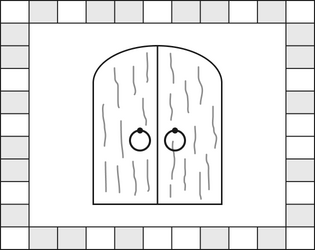
- I noticed there are some assumptions needed. e.g. "kick down door" is an action, but I could not figure out what that related to until I saw the doors on the third room type. I assume the only way I can enter that room is to kick down the door.
- Once I recruited a goblin, combat became much safer, though I never fought a boss because I didn't play for long.
- Exploding dice feel great.
There's lots of variety here for so few words. I think there's a few places where the rules could be made slightly clearer, but I don't mind that it assumes the reader isn't stupid.
If you ever want to collaborate on a slightly fancier/shinier/more polished version of this (still one page, still few words, still lots of variety), let me know. Could sell it for $1.
The starting max health is 15, so a "rest" action would be wasted since it wouldn't have anything to restore (e.g. you wouldn't go up to 20 HP).
But you can always return to that nothing hex to rest in it later, to use the one-time rest.
Really glad to hear you like it. Let me know if there's anything you think I could improve.
macOS didn't flag it as an untrusted app, so I couldn't allow in that way. I used this command in the terminal to remove the "damaged" flag from the app:
"xattr -cr /path/to/application.app"
After that, I was able to open the game, but as soon as I click "Start" the app crashes.
I assume this means the game doesn't work on macOS (at least not the most recent version).
Thanks for these questions. You're right that the rules aren't clear, so I've updated the PDF to 1.2.
To answer your questions:
- The omega-drive adds one extra move and attack, for two of each, total.
- It's assumed that the mech docks between sectors, but you don't need to do it manually. Because of this you choose a launch zone at the start of each sector.
- Once you've defeated the last enemy in the sector, you can move on to the next immediately: no new enemy, and no event.