Link to your Game Design Doc on Google Drive.
https://docs.google.com/document/d/1upGJN1CTdJKV0ThFdq13nWnTJXhAv8mMxMWA9jiK52U/edit?usp=sharing
Have you checked that your GDD is publicly accessible ?
Yes
Is your game set to public on itch.io so we can see it?
Yes
Summarize your game!
SWORD & SHIELDS: GAME DESIGN DOCUMENT
CHAPTER 1: INTRODUCTION
1.1 Game Summary Pitch
Sword & Shields is an Idle RPG with Turn-Based Strategy elements focused on inventory management and persistent growth. Players step into the role of a lone hero who must navigate a dangerous, node-based world to defeat four powerful bosses. Unlike traditional RPGs, defeat is not an end but a strategic reset, allowing players to retain their hard-earned gear and unlocked potential for their next attempt.
1.2 The Core Vision
The game focuses on "Growth through Persistence." The primary experience is the satisfaction of seeing a tiny knight evolve from a basic combatant into a legendary warrior through clever gold management and tactical loot choices.
1.3 The Story: The Legend of the Last Aegis
The world was not always a series of cold, mechanical paths. Legend speaks of the Ethereal Forge, a place where the balance of the world was hammered into shape. But that balance was shattered when the Alabaster Titan descended from the void. With a single gaze, he turned the lush kingdoms into a calculated grid of danger, replacing life with "Mechs"—soulless sentinels designed to maintain order through force.
You are a squire of the fallen order, the last one capable of wielding the Living Steel. While others fled, you stepped forward with only a rusted blade and a wooden shield. You are not a god, and you are not immortal. You will fall. You will be broken.
But the Titan made one mistake: he underestimated the power of persistence.
Every time you are defeated, the Ethereal Forge pulls your soul back to the start of the path. You do not return empty-handed. You bring back the gold of your enemies to reinforce your gear and the knowledge of the paths you walked.
High above, the Titan’s massive head floats in the neon sky, watching you with indifferent curiosity. He thinks your journey is a loop of futility. Prove him wrong. Collect the relics of the fallen, unlock your true potential, and climb the paths until you are no longer a tiny hero, but the giant-slayer the world has forgotten.
Your shield is your resolve. Your sword is your path. The journey begins now.
1.4 Target Audience & Platform
Platform: Desktop and Browser.
Audience: Casual players who enjoy "Idle" progress and veteran RPG fans who appreciate inventory tetris and strategic preparation.
CHAPTER 2: GAMEPLAY & MECHANICS
2.1 The Strategic Path (Node System)
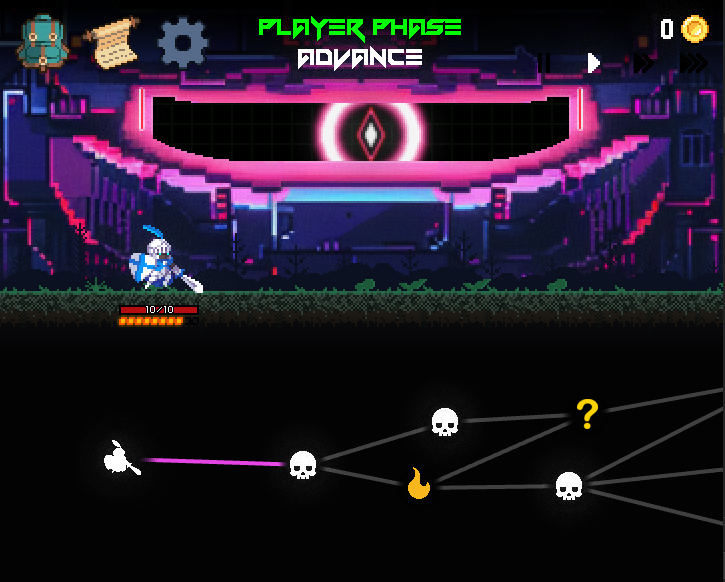
The world is explored via a horizontal map of interconnected nodes. The player decides the level of risk and reward by choosing their route.
Combat Nodes (Skull): Face mechanical and mystical enemies that drop gold on death.
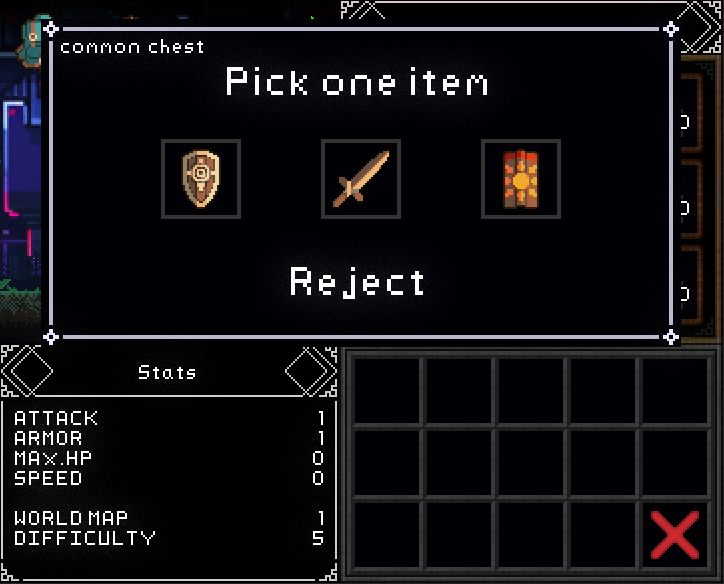
Treasure Nodes (Chest): Obtain new Weapons and Shields of varying rarities (Common to Mythic).
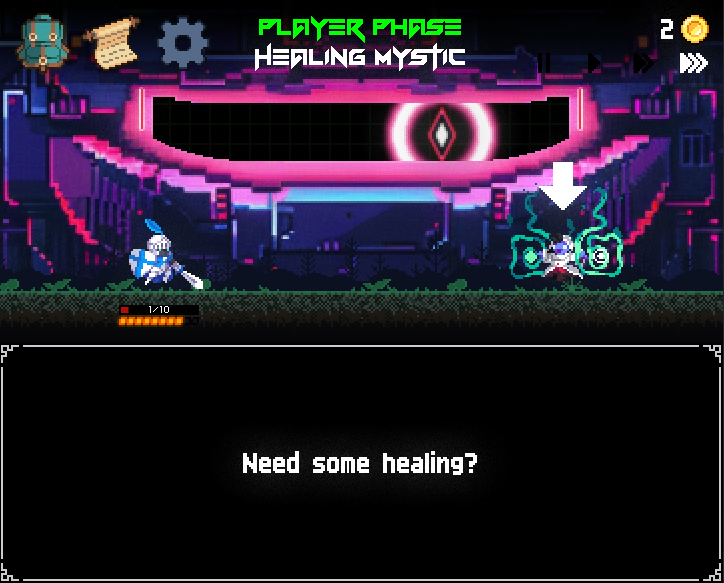
Recovery Nodes (Campfire): Essential stops to restore health.
Mystery Nodes (?): Hidden encounters that could result in great riches or a sudden, difficult ambush.
2.2 Turn-Based Combat
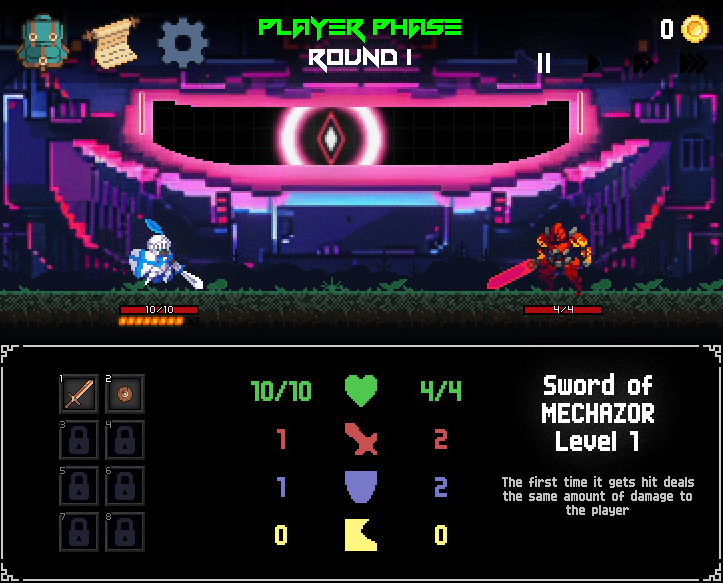
Combat is automated and determined by Speed (SPD).
Turn Order: The unit with the higher SPD stat strikes first.
Speed Management: Players can adjust the flow of time (x1, x2, x3) or pause the action to analyze the combat.
Special Abilities: Certain enemies, like the Chassis of Mechazor, possess unique traits such as "First Turn: Steals 1 Attack from the player."
2.3 Incremental Progression
Death is a mechanic, not a punishment.
Persistent Unlocks: When defeated, the map resets, but you keep all items, gold and any equipment slots you have purchased.
Gold Economy: Gold earned from enemies is used to unlock 6 additional equipment slots, expanding the hero's power exponentially.
Equipment upgrade (W.I.P.): All items can be upgraded or reloaded using GOLD as payment.
CHAPTER 3: INVENTORY & EQUIPMENT
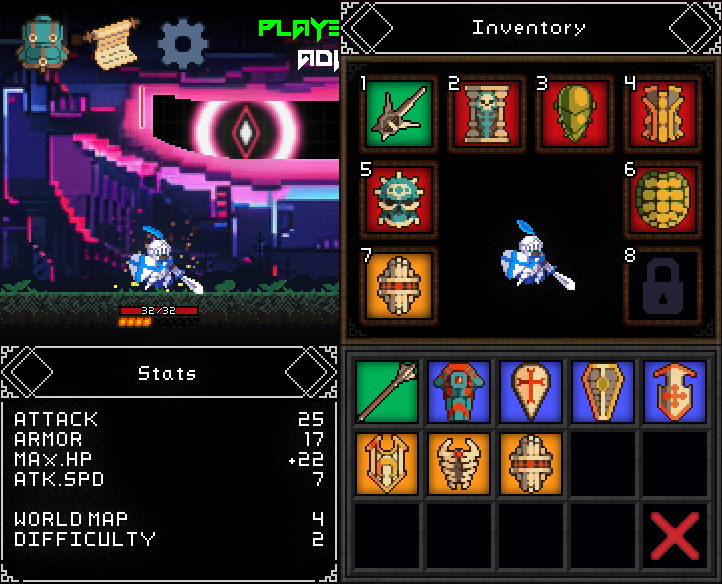
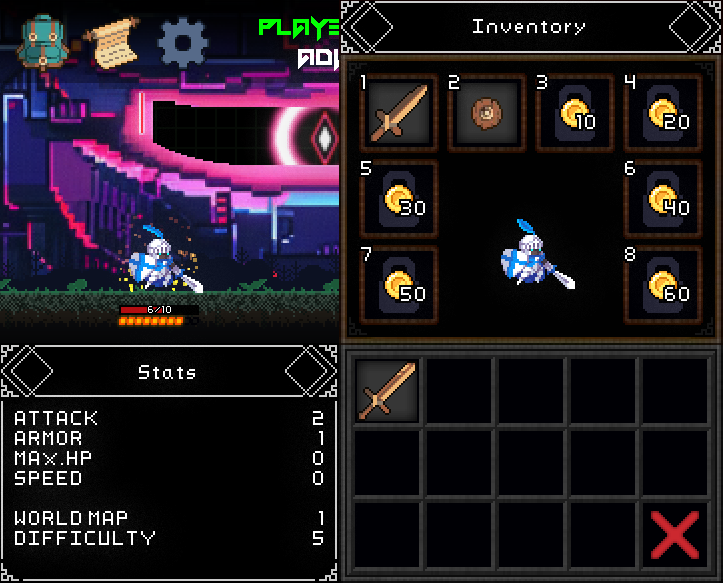
3.1 Equipment Slots
The hero begins with a restricted inventory of 2 slots (Primary Sword and Primary Shield).
Expansion: Players can spend gold to unlock up to 8 total slots.
Management: Players can swap items between "Equipped" and "Backpack" or delete unwanted items to clear space for higher-rarity loot.
3.2 Scaling and Rarities
Equipment power scales with the Map number.
Map 1: Focuses on Common and Uncommon gear.
Maps 2-4: Introduces Rare, Epic, Legendary, and Mythic items with significantly higher base stats.
CHAPTER 4: WORLD & CHALLENGE
4.1 Enemy Scaling
The world is alive and growing.
Path Scaling: Enemies level up slightly with every node you progress on a single map.
Map Scaling: Moving from Map 1 to Map 2 (and beyond) triggers a significant jump in enemy levels and complexity.
4.2 The Four Great Bosses
The game is structured around four milestone encounters:
The Minotaur: The brute-force gatekeeper of the first realm.
The Iconclad: A high-armor sentinel requiring high-pierce strategies.
The Worldcore Golem: A massive tank with high HP and devastating area attacks.
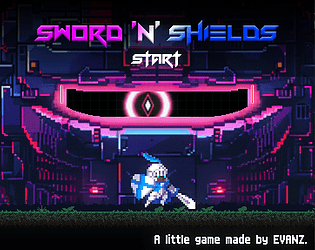
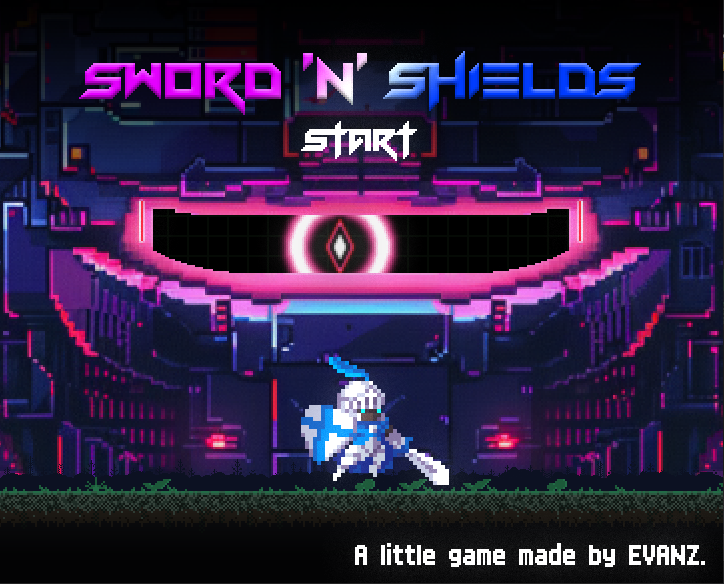
The Alabaster Titan: The final challenge, whose giant head watches the player from the background throughout the entire game… waiting…
CHAPTER 5: VISUALS & ATMOSPHERE
5.1 Art Style
The game utilizes a high-contrast Pixel Art aesthetic.
Environment: Neon-lit, futuristic, and dark fantasy backdrops that emphasize the "Gaze" of the final boss looming in the distance.
5.2 User Interface (UI)
The UI is designed to be informative at a glance, showing:
HP and Max HP (Green Heart).
Attack Power (Red Sword).
Armor/Defense (Blue Shield).
Speed/Agility (Yellow Boot).
CHAPTER 6: DEVELOPMENT ROADMAP
6.1 Phase 1: MVP (Minimum Viable Product)
Core combat loop and basic enemy AI.
Map generation for the first 11-depth path nodes.
Basic inventory (Sword/Shield swap).
6.2 Phase 2: Content Expansion
Implementation of all 4 Bosses.
Rarity system and loot tables for Maps 2, 3, and 4.
Mystery Node logic and campfire healing.
6.3 Phase 3: Polish & Balancing
Enemy level scaling adjustments.
Enemy passives setup. (WIP)
Visual effects (VFX) for attacks and critical hits.
Final Boss background integration.
Please explain how your game fits the theme.
The Alabaster Titan: The final challenge, whose giant head watches the player from the background throughout the entire game… waiting…
Did you use Generative AI to make any assets in your game?
No
Is there anything you'd like the judges to pay particular attention to?
Open source assets were used for the player and enemies.


Leave a comment
Log in with itch.io to leave a comment.