A browser game made in HTML5.
The story took a turn I never saw coming. At first I didn't think much of it, then halfway through I was grumbling, and near the end it had me crying, which is embarrassing.
I've been looking for female-centered games lately, and I almost scrolled past this one when I saw the setup of an MC who can't decide her own fate. But somehow I had a feeling the story might not be what I assumed. Or maybe I was just curious: who is really the one saving the princess here?
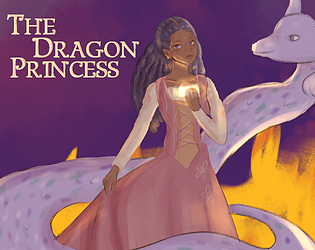
I played it on my phone, on and off. It's really slow-burn. The early plot felt like the tired old "dragon abducts princess" cliché, but the moment Happho spoke, I was stunned. I didn't expect it to be SHE. Clearly I was the one carrying stereotypes. That's exactly why I kept playing: I wanted to see how far two women would go together.
The voice acting really impressed me too. A fully voiced game is rare, yet here almost everyone is voiced, and it's empathetic. Azaiah's voice paired with his expression genuinely made me want to punch him frame by frame.
As I played, I was noting(roasting). That father-and-son-in-law pair was hypocritical and disgusting. So a daughter really does count for less than a son-in-law: this so-called father cares more about his son-in-law's safety than his own daughter's life. Wow, what a father. A man as a father is no father at all.
And almost everyone around Amaia is male, which felt suffocating. She could have had a female teacher; her mother could have been a queen, just as her friend is Happho and her student is a six-year-old girl.
But later I understood this game is grounded in realism. It's real, so it doesn't romanticize love. It takes Amaia's ideals seriously, voices her emotional needs, shows her inner conflict, and portrays that man's cruelty and selfishness honestly. It also understands that what Amaia needs most is not a man's love. That's why, when Caleb confesses, she doesn't feel hollowly comforted, she feels fear, fear that this man might become a second Azaiah. That means the very concept of romance ends up tainted by bad men, to some extent, but anyway, gender inequality is real. The "true love" that romance novels sell is not a cure-all. I've always known that, and yet here I fell for it again, which helps me understand more.
It also doesn't suddenly hand Amaia some divine power. So Happho dies, and Caleb doesn't kill that man either——Still angry: you had it in you to slay a dragon, but no courage to kill the king? Is a king really scarier than a dragon? Amaia's inability to fight that man wore me out too. I believe women have muscle. Neolithic women had arm bones stronger than today's elite female rowers. But I also know that struggles like Amaia's are far from rare.
So what amazed me most was Amaia pulling the golden nugget out of Happho's mouth, swallowing it and turning into a dragon. I thought to myself: heavens! Isn't this the inheritance passed down from one generation of women to the next? This is the witch. This is the dragon.
I suppose the old woman who fell from the sky might be Happho's true form. She looked so gentle. But why did she have to go? I'm sobbing. A thousand cuts wouldn't be enough for that man.
The ending, where Amaia listens to the wishes of so many, many women, I couldn't hold it in. I'm bawling my eyes out. So where are all the women scientists? They exist, yet invisible. That's it. And the "a room of one's own," straight from Virginia Woolf, at the end made me sob outright.
The foreshadowing pays off beautifully too: the first person Amaia sets out to help is the daughter of the teacher who once helped her! Amaia becomes a messenger who helps women realize themselves, a mission that feels a bit different from Happho's, an evolution of it, and all the more uplifting.