idk maybe he’s working on a new video or something
or he could be working on a BIG update
wild
i have no words
i bet someone is gonna make bad apple with this
i think customizable ROM sizes would be very useful for CPUs / GPUs
bump^2
using LEDs for displays is genius! you can also display letters with this design
activate the clock
9 bytes: 24 RGB displays
address: 1 byte -> 256 possible addresses
9*256=2304=2.304KB
1GB = 1,000,000KB
1,000,000 / 2.304=434027.777...
meaning you need 434028 2.304KB-memory cells
(you need 10,416,672 RGB displays for 1GB)
When setting the clock speed really high (1 step per clock tick) it becomes unstable.
64-Bit counter: (please excuse my very sloppy wiring)
bump
Another Suggestion: A program like the one in the seven-segment display video, where you input a truth table and it generates a logic circuit
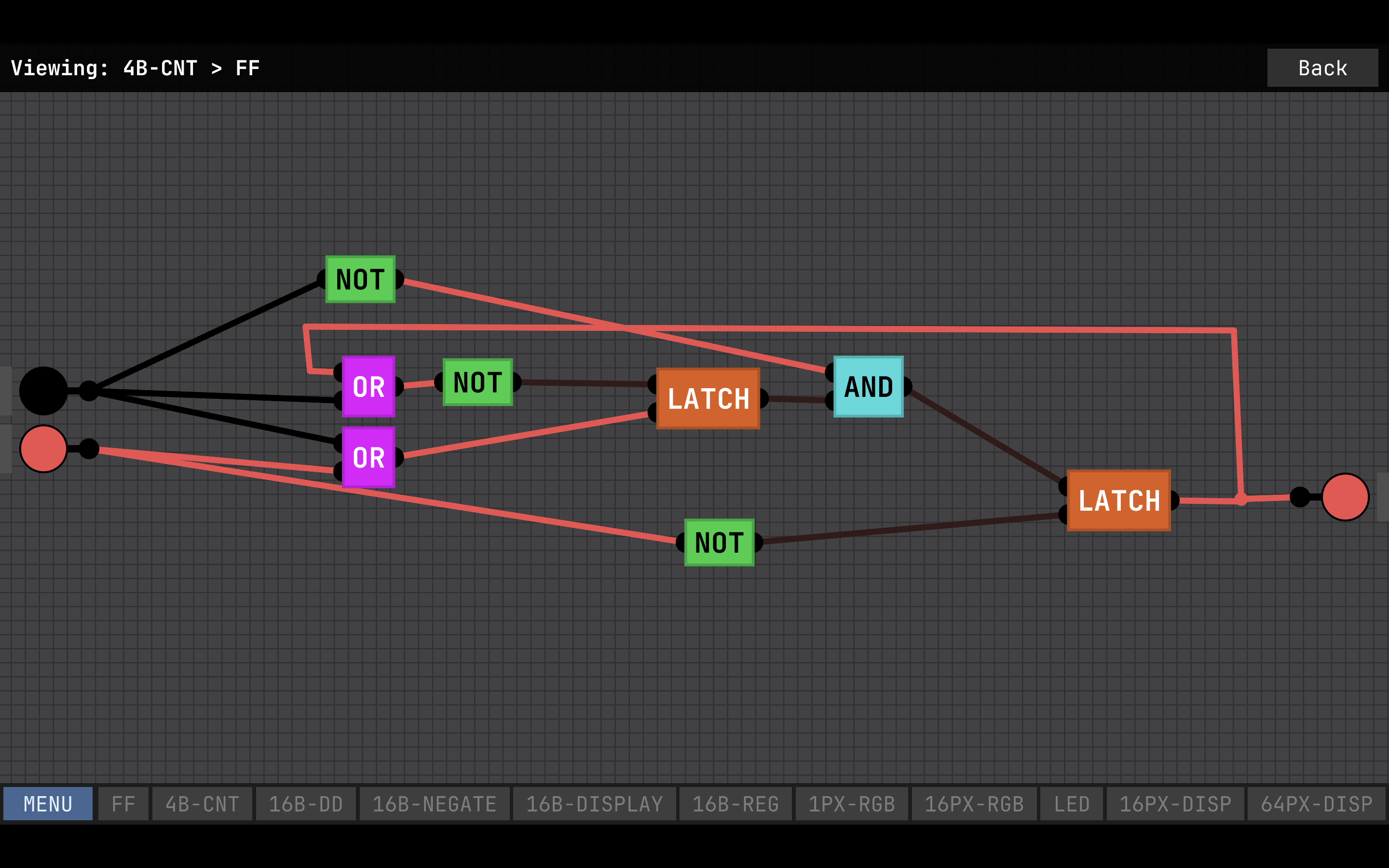
Here is a design using Flip-Flops:Flip-Flop (FF):
Suggestion: 16-Bit input pins for more efficient data transfer
What do the inputs for the monitor do?
The "Address" input selects a pixel on the display.
The "Pixel in" input is required to write the pixel. idk what it does
The "Reset" input resets the display.
The "Write" input writes the pixel on the display.
The "Refresh" input refreshes the display.
The "Clock" input is used for the clock.
I hope this helps. :)
When you have a display in the chip, click "customize" when saving. There you can drag the display onto the chip and scale it.
fullscreen causes crash on mac :(


 Flip-Flop (FF):