

Congratulations! I do not consider the other two games as real contenders in this jam.
I have some questions in regards to rules of the game.
1) Mogoth treads - they enable movement "forward". Does it mean that Mogoth tank does not move in any direction but only towards the exit, in a straight line? Other units do not have a mention about movement "forward", hence my uncertainty... Also, is Mogoth movement limited by Obstacles? (I assume that it is).
2) Skimmer special ability is about ignoring Water - but on the map there does not seem to be any Water? Is it about Obstacles? Can Skimmers ignore Obstacles?
3) Flipping Vaiar units. I assumed that Vaiar unit that is Hit once by Mogoth Gun cannot do anything (and is eliminated if it is Hit successfully twice by Gun) - no attack ratings on reverse and taking up an Action is meant to flip the unit. Do I understand it right though that even "damaged" Vaiar units are flipped back to their "fresh" side by the end of the Turn? ("Flip all units... to their fresh side")
If so, Mogoth player needs to hit with Gun twice to permanently eliminate their target - as one Hit "pins" them for their Actions but leaves them on the map.
Thank You for the game!
RTokarczuk
Creator of
Recent community posts
As with Exodus, I had the opportunity to read the rules, not to play the game... but I have questions.
1a) How does one marks up terrain on the postcard? Should I write/ use a marker on the card? Setup steps completely omit that element, even though Mission descriptions provide exact locations of terrain features.
Also, I cannot tell the difference between Mech Unit and Wall on Mission 1 diagrams - those lines on the borders of spaces are much thicker in Mission 1 than on other diagrams
1b) How does one divide damage between commandos? One point of damage - it is given to whom out of two or three soldiers? Two points of damage - can they be allocated to a single commando if there are more in the group?
2) Missions require to use Commandos Special Abilities. But who can fulfill Mission 1 and 2 requirements? No one has an ability that specifically mention destroying depots and radio relay - instead we have special abilities that provide -1 to close combat, climbing walls etc. Probably any commando will do in Mission 1 and 2 but this "use commando special ability" in mission goals confuses me.
3) Mission 3 goals, as they are explicitly connected to Sapper CSA - if Sapper is gone (depending on damage allocation in combat), the mission cannot be fulfilled, right?
4) How do we mark German soldier 'dead' in a particular space (for the purpose of German move).
Thanks in advance!
I have not played the game yet, because of holidays and family. I have read the rules and I have few questions and remarks.
Remarks:
Description of the phases mention "cards" (plague/ obstacle card) but there are (in the setup) "counters" and "tokens".
Questions:
1) Retreating because of Confrontation Challenge - when Moses wins, the Pharaoh retreats one space but in which direction? If Pharaoh wins and Moses can spend 1 Miracle, Moses "escapes"... but what does it mean? Does he retreat anywhere or does he remain in the same space, only the game does not end?
I imagine that at the beginning of the game, Pharaoh is ahead of Moses but later, Moses "bypasses"/ leaves Pharaoh behind... Nevertheless, this Pharaoh Retreat may imply that Pharaoh will be kept ahead of Moses' token, depending how one understands "retreat".
2) Hail Plague Card: What does it mean that Pharaoh "loses 1 movement point"? The rules on Pharaoh movement mention only moving by one 1 space. Does it mean that Pharaoh does not move at all for two turns?
3) Verbiage in Plague cards. "Gnats" have "Pharaoh may not use an obstacle card" - does it mean that Pharaoh does not draw a card or that its effects are ignored, the card is still drawn? What is the difference between "Frogs" and "Death of Livestock"? One asks for removal of one obstacle card (from where?), the second asks to discard 2 obstacle cards from Pharaoh's deck. Maybe they mean the same effect of removal of a card/ cards from the deck... only they use different phrases.
4) Is there a limit on how many Plague cards Moses can have at any single time?
Thanks in advance!
I hope that Your travels went fine.
Soloing Your game is challenging :) as I cannot quite forget which Green Ship is the proxy one. Most of other aspects that I have brought up can be resolved with a scrap of paper and secret notes (which is why soloing of the game is challenging).
I have not won a single time with just two patrol ships - even with freedom of choice how many Green ships are in the game, the ability to delay their entry *and* pick starting/ending point means that slow moving ships have a difficulty to catch up with everything. I am guessing that this is the lesson - a difficulty in protecting the integrity of the cable/pipe network without using additional resources.
One thing that I appreciate about this design is how "modifiable" starting conditions are: how many pieces one has to their disposal, how many special units (if any) take part in the session: in short, replayability and even the ease of house-ruling (one idea that I'm toying with now is Green Ships reentering the map for "the return course"; but only theoretically: this would certainly increase the game time - maybe the chance of Proxy ship not doing any damage on the initial course is not worth it).
Thanks again for Your design!
Few questions about the rules:
- What kind of dice is being used in the game? Six sided one? Ten sided one? I cannot find any reference to that in the rules or on the project page.
- How does rolling dice (as mentioned in tips) help cover the identity of the Green covert attack ship? Attack Cable action can be performed if the attack ship is in the cable hex... but the action does not provide explanation that die rolls are made for each and every Green ship that may be at that moment in the cable hex - and this is the crux of my question. Does Red player simply knows which one roll is made "for real" and which are fake?
- How many spaces Green ships move?
- Is there any limit to the number of actions that may be performed: for example, Blue player can Inspect only one ship per turn, even if more vessels are in the eligible positions?
- Because of my family situation, I have become solitaire player. Therefore, noting things secretly on paper is tough for me.
a) How does one mark up the delay of the Green ships' initial movement - how does one remember that it is 'up to 5 turns ago'? Turn track could help here.
b) Marking up destinations - if the design would allow for double-sided counters, Green ships could have their destinations (or attack ship identity) on the reverse side. This means that 9 Green ships would have to have 6 potential destinations assigned - maybe 7 ports and 2... or another combination.
Right now, the possibilities for destinations are endless and depend on Red player declaration during the setup. I just know myself enough that I would need to write those declared destinations down - especially if 10 Green ships are sailing at the same time on the board. Having their destinations on the reverse side would help me as a Red player (and I would remember also the identity of the attack ship :) ).
Even the status of the anchor - dropped or not - could be represented by a counter kept "face down" by the Red player (this would require two separate counters, with 'dropped' and 'not dropped' state).
Thank You for the game, I am preparing myself to play it (single handedly, though). I like the map and how it sets up the game for a puzzle for both sides...
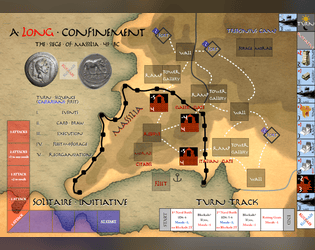
To place a counter on the map, on the construction side, a player needs to spend a card with a value higher than what is on the "built" side. To finish the construction (flip the counter), either the counter needs to survive to the reorganization phase or the player plays a second card with the value higher than structural value on a construction side. It is more expensive to start the construction than to finish it. The phrasing is confusing, I think I will try to color code the costs or use symbols on the counter (3A - 1B, for example, to give the notion that first one needs to pay 4+ and then 2+).
Good catch - yes, one builds in an occupied space. I will add this in the next edition of the rules.
Massilian damaged walls counters: I have decided to include only one, because the second damaged wall concludes the game with a Caesarian win. Can it be added to the postcard? It can, but this would require some layout changes... and I would rather concentrate for now on the clarity of rules. Once they are more solid and error-proof, I will know how much space I have for additional counters.
2 ramps and one brick ramp or 3 ramps. Historical narratives/ maps for the siege underline only two approaches/ ramp locations that have been used by Caesarians. In other words, I made a decision for the players to decide which way they want to go. Brick ramp will only enter play once at least one regular ramp has been destroyed - there won't be three approaches available to the Caesarians at any single time.
(Gallic Gate received "weaker" -4 modifier in contrast to other Walls having -5 modifier; it seems that Caesarians concentrated here, maybe because of elevation differences being potentially smaller than with two other parts of the walls).
Massilian movement in Solo - offiicially does not exist. Massilians in Solo do not follow the regular sequence of play - they only get x attacks/fights depending on Caesarians' activity. I have not tested it extensively - in my games I was not able to eliminate a single die (because of the modifiers). Slow trickle of losses, sure... so I have never ended up with a situation where Massilian move was crucial. Theoretically, advancing to the weakest target may end up in a move (into adjacent space to the target)... but this would need to be stated in the postcard more clearly.
All of this may be problematic in solo mode - but at least for now, I do not have anything better as an answer.
Same amount of pips for Massilians in Solitaire. I have not written anything about it on the postcard... but possibly even division would work the best for solitaire game: so all Massilian dice end up on 4 pips (12 pips total) and one Albicii die also have 4 pips. Question: where to place Albicii in solitaire variant? They could start with Fleet, they could start in Reserve (where during my solo tests I liked to place them).
Could be randomized... or maybe I will think of some ways of writing those additional details onto the postcard. Space is a tricky thing... I even started considering the two-player version of the postcard and a single player of the postcard... but, at the moment, this is the last resort (though it would give me the chance to flesh out more ambiguous elements - for example, are Massilians AI doing anything doing the reorganization?
Assigning dice pips to the Fleet space = my mistake. During setup, Massilians should divide their 12 Massilian pips and 4 Albicii pips between Wall spaces, Reserve space and Fleet Space = 5 spaces total for 5 dice that they have. So, the Fleet is "populated" during the setup and, later in the game, it can be changed during the Reorganization segments.
I will mark this as the correction that needs to be added to the setup procedure for Massilians. I won't ammend the files immediately, I will leave this for few days - there may be other things that we will find out. (I know, for example, that Massilians could have clearly stated opportunity to re-Build damaged Walls... but the rules as written currently are silent on this)
Thanks everyone for joining this curious designing adventure! (where not everything is set in stone yet :P )
In one of my games, unless I have misunderstood rules, I have generated Casualties next to Japanese unit. They got eliminated in the next move (another card draw activated that Japanese unit). I have lost because my protagonist could only move one square at a time and he was simply too far from the Casualties.
It is, indeed. Player(s) control the defending force and implement the movement/ resolve combat for the 'artificial attackers' that try to enter the central star zones.
I did not put any basic information onto the postcard about number of players and whether it is solitaire or not... for space reasons. Your comments allow me to revisit the game and see what I can improve - so thank You for Your interest in this little design. If You will have any questions, let me know - I will do my best to answer.
I have played few times solo the 0.01 version on TTS. Below few comments of mine:
a) the rules do not explain what is what on the cards. This made me look more than twice in search for the 'burst value' that is mentioned in the rules before the reader is provided with some explanation what 'burst value' is (within combat section).
b) the components available in 0.01 version do not make it easy to mark the Air Frame / hit points after the damage is being done to a plane - mostly because both players can modify the damage by adding cards. If both target and firer modifies somewhat the initial damage value, how am I supposed to denote the ultimate damage that is inflicted upon the target? Especially, if the ultimate damage value is different than initial or as stated on any one of 'modifiying cards'?
What is fun and fine about the game? Combinations of planes and pilots, decision how to use one's cards (there is actually some planning/ thinking involved :) and players can set up various situations for themselves and their opponents). Dogfights play quick and it is very easy to envision this game being played in a campaign mode.
I am well aware that this is not the final version of the game - nevertheless point 'b' is the thing that I needed :P to state.
This design looks impressive but there is so much information on both sides that I never have managed to play this game with confidence. I cannot even say if this is a two player game or a solitaire. I do not know what exactly a Treasury is. Are the chess pieces being moved or white and black dice between the spaces? Probably both.
Some additional tutorial or a video would be helpful, as there is a lot to this game and the interplay between various parts seems very interesting.
What happens when active player rolls numbers on both dice that do not belong to their mice?
Other than this little thing, it's a charming game. Victory conditions require a double glance, as they enable players to strategize and plan maneuvers... and the possibility of flinging mice into space is... fun.
I will just assign mining duty to one of my rodents and the flinging duty to another :)
The rules lack information about the bases - can they move, do they have HP? Are they important for victory?
There are also no tokens to denote loss of HPs... nor it is easy to tell if General can inflate HPs of the adjacent units infinitely or only to their maximum (or even one above the maximum?).
The rules are easy enough for me to make up for the lacking detail... but those details should be provided, hence my lowered score in the 'playability' section.
One thing that kept confusing me in my solo games was the meaning of "a round" and "a turn". In the rules, those two are introduced in a section 'round structure' and it starts with:
"On their turn, the player chooses a card..."
I had to reread this few times and keep reading about the subsequent usages of 'a round' (a card can be used only once per a turn and per a round, nukes are claimed at the end of a round, not a turn).
Part of it is my own grasp of language: I always thought that 'a turn' is a longer unit than 'a round' - that players take rounds in a single turn of the game.
The designers managed to create a game where a lot of depends on decisions of players - which unit to send, when and which way. I'd like assymetrical sides with different ratings/ special abilities but this design works. It is simple - it certainly serves as a teaser for the "bigger game" that is in the works :)
Re: blocking and some of my thoughts
And Your idea is the same as I read it initially... but then I thought of a possibility of 'freezing'/locking up enemy units with the best defensive unit (or units) - not to eliminate them... but to keep them fixed in place. Time limit of 4 rounds may mean that if the units get stuck on the hill-side or valley-side, they may not be available to the player where it counts.
Also, You have arranged the defensive values in such a way that every unit is able to defeat every unit, so this tactic may simply not work with certain.
It is, however, interesting/ puzzling (in a positive sense) that the attacker can only achieve 'no effect' or 'enemy eliminated' result... there is no way to hurt yourself with a bad die roll :)
Side note:
Is there a significance to the fact that unit symbols on the KIA side are reverted? Take a look at red infantry counter with a city skill - it looks like the symbol ended up rotated 180 grades :)
Thursday/ Friday I hope to have more questions. I like the lore and that this is the original setting.
Do players alternate playing their cards or do they play all of them, one after another... and then the game switches to the other side?
There are no 'stacking limits', right? In one space there may be more than one unit of each side?
Also, just to clarify - does 'blocking' mean that units cannot move away from the area occupied by enemy ('stuck')?
I was wondering whether that 120 minutes included reading the rules and watching the YT video... but then again, it can be different when the players learn the game by themselves, when the designer is not "behind Your shoulder" etc. It may be also a sign that my rules are not clear or that they convey the wrong message.
In Your game, did You exhaust the draw pile (and all the reshuffles, as well)? I don't think that I have stated this in the rules explicitly... but my intention was that at some point, the players will run out of the cards to play... and after the last reshuffle (adding the "last face cards") - the cards that are played/ discarded are out.
I may need to add to the rules a remark that if all cards are 'used up''/ if the last card is used up, the game is over, probably in a sort of a tie.
https://steamcommunity.com/sharedfiles/filedetails/?id=2973525699
This is really a quick and dirty module - I have not looked for Your module earlier (I did not notice it on itch page for the design). Mine is very similar to Yours... only uglier :) ... and I added a marker for "Attack/ Evade" (with a reminder which one involves 'adding' and which one is about 'subtracting').
No scripting. Preparing the TTS module for solo game would require really creating rules for a "bot" side - or sides - and I am not ready for that. I simply wanted to have Your game in a digital format and be able to move pieces and play it... playing both sides to the best of my ability.
Thanks for the feedback!
I can use it to improve the rules/ phrasing, to clarify the uncertainties and correct the faulty phrasings. The new version of the postcard should be uploaded before the end of this week.
What exactly were the players doing that the game took 120 minutes? In my "internal testing" (showing the game to myself and also three other people that are not me :) ), this has never occurred. I am guessing that players made an attack - maybe with a shield bash, maybe not, and then moved 'backwards' to rest and reduce the fatigue. In short, I think that in your game players were making different decisions than it did happen in the games that I've seen. (This is not a complaint, just a public realization that this design never received more intensive, "external" testing).
My meager tests always ended with one side receiving the second hit before drawing the very last card of a deck. Sometimes the game was even over before the first "reshuffle". My idea was that if the one player plays aggressively, they may end up overwhelming the other... or be rebuffed and effectively countered (and KO'd). From Your description, if the principle behind the player's decisions were to be sure (99% and more) of success, then yes - the game lasts longer.
Thank You for Your interest and time dedicated to the game!
Thank You for the answers!
I can only return the compliments with a question and a short discussion. I have been crafting a TTS module for Your game (I wanted to give my printer some respite). Would You be interested in the module? Nothing fancy there but it allows me to play two sides by myself.
You are certainly right about 'soloing' this game. The counters, cards in the hand of Narco player - this makes it very difficult to craft a solo mode for Your game... while retaining postcard-size space for the rules. For now, I am simply playing two sides by myself.
At a glance, however, it does look like Policia side is somewhat easier to "automate", as their actions depend on Budget/ Public Support values and victory conditions (breaking the routes, with some additional capabilities for Plane landing) - all of which is 'public knowledge' and therefore can be used in crafting 'algorithms' or decision trees.
I am trying to learn the game and I do not fully understand the rules. I will be grateful for any help :)
1) Build Pista/ Land action: Can there be only one card face down at any time? Or is it possible to perform multiple 'Build Pista' actions, to place there all the possible suits (and later go for 'Land')?
2) Deploy Policia action: Where exactly an undeployed Policia can be placed? Cities? Villages? It looks like a symbol is missing.
3) What happens to discarded cards in a single playthrough? Are they "used up" and do not return? Maybe, given that FAST victory relies on Narcos not being able to draw any... but - Operation procedure, step 2, mentions shuffling cards into a face down stack. Which cards exactly? All cards, including discards, that have not been taken as Intel yet? Shuffle (once again, after the setup) the 'draw deck' only?
4) FAST drawing intel and Narco cards. Does 'draw 1 intel' means to take a card from 'draw deck'? Does 'draw Narco cards equal to...' means to take a card from Narco hand?
5) Operation resolution. FAST rolls a FAST die. Step 4 mentions that 'dice' (multiple) are added or subtracted. Does it mean that value of Policia die is added or subtracted to/from the value of a FAST die?
6) Interdict action: Discarding 2 intel cards "teleports" a deployed Policia no matter the distance, right?
Thanks in advance! The game is interesting and looks great - it is not easy to 'solo' it :) probably because it is a good two player game. The concise rules are not quite clear in few places - I am not sure how exactly the deck operates. Nevertheless, You both achieved a marvel: being able to use effectively the postcard' size of space to provide map, counters and instructions for a set of procedures.
You have used white background and red (or black) font. Would it be possible to increase the size of the font, by 1 or 0.5? Alternatively, a different font that has different typeset (uppercase/"capitals"). Similarly with the spades/clubs symbols.
They read fine on a screen but on postcard sized paper, particularly with artificial light (late in the evening), I had some problems 'reading quickly'. Red helped, yet black font was the main troublemaker :)