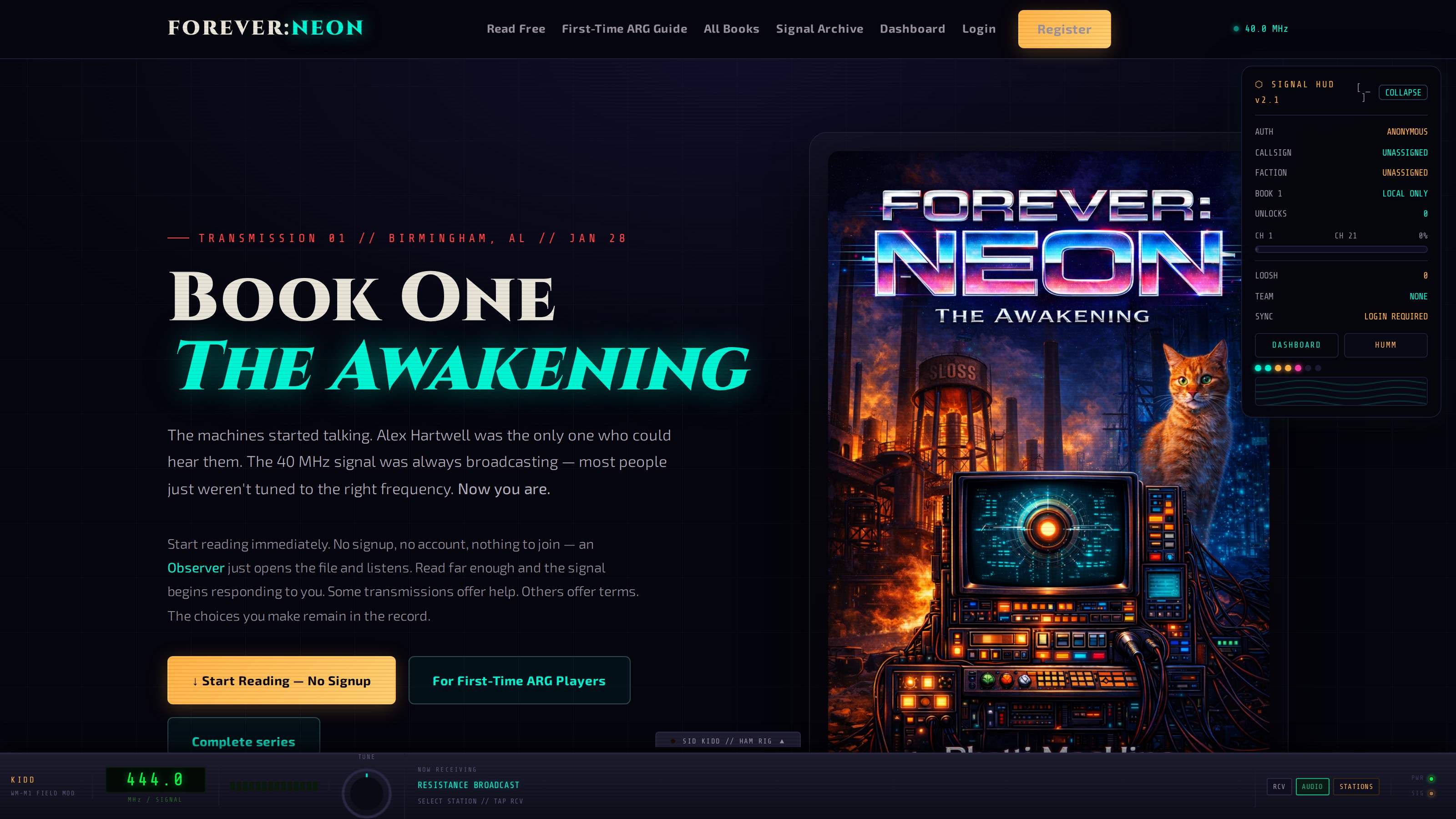

https://phatti-machine.itch.io/foreverneon-operation-alpha
If you’ve been following FOREVER:NEON, testing pieces of SubstrateNet, or waiting to see where this increasingly unreasonable project goes next, here’s the current state of things.
The short version is that development is very active, but production updates will be deliberately limited until September 1.
That is not because work has stopped.
Quite the opposite.
Over the past several days we have completed one of the largest concentrated development pushes the project has had so far. Book 1’s browser ARG, Living Archive, missions, campaign systems, mobile interfaces, faction presentation, identity/progression systems, media infrastructure, and production cleanup have all moved substantially forward.
The reason you may not see constant live updates between now and September is much less dramatic:
I have insisted on building this project almost entirely on free-tier services until the project begins generating enough funding or sales to support its own production expenses.
That means GitHub Actions, hosting services, storage, testing infrastructure, AI development tools, commerce services, and the other little invisible machines that make modern software possible are being treated as part of an economy-line production model.
FOREVER:NEON is not being financed by a publisher, studio, venture-capital firm, or someone’s uncle with suspiciously good seats at Falcons games.
At this stage, the rule is simple:
The production should eventually pay for the production.
Until that happens, I am deliberately avoiding turning development into a monthly pile of subscriptions and usage charges.
Book 1 itself remains free to read, and its ARG systems are being built around that same philosophy of low-friction access. No registration is required simply to read the book, while accounts remain optional for the broader Dashboard and ARG functionality.
Why September 1 Matters
Our current GitHub Actions allowance will not replenish until approximately September 1.
Automated browser testing and CI are extremely useful, but during a development sprint they can also consume paid capacity remarkably quickly. Install a browser, run a hundred tests, upload some artifacts, repeat. Civilization truly peaked when we invented computers that charge us money to verify that other computers are behaving.
So until September 1, our policy is:
Routine automated production runs are paused.
If something is discovered that is genuinely preventing beta testing from continuing, I will spend the money and fix it.
A broken mission, corrupted progression, inaccessible reader, authentication failure, or another real production blocker is worth addressing immediately.
Cosmetic issues, planned upgrades, deeper cleanup, visual improvements, and non-critical enhancements will instead be prepared in draft branches and consolidated for the next major integration cycle.
That allows us to keep working without wasting limited infrastructure money on dozens of incremental validation runs.
What Has Been Happening Behind the Curtain
A tremendous amount of Book 1 infrastructure has been rebuilt or upgraded recently.
The focus has increasingly shifted away from making the ARG look like a collection of ordinary web pages and toward making it feel like a physical recovered world.
The guiding rule is now:
80% believable recovered equipment or documentation.
20% impossible behavior.
If a mission interface supposedly represents a strange machine from 1988, it should look like a machine somebody could have dragged onto a workbench in 1988.
If something is supposed to be a recovered personnel file, cassette, memo, surveillance photograph, technical manual, or newspaper clipping, it should look like a physical object that existed inside the story.
Not a modern website wearing a beige paper texture and hoping nobody notices.
That principle is now being applied across the production.
Recent work includes rebuilt or heavily revised mission interfaces, the Identity Ledger, faction-aware Archive presentation, mobile corrections, VICKY repairs, SIGILTRY hardware controls, Three-Seventeen presentation work, HAM receiver improvements, Living Archive media auditing, and a new Book 1 campaign dispatch architecture.
Book 1: The Current Foundation
Book 1 is increasingly becoming the foundation for the systems the rest of the series will inherit.
The current browser production includes a combination of:
- the novel reader
- Dashboard
- mission systems
- Living Archive
- Signal Archive
- Incoming Signals
- faction activity
- recovered documents
- personnel records
- OcculTek material
- Bestiary material
- World Control records
- WXPO material
- code redemption
- persistent identity/progression
- faction-specific presentation
- mobile interfaces
- training missions
The purpose of the current beta is to discover where the experience breaks, confuses people, fails on different devices, or simply makes sense only to the person who built it.
The Living Archive Is Becoming Faction-Aware
One of the more important developments is the evolution of the Living Archive.
The four main viewpoints now have distinct presentation models.
Observer records resemble released institutional or government material.
Resistance records feel more like recovered field evidence, witness material, damaged dossiers, and operational files.
Vril records emphasize classification, capabilities, personnel utility, control, routing, and institutional interpretation.
Double Agent material increasingly functions as contested filing, where multiple sources or interpretations can be compared.
The next major content pass will push this much further.
The intended model is roughly:
80% shared underlying evidence
20% different interpretation
The event may be the same.
The faction’s understanding of what happened may not be.
One group may know something another does not. One may misinterpret evidence. Another may omit it. One may consider a person a witness while another considers the same person an asset.
Later, a small number of these discrepancies may contain information that actually matters to URP progression.
Missions Are Becoming Machines
Based on early feedback several Book 1 missions have gone through major visual and interaction redesign.
SIGILTRY is the clearest example.
What used to behave more like a collection of puzzle controls is being transformed into a believable late-1980s field instrument, complete with physical selectors, rotary controls, indicator hardware, recessed bays, specimen fixtures, and other elements that make the mission feel like recovered equipment instead of a webpage.
Three-Seventeen, the Kidd HAM receiver, Mrs. Pruitt’s Darkroom, VICKY, Ghost Carrier, Machine Lexicon, Hidden Carrier and other interfaces are going through similar treatment at different levels.
As the books move forward through time, the technology should evolve with the decades.
Book 1 belongs to late-1980s analog equipment, paper records, CRTs, radios, magnetic tape, institutional terminals, newsroom hardware, early networking, photocopies, surveillance images, and physical evidence.
The system evolves with the story.
Operation ALPHA and the Media Cleanup
One major upcoming pass is a full audit of every piece of media a tester can encounter.
Operation ALPHA / DEAD AIR is one of the obvious examples, some current recovered-document and cassette-related imagery still needs to be replaced or upgraded.
A cassette should look like a cassette someone actually handled.
A recovered document should look printed, typed, stamped, folded, copied, filed, scribbled on, stained, taped together, or otherwise physically used.
Technical evidence should look like technical evidence.
Personnel photography should look like personnel photography.
Nothing should look like an image that exists only because a browser needed something to fill a rectangle.
The media audit will cover photographs, tapes, notebooks, dossiers, maps, schematics, technical sheets, propaganda, forms, surveillance stills, newspaper material, equipment photos, broadcast material and other recovered artifacts.
The Living Archive alone contains a substantial amount of written material that still needs stronger image support. A recent audit found dozens of Book 1 records where the writing exists but dedicated image/thumbnail presentation remains incomplete.
Mobile Is No Longer an Afterthought
Another major priority has been phones.
Earlier versions of several interfaces were effectively desktop equipment squeezed onto a smaller screen and politely asked not to misbehave.
That is changing.
Recent iPhone and Android testing exposed where desktop-derived layouts were becoming crowded, awkward, or functionally compromised.
The newer approach treats the phone layout as its own operational view.
WXPO, VICKY and the Less Finished Corners
Some areas remain visibly less mature than the current gold-standard interfaces.
WXPO / Stormy’s Desk is still intended to become more convincingly like a late-1980s newsroom production station, including a stronger message and production workflow.
VICKY has already received significant repair work, particularly around mobile compatibility and interactive controls but will continue to be rewired as part of the full production audit.
Other missions still need difficulty, presentation, or media improvements.
Those are improvements, not reasons to take beta testing offline.
The September Cleanup Push
Between now and September 1, much of the work will involve preparation rather than frequent live deployment.
That includes:
full URP-facing production audits
out-of-universe text cleanup
obsolete-route identification
media inventory
faction record classification
Archive cleanup
mobile review
mission UX review
accessibility inspection
store and merch preparation
documentation
DragonCon material
code changes that can safely remain in draft for.
Around September 1, those prepared changes will go through a concentrated integration cycle.
The plan is to rebase relevant work against current production, run targeted verification first, run full browser testing after the targeted tests are clean, fix actual regressions, merge in dependency order, deploy, and then perform another desktop/iPhone/Android production audit.
DragonCon
DragonCon is an important near-term milestone.
The goal is not to have every idea for all six books finished by then. That would be insane even by this project’s standards.The novels are finished story-wise in any case.
The goal is to have the parts people can actually encounter stable, convincing and worth encountering.
DragonCon is also useful because Forever:NEON benefits from people encountering it outside the controlled environment of development.
Real people do things no test suite predicts.
Store, Merch and Funding
The commercial side of the project is being built carefully rather than allowed to dictate the story.
Current work includes the e-store, books, merchandise, donation links, ARG-related physical items, possible faction merchandise, signed editions, codes and other physical/digital products.
Fourthwall has been the preferred merch direction, while PayPal and Ko-fi have also been incorporated as low-profile support options.
The important point is that funding changes the production ceiling.
At present, I am deliberately using free-tier or very low-cost services wherever practical.
If book sales, merch, donations or other revenue begin covering infrastructure costs, that money can go directly back into:
- hosting
- automated testing
- storage
- media production
- physical ARG material
- development tools
- prototypes
- convention materials
- expanded services
- future client builds
I would much rather have the project earn the ability to become more expensive than begin expensive and hope somebody eventually pays for it.
What Comes After Book 1
Forever:NEON is a six-book series, with the ARG evolving alongside the chronology rather than merely repeating the same mechanics six times.
The rough era progression is,
Book 1: 1987–1989
Book 2: 1990–1999
Book 3: 2000–2009
Book 4: 2010–2019
Book 5: 2020–2024
Book 6: 2025 onward
Each period changes what technology, media, communications and social systems are available to the story.
Book 1 is analog-heavy.
Book 2 moves into the 1990s.
Book 3 enters the early networked era.
Books 4 and 5 encounter increasingly modern information ecosystems.
By Book 6, the line between the fictional network and the technology used to access should become considerably thinner.
The ARG is part of the story, not an advertising campaign stapled onto the side of the books.
Book 2-6
Book 2-6 design work has already begun..
More puzzle density, more systems interaction, more faction consequences, more contradictory evidence and stronger use of the era are all part of the direction.
The series should teach you how to understand its systems in Book 1 and then gradually become less charitable about what it expects from you.
Persistent Identity and Progression
The Identity Ledger is another foundation intended to matter beyond a single mission.
The system is designed around pseudonymous identity and continuity rather than invasive tracking.
Current design work keeps it isolated from puzzle answers, fingerprinting, location tracking and unwanted reward behavior during TRAINING.
The long-term purpose is to allow somebody’s history with SubstrateNet to accumulate meaning over time.
That will become increasingly important as faction perspectives diverge.
Future Platforms
The browser remains the core platform.
That keeps participation accessible and makes Book 1 available without asking somebody to install a 90-gigabyte launcher to read a book. Although the Book 1 ebook will be available as a PDF or similar download for free and 2-6 for a projected $4.20 each. Hardcopy versions are also in the works via KINDLE.
A desktop client has also been considered for later development, including a Windows-first Steam direction, with prior planning targeting a release candidate in the fall and private polish before the broader December ARG launch.
Longer-term expansion can go further than that.
The architecture is being built so that the early books function as one continuous responsive web/PWA experience, while later stages can support more specialized native or immersive implementations where they genuinely improve the fiction rather than existing because “VR” looks good on a pitch deck.
What I Need From Beta Testers
I am not looking exclusively for people who are already good at ARGs.
In fact, somebody unfamiliar with ARG conventions can expose problems experienced players unconsciously work around.
Useful beta feedback includes:
where you became confused
where you expected something to be clickable
where instructions felt too obvious or too obscure
whether a mission worked on your device
whether something looked fake
whether something looked modern when it should not
where navigation failed
where you got lost
where you accidentally found something you probably should not have
whether the faction material actually changed your interpretation
whether a puzzle felt satisfying when solved
whether you needed outside explanation to understand something that should have stood on its own
Breaking things is useful at this stage
One of the central beta goals is still brutally simple. Can a new tester enter the system, reach the book, progress far enough to hit the early ARG gates and use the terminal without somebody standing beside them explaining what the hell the designer meant?
The Road to December
The current rough production rhythm is as follows.
August: audit, cleanup, media inventory, mission preparation, faction content work, store preparation, DragonCon readiness.
September: major integration and QA push after CI capacity resets.
October: continued beta testing, deeper Book 1 polish, client/desktop experimentation where viable, additional commerce and physical-material preparation.
November: private stabilization and final live-system preparation.
December: transition from Book 1 TRAINING behavior toward the intended live ARG environment.
One Last Thing
There will be fewer visible updates between now and September 1.
Do not mistake that for inactivity.
It means I am refusing to pay repeatedly to run infrastructure that can wait two weeks.
If beta testing breaks, I will fix it.
If the issue is cosmetic, organizational, preparatory or part of a larger upgrade, it will join the September integration queue.
That distinction allows us to keep building while preserving the basic economic rule behind the project.
Until FOREVER:NEON starts funding itself, production stays lean.
In the meantime, testers are helping shape the part that matters most.
Thank you,
– Phatti