
I love the idea, the main character walking at train speed and every enemy on foot make the whole thing quite strange. Why don't you use cars, bikes or horses?
paulvern
Creator of
Recent community posts
Hi everyone,
I'm not very sure of what's the best strategy to publish updates when releasing something.
I mean, I post something as a release in the 'release announcement' as I did HERE.
Then, when updating my game or after a bug fix, I can edit the same post and add some informations about what's new.
But the post keeps staying where it is, probably many pages after the first.
Do I need to make a new post every time or am I doing something wrong?
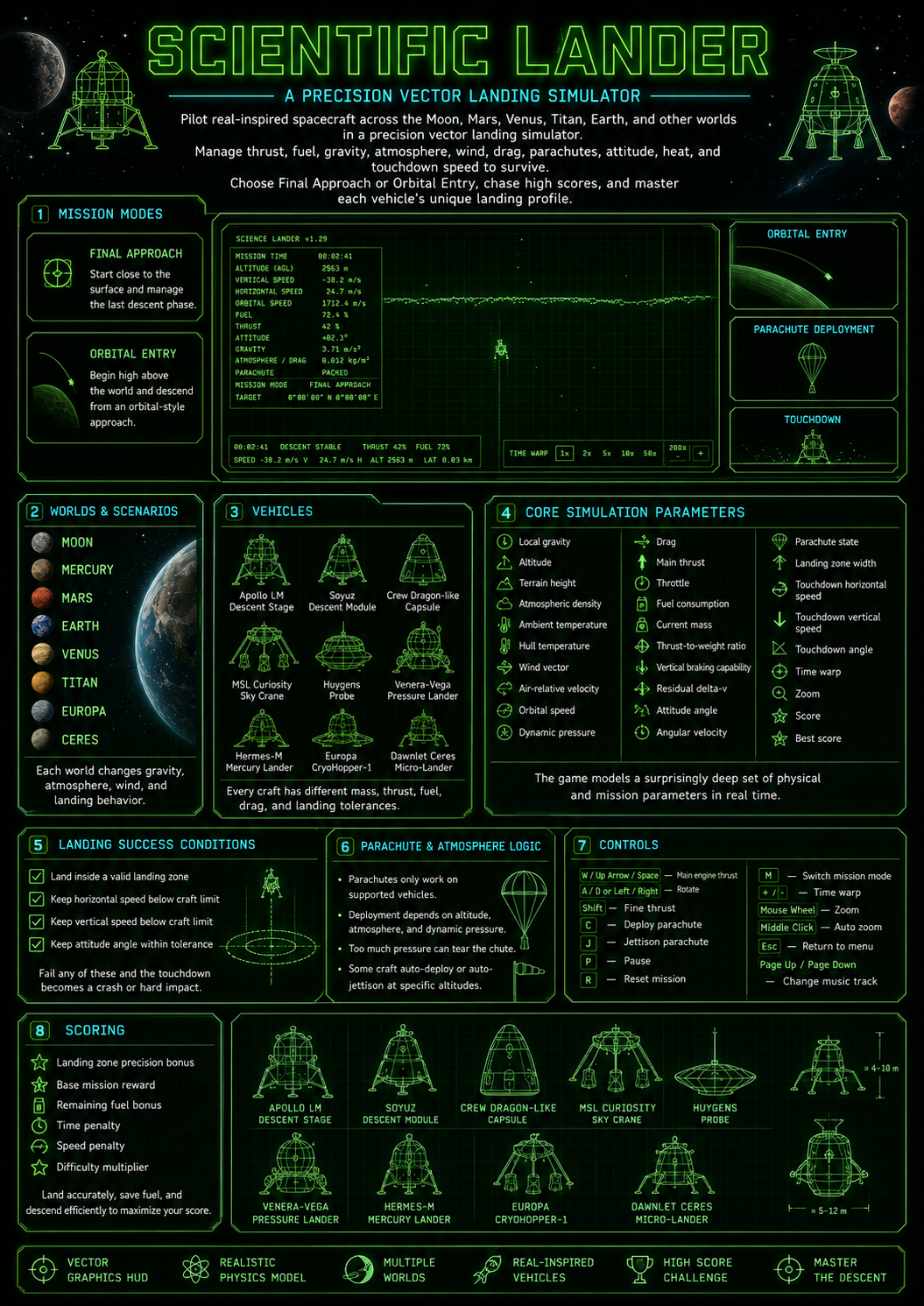
During my latest update to my project (Vector Arcade) I've added my most complex game, Scientific lander.
It's a lunar lander with complex calculations and variables. I would like to take into account all the main parameters that could affect a real mission, but I suppose I'm still missing something. Any help/idea will be very appreciated.
At the moment I'm taking into account the following:
1. Altitude
The game computes altitude as: terrain height at the spacecraft x-position, minus the spacecraft bottom position. So altitude is based on actual terrain, not just a flat ground.
2. Local gravity Gravity changes with altitude. The code uses an inverse-square law: stronger near the surface, slightly weaker at higher altitude. So local gravity is not constant during the whole descent.
3. Air density Atmospheric density is calculated with an exponential decay model: high near the surface, lower with altitude, zero on airless worlds. This directly affects drag, parachutes, engine behavior, and heating.
4. Ambient temperature Ambient temperature is computed from the world’s base temperature minus a lapse rate with altitude. It is clamped so it never drops below a minimum floor.
5. Wind Wind is not a fixed number. The game computes wind from: base wind, wind shear / jet component, gust component, altitude damping / boundary-layer behavior, x-position, and mission time. The result is a wind vector with x wind, y wind, and total wind speed. This means the lander is affected by time-varying and altitude-varying wind.
6. Relative velocity The code distinguishes between spacecraft velocity and air-relative velocity. Relative velocity is spacecraft velocity minus wind velocity. This matters for drag, parachute stress, dynamic pressure, and landing evaluation.
7. Dynamic pressure The game computes: q = 0.5 × air density × relative speed². Dynamic pressure is used for parachute safety, atmospheric load, and HUD readout. If dynamic pressure is too high during parachute deployment, the chute can tear.
8. Drag Drag depends on dynamic pressure, vehicle drag coefficient, and vehicle area. If the parachute is deploying or open, extra drag is added based on chute drag coefficient, chute area, and deployment fraction. So drag is stronger in dense atmosphere, at high speed, with larger capsules, and with the parachute deployed.
9. Thrust and throttle The engine model includes engine availability, throttle target, minimum throttle, fine-throttle mode, and smooth throttle interpolation. Pressing thrust engages the engine only if the craft has an engine, it has fuel, and thrust input is active. The code uses full thrust, fine thrust with Shift, and throttle smoothing rather than instant jumps.
10. Atmospheric engine efficiency The code interpolates engine efficiency between vacuum specific impulse and sea-level specific impulse. This means the engine performs differently depending on atmospheric density. Parameters involved: ispVac, ispSeaLevel, and normalized atmospheric factor from density.
11. Fuel consumption Fuel burn uses the classical relation: mass flow = thrust / (Isp × g₀). So fuel consumption depends on thrust, specific impulse, throttle, and elapsed simulation time.
12. Spacecraft mass Current mass is dry mass plus remaining fuel. Mass affects acceleration, thrust-to-weight ratio, braking capability, and residual delta-v.
13. Angular motion / attitude The lander tracks angle and angular velocity. Left/right controls rotate the spacecraft. Angular velocity is damped over time. Landing safety also checks the final attitude angle.
14. Hull temperature The code tracks hull temperature continuously. It uses a heating term based on atmospheric density and relative speed, and a cooling term based on difference from ambient temperature. This creates a simplified reentry/heating simulation. Displayed values include ambient temperature and hull temperature.
15. Residual delta-v The HUD estimates the remaining delta-v from current fuel using the rocket equation. This gives the player an idea of how much maneuvering ability is left.
16. Thrust-to-weight and braking The HUD also computes and shows maximum thrust acceleration, thrust-to-weight ratio, and vertical braking / net vertical acceleration. These are important for judging whether the vehicle can arrest descent in time.
17. Terrain and landing zones The terrain is procedurally generated. The code creates a simulated world width / height, a polyline terrain profile, random variation, long-wave terrain shaping, and different terrain depth depending on mode. The game also creates discrete safe landing zones: Final Approach has 8 zones, while Orbital Entry has 9 zones. Each zone has x1 / x2 horizontal extent, y height, width, difficulty, point value, and name, such as Zone A or Zone B.
18. Landing-zone point tiers The code uses four point levels: 100, 250, 500, and 1000. These correspond to narrower / harder zones.
19. Difficulty system The game includes 3 difficulty modes: Easy, Arcade, and Hard. Easy gives more fuel, more generous landing tolerances, a lower score multiplier, a lower starting altitude, and lower time scaling. Arcade uses baseline / default values. Hard gives less fuel, tighter landing tolerances, a higher score multiplier, a higher starting altitude, and higher time scaling.
20. Difficulty parameters used in code Each difficulty modifies fuel, safe, score, startAlt, and time. These affect starting fuel, touchdown tolerances, final score, initial altitude, and initial time-warp behavior.
21. Parachute logic Parachutes are handled with several states: packed, deploying, open, jettisoned, and torn. The code checks whether the craft has a parachute, whether the craft is alive / not landed, whether the parachute is still packed, whether atmosphere exists, current altitude, maximum deployment altitude, minimum deployment altitude, and current dynamic pressure. Some vehicles have auto deployment below a certain altitude and auto jettison below another altitude. If dynamic pressure exceeds the parachute limit, the chute becomes torn and deployment fails.
22. Landing success logic A landing succeeds only if you are inside a valid landing zone, horizontal relative speed is below the allowed limit, vertical relative speed is below the allowed limit, and attitude angle is below the allowed limit. The limits come from the selected vehicle and are modified by the current difficulty setting.
Version 0.4 is here with a new, complex game in spectacular neon vector graphics
I'm very proud of this new game.
Look at all the updates here: https://paulvern.itch.io/vector-arcade/devlog/1529631/version-04-a-new-game
Download the new version here: https://paulvern.itch.io/vector-arcade#download

Hi everyone, here it is my first working project, Vector Arcade, a collection of neon vector games with some new ideas (at least I think they are new).
I've always loved old Vectrex games, how they looked and how they played.
There are many remakes of those games, so I don't think anyone needs other remakes. I tried to put together some new ideas with an old vector neon style.
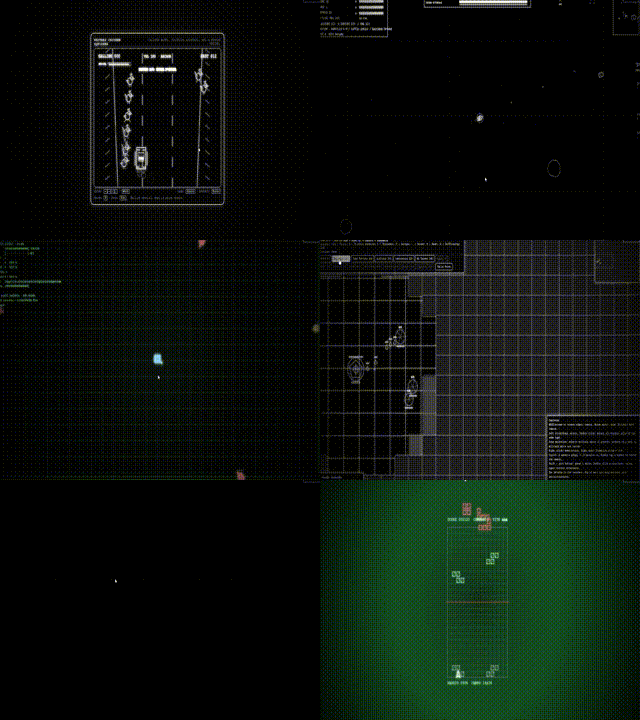
So here it is Vector Arcade, a neon wireframe collection of retro-inspired mini-games for Windows, built around the look and feel of classic vector displays. Pilot starfighters, command tanks, survive chaotic chicken highways, defend a mothership, clear falling tetromino enemies, and lead armies in Vector RTS.
Each game includes local high scores, difficulty modes, sound effects, bilingual support, and a unified arcade launcher.
Features:
- 7 retro vector games in one arcade launcher (yes, all of them have bugs at the moment) - English and Italian language support selected from the main menu. - Easy / Arcade / Hard difficulty modes. - Local high scores for each game. - Neon Vectrex-style visuals with glowing wireframe graphics. - Sound effects and optional MP3 soundtrack support (I've included two songs made with SUNO) - Portable Windows build. - Includes action, strategy, survival, tank combat, space combat, and arcade puzzle gameplay.
Included Games:
1) Chicken Squisher A chaotic arcade driving game where your engine survives by crushing waves of chickens. Chain combos, dodge rooster attacks, and keep your speed alive (just stupid and fun, with ugly graphics!)
2) Chicken Panic Run A frantic road-crossing survival game with traffic, aircraft, power-ups, near misses, and escalating danger (so difficult you will probably never see the aircrafts :-))
3) Deep Raid A space combat game with ship classes, energy management, enemies, carriers, asteroids, upgrades, and boss encounters (the best game in the collection, imho. Enemies actively defend the mothership using different formations, carriers launch mini aircrafts and they need to return to carriers to refuel, large battleships can turn very slowly, enemies try to not fire if another enemy is on their way as they can kill each other).
4) Vectrex Mothership Defend a massive capital ship, manage resources, launch allied craft, survive enemy waves, and use tactical fleet commands (highly chaotic and some slowdowns... but funny)
5) Tank Arena A roguelite tank arena with selectable tank classes, upgrades, bosses, special enemies, and escalating waves (with recoil! and enemies can damage themselves when firing at you)-
6) Tetrattack A Galaga-meets-Tetris arcade puzzle game where enemy tetrominoes attack, fall, rotate, and lock into the grid (a bit chaotic at the moment, but I loved both games... so here it is)
7) Vector RTS A real-time strategy game with fog of war, base building, workers, unit production, formations, upgrades, minimap control, and AI waves. The best thing about it is in my opinion the formation mode of the units. Try it (I've taken the idea from Zero-K).
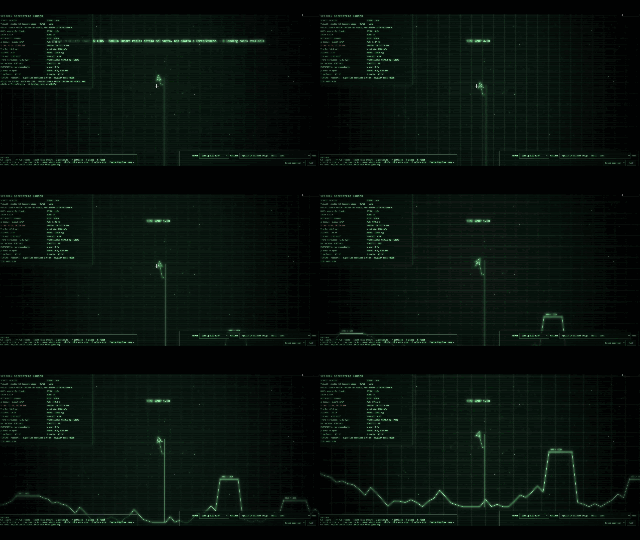
8) Scientific lander (a new game - read more about it in the next post)
Download it from this page: