

Thank you both for the comprehensive answers. I have started to write a parser for Adelie-like commands, but have noticed that I have much to learn about Lil and its operators. They are crazily powerful, but take some time getting used to.
I should really start with what is there already, so thank you for pointing this out.
@woodring's approach seems a nice next step without having to write a full parser for a command language, so thank you for this.
A member registered Dec 30, 2017
Creator of
Recent community posts
Coming from a different angle than Millie Squilly in her project, I have also pursued ideas for a dedicated Decker machine. In my case, the motivation was to have a "substrate" for young people to tinker with creative computer uses ("malleable software"), but also connect them with the physical world ("physical computing").
My problem up to now was that fewer and fewer young people have access to their own computer with a real keyboard. The default for some years has become that young people get their own mobile phone (instead of their own laptop). At school, computers are more and more replaced with tablets (mostly iPads in our case), without a keyboard as default. I know that, of course, with just a little dedication and very little money, a real computer can be had. It's just that this is no longer the default and younger people begin to see physical keyboards as a thing only old people want.
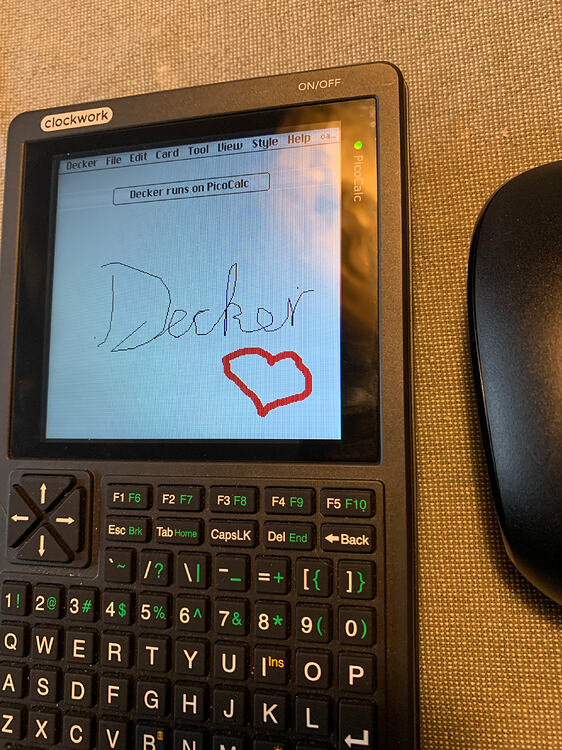
Since the sommer of 2025, with the PicoCalc by Clockwork Pi, there is a new, relatively cheap device that fits my idea of an entry-level device that can serve as a "dynabook" for creative uses of computers. My first attempt was to port Lil (and later, Decker) to the Pi Pico microcontroller in the device. However, for some months now, there has been an exciting new option, which I have only become aware of a few days ago: The machine can rather easily be fitted with a Raspberry Pi Zero 2. This little computer is powerful enough to run Decker easily. It also provides all the niceties of a full computer, including WiFi (to ssh into it) and Bluetooth (to connect a mouse).
Just yesterday I managed to compile Decker (it was trivial) on the Pi Zero (as an initial experiment, without the 2. I would not recommend it - too slow. Go for the Zero 2W):
This is the my forum post about this little milestone.