

“Your Robot Best Friend” is a story based game about a robot on a mission to rebuild his robot friends. The robot walks around a home searching for different objects that the creator will then use to rebuild his friends. The designer used Bitsy to create 3 effectively designed rooms to explore, and lots of detail in the blocks that make up the walls and other areas that cannot be walked on. There are doors on the back wall of two of the rooms, but they are just for decoration and cannot be entered. The entirety of the game space is not too large, but the designer gives reasons to revisit each room multiple times to maximize this space, so a larger space is really not necessary. The three rooms are organized side by side, such that exiting to the right of the center room leads to entering at the left of the right room. This gives the impression of the rooms being adjacent in space, even though Bitsy doesn’t actually have any concept of how rooms are organized in space. There are also transitions in time where the game zooms in and out of the same room, signaling the creator building a new robot. At the end of these transitions, you are still in the room with the creator, but there is also another robot in there with you. Clever block designs give the feeling of each room being one complete image rather than a collection of blocks. This is something that I remember struggling with in my Bitsy game, but the designer managed it here. Intractable blocks are marked by including some white in the block. This is the only use of white in the entirety of the game. The color choice of a palette of lavenders gives the game an appealing appearance that also matches the wholesome story of a robot helping to rebuild his friends. None of the colors are too harshly contrasted, but their differences are still visible. Text is used by each intractable object, and is sometimes more useful than others. This encourages players to interact with everything possible in a room. Additionally, as someone who usually skips through text in games, the text here was concise and meaningful enough to keep me actually reading it throughout my playthrough. Text that was not useful for progression previously can change to useful text later. For example, the cat originally just meows at you, but helps you progress in the game later. The creator talks differently from the cat, and interacting with objects results in the robot Jeremy talking to himself. The primary verbs that I noticed in the game are walk, talk and examine. Walk is the first verb noticed because you cannot get anywhere without walking around and between rooms. There are some characters to talk to, like the cat and the creator. These cover the talking in the game. Otherwise, objects that are intractable seem like they are being examined more than anything, to check if they can be useful to the player at that time.
handera
Creator of


Recent community posts
1. The central uncertainty in the game is all in the apples. The location that they fall from, their speed, and the timing of their fall is all uncertain. Which of these factors are random versus algorithmic I am not sure; but regardless, while playing they are all uncertain to the player. These uncertainties can make the difficulty of each playthrough extremely variable. Sometimes I was able to gain points easily, and other times right at the start I would need to deal with two apples simultaneously on opposite sides of the screen and it seemed impossible. I do think that in some instances a player can just get unlucky and have to lose a life because it would be impossible to put the basket in two places. But in others, choosing the correct strategy is essential. I personally found that going for the fastest apple first is nearly always the best way to go, even if it is much farther away than a slower apple, because it is easier to quickly move over to the slower apple after. These moments are very hard to perceive because it looks like the closer apple will hit the ground first every time, but this is rarely the case. Also, learning that the apples hitting the side of the basket are caught as well was helpful. That allowed me to catch some apples at the last second after dealing with a faster apple. Without this feature, the amount of situations where a life must be sacrificed would increase.
2. In Frog Land, the challenge of the game is to avoid the dinosaurs as you maneuver around the screen, attempting to get the lily pad and deliver it to the bottom of the screen. The game wants the dinosaurs to hit me, because without the dinosaurs the game would be no fun. The horizontally moving dinosaurs fill the screen so that the player is never safe where they are, and they start moving immediately so if the player is not prepared as soon as they start, they will surely die. The dinosaurs do not anticipate the player’s movements themselves, but there is a particularly speedy dinosaur that crosses the lily pad, which was likely a design choice to increase difficulty because the designer knew that all players would have to go to that area of the screen. The enemies do indeed want to kill you; any time spent in contact with a dinosaur rapidly decreases your health. This being said, as I mentioned before they do not actively move towards you. Their movement is fixed, but it is in the spacing and quantity of enemies that makes it so at any given moment the player will always be actively avoiding an enemy. No forces in the game are there to aid you, you must simply avoid the dinosaurs until you complete the task. There is no solid path, the easiest path depends on where the dinosaurs are so it will always be different. I have found that a more patient path allows for an easier passage to the bottom of the screen.
2. The player’s role in Dungeon is as a knight escaping the Dungeon that the game is named after. Other roles include skeletons, however they neither have anything to say nor do they harm you. The conflict is the confines of the dungeon and the dangers within it. As a platformer, there are gaps between platforms that send you back to the start of that section if you fall in them. This is the goal of the game, to escape the dungeon by jumping between platforms without falling into the pit of skeletons. This makes jumping the core mechanic, because the quality of jumps is what separates a successful maneuver from a failed one. Height of jump, timing, and movement speed while jumping all help determine whether you will cover the distance of a jump, and whether you can stay on the platform that you land on. Horizontal movement is also a key mechanic, but I would say the game is more focused on jumping because movement is largely important for the way that it affects jumps. The resources of the game are beans, which you can pick up in cans along the way. I never found a use for the beans, if one exists, but I gathered them all nonetheless. These mechanics essentially describe the rules: move and jump across platforms to the right until the end of the dungeon is reached. You cannot move backward through scenes, and the dungeon roof prevents you from moving too far upward. This simulates a real-word dungeon escape, an experience that I unfortunately have never had.
The Space in “My Name is Alice?” is organized as an open outdoor forest area as the main space, with different doors to enter within that space. The scenes are organized so that it feels like entering a building takes the player inside that building. The designer even made clever ways to prevent players from walking into entrances that don’t lead to new scenes, like one avatar telling you not to go up the stairs because it leads to his bedroom. There aren’t really wide and narrow parts, just the insides of buildings being smaller scenes because it makes sense for the space inside a small building to be limited. The space seems very continuous. Each scene change takes the player right to where they would logically go from where they exit, like a trigger at a front door takes you inside. There are no large jumps in space that make the map feel discrete. The player can collide with the trees and such in the forest area, and there are cliffs on the bottom and top of the map to prevent movement past them. You are able to move through small rocks and some avatars, but collide with large trees and the lake. Inside the buildings, you collide with any walls as well as any furniture in the room. The triggers are on the doors of the buildings and in a cutout of the cliff at the back. Within these spaces, a mat on the ground where you enter marks the exit, where you can go back to the forest area.
2. What is interesting about how the passages in “Trip to the Zoo” are organized is that it felt eerily similar to how choices are presented to us in real life. There is no real system to it. They are not evenly spaced evenly weighted, they seem to come at you randomly, and some will be more important than others. For example, one choice at the start of the game was whether or not to get a burrito on your way to the zoo. For all I knew when making this choice, choosing the burrito could have led to a car crash that made me never arrive at the zoo, or another radical story changing experience. As it turns out, I simply ate a burrito and continued on to the zoo. This choice was not particularly important, but players have no way of determining what choices are the most important when playing. This makes it difficult to guess where many of the choices will take you. The only choices where I was confident about what would happen were the exhibit options. I imagined that selecting monkeys would take me to their exhibit. Other than that, I knew very little ahead of time. The organization allows you to return to the main area after each exhibit so that you can visit all of the exhibits, and no choice is going to exclude a player from any of the experiences in the game. I imagine the shape of the story as a sort of windmill, where you start at the base, the center of the zoo is the middle and the exhibits are at the end of the propellers.
5. The mechanic of clicking is especially important in “I AM A CAT” because nearly every passage includes a choice to be made. There is so much user input, especially compared to the story I made which is roughly linear with a few minor alternate paths along the way. At the start every hour in the game, the player gets to choose what the cat will do. Each hour, there are three to five options of how to spend that hour, from eating to napping to playing, etc. The player’s choice is made by clicking on one of the listed activities. The highlighted terms are generally at the end of the passage, which to me signifies that the cat is completely finished with any past activity and stagnantly waiting for the next one to begin. The game then splits off depending on what choice the player makes. This is when the player’s options are limited. For most choices, there is a passage describing the activity, and the player is only given a single place to go after that passage. After an activity is chosen, the cat will spend the next hour doing that activity, and the player will not receive another choice until they are choosing the next activity, and the clock is an hour later. Clicking in this game definitely represents an actual activity, not a mental process. After each click, I imagine the cat doing that activity for an hour before getting bored again and making another choice. This story would not work if it automatically advanced to the next passage, because that would remove all player input.
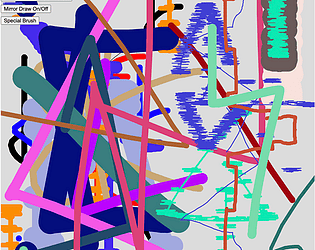
2. The immediate inclination when opening a drawing game is to select a color, or size for your brush. That is what I thought to do and wanted to do here, however no such options exist. Players are only given three brush options, with no description of what each might do. This leaves players no choice but to choose one at random and see what happens. This comes with limitations, because players cannot choose how they want to draw. However I would argue that it does not limit creativity, it simply forces players to be creative with the different options given to them.
Of course, adding basic color options would have been very easy to add. It is not that the creator forgot, or didn’t know how; they made a conscious choice to only allow the unique brushes that they created. In fact, designing their 3 brushes must have required a lot more work than creating a straight brush in multiple colors. They likely did this to differentiate their game from others, and encourage players to be creative with brush tools that they have never seen before. Someone can open 10 different drawing games, click on a simple red brush, and have essentially the same experience. This game does not allow that because there is nothing simple about any of the brushes. Usually I try a drawing game by scribbling with all of the tools provided, but here, I tried to use the tools to create something interesting, and with more structure than just some random lines.
4. At the start of playing this, I pretty much just clicked on as many buttons as I could and scribbled with them to see what is possible within the game. I was very surprised when I clicked the plus button and began to draw. At the time I also had the rainbow color selected, so what I saw was a circle that was quickly changing between the colors of the rainbow and gradually increasing in size until it covered the entire screen. This was a very unexpected result, so I began to experiment with it. My favorite result came from starting with the +/- brush as the size of the screen, and then clicking minus and simply holding the cursor in the center of the screen. This resulted in overlapping rainbow circles that gradually got smaller, creating a series of rainbow colored concentric circles filling the screen. Such an elaborate image created by simply holding the cursor in one place was very cool. It required no artistic skill, just the willingness to explore what the different tools of the game were capable of. This concept also gave me more ideas for what I could have done in my game. Specifically I thought about a brush that moves from thin to thick, but when it reaches a certain limit would get gradually thinner again. This would be the same concept as the one in this game but with a smaller range and less control by the player. The +/- tools in this game really interested me, so after I discovered them, they were all i wanted to play with.
Solving level 3 was eye opening for me because it was the first time in my playthrough that I had to consider which side to focus on first. In the first two levels I simply focused on the left first, got the crate on the goal there, and then worried about the other side. When I tried that approach on level 3, I got the right crate stuck against the wall and had to restart the level. The level design is so open that at first glance it looks impossible to mess up, but that is how I quickly found myself restarting the level. The wall on the left side is specifically placed so that if the player solves the right side first, the player will still be able to move the crate to the goal on the left side. Once I tried the level a second time and saw that the crate on the left got stuck against the wall that cuts out while solving the right side, I knew that I was on the right track. Then I was able to do the left crate second and finish the level accordingly. It is that wall that keeps the crate away from the edges of the map, where it cannot be moved properly. This was the only level that I had to try twice in the game, because once I learned my lesson about blindly solving the left side first, I was able to apply that to levels 4 and 5.
A key rule in Find the Princess is the rule that allows players to teleport to a coin when moving towards it in the same line. This is a unique rule that changes the game greatly, because understanding this rule as early as possible makes beating the game a lot easier. My first playthrough, I got almost all the way through the game before I realized that I could teleport through walls by positioning the avatar in line with a coin that I want to teleport to. This meant that I was completing all of the mazes regularly. It is still possible to complete the game this way, but this rule adds another dimension. It allows players to beat the game faster, but also gives players a completely different mindset for each level. Rather than looking for pathways in the maze, they will be looking for coins near the princess. This is what I did on my second playthrough.
Another key aspect of the rule is that it can only be used once for each coin. This requires players to avoid moving towards a coin unless they want to teleport to it. There is one instance in the last level where I teleported to a coin near the princess, but then accidentally teleported back to a coin in the middle of the maze while trying to get to her. In this way, the rule can make the game easier in some circumstances and harder in others. Understanding this rule throughout my second playthrough made it seem like a completely different game, which is why it is so important.
An interesting design choice in the game Shopping for a Gift is the layout of the rooms. Rather than have a single continuous pathway for the player to follow, the designer offers players multiple options of where to go off of the first room. Each different room offers the player a different experience. 3 of the rooms give the player an item, (toilet paper, Mountain Dew and a picture frame) while the last room allows you to continue through the game. All of the exits go both ways, so no matter where the player chooses to go first, they can still collect all of the items and enter all of the rooms. The only possible exception to this would be if the player went all the way to the exit without exploring any of the three pathways.
The most notable design choice made about the room organization for me is the way that exits are signaled. The first three rooms have simple pathways, and the other choice off of the first room is a specially designed block. This signals to the player that this exit is different from the previous three, and could progress you through the game rather than just take you to a room with only one door. This influences them to explore the other three rooms before using the fourth exit. Then, after using the fourth exit, the next door is shaped like stairs, signaling to the user that the subsequent room is downstairs. This choice allows players to visualize the space that the rooms take up.
The text used in Turtle Adventure Game 1 is used in multiple ways, most notable as the primary tool used to direct the player through the game. Rather than directing the player with walls, the player can move anywhere in the room and relies on the text given by fishes to find the exit. The directional text is not always given to the player automatically. Branching is used to make the player collect items (seaweed and starfish) before giving the helpful hints. If a sufficient number of items is not collected, the player is often simply directed to collect more. One example of this is in the second room. Without a sufficient amount of seaweed, the fish will tell you to collect more. After collecting the seaweed, the fish will tell the player to exit in the bottom left corner of the room.
The text is also used to identify items. When the player collects a starfish or some seaweed, text tells the player so that they know what they are collecting. For example, when collecting seaweed, the text simple reeds "i am seaweed".
The final piece of text in the game is said by another turtle, signifying the end of the game. Finding the other turtle and speaking with it tells the player that you have successfully completed the game's objective and are now finished.
Throughout the text, breaks are used to separate thoughts or sections of the text. For example, the fishes say "i am a fish" in the first thought, then after a break give the player a direction. This simply makes the text easier to understand.