

Peek has since been deprecated by its creator. (I’m going through this thread and leaving notes to save others from dead end searches.)
A member registered Apr 29, 2025 · View creator page →
Creator of
Visual novel backgrounds
gritty retro futurism

hoppy pixel art at dusk
Atmospheric and celestial symbols.
Stone, brick, and metal style assets.
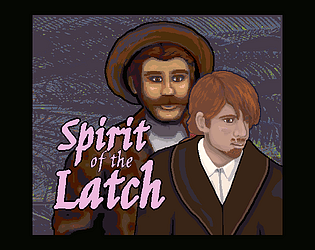
retelling of a classic fairy tale
original sci-fi short
Recent community posts
itch.io Community » Game Development » General Development · Replied to Wend1go in Creating a GIF for your game
WC: 3700.
Sprites: 3/5 serviceable.
I’m hoping to make that a full 5/5 tomorrow.
Backgrounds: 5/7 started.
Premade brushes for Krita speed up the painting on nature over houses and modern vehicles. I’m particularly fond of “grass”.
GUI: Have a guitar, as a treat.
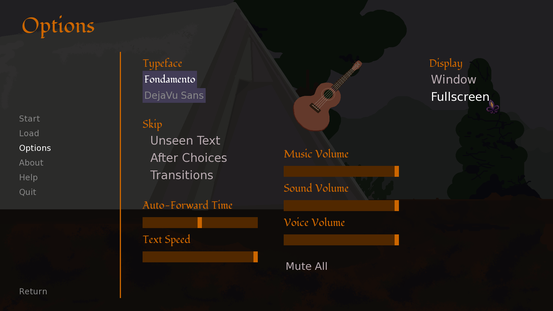 The background is not an example of Krita brush use, only of Aseprite scribbles.
I think you chose cute subjects and an interesting concept that makes for very challenging pixel art to practice on.
To help me explain why, I worked out my own version for comparison. I’m aware not everyone wants unexpected depictions of their pets from strangers, so no hard feelings on my side if you prefer to skip it.
redraw
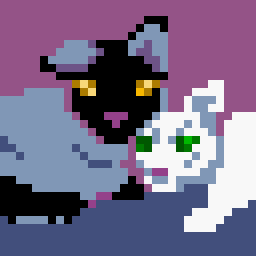
This isn’t exactly good pixel art, which exemplifies how difficult the subject is. Your drawing has a cozier feeling than mine. My detailing is likely wrong. I had to guess without reference where feet and spines would be.
The thing is I initially guessed your duo was a bat and a rat, not two cats. On further study, I can’t figure out what Carrie’s body positioning is, and the purpose of the large pink spot up front is a mystery.
The smaller the canvas, the simpler the subject needs to be, unless the pixel artist is strong on advanced technique.
My pixel art skills feel mid-level at this time. I didn’t use the strongest techniques for two contrasting figures for such a small canvas. An masterful drawing could use dithering to define the shapes or reduced the two cats to simple cartoons.
What I tried to do well enough to demonstrate: color balance and careful pixel placement to define features.
A common trick is to check the readability of the image by viewing it at its full size. You likely don’t want half the image to disappear into roughly the color swath.

Do it look like a pair cats, or whatever it’s meant to be? Does everything important come across? If not, change the pixels.
Anyhow, my suggestion is to draw Harry and Carrie separately. Draw them at different sizes. Get a solid feel for their features and how each works in different settings, assuming your game backgrounds won’t all be the same.
You’r at a good starting point.
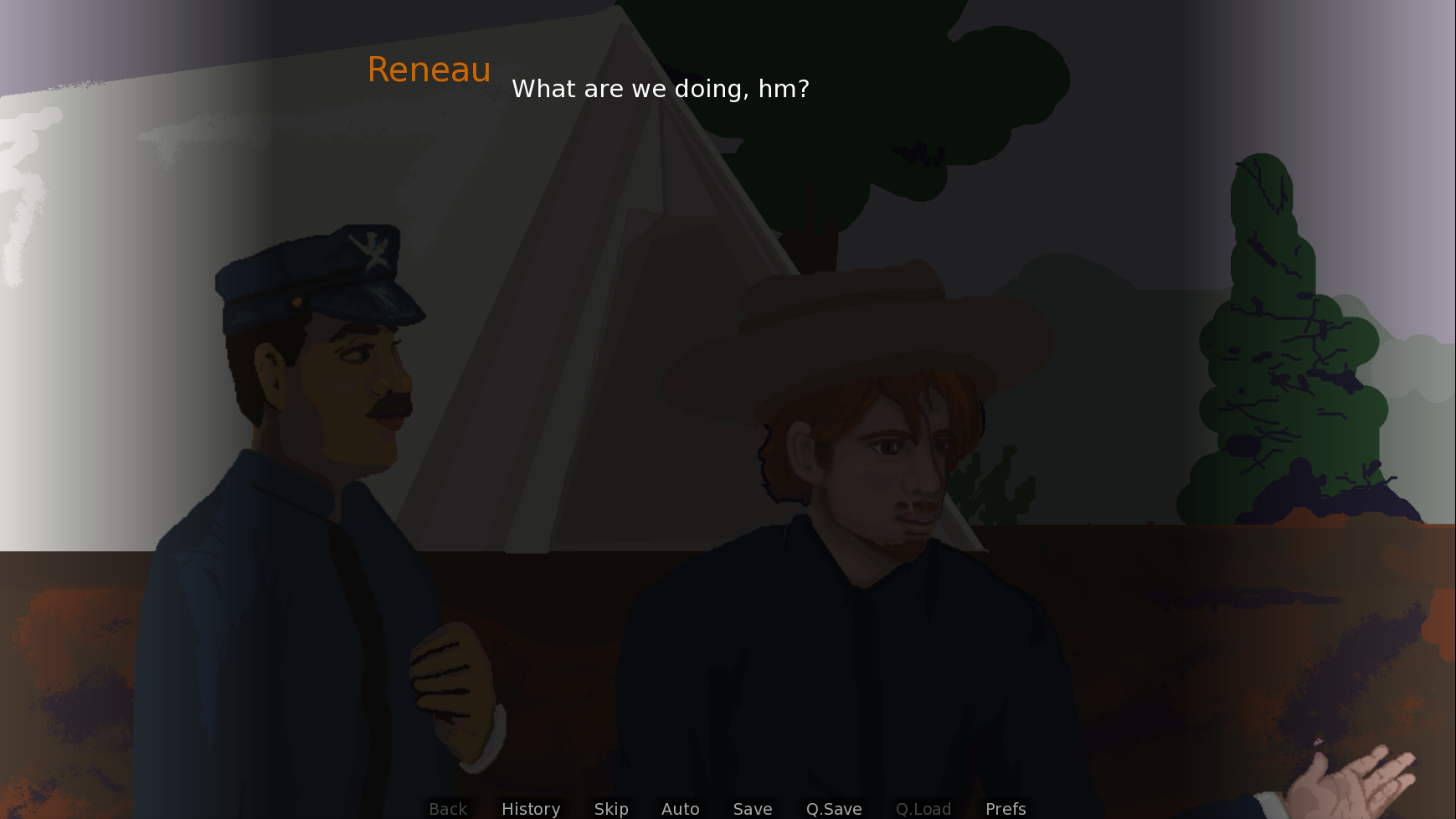
Everything in this mockup is subject to change. Some of it I already know is wrong and expect to redo later this week. The screenshot is to show that there is visible progress.
Latest developments:
- I picked a general setting, further south than what I as initially thinking, because I have photos, museum notes, and access to books from trips that would be useful.
- The blues in the uniforms and the skin tones are feeling closer to correct.
- An outline is coming together, and I’ve got ideas about how to cut it down to a manageable size.
Some thoughts from story worldbuilding research:
Relatively peaceful doesn’t mean the US military or the businesses or any property owners stop committing cruel acts with massively devastating consequences. This shouldn’t surprise me by now, and it is part of the story. The big trick is to writing in general is to use enough of the real world that the story world is believable or interesting without showing too much of its horrors.
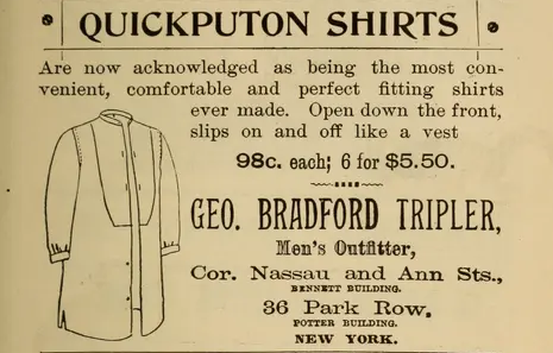 One of my favorite ads, found in Pussy: Her Language (1895)
Men’s shirts were a competitive fashion industry. Nevermind (for our purposes) the politics of fabrics or the arguments about whether or not the maiming factories were evil. The styles are different in every ad, drawing, or preserved garment from the time period. I was hoping to figure out which style to go back to use in “SotL” before its next version release, but uhhh….
Nineteenth century uniforms were far less consistent in style, materials, and colors than what museums and books tend to let on by selecting the stereotypical examples to display. Is this relevant? Yes! The US Army and its members experimented with uniform materials and styles for several decades after the Civil War officially ended. In the specific decade I’m researching, 1890s CE, the US Army was using the light tan color for cavalry and its (wait, WTF?) tropical invaders. Everything from the specific color to coat length to decorations could vary from person to person, especially among the officers, who would present themselves according to personal preferences. That means there’s freedom to mix and match and still be able to justify my decisions. I like that.
itch.io Community » General » General Discussion · Replied to Firefly in if you use ai art your lazy