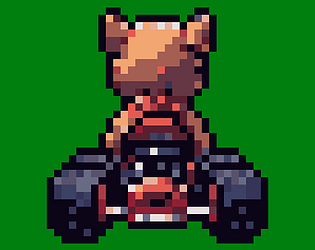
I get your point, but pointing out that a tech demo isn’t a full game yet doesn't really add much. What matters is that the core systems (movement, opponent behavior, rendering) are already in place, which is usually the hard part. That's exactly how games start.
Also, considering this is written by hand in assembly on real Amiga hardware, without any framework (aside from a small c2p.library I made available with source), it naturally requires a lot more time to develop.
alimede
Creator of
Recent community posts
Thanks a lot for the feedback, I really appreciate it!
I'm really happy you liked what you saw before the crash.
If you have a moment, could you tell me a bit more about the crash? It would really help me track down the problem.
For example:
- What hardware are you running it on? (Amiga model, CPU, RAM, etc.)
- When did it crash? At startup, during the demo, while racing, or when exiting the program?
Any detail you remember could be useful. 😊
Thanks a lot, really appreciated!
Very happy you like the demo — still a lot of work to do, but we will try to push it more as possible and make a full proper game, very Amiga style, with all the bells and whistles.
Let’s see who will win at AmiGameJam 2025 — may the best entry wins! Anyway I already saw some really cool productions from the other teams, the Amiga spirit is still alive and kicking :-)
It’s possible in theory, even on older Amigas using very large “mega pixels”, but the current c2p.library is not ready for that yet.
At least two important features are missing:
1) Horizontal output pixel scaling
Right now one input byte is converted into one real output pixel.
To support huge pixels, the library should allow a configurable output format where each input pixel is expanded horizontally:
-
1 → 1 pixel (current behavior)1 → 2 pixels
-
1 → 4 pixels
-
1 → 8 pixels
Vertical stretching can be handled outside the c2p.library using a suitable copperlist that repeats scanlines.
2) 68000-compatible chunky2planar routines
The current implementation is optimized for 68020+ CPUs (long shifts, swaps, advanced addressing).
To run on Amiga 500/600 OCS/ECS systems, a separate base 68000-compatible version of the c2p routines is required, without 020+ instructions.
--
In short:
yes, it can be done on older Amigas with big pixels,
but the c2p.library first needs output scaling support and a true 68000 backend.
As it stands now, it’s designed for 020+/AGA-class machines, not OCS/ECS.

https://gbude.itch.io/slide-four-the-ingenious-puzzle-game
Hi guys, first of all: sorry for my writing but English is not my mother tongue :-)
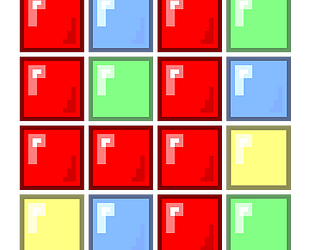
Slide Four is my first fully developed mobile game using the MonoGame framework. The game is inspired by the 15 sliding puzzle, but adds its own features such as the non-rectangular game map and, above all, the concept of merging the tiles together in groups of 4 or more. When these groups are formed, the player collects the elements contained in the tiles and these become fixed blocks that can no longer be moved. This makes each level a little more difficult as tile groups are formed.
Thanks to these elements the player collects stars or virtual coins.
Each level includes a goal to reach, and for each level it is possible to reach up to 3 stars based on the number of tiles containing stars that are collected.
The game is free to download from Google Play, there is a banner at the top but I don't think it's very invasive.
I would very much appreciate your comments and suggestions, I am developing a shop where the player can buy upgrades using the virtual coins collected during the game and I would also like to have other ideas on possible future developments (levels, features, etc.).
Kind regards to all .. ciao