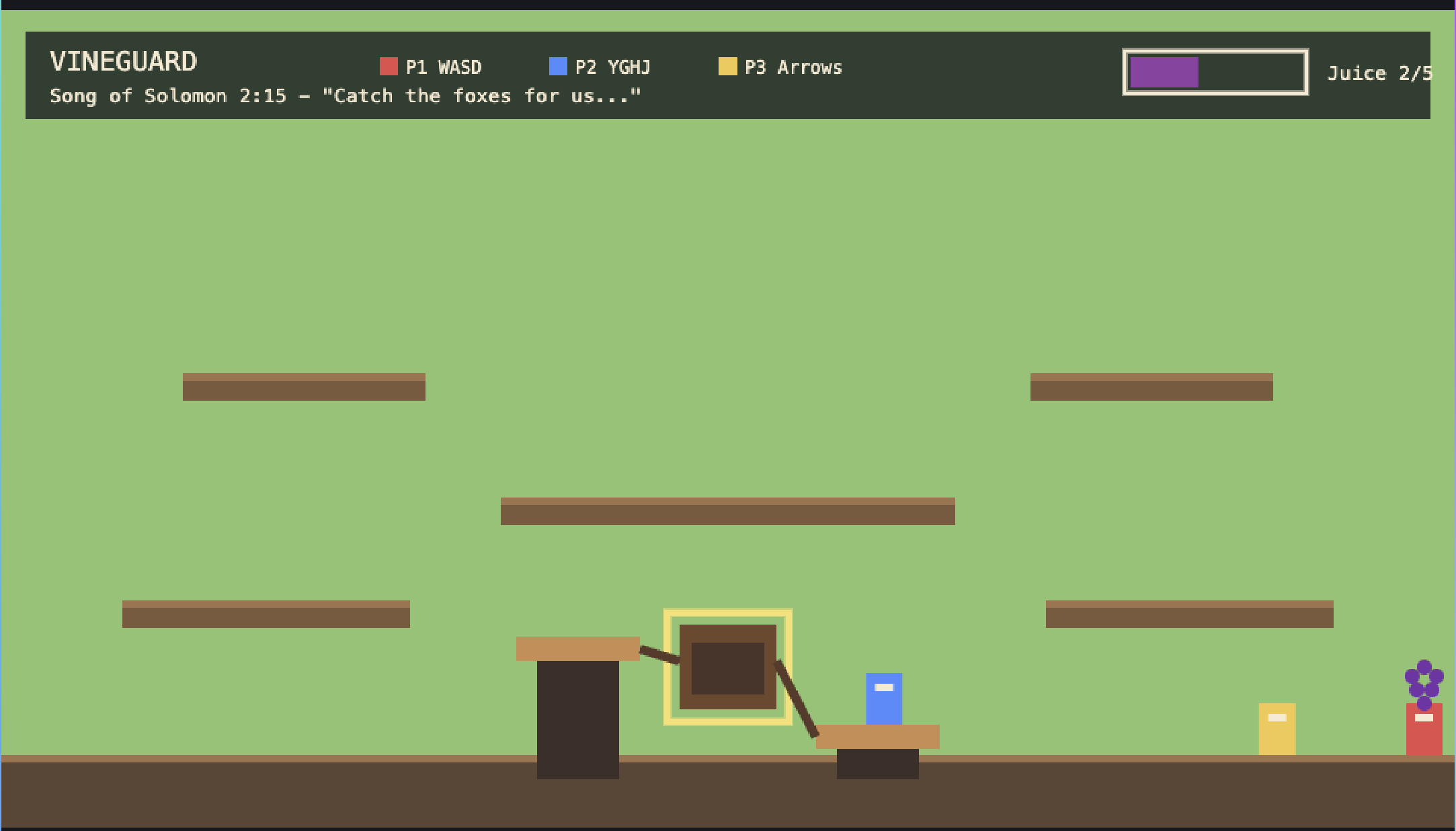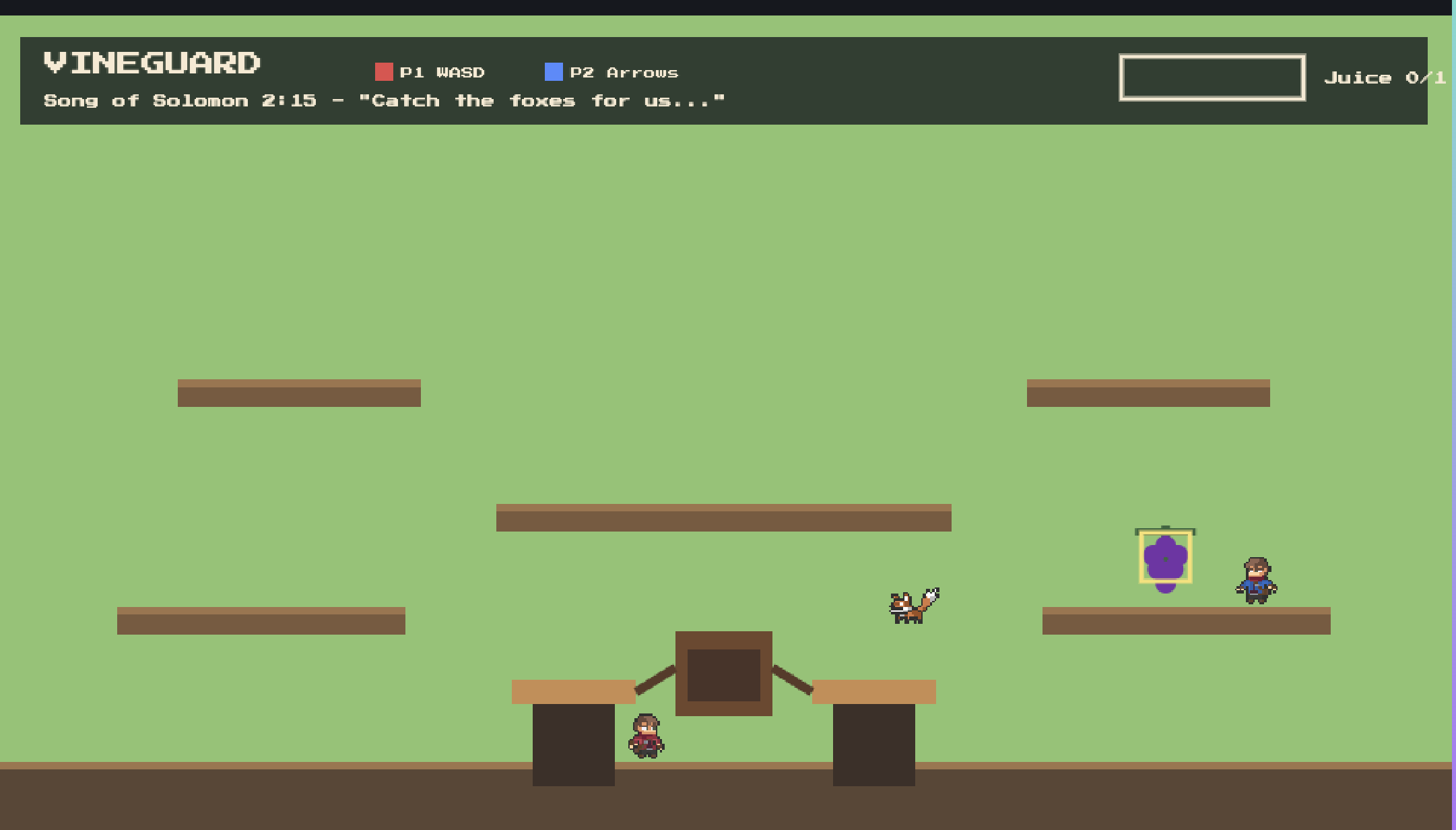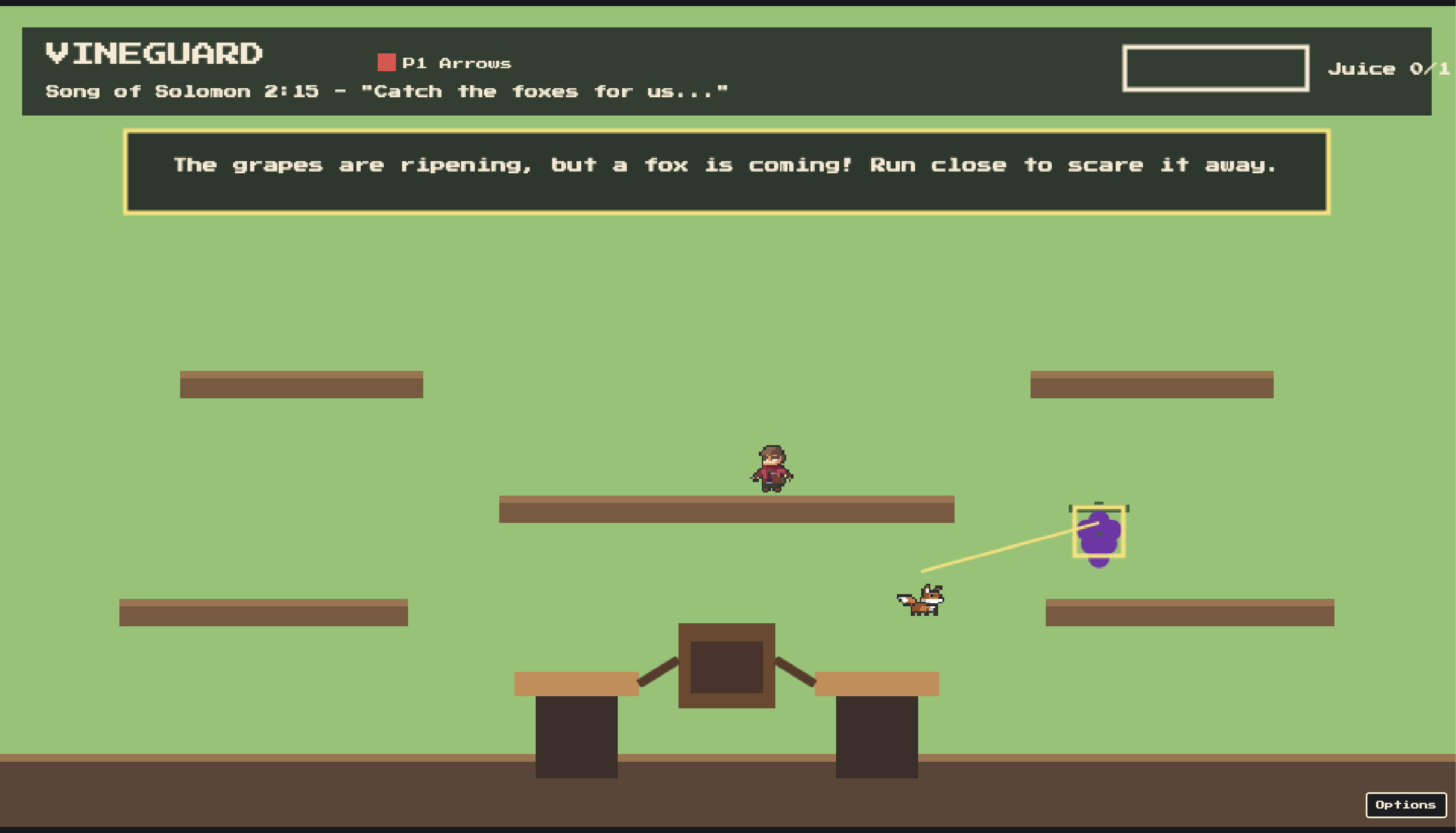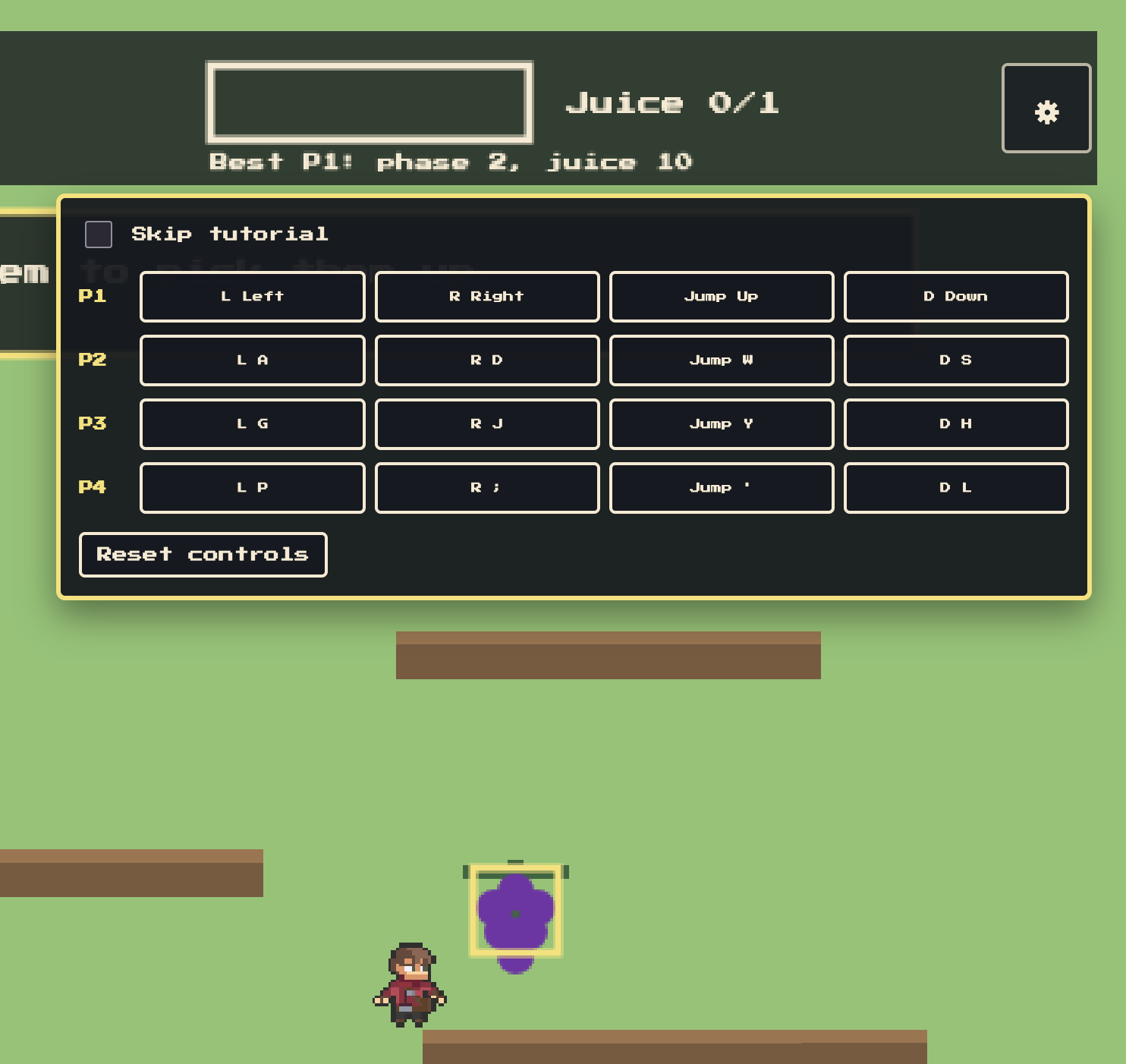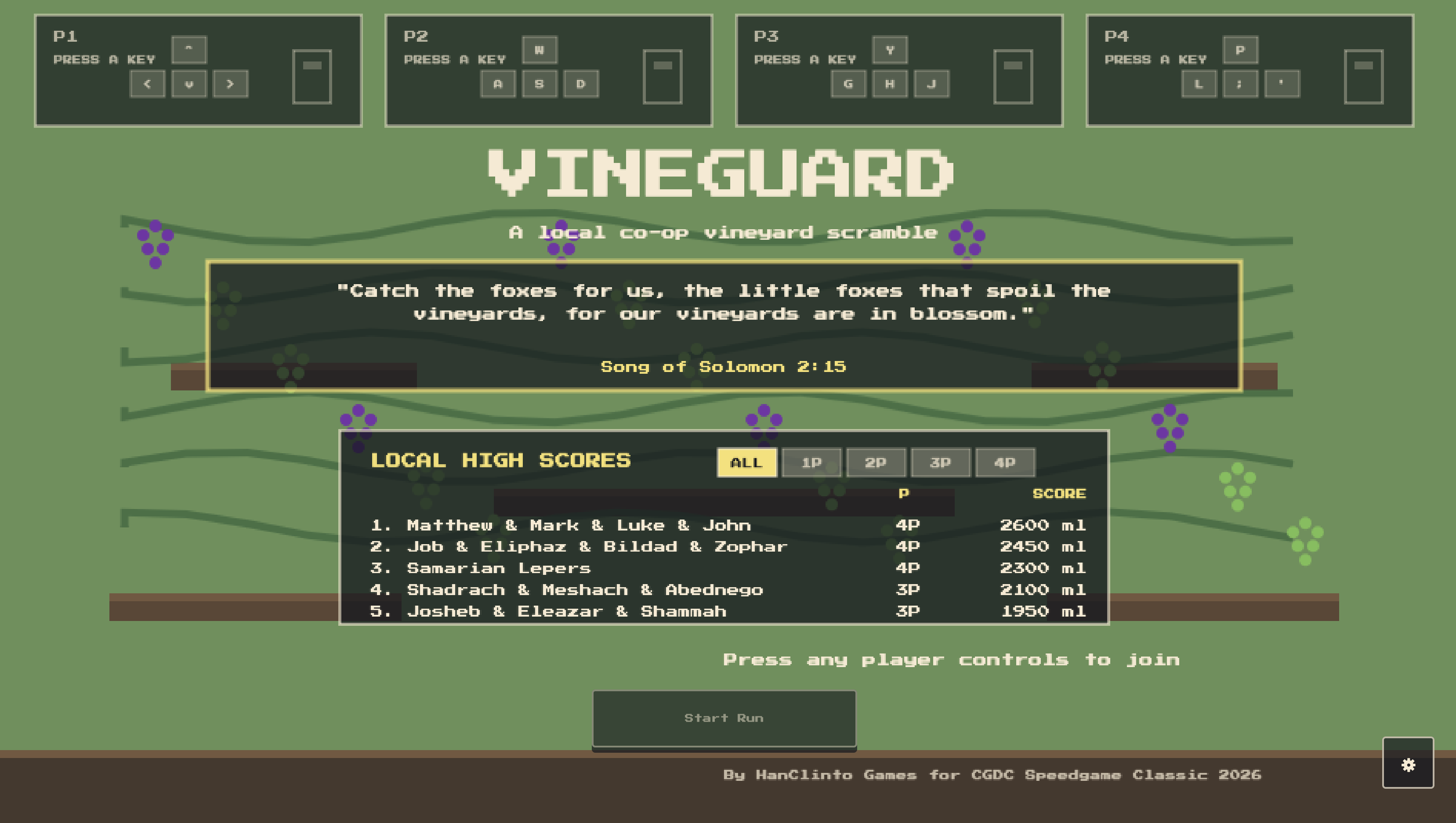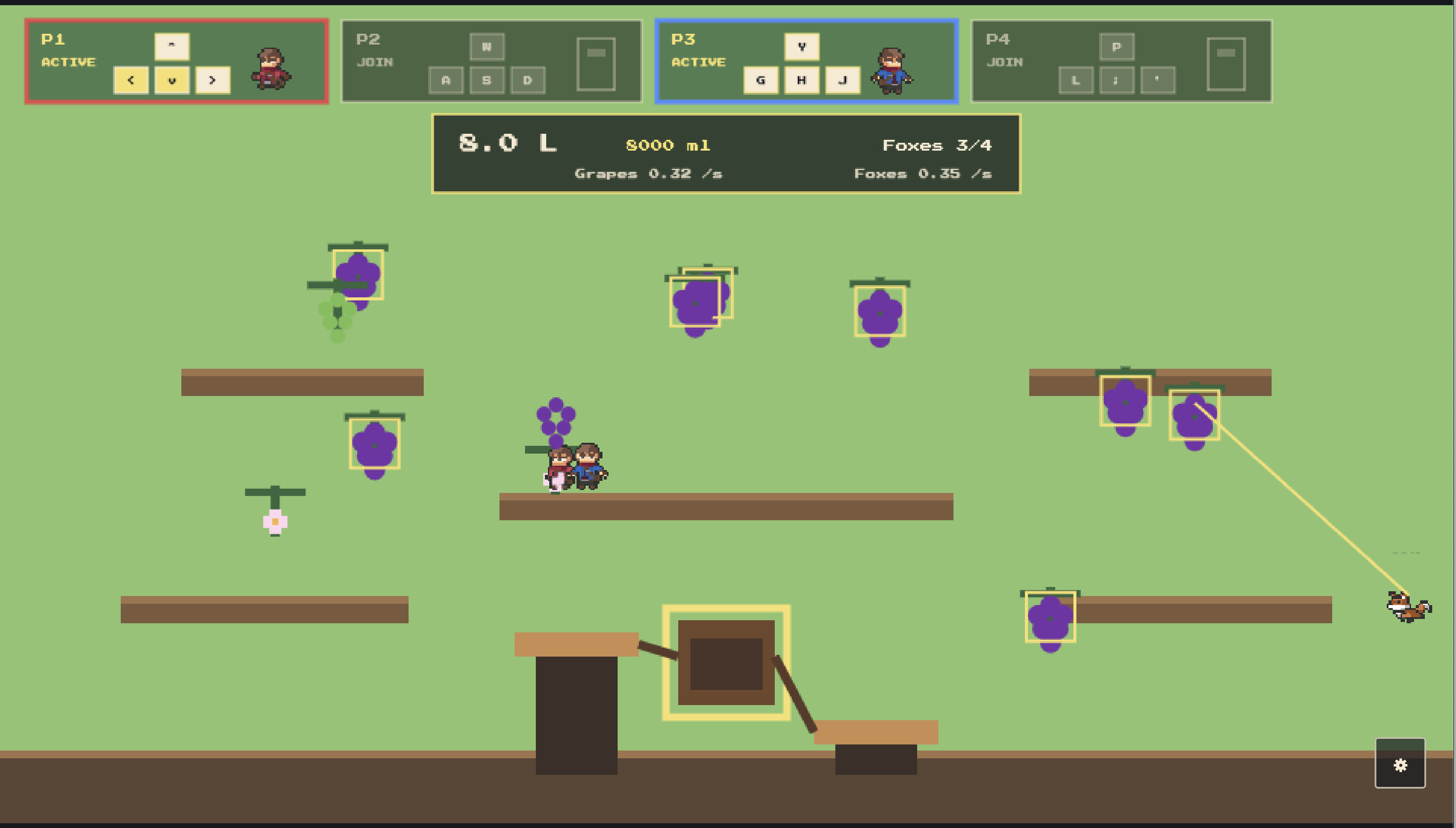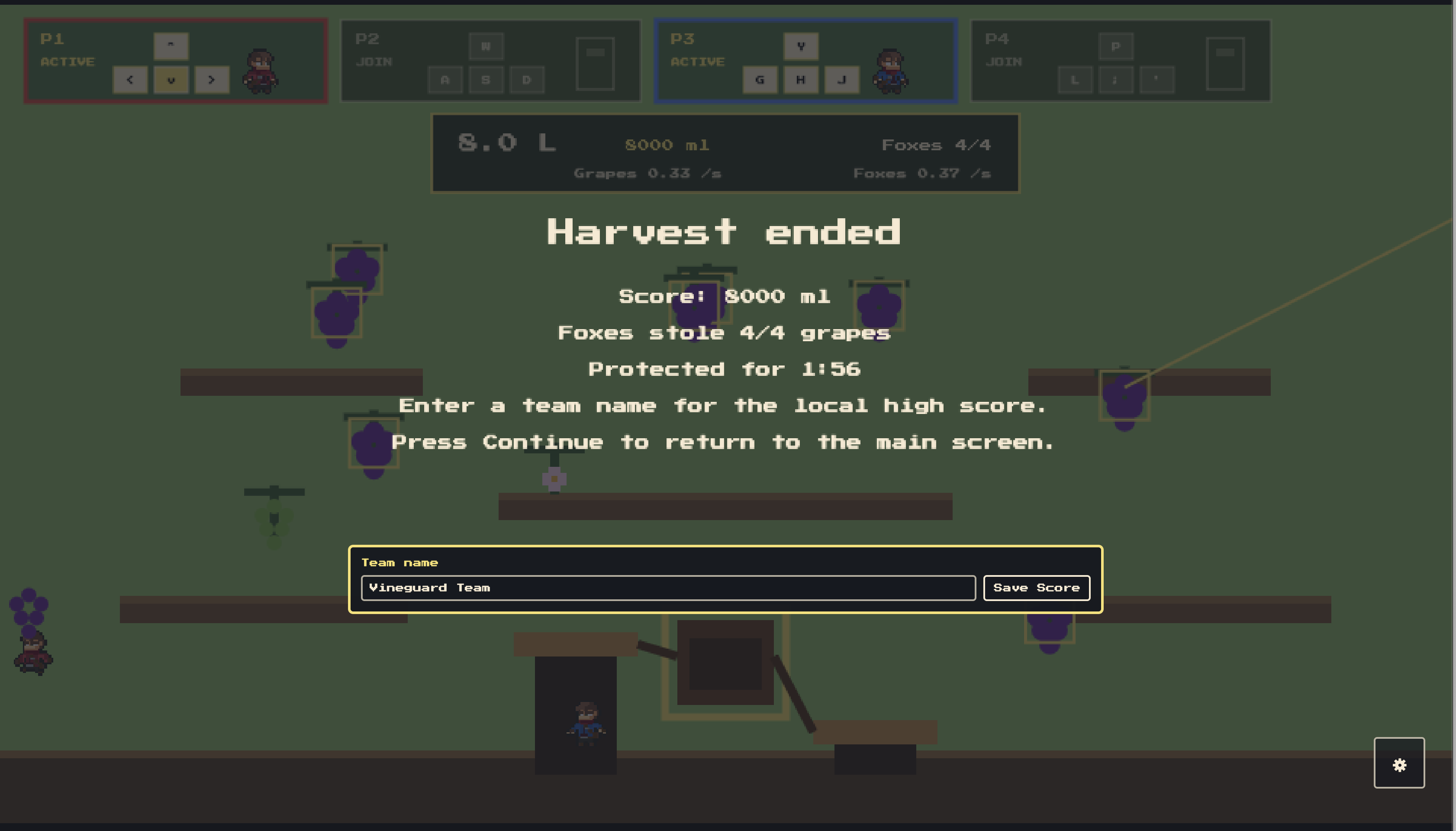
Follow along as I vibe-code a last-minute entry:
https://hanclinto.github.io/vineguard/
I'm currently traveling in England for the last 2 weeks and am still here for a few more days, but in between traveling and events and everything, I'm trying to get a semblance of a small game written.
Here is what I started with as my spec, and I am vibe-coding this with Github Copilot w/ GPT 5.5:
# Vineguard
_A fast-paced local multiplayer cooperative PvE harvest-and-defense action platformer with party-game pressure and light competitive stats._
> "Catch the foxes for us, the little foxes that spoil the vineyards, for our vineyards are in blossom." - Song of Solomon 2:15
> And he told them many things in parables, saying: "A sower went out to sow. And as he sowed, some seeds fell along the path, and the birds came and devoured them." - Matthew 13:3-4
> "And they went out into the field and gathered the grapes from their vineyards and trod them and held a festival..." - Judges 9:27a
> "Let us go out early to the vineyards and see whether the vines have budded, whether the grape blossoms have opened and whether the pomegranates are in bloom." - Song of Solomon 7:12
> "They shall build houses and inhabit them; they shall plant vineyards and eat their fruit." - Isaiah 65:21
## Design Pillars
- Local couch co-op first. No online multiplayer.
- Easy for mixed skill levels to play together.
- One-screen arcade-cabinet feel.
- Cooperation first, with playful individual stats between rounds.
- Social, readable action: players should quickly understand what needs help.
- Simple controls, no attack button required.
- No-build HTML, JavaScript, and Canvas, deployable on GitHub Pages.
- Code should be straightforward enough for advanced middle-schoolers to understand.
## Theology of Games
So many things that God gave us have both holy and unholy uses. It is interesting that gluttony is one of the seven deadly sins, yet there are prescribed feasts for the people of God, and Holy Communion is one of the ways God provides His grace to us.
So if we are "wired for food", yet food has both holy and unholy uses, then we ask: what did God have in mind when He wired us for games?
We believe games are at their best when they draw people and families together, and games are at their worst when they draw people and families apart.
Vineguard should feel like a joyful, communal game about protecting what is growing, gathering the harvest, and celebrating shared work.
## Inspiration
- Killer Queen: local arcade energy, drop-in feel, one-screen readability.
- Overcooked: cooperative chaos, self-organizing roles, visible workstations.
- Ultimate Chicken Horse: approachable platforming and playful social friction.
## Target Scope
- Jam length: one week.
- Players: 1-4 local players.
- Balance target: 1 player can test and understand the loop, 2 players is minimum fun, 3 is adequate, 4 is best.
- Session length: roughly 15 minutes max unless players get an especially strong run.
- Round length: roughly 3-5 minutes.
- Minimum satisfying version: one screen, four local players, foxes only, platformer movement, harvestable grapes, central see-saw winepress, round progression, and local high score.
## Core Game Loop
Players defend grape clusters as they grow in a vineyard.
Grapes begin as blossoms, grow into fruit, and eventually ripen. Ripe grapes can be harvested by players, carried to the winepress, loaded into the vat, and pressed into juice.
Foxes enter the vineyard and try to steal grapes. Players scare foxes away by approaching them. A scared fox drops what it is carrying and flees.
The round ends when the juice jar is filled. The game ends when the players can no longer defend the vineyard, such as when all usable grapes are gone or stolen.
Between rounds, players get a short pause, see team progress, and see individual contribution stats.
Play continues through escalating phases until the team loses. The team's high score records how much juice they collectively produced and how many players participated.
## Vineyard And Grapes
Grape clusters appear at fixed vine locations around the map.
Each cluster has clear growth states:
- Blossom: cannot be harvested or stolen.
- Unripe fruit: cannot be harvested by players, but can be stolen by foxes. If stolen and dropped, it disappears.
- Ripe fruit: can be harvested by players and can be stolen by foxes. If stolen and dropped, it remains on the ground and can be picked up.
Ripe grapes should be visually obvious. Use a clear sprite state and a small particle effect, sparkle, pulse, or bounce when they become ready.
Players can carry only one grape cluster at a time.
When carrying grapes, a player can deposit them into the winepress only if the press vat is empty. If the vat is occupied, the player keeps carrying the grapes.
## Foxes
Foxes are the first and only required enemy type.
Fox behavior:
- Enter from an edge of the screen.
- Choose a target grape cluster.
- Run toward the target.
- Pick up the grapes if they reach the target.
- Carry the grapes back toward a screen edge.
- Escape with the grapes if they leave the screen.
- Drop carried grapes and flee if a player gets close enough.
Foxes should not need to be killed. Cartoon contact or scare effects are fine, but the main verb is "scare away" rather than "attack".
Ravens are a later expansion idea, not part of the first implementation target.
## Winepress
The winepress is the central social machine of the game.
It has:
- A central vat that holds one grape cluster at a time.
- A juice jar or meter showing the round goal.
- Two piston platforms or pump handles, one on each side of the vat.
The two pump platforms work like a dual-pump railway handcar mechanism:
- Landing on one pump platform drives it down.
- Driving one side down raises the opposite side.
- Standing still on a pump platform is not enough to press.
- A player must be airborne and then land on the platform to cause a pump stroke.
- One player can operate both sides by jumping back and forth, but this should be slow.
- Two players alternating jumps should press much faster.
- Great timing should feel satisfying, but mediocre timing should still work.
The distance between pump platforms can tune how valuable teamwork is. Wider spacing makes solo pumping harder and tandem pumping more desirable.
## Readability And Guidance
The game should constantly but quietly show what needs attention.
Important readability cues:
- Ripe grapes should sparkle, pulse, or emit particles.
- When a player is carrying grapes and the press is empty, highlight the vat or show a clear deposit cue.
- When the vat is loaded and ready to press, highlight the pump platforms.
- Fox intent should be readable: players should be able to tell which grape cluster a fox is targeting or whether it is escaping with grapes.
- The juice jar should clearly show progress toward the round goal.
- Danger should be visible before failure feels sudden.
Avoid tutorial text during active play. Favor animation, color, particles, outlines, and simple icons.
## Player Roles And Mixed Skill
Vineguard should let players self-organize without formal classes.
Example roles that should naturally emerge:
- Pump operator: stays near the winepress and works the see-saw.
- Harvester: grabs ripe grapes and carries them to the press.
- Defender: chases foxes away from threatened vines.
- Runner: handles far vines and urgent recoveries.
Less confident players should be able to contribute by staying near the center, operating the pump, or guarding nearby grapes. More adventurous players can take on longer routes, fox recoveries, and multitasking.
Falling, missing a jump, or arriving late should cost time, not remove a player from the game.
## Controls
Supported players: 1-4 local players.
Preferred controls are simple platformer controls:
- Left
- Right
- Jump
- Down or special, only if needed
The first implementation should not require an attack button. Players scare foxes by proximity or collision.
Keyboard layouts to consider:
- Arrow keys
- WASD
- YGHJ
- PL;'
Players should be able to press any key from an unused valid control set to join.
Gamepads should be supported if practical through the browser Gamepad API. A simple "press any button to join" flow is ideal. Full controller calibration is optional and should not block the first playable version.
Keyboard ghosting should be tested early, because four players on one keyboard may not work reliably on every keyboard.
## Difficulty And Progression
The game progresses through phases or rounds.
Later phases can increase difficulty by:
- Adding more grape clusters.
- Spawning more foxes.
- Increasing the juice goal.
- Making foxes faster or more coordinated.
Do not increase difficulty automatically just because more players join. High scores should record the number of players.
Aim for phase 6 to be wild and difficult, but possibly beatable by a highly skilled group.
## Stats And Awards
Between rounds, show team progress and playful individual contribution stats.
Stats should celebrate different kinds of contribution rather than shame weaker players.
Possible stats or awards:
- Bane of Foxes: scared away the most foxes.
- Champion Grape Stomper: contributed the most pump strokes.
- Chief Harvester: delivered the most grape clusters.
- Vineyard Guardian: saved the most threatened grapes.
- Long Hauler: delivered grapes from the farthest vines.
- Steady Hands: fewest dropped or interrupted deliveries, if tracked.
## Visual Style
Low-res pixel art, similar in spirit to Killer Queen.
Characters are small, readable humanoid avatars. Keep them simple and strongly color-coded.
Foxes are generic red foxes. They should read clearly as cute but troublesome vineyard pests.
The game should feel warm, festive, and communal rather than grim or violent.
## Bible Verse Presentation
Song of Solomon 2:15 is the central verse.
Verses may appear on the splash screen and between rounds as decorative flavor text.
The game mechanics should carry the theme more than in-game text does. Active play should remain readable and uncluttered.
## Framework And Code Expectations
No-build HTML, JavaScript, and Canvas is ideal. The game should run on GitHub Pages.
The project should deploy to GitHub Pages when changes are pushed to the `master` branch.
Keep the code simple, modular, and understandable. Clear separation is preferred for:
- Main loop and timing
- Rendering
- Input handling
- Player movement
- Grapes and vineyard state
- Fox behavior
- Winepress behavior
- Round progression and scoring
Avoid overengineering. Prefer direct, readable game logic over frameworks unless a tiny helper library becomes clearly worthwhile.
## Implementation Priorities
Build in this order:
1. Single-screen Canvas map with fixed dimensions and responsive scaling.
2. Local player join and keyboard input.
3. Platformer movement and collision.
4. Grape growth states and harvesting.
5. Winepress deposit and two-sided pump interaction.
6. Juice jar goal and round win state.
7. Fox targeting, stealing, escaping, and scare-away behavior.
8. Round progression and between-round stats.
9. Gamepad support.
10. Polish: particles, highlights, animations, sound, title screen, high score.
## Testing And Verification
Test whatever can reasonably be tested from an agentic browser harness.
Important flows to verify:
- Players can join with keyboard controls.
- At least two players can move and jump independently.
- Blossoms cannot be stolen or harvested.
- Unripe fruit can be stolen by foxes but cannot be harvested by players.
- Ripe fruit can be both harvested by players and stolen by foxes.
- Ripe grapes can be deposited into the empty winepress vat.
- If the vat is occupied, a player keeps carrying their grapes.
- Pump strokes require landing on a pump platform from the air.
- Alternating pump strokes add juice and can complete a round.
- Foxes drop stolen ripe grapes when scared and can escape with grapes if not stopped.
- A round can be won by filling the juice jar.
Use browser automation, screenshots, and direct game-state checks where practical. If something cannot be verified automatically, record what was manually checked or left unverified.
## Deferred Ideas
- Ravens that attack from above.
- More maps.
- More vineyard hazards.
- AI helper for solo players.
- Full gamepad calibration.
- More elaborate awards.