On Ascension 15, and I’ve played about 180 rounds total, so I feel I can have opinions.
Overall
-
Solid interface, sounds, and art on desktop. All the core game behaviors work well and are inviting.
-
I would like more tutorialization. The new roles pour in too quickly in standard to get a handle on them. The way I would implement this is a tutorial mode from the main menu for each type of character with 3-5 rigged rounds that showcase behaviors and rules intersections. As new characters come into play, unlock more games for the same character.
-
Tags could be improved. I used them heavily, but the options were insufficient. I would split the colored tags into labels that you can apply one each of Set 1 (Good, Evil, (Unknown)) and Set 2 (Truth, Lie, (Unknown)).
Bugs observed
-
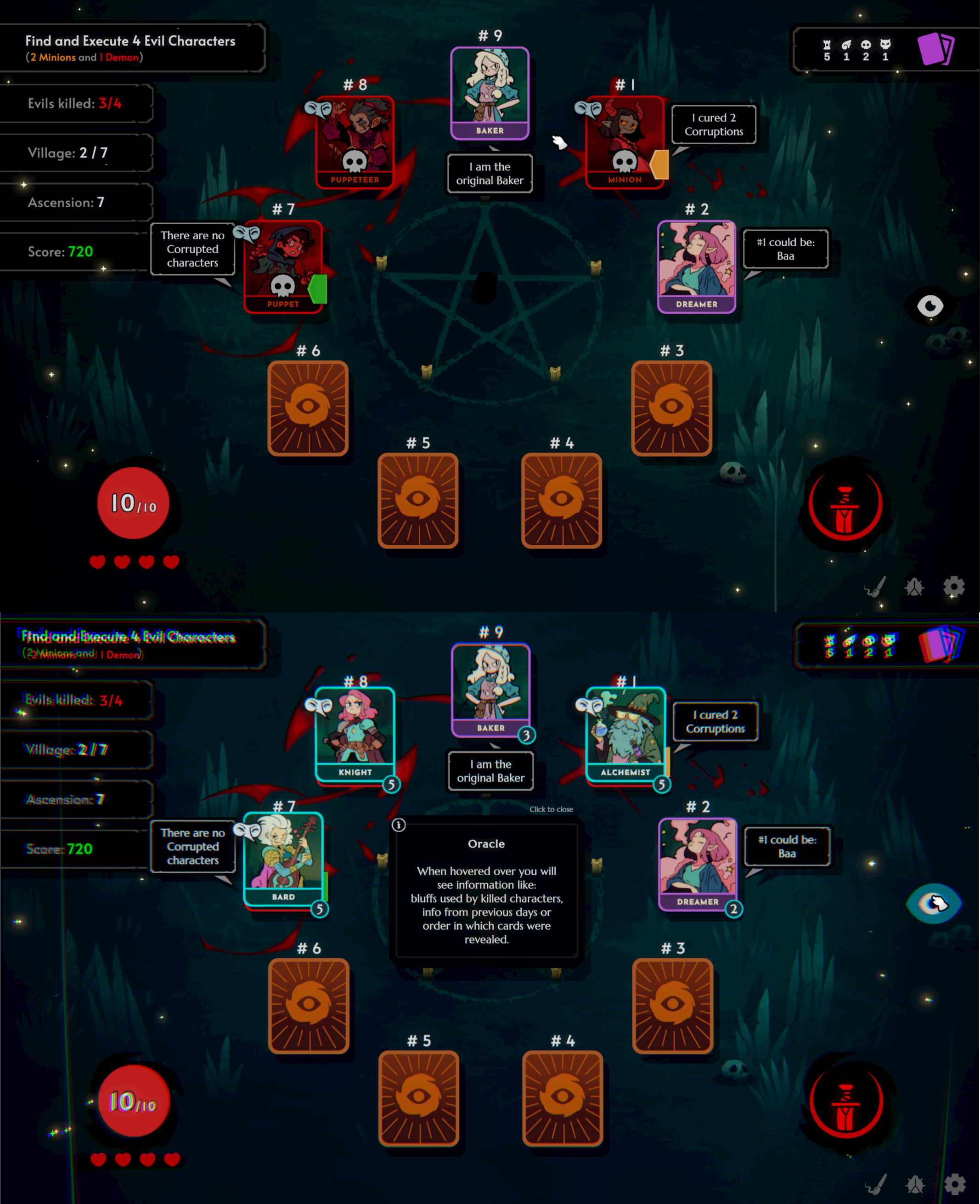
The web version sometimes fails to clear out some old cards, causing a double layered card effect with fake cards over the real ones. Touching oracle mode solves it.
-
Postgame summary sometimes shows wrong draw order. While hovering gets you some info, it doesn’t show the identities of face down cards Lilis killed, which would be handy.
-
Dead evils in Lilis rounds who disguised as renewable characters don’t have their abilities renew.
Characters I think work well:
-
Bard - Not quite as useful as the scout, but feels balanced.
-
Bishop - Potentially the strongest role in the game because they are useful when either lying or truthful. There’s always two good characters among their description. Sometimes a board is such that the strongest opening move is to kill the bishop to validate potential IDs, especially if there is a drunk in play. That doesn’t mean nerf because I need some strong roles that call out other characters specifically to balance some of the underwhelming ones.
-
Confessor - Strong in a game with limited corruption, weaker in a game with corruption but useful for being a target of abilities. Overall well balanced.
-
Druid - Useful for drunks and fake bombardiers, and can very reliably self-validate in most games if not useful.
-
Empress - Potentially the second strongest role in the game because they are useful when either lying or truthful. Especially useful when lying in high evil number games. That doesn’t mean nerf because I need some strong roles that call out other characters specifically to balance some of the underwhelming ones.
-
Enlightened - Well balanced, not a dominating role like empress, but often helps clinch.
-
Fortune Teller - Deceptively simple in a good way. Using the fortune to simply self validate with known goods is often less valuable than trying to use it as a select-target gemcrafter, with one known good and one unknown that will break a conundrum in one kill. Very strong in Lilis rounds since the first Lilis kill is never(?) a wretch so you have a known good to play with.
-
Gemcrafter - Basic ability, better when lying. Solid role.
-
Hunter - Surprisingly strong.
-
Judge - Basic ability with thoughtful use cases, simpler to use than fortune teller and combines well with it.
-
Knight - A weaker card. The occasional free kill and ability to validate don’t make up for the low grade bombardier liability in a corruption round. I like it for the same reason as bombardier though - it feels like a gamble you have to work up to. Also looks like a Link to the Past Link.
-
Knitter - Low key one of my favorite cards because of how effective it is in early game, in just about every type of game, lie or truth. It isn’t in your face powerful like empress or bishop, but clutches more frequently than I expect.
-
Lover - a solid card, rarely feels useless, not OP.
-
Medium - more powerful when lying and often clinches corruption games.
-
Oracle - strong card, with the likes of Empress and Bishop
-
Scout - love child of the knitter and hunter. Also surprisingly strong.
-
Slayer - great for taking an early-game risk, balanced with the intrigue added when killing often doesn’t work. I would have never anticipated Grocery Store Brand Geralt would be balanced as well as he is.
-
Wretch - Favorite outcast because it doesn’t time bog rounds with more “if X, then Y”.
-
Doppelganger - A well balanced outcast that makes it harder to spot minions, but guarantees a truth teller in its pair.
-
Drunk - Adds drama and intrigue, but too much intrigue if a drunk and plague doctor are in the same game with another corrupter.
-
Lilis - The refresh ability mechanics need to be prominently introduced somewhere. Lilis rounds add lots of tension in a good way, especially when those refresh roles come up. I would do away with the -2 health every kill. It can raise the tension if there is a drunk in the same game, but it doesn’t add a lot.
-
Poisoner, Pooka, Chancellor, Puppeteer, and Puppet - I REALLY like the evils that have location-based mechanics. They work well, especially with limited reveal games. Puppet’s strange honest mechanic works well because of this.
-
Minion and Twin Minion - Simple, but a breath of fresh air in games where there are drunks and Plague Doctors.
-
Shaman - cool ability, interesting in games with doppelganger.
Characters I have no particularly strong feelings about
-
Architect - I prefer the relative direction characters over this global option role more. All the characters can often occasionally clinch the game, but I feel like the architect underperforms.
-
Plague doctor - I have strong feelings, but they resolve to net neutral. Doc is useful and interesting, but playing a round with them takes longer. The corruption snipe across the board adds the most intrigue of any character in game, so I have to do a lot more work to hash out truth-lie combo possibilities. The most common role that makes me reset games because I don’t want to take that long. I had a streak of about 10 games in a row without the doc, corruption, not corruption, and frankly I didn’t miss him too much. I guess my net feelings are too much of him is annoying.
-
Jester - Clunky. I finish a lot of rounds without tapping it.
-
Poet - Seems like a card to rig rounds to have duplicate/not-in-play villagers. Fine by me, but I don’t like that I need to have all the mimicked-cards memorized because there is no place in game to reference rules for cards not in play. Otherwise a fine card.
-
Witness - Rarely comes up so I haven’t developed an opinion. I wonder if the frequency is bugged. Maybe I am just unlucky.
-
Bombardier - Occasionally results in “flip a coin not to die” logic forks which are sometimes avoidable by plotting ability use better. I like bombardier’s drama, but I can’t put it in “works well” because it can kill a round through no fault of the player. I screenshotted an example of this.
-
Witch - Kind of boring. Witch’s can’t reveal last card should be changed to “Witch turns the last card flipped into animal. Kill the witch to change them back. (Animal cards don’t count as flipped for score purposes)” Looking at a facedown card is boring. It would be a lot more interesting to see a pig, or newt, or llama, or dog, or cat, or something.
-
Baa - Adds uncertainty about drunk and doppelganger and disguise as outcast games. Does its job as intro demon.
Characters I like less because they tend to be obnoxious
-
Alchemist - Often not useful, most useful when he does nothing. Ability is underwhelming. I often find myself in a conundrum with him where there a choice between assuming he acted, or him lying about it (Pooka has a wide sweep), and thus he’s not useful to early game logical eliminations until I kill someone, and by then other roles will have allowed be to make a better judgment call. It’s actually problematic that he shows up so often with the plague doctor because the plague doctor’s ability to snipe across the board makes him far more tenuous to trust vs maybe being adjacent to other liars. And him not doing anything about the drunk to add even more uncertainty is just a napalm skunk thrown on the dumpster fire.
-
Baker - They feel like a gimmick. The behavior is really bizarre compared to previous characters so the baker is stressful in a “I don’t really know how this character’s ability works so I don’t know how to gain useful info from it” sense when they first start appearing. By the time I got used to them, I wound up hoping they lie because that’s more useful than the baker chaining to overwrite more useful character roles. I sometimes reset baker games that don’t have enough corruption causing sources.
-
Dreamer - The least useful villager role, even in Lilis games with the night refresh. Can’t really validate anyone but themselves, and only after an evil kill or if wretch is in the game. This character needs a buff or to be done away with - the only role I have feelings this strong about. I’d rather Dreamer only show up in 3+ evil games and eliminate an evil possibility, e.g. “Can’t be Pooka”. (“Pick 2 characters: Learn which Evil role they aren’t. If Good picked, learn random info. Hints: If Lies: If Evil picked, learn correct info. “#1 couldn’t be: Puppet. #2 couldn’t be: Puppeteer”)