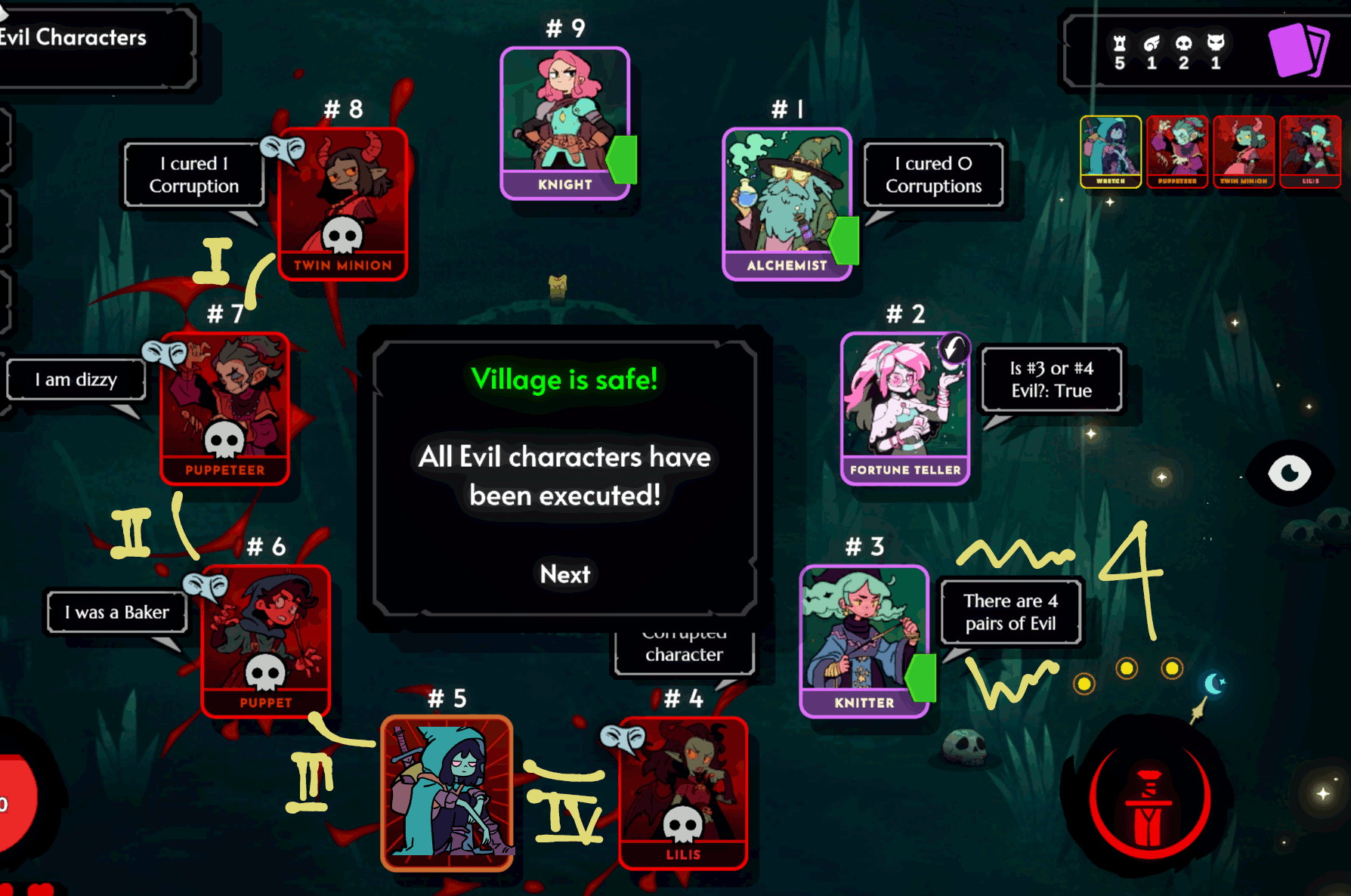
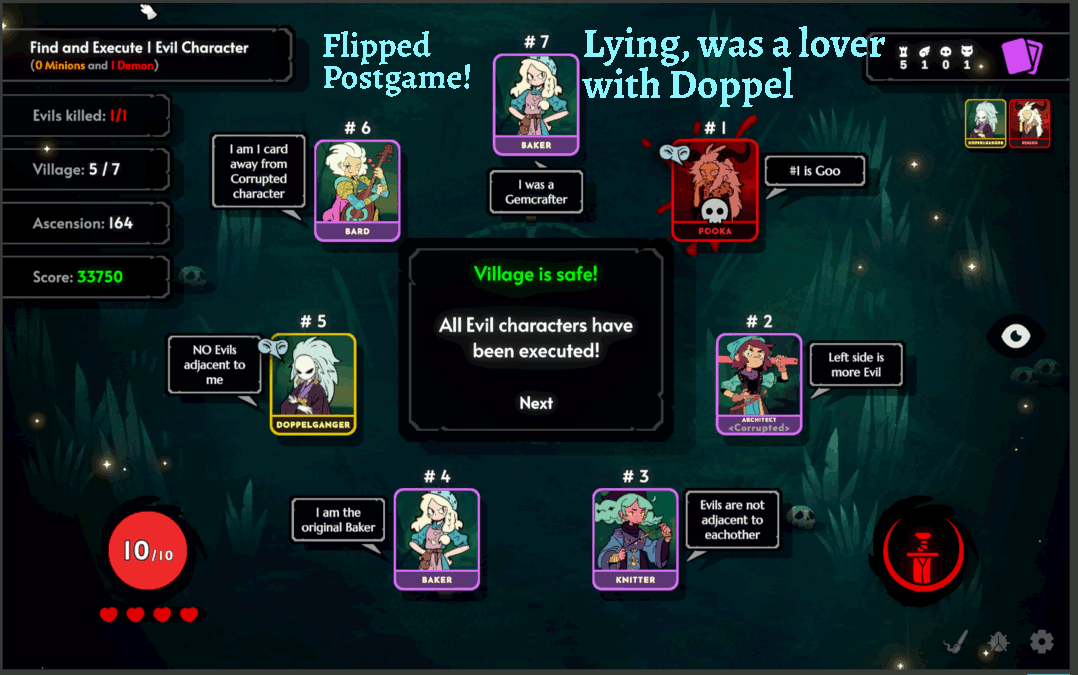
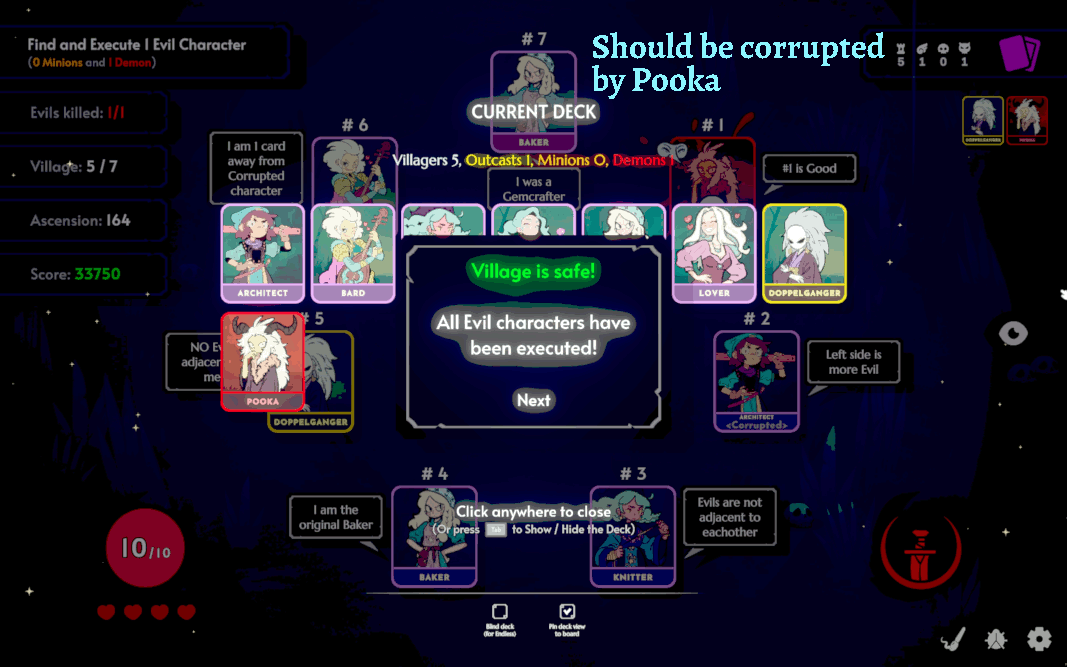
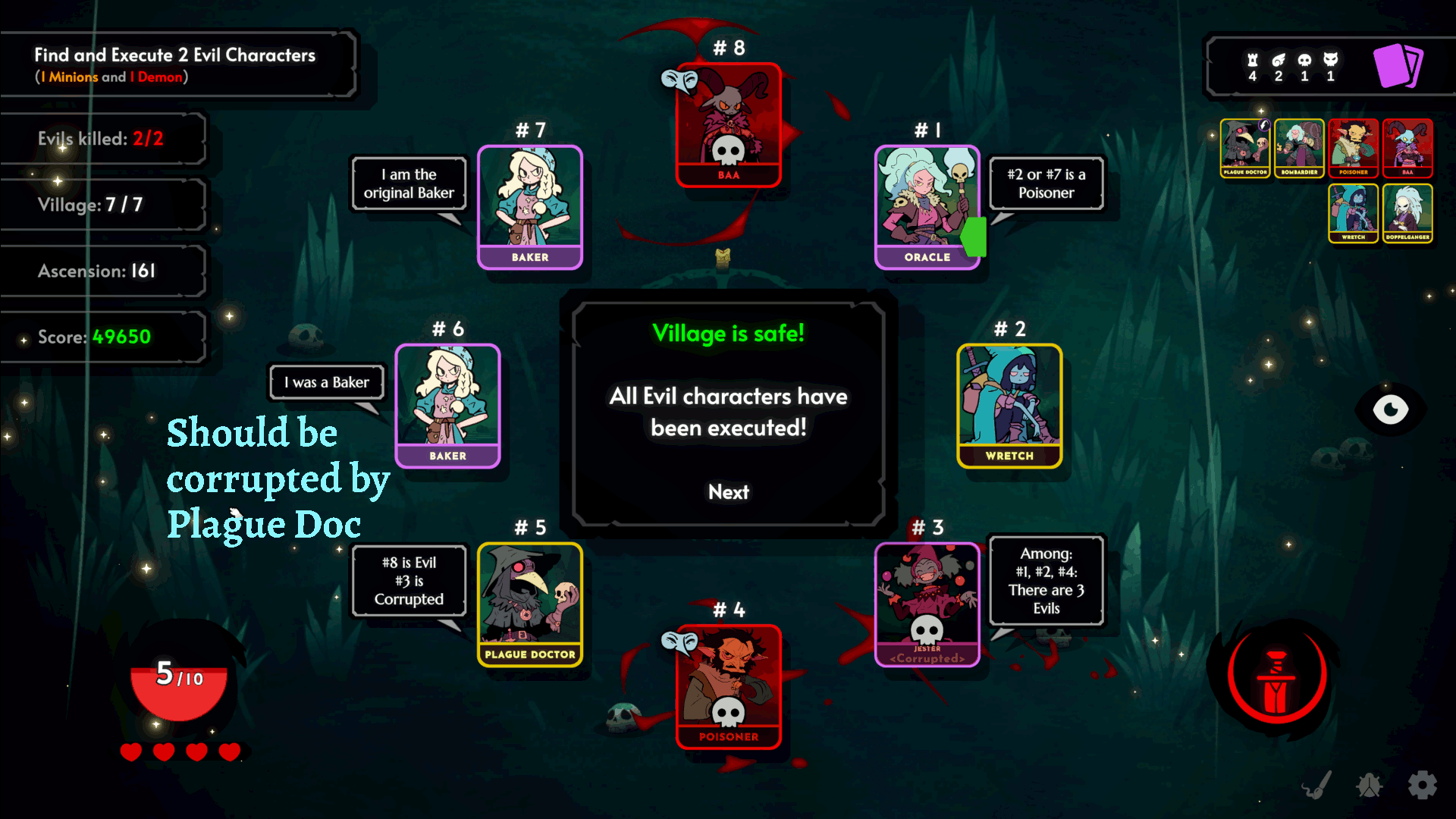
By elimination, yep. The other rabbits at least tried to use their powers, even if they weren’t skilled enough succeed. Beast master is so scared they pretend someone else has their power.
Ryftik
Recent community posts
This is a good one! Maybe par of slightly less than architect (but def less than oracle) because of the specificity but it doesn’t combine with any existing character role which keeps the balance.
Maybe the dancer should name one odd and one even Evil if you wanted to increase the potency a bit. (Puppet is Odd, Puppeteer is Even) (No even evils and no odd evils would be pretty helpful if that happened, which might be too OP.)
Great Update! There are punchy gloves now on the apparent character exclusives. Oh no, garbage items! You threw off my Deck duplicator groove! (Still bought two!)
And I finally saw Doc again! I forgot how tricky he is, especially with that one full heal that you have to freeze or lose a universe to.
Is his primal first aid supposed to do anything if his HP is not at 1? He still healed even though I had Exclusion Principal to make sure he didn’t have a 1 universe.
My endless streak, split between my login and unlogged-in cookies is now 100 villages in a row, so I am now comfortable having even more opinions.
More Bugs Observed
Oracle mode bug. The flip-order tracker should not reset after executing a character.
Text off screen.

Pooka Frequency Check? I like Pooka in my endless games, but I seem to get the true fluffiest evil 50% more than Baa. Goat guy seems under-represented.
Playstyles
All minion games. I don’t mind the demons, but it would be nice to regularly have all-minion games in hard mode to mix it up a little. The minions have a greater range of disguise and slightly more chaotic abilities on average so they are quite challenging.
Wording Fixes
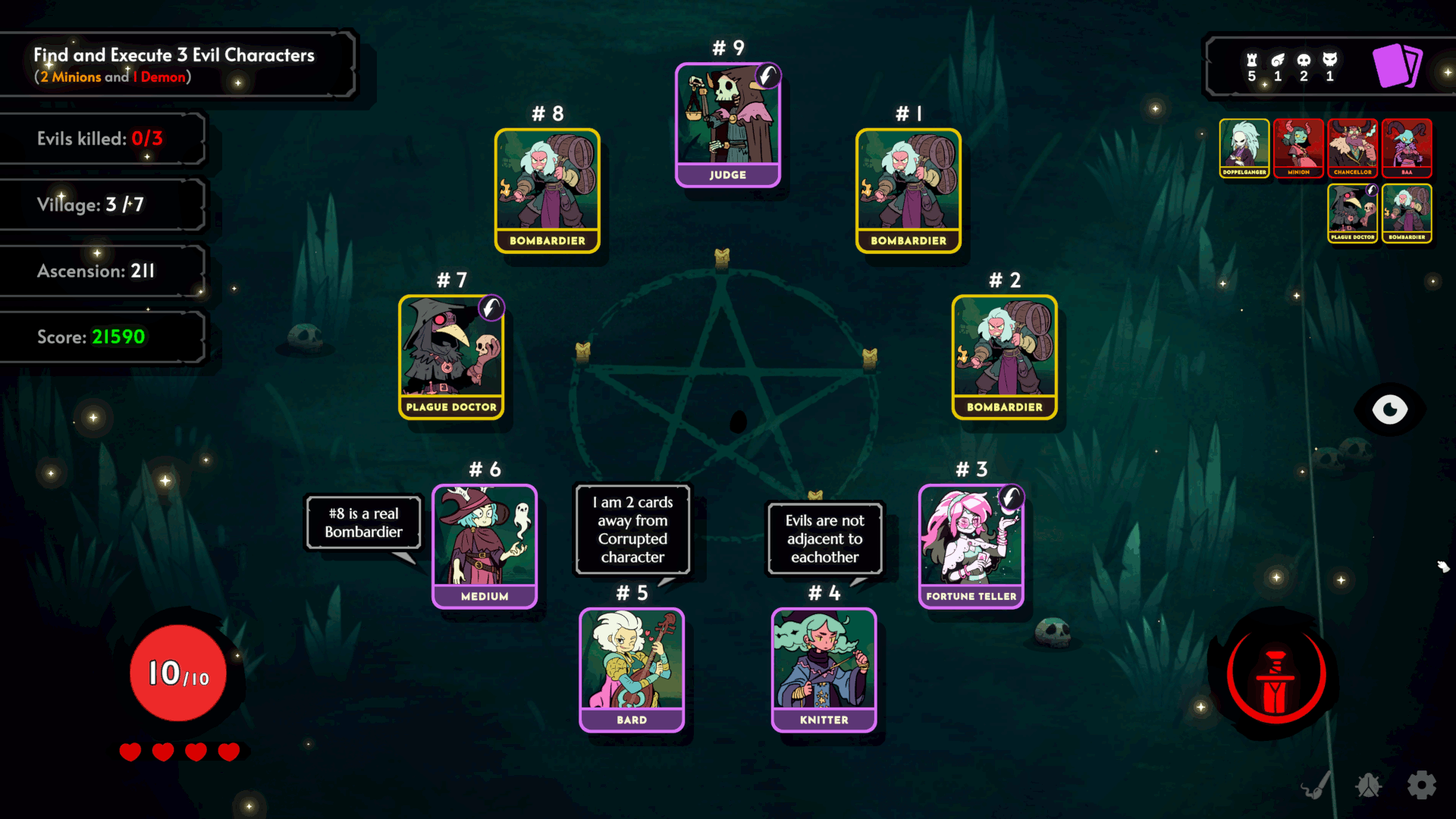
Small fix to Medium. The medium should say “#3 is actually a doppelganger” instead of “#3 is a real doppelganger” to match the better phrasing of the drunk.
Evil Hover text. The Evil hover text has a few grammatical oddities. Maybe change it to “Character alignment. Eliminate all Evils to save the village. Evils Lie and Disguise, unless specific rules say otherwise.”
(Current text is “Character Alignment. Eliminate them. Most often Lie and Disguise. Eliminate all Evil to save the village.”) IMO, the plural noun “Evils” as a shorthand for “evil characters” is trivial to understand, used consistently in other parts of Demon Bluff, and fits the gamelike context.
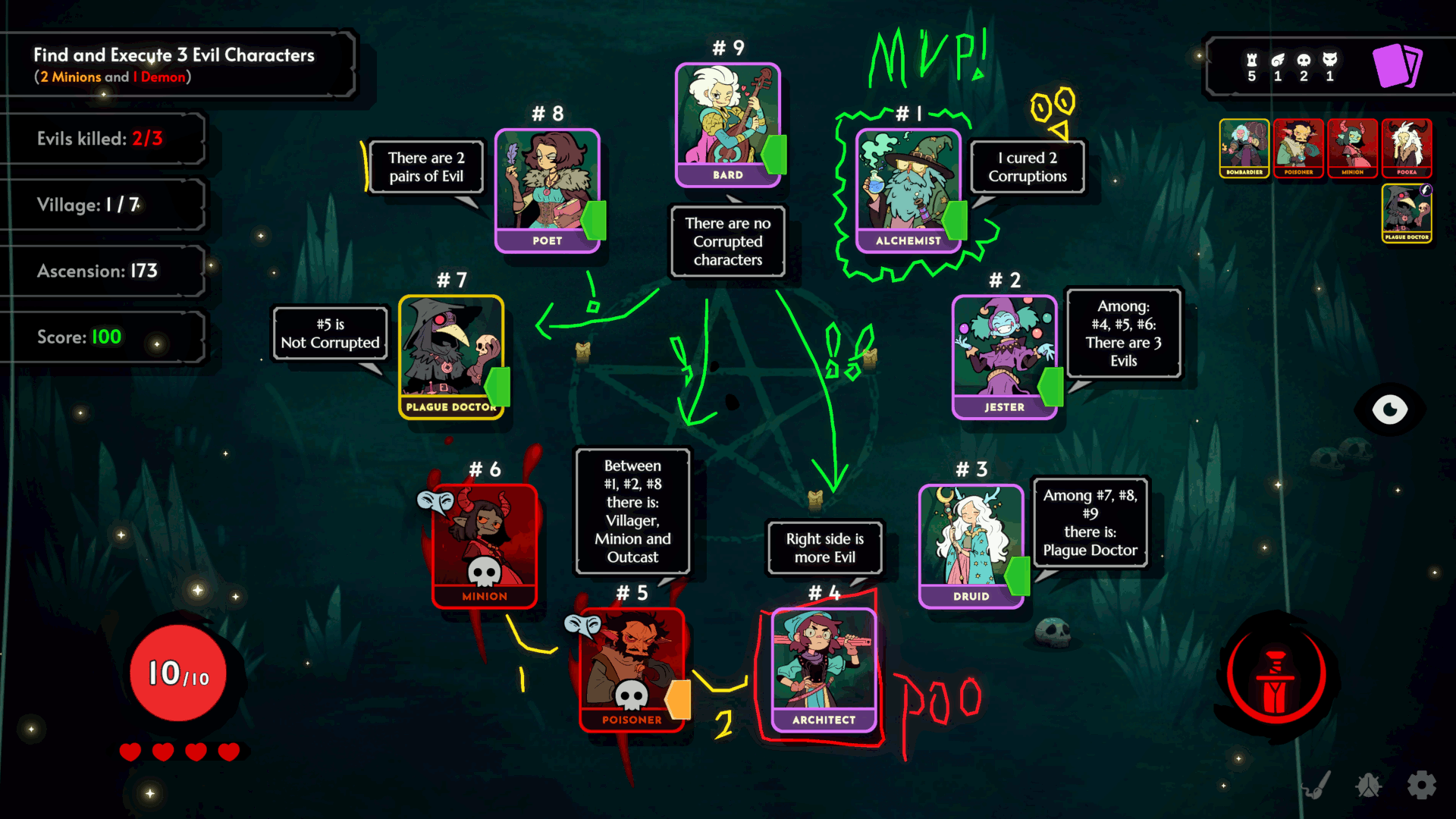
Alchemist Activation. Alchemist’s card should mention that his ability triggers at the start of a match when he is still facedown after evils and outcasts have acted because he is a violation of the typical rule that most abilities trigger on flip.
Chancellor and Puppet. It would be helpful to note somewhere that Outcast and Evil numbers in the upper right Villager/Outcast/Minion/Demon tracker don’t reflect the totals in game because of these characters’ abilities.
Minor plurals. It’s the littlest of nitpicks, but 1 minion and 0 demons in the upper left tracker would be correct.

Outcast-related deck bloat
Hard games generally have one too many possible outcasts in the play deck. This makes Baa completely meaningless as a demon.
For instance, a 6 Villager, 1 Outcast, 2 Minions, 1 Demon game with Chancellor, Minion, and Pooka has 15 cards in the play deck (9 villagers (6 real + 3 potential disguises), 4 outcasts, 3 evils) for 10 cards on the field. The play deck should only have 3 outcasts to account for the one chancellor will add, and a possible outcast disguise.
In a 9 card game with Witch and Pooka and 2 outcasts, 4 outcasts show up in the play deck. In this type of game, I would expect play decks that alternately have 2 or 3 outcasts, varying the uncertainty.
Fixing the outcast deck bloat would make hard games marginally easier on average because of uncertainty reduction, but it benefits players who like more logical approaches as opposed to stab-and-find-outers (like me!). You could have a mix of both, too.
Baker. The baker is a benefit & drawback flawed character like an outcast, but they can’t be listed as one because their ability wouldn’t work. That said, internally, I really think the baker should be treated as an outcast for frequency purposes. Remove one outcast from the game if a baker is going to show up.
Even more characters that could be in the game
Gardener
(Villager, Good) (↶) Pick 1 character: Learn how many evils were still facedown after the selected card was first flipped over. [NO NIGHT REFRESH! BUT MAYBE NOCTURNAL REFRESH.] Hint: Oracle Mode numbers cards by the order they were originally flipped in.
Lazybones
(Outcast, Good) Disguises as a Villager or Outcast with an (↶) activating ability. Trying to use their ability reveals Lazybones’ true identity.
(↶) Select two/three cards from the pop-up deck of eligible roles. Lazybones randomly disguises as one of those characters and can use their ability. Hint: Truthful villagers always see Lazybones as Lazybones and an Outcast.
[The ability is Lazybones running off to the neighboring village to borrow someone else to do their job! And the eligible roles might be the villagers in the current deck, or cards that are less powerful. Lazybones keeps the yellow outcast card border when it borrows a new role as a reminder of what they are.]
[A card to throw off careful player calculus, but give them an opportunity to try to pick a custom villager in recompense.]
Nocturnal
(Outcast, Good†) Game Start: I disguise as a Good Villager currently in play. I am initially Good and Truthful.
If a Good character is Executed, I turn into a Lying Evil Demon that must be Executed! (Note: Evils who slay Goods do not turn Nocturnal.)
Hint: When Nocturnal turns Evil, cards with abilities that refresh during a Night Cycle instantly renew. Previous statements and actions Nocturnal made while Good are still seen as truths, but any new ones after a turn will be Lies.
“A sinister and restless bloodline, reawakened by innocent blood spilt.”
[A card to share the game with a drunk or doppelganger, best friend of the Chancellor. Might also need the ability to reactivate any one living card’s power if there are not enough night refresh roles on the board. I think disguising as a card not in play like a usual demon is a bit too tricky when there is corruption everywhere.]
Ghul
(??? Evil) If there are no dead characters, lose 1 health on every other card flip, starting with Flip 1. (e.g. 1,3,5,7,9)
[Not sure if this would be better or worse in play than the other one health lost per flip baddie with reduced penalty I suggested below. The goal is to encourage strategic flipping and early risk-taking. Should not show up with Lilis or any other health subtractors. (Although I think of Lilis as a slightly stronger Witch, like Pooka is a stronger Poisoner, and doesn’t need extra bleed damage because losing a good villager selectively is its own penalty.)]
The wretch catches a lot of people because they are used to thinking of the wretch as a safe, good character because no evil ever disguises as them.
But remember the wretch is seen as a random evil minion (it might change within rounds) by everyone but a truthful dreamer, who sees them as a cabbage. That means Lilis won’t kill a wretch on a first night because she thinks they are an ally, for instance.
In this case, the oracle thought the wretch was a poisoner, which immediately validated the oracle as truthful (albeit kinda useless, lol).
It also means you have to be more careful with hunter’s testimony because “poisoner” could be the real poisoner or the wretch.
[there should be a healing item for low universe runs]
“Miracle” heals (if I recall) five HP in the universe of your choosing, which IMO is generally more useful the fewer universes you have. It occurs to me that I could have the shop be more likely to stock items that it thinks are more useful to your current run, which might be necessary given how “bloated” the item selection has become.
The thing about those single universe target items is they take up a whole deck slot. I feel like there a sweetspot that is “Once per floor, pay 4 energy for 20 healing divided evenly across all universes you have, rounded down.” So if you have a four universe run, it’s super nifty, but a waste of a card in many universe situations.
Agree with your logic on wave collapse. It helps with the fun.
And also agreed on adjusting the shop inventory to match your current situation!
The Baker chains so long as the new Baker’s original role is not corrupted.
If not corrupted, the first Baker flipped (or Doppel baker) truthfully says “I am the original Baker”. It then targets a still facedown villager card to become a baker, who when flipped will try to baker another villager, creating a chain. The chain breaks if a baker tries to target a corrupted character, who will turn into a baker but lie about what their original role was and will not baker any more facedown cards.
A puppet who was a baker will claim “I was a baker.”
The strat in the game you just played would have been to shank the confessor, since there are no outcast disguisers to worry about (so bomby is real). If the confessor was corrupted because the poisoner was nearby (only 1 corruption in this game and they must be next to the poisoner), the poisoner must be the #5 baker claiming medium because 7 was telling the truth. And Baa would be the dreamer because demons can’t be the same role as a villager and the other bakers are clear.
Of course, shanking the confessor would have revealed Baa, meaning 7 was lying and you could validate the dreamer on Baa to reveal the dreamer was also lying. Then it becomes a fifty-fifty choice about who to shank (you still have 10 health, so you win).
Sometimes the best strategy is to figure out potential solutions and then spend the free kill on someone suspicious you think you would break the conundrum.
This is also why Baker games are tricky because the jester and medium might have given you more and better information.
I enjoyed the main quest and the three lantern hunt, but not even the path of observation let me escape the jarring gameplay switch, so I decided to call it a game with the standard ending.
Also the GUI navigation is a bit clunky. Not having a backscroll between clues, having to hit the inventory every time to light a candle rather than just having a hotkey for each item, or letting you shortcut by just X to interact once you have the useful item. And the clue to the green location should have probably been a collectable, so you wouldn’t have to memorize how it was done.
The cannon puzzle was excellent. I might have labelled each of the candles in the lighthouse puzzle with the symbol of their lighthouse to reduce backtracking later.
It might be tricky to implement because it seems like a strong role, but a Gardener who says some variant of [if there are evils / X number of evils are / a specific evil is] still facedown when revealed might be interesting, and helpful in any kind of flipping is a limited resource game. This would also help tutorialize oracle mode’s flip tracker.
You could have a barkeep do the same (or a bit better) for outcasts (to keep track of that darn drunk! And to know if Lilis swatted my doppel or doc!).
The math works out that you can get 8 extra dollars in play if you keep it alive the whole game. I feel like progressively making it more expensive is the best strat so when you are really cash strapped at the beginning you can try to farm it, but if you just want to gamble for points at the end, you better be confident.
I’ve tried nubby a half dozen times, and even with aggressive healing and the tactic you suggested, there is enough chaos that the dollars invested probably pans out less than 50% of the time. Kobold, that guy with Silence, and the Knight pretty heavily punish low HP and right-side universe situations and it is pretty common to get one of them, so you have to keep investing on healing. I’ll buy a nubby before a final fight if I think I can roll over boss (e.g. I’ve got EMP and some other shield game vs. Princess), but I’d rather reroll most days.
Maybe the balance with sword and shield is to only add shield if you don’t have more than one or two.
Re. Wave Collapse, I feel like there is a conundrum. If you don’t invest in attack items because you are doing a status or shield flip type run, it is pretty hard to win without it because you are in rounds for so long because your attack is flat out bad with the defaults. Going without it on non-attack runs feels like a punishment for attempting any sort of ‘creativity.’ And part of the problem with that is many of the other healing items are pretty situational - if the healing situation were more balanced, wave collapse could be better regulated. And I’m not really sure how to approach that without a lot of tweaking and playtesting.
If you go gangbusters on attack items and shuffles, wave collapse lets you coast. I feel like the balance would be to reduce frequency/increase cost of wave collapse if too many attack items or increase frequency/decrease cost if you purchase more status items and are clearly going for something kind of “off brand.”
Ultimately I’d rather play a fun game than a perfectly balanced game, and wave collapse works in that direction. And the runs that I remember most fondly were probably my first or second run where it came together right away where I had poison and flip and could nab shields, and that one absolutely bonkers run where I think I somehow lootboxed a second deck duplicator (I really wish you could see what you bought at the end of a run because I wish I could verify what I did for that one - I was still learning the ropes.) and wound up with 46 energy.
But one way I would balance wave collapse is to make sure you can’t have more than one, even with deck duplicator.
But mostly, I think the biggest missing item right now is a healing item that gets more effective when you have fewer universes. That would truly make those low universe runs viable, playing close to the edge.
Its pair would be an item that heals if you lost a universe in the current round.
Characters that could be in the game (Part 1)
-
Cosmetician (Villager, Good). Pick 2 characters: Learn if any of them is Disguised. “Is #1 or #2 Disguised? True!” (Aka a Medium-Teller)
-
Fixed dreamer. (Villager, Good). Pick 2 characters: Learn which Evil roles they are NOT. Hints: If Lies: If Evil picked, learn correct info. “#1 couldn’t be: Puppet. #2 couldn’t be: Puppeteer”
-
Snatcher (minion, Evil) - Swaps bodies with one Villager, which counts as a Disguise. The Villager replaced by the Snatcher truthfully tells how many cards away the Snatcher is from another specific Evil (or themselves if another evil is not in the game). Lies and Disguises. Tip: Truthful villagers aren’t fooled by the swap. Executing the Snatcher cures the villager of all evil influences and allows their abilities to be used.
A deliberately easier minion, to pair with nastier ones. You know the snatched card is good from the start, like a confessor. -
Grave Robber (minion, Evil) - While alive, dead characters do not reveal their true identities or if they were corrupted. Reveal after the Grave Robber is killed. Lies and Disguises.
All you learn is if you slew an evil or not by watching the evils remaining counter. I would match Snatcher with “strong character” games that have empresses and bishops (and oracles and knitters) and puppeteers and puppets. As I got better at playing, sometimes the best opening move was to “validate” a suspicious empress or bishop by killing them. This would take away a useful tool without being too wretched about it. -
Vampire (demon, Evil, Night Cycle refresh) - While alive, subtracts 1 health on every flip. The penalty for wrongful executions decreases by 3 for the duration of the round. Lies and Disguises.
Even with an average of only 2 for a wrongful kill penalty, decreased to encourage more early risk-taking killing, you still can’t afford the free kill if you don’t work fast and are picky about what you flip. Better in games with more strong characters and fewer evils. Remove the -2 health mechanic on Lilis. (Or make Lilis this card, and the night killer the Vampire.)
On Ascension 15, and I’ve played about 180 rounds total, so I feel I can have opinions.
Overall
-
Solid interface, sounds, and art on desktop. All the core game behaviors work well and are inviting.
-
I would like more tutorialization. The new roles pour in too quickly in standard to get a handle on them. The way I would implement this is a tutorial mode from the main menu for each type of character with 3-5 rigged rounds that showcase behaviors and rules intersections. As new characters come into play, unlock more games for the same character.
-
Tags could be improved. I used them heavily, but the options were insufficient. I would split the colored tags into labels that you can apply one each of Set 1 (Good, Evil, (Unknown)) and Set 2 (Truth, Lie, (Unknown)).
Bugs observed
-
The web version sometimes fails to clear out some old cards, causing a double layered card effect with fake cards over the real ones. Touching oracle mode solves it.
-
Postgame summary sometimes shows wrong draw order. While hovering gets you some info, it doesn’t show the identities of face down cards Lilis killed, which would be handy.
-
Dead evils in Lilis rounds who disguised as renewable characters don’t have their abilities renew.
Characters I think work well:
-
Bard - Not quite as useful as the scout, but feels balanced.
-
Bishop - Potentially the strongest role in the game because they are useful when either lying or truthful. There’s always two good characters among their description. Sometimes a board is such that the strongest opening move is to kill the bishop to validate potential IDs, especially if there is a drunk in play. That doesn’t mean nerf because I need some strong roles that call out other characters specifically to balance some of the underwhelming ones.
-
Confessor - Strong in a game with limited corruption, weaker in a game with corruption but useful for being a target of abilities. Overall well balanced.
-
Druid - Useful for drunks and fake bombardiers, and can very reliably self-validate in most games if not useful.
-
Empress - Potentially the second strongest role in the game because they are useful when either lying or truthful. Especially useful when lying in high evil number games. That doesn’t mean nerf because I need some strong roles that call out other characters specifically to balance some of the underwhelming ones.
-
Enlightened - Well balanced, not a dominating role like empress, but often helps clinch.
-
Fortune Teller - Deceptively simple in a good way. Using the fortune to simply self validate with known goods is often less valuable than trying to use it as a select-target gemcrafter, with one known good and one unknown that will break a conundrum in one kill. Very strong in Lilis rounds since the first Lilis kill is never(?) a wretch so you have a known good to play with.
-
Gemcrafter - Basic ability, better when lying. Solid role.
-
Hunter - Surprisingly strong.
-
Judge - Basic ability with thoughtful use cases, simpler to use than fortune teller and combines well with it.
-
Knight - A weaker card. The occasional free kill and ability to validate don’t make up for the low grade bombardier liability in a corruption round. I like it for the same reason as bombardier though - it feels like a gamble you have to work up to. Also looks like a Link to the Past Link.
-
Knitter - Low key one of my favorite cards because of how effective it is in early game, in just about every type of game, lie or truth. It isn’t in your face powerful like empress or bishop, but clutches more frequently than I expect.
-
Lover - a solid card, rarely feels useless, not OP.
-
Medium - more powerful when lying and often clinches corruption games.
-
Oracle - strong card, with the likes of Empress and Bishop
-
Scout - love child of the knitter and hunter. Also surprisingly strong.
-
Slayer - great for taking an early-game risk, balanced with the intrigue added when killing often doesn’t work. I would have never anticipated Grocery Store Brand Geralt would be balanced as well as he is.
-
Wretch - Favorite outcast because it doesn’t time bog rounds with more “if X, then Y”.
-
Doppelganger - A well balanced outcast that makes it harder to spot minions, but guarantees a truth teller in its pair.
-
Drunk - Adds drama and intrigue, but too much intrigue if a drunk and plague doctor are in the same game with another corrupter.
-
Lilis - The refresh ability mechanics need to be prominently introduced somewhere. Lilis rounds add lots of tension in a good way, especially when those refresh roles come up. I would do away with the -2 health every kill. It can raise the tension if there is a drunk in the same game, but it doesn’t add a lot.
-
Poisoner, Pooka, Chancellor, Puppeteer, and Puppet - I REALLY like the evils that have location-based mechanics. They work well, especially with limited reveal games. Puppet’s strange honest mechanic works well because of this.
-
Minion and Twin Minion - Simple, but a breath of fresh air in games where there are drunks and Plague Doctors.
-
Shaman - cool ability, interesting in games with doppelganger.
Characters I have no particularly strong feelings about
-
Architect - I prefer the relative direction characters over this global option role more. All the characters can often occasionally clinch the game, but I feel like the architect underperforms.
-
Plague doctor - I have strong feelings, but they resolve to net neutral. Doc is useful and interesting, but playing a round with them takes longer. The corruption snipe across the board adds the most intrigue of any character in game, so I have to do a lot more work to hash out truth-lie combo possibilities. The most common role that makes me reset games because I don’t want to take that long. I had a streak of about 10 games in a row without the doc, corruption, not corruption, and frankly I didn’t miss him too much. I guess my net feelings are too much of him is annoying.
-
Jester - Clunky. I finish a lot of rounds without tapping it.
-
Poet - Seems like a card to rig rounds to have duplicate/not-in-play villagers. Fine by me, but I don’t like that I need to have all the mimicked-cards memorized because there is no place in game to reference rules for cards not in play. Otherwise a fine card.
-
Witness - Rarely comes up so I haven’t developed an opinion. I wonder if the frequency is bugged. Maybe I am just unlucky.
-
Bombardier - Occasionally results in “flip a coin not to die” logic forks which are sometimes avoidable by plotting ability use better. I like bombardier’s drama, but I can’t put it in “works well” because it can kill a round through no fault of the player. I screenshotted an example of this.
-
Witch - Kind of boring. Witch’s can’t reveal last card should be changed to “Witch turns the last card flipped into animal. Kill the witch to change them back. (Animal cards don’t count as flipped for score purposes)” Looking at a facedown card is boring. It would be a lot more interesting to see a pig, or newt, or llama, or dog, or cat, or something.
-
Baa - Adds uncertainty about drunk and doppelganger and disguise as outcast games. Does its job as intro demon.
Characters I like less because they tend to be obnoxious
-
Alchemist - Often not useful, most useful when he does nothing. Ability is underwhelming. I often find myself in a conundrum with him where there a choice between assuming he acted, or him lying about it (Pooka has a wide sweep), and thus he’s not useful to early game logical eliminations until I kill someone, and by then other roles will have allowed be to make a better judgment call. It’s actually problematic that he shows up so often with the plague doctor because the plague doctor’s ability to snipe across the board makes him far more tenuous to trust vs maybe being adjacent to other liars. And him not doing anything about the drunk to add even more uncertainty is just a napalm skunk thrown on the dumpster fire.
-
Baker - They feel like a gimmick. The behavior is really bizarre compared to previous characters so the baker is stressful in a “I don’t really know how this character’s ability works so I don’t know how to gain useful info from it” sense when they first start appearing. By the time I got used to them, I wound up hoping they lie because that’s more useful than the baker chaining to overwrite more useful character roles. I sometimes reset baker games that don’t have enough corruption causing sources.
-
Dreamer - The least useful villager role, even in Lilis games with the night refresh. Can’t really validate anyone but themselves, and only after an evil kill or if wretch is in the game. This character needs a buff or to be done away with - the only role I have feelings this strong about. I’d rather Dreamer only show up in 3+ evil games and eliminate an evil possibility, e.g. “Can’t be Pooka”. (“Pick 2 characters: Learn which Evil role they aren’t. If Good picked, learn random info. Hints: If Lies: If Evil picked, learn correct info. “#1 couldn’t be: Puppet. #2 couldn’t be: Puppeteer”)
Having played through more than a hundred times now, mini-bandaid should be cheaper by 1. Pretty much all the healing items are better.
Sword and Shield should be a repeatable item, not one use. It’s technically worse than knife which does 2 damage since it contributes less towards ending a round.
Nubby universes are too expensive towards the beginning. They have to survive a while to be worth it.
I wonder if final boss Doctor’s frequency is bugged. I get him a lot less than Medusa or Princess.
I just now discovered infinite money mode exists so I can play test hands.
I think the cheapest hand I can consistently beat the game with is Dagger, Wave Collapse, Icy Breath, Recycle, Auto Energy (to make deck duplicator’s frequency increase), Deck Duplicator. I got about all of those (subbing EMP for freeze) in one real run plus a few things I didn’t need and got 827.25. If you got lucky, picking up the quarter for each universe defeated, the ten dollar bill, and the blind for 5 I bet you could break 1000 points.
I’m fairly well aware of the game mechanics at this stage. Getting there was frustrating, and now I realize it didn’t have to be. It became a lot less frustrating when I used the wiki.
There is quite a lot of nuance to the baker, such as when it hits a corrupted character and ends the chain, what the medium says about a villager before they get converted (and worse if the villager turned into a baker was corrupted then lies about their original role so you have the medium and the baker arguing), a doppel baker rebakering a baker, which I had happen. Does an alchemist’s ability trigger at flip (not this) or at game start after the evils/plague do their corruptions (this) so if he gets bakered, did his original cure ability work before?
There’s so many new roles appearing at this point, the player is still adjusting to a lot of things. It’s a lot to take in, without any low risk tutorialization to test understanding, or simply a tutorial mode where I can pick what cards are in play and try to get a run where the desired collision between rules happens so I can see how it plays out.
And it really sucks to lose a run because a 7-round ascension takes me forty-five minutes to an hour thirty if I am being somewhat careful/thoughtful and how far along I am.
I think the best way of handling it would have a mode of themed challenges for every role where the rounds are rigged to act as a tutorial. So you would have a baker-themed five village ascension challenge that runs through some of the weirder rules interactions.
Perspective from Ascension 8 (just so you know I’m not screwing up too terribly), what you are saying isn’t wrong, but the minimalism is frustrating and the wording isn’t great.
“Always Disguises as a unique villager, can not double-claim a good character.”
Should be
“Always disguises as a villager in deck but not in play, and never an outcast.”
“Double-claim” is jargon, and should be defined somewhere, and frankly is misleading because I’m pretty sure the drunk can double-claim with a demon.
I wish I could open a compendium and just see all the characters explained with a little more elaboration - “targets villager, not outcast, minion, demon”. Or have a face up test mode in the main menu to verify behaviors I’m not 100% sure about, like the baker’s propagation. With the judge-wretch example, my thought was, well, the wretch breaks the other villager’s judgments, so would the judge be fooled?
I have no idea what you mean by “renewing abilities”.
After Lilis murders someone in the night, several of the character powers can be used again: the Judge, the Dreamer, the Jester, and the Fortune Teller. Keep in mind it overwrites the last use so you have to write down what they said before. You might be able to off Lilis in time, or leave only Evil characters unflipped for the second night cycle.
When I figured that out, Lilis rounds became a lot less intense, although you sometimes get unlucky.
I find myself relying pretty heavily on the wiki for unspoken mechanics like demons can’t disguise as a villager in play but minions can, or outcasts can’t be corrupt (except the drunk), and judge sees the wretch as truthful (even though other characters see wretch as evil), and which roles renew abilities after night passes in Lilis rounds.
There’s an unacceptably large gap between the mechanics on the cards, and the mechanics as relevant that maybe a compendium within the game could address.
The ability to practice with a deckbuilding mode would be helpful or at least more casual.
In your first game example, the strategy would have been to go right, not left, towards the exit.
… forgive me if I am wrong, but I think you must not have figured out the main rule of the game.
There is a lot less randomness in the game than you think. Here’s a hint.

This part is always consistent between games.

A couple more of these and I could have found out if the game bugs when the opponent starts with 0 hit points. Alas.
Also, playing like this feels like a sin.
Other really strong starts besides autos + double deck…
Recycle + wave collapse healing + attack items + freeze breath (usually can find wave collapse when you need it which lets you conserve cash - current max with this strat is 827.25). Freeze breath can be subbed for EMP, shield swap, and steal shields
Silly shields (particle collapse + Lottery + Autoshield + a shuffle or two) (But fight the shopkeeper instead if princess comes up, she’ll wreck you)
I feel like if there was another round before him, he’d be okay. Kobold’s pain in part depends on you had before him.
He almost always takes more lanes than Medusa, especially if he shows up in the same game as the dork who runs away so I am missing buying power because I couldn’t shut him down fast enough. Some of those early guys also have the force a draw power, and if I didn’t pick up a better weapon, I sometimes miss on lanes I could have won because I could hold even, I just needed to get lucky.
Overall, Kobold feels like an off-brand strategy wrecker - he piles on damage pretty quick.
If the player is trying something kind of weird and doesn’t have a freeze item to shut him down, it’s rough. I wind up taking the Healing Wave collapse or shield boosts I really wouldn’t want quite yet just to deal with him.
He’s the true final boss if you are trying to go for a high score. The two times I beat him instead of the final boss, I used the combo of “start fight with X” options, buy attack items, and then double deck strat to wail on him before he can set up.
A lost a couple universes to the damn kobold who is the true true final boss, but 575.68 is my current best.
Edit 4 2025-11-13
Having given it another couple goes, the biggest quality of life updates I would add are…
-
Moving “useless” cards to the bottom of your deck (e.g. start of round effect cards) but only if you don’t plan to have bosses that seal the 1st card drawn in your hand, etc.
-
Threat range indicators on enemy turns, flickering on your HP bars and shields, for min and max damage that could be dealt. (Like clipboard would show 2 solid yellow, while spit, a range of 1-3, would show 1 solid yellow, and 2 blinking yellow)
-
Stealing nintendos little faces idea, icons for the status effects added to the tooltips and attack descriptions would be helpful.
-
Show deck on the ending screen so you can examine or screenshot it.
-
Another couple rounds tried, and I feel like the opportunity to get marginally improved basic attack items (e.g. plain knife) is just a little too rare. I am winning without them, but they aren’t coming up even on reroll.
-
An item to convert turtling into damage boosting would be nice. I had a run where I went silly shields - like starting a round with 12 shields and all I wanted to do was convert some shield to damage.
-
The nub universes should be a lot cheaper, or the max HP lifting item should continuously keep going. I haven’t felt like they are worth it.
-
I have only bought small bandaids once and never again. I think they should be cheaper or reusable.
I’ll edit if I think of more things.
I would say pay to upgrade is fine. If you were super fancy you could combine items into others, but that sounds like work.
A few more one cost items would be helpful, especially a one-cost item that let you use it multiple times in a turn to poke so you didn’t need to buy multiple. I found myself wanting to poke the enemy a lot because I had one more power but nothing to do with it on probably about 1/3 turns.
Edit: Something like Basic Jab: spend an energy to poke a single world for one damage (option always available). Useful enough to disrupt certain effect cards, lets you burn extra energy for something. Would be less useful as more worlds, but hey.
I had fun with poison self for shields, double shields, and flip status to opponent combo.
Real MVP was wave collapse healing. EDIT The dumb opponents card was even better.
I wish there was a way to pay to remove cards from deck or else something else to pay to upgrade came up. From the comments apparently there was a card for that, but I never encountered it, which suggests the frequency might be a bit low.
I ignored money gain, and did okay. Not losing any universes was more important, and I managed a perfect run until princess.
In the main game, there is a ‘secret’ boss fight, sort of.
I got whacked because I found it before I fought anyone else and had no items!
Edit: Beat the boss, but I didn’t fight the last mainline boss! It ended my run!
Edit I also feel like using eye-contact on Medusa ought to have a side effect, lol.
I read your other comments and good of you for sticking with it!
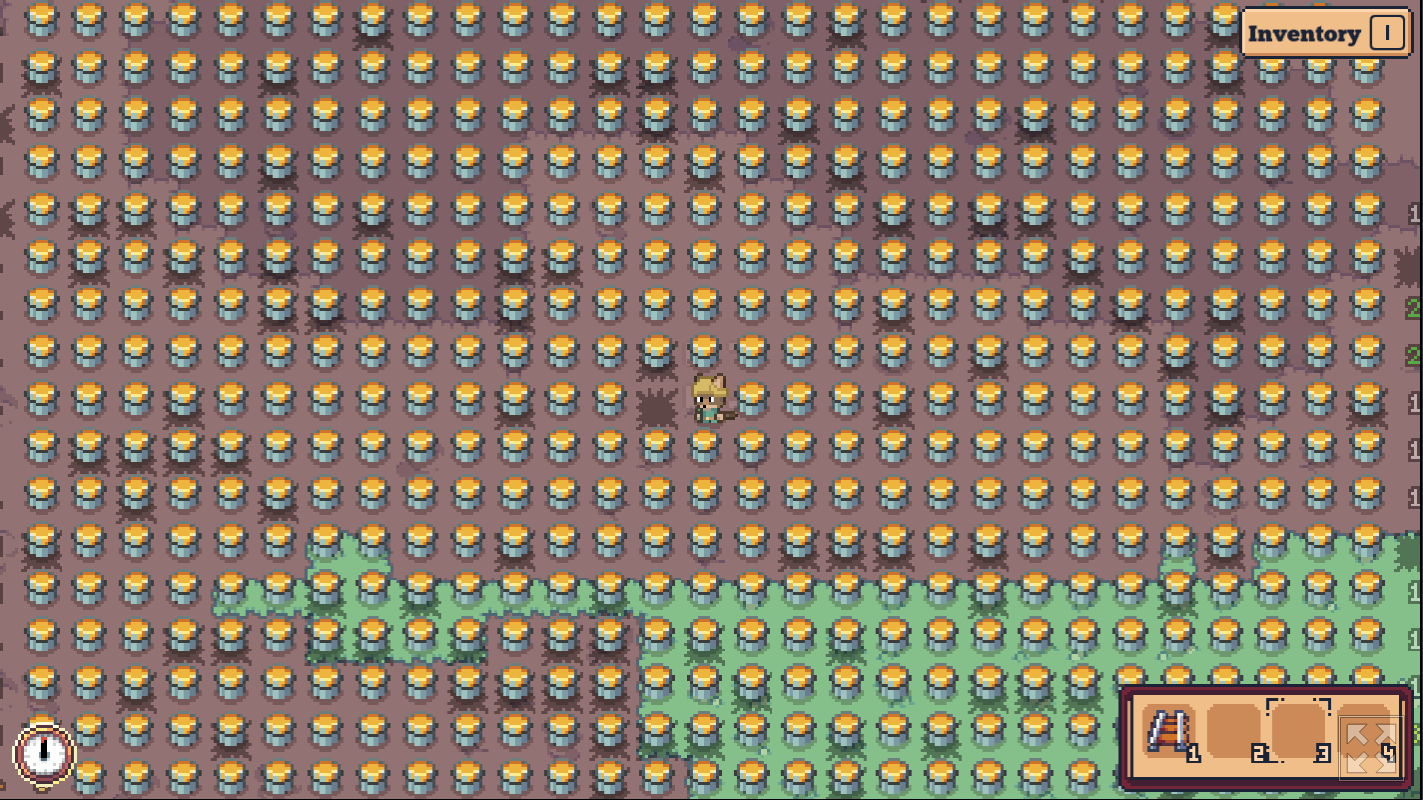
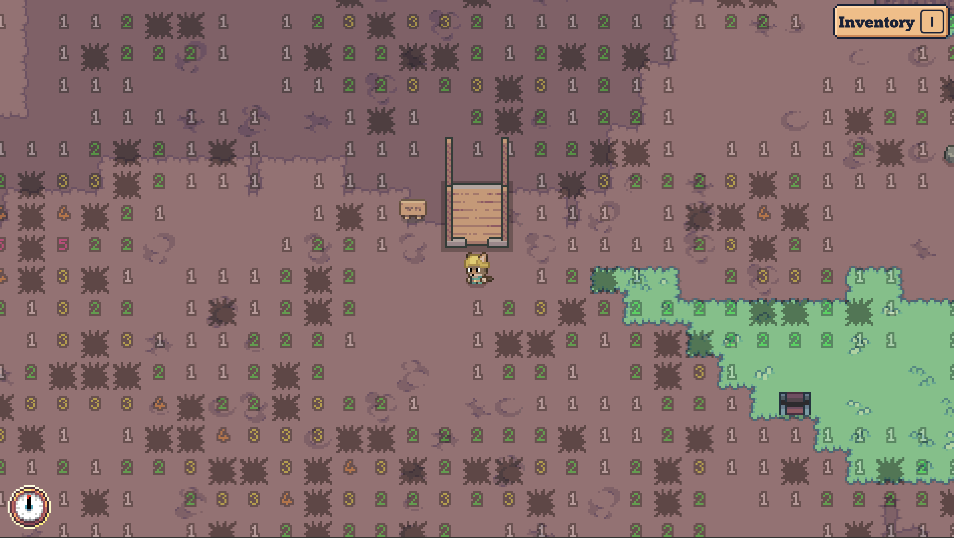
Try getting the lower right star without going through the block of hedges. I think the hedges are slightly more intuitive, but you can actually get all 4 stars without touching a single hedge in that square block using the hard to reach hint in the trophy room area. Turning off the fog would probably help too!