

That's awesome! Thank you so much for explaining it :D
I might make a similar tileset with just 47 tiles to see the difference better. If I do so, I'll post it here :)
By the way, could you clarify what dimensions is a single individual tile image? Is it 16x16?
328 days ago(+1)
Not sure if I did mention it, but they are 32x32. I believe they should scale without much issue, though I could always whip up a smaller version if anyone ever inquired. I've been a bit busy, but I have some time off soon. This conversation has been interesting to me, too. I'd like to see if I can pick through my work and find the spot where l had to convert up to the bigger tileset. If I do, I'll come back to this thread with the specific example that broke the blob tileset for me, and demonstrate how.
282 days ago(+1)
Sorry it took so long to get back to this again. Work keeps me busy, but I'm sure you know how it is. Okay so I think I can finally point out where the "blob" tileset fell short for me.
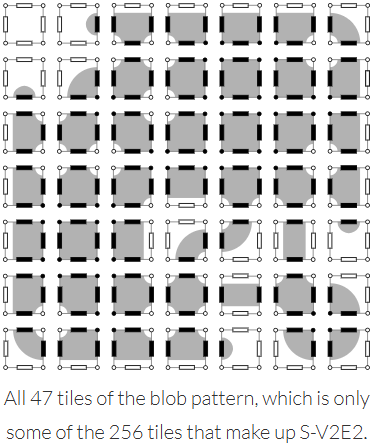
Image credit (this is a great page talking about tilesets btw): https://www.boristhebrave.com/2021/11/14/classification-of-tilesets/
As you can see, none of the tiles in this particular set are corner-only tiles.
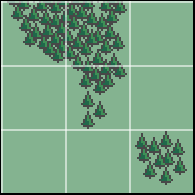
So for example, say that my auto tiler rendered a map, and I take a snapshot of this square pattern of 9 tiles, wherein X represents a forest tile and 0 represents some other terrain:
XX0
0X0
00X
If rendered using only the blob tileset, it comes out like this:
But using a 256-tile set where I can specify that corner connection, then it comes out like this:
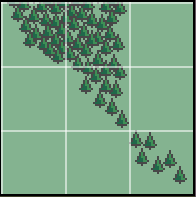
This use case comes up constantly in my map gen and it comes up a lot more natural with the 256-tile set.
Hope this finally cleared things up!