A downloadable game.
Very quick read with some good stuff in there. In this review I describe some features in a critical light, but I know for many OSR folks these features that I dislike will be straight up selling points. (You know who you are.)
You may run into issues adapting some content as this is one of those OSR hacks which uses its own version of the 6 stats. Basically, Constitution -> Vitality, Intelligence and Wisdom both -> Smarts, Charisma -> Charme, and a new Luck stat which the book actually says should be the stat used for most saves.
There are 3 "main" classes - a warrior, a spellcaster, and then a "hexer" which is like a half-caster gish. There's also one extra super class with every class ability and no drawbacks which you can only use if you roll all your starting stats high. I feel like this is kind of silly, you already get the benefit of your high starting stats, do you actually need the special super class on top of that? It's just win-more. 3d6 down-the-line is an OSR staple but adding the Paragon introduces a power gap which encourages a play pattern where you just keep throwing your dorks into the meat grinder with abandon until you can get the best class, then you can finally play the game for real.
Character level is essentially meaningless, basically just "how many times have you gotten to increase a stat?" And since you roll your stats totally randomly at the beginning, this can't even be used as a shorthand for character power. A level 10 character could have started with really crappy stats so would be mechanically weaker in every way than a level 1 Paragon. No mechanic looks at level, no value is derived from it. I would just remove the concept entirely. (Basically 1 sentence: "For every 100 EXP spent [on leveling up stats], the character advances one level.")
Tunnel Hack uses a mana cost system rather than Vancian casting or spell slots. I like this a lot, it's just a lot simpler. There's a short but well-rounded spell list with very minimalist descriptions, enough to support play but leaving a lot to the imagination.
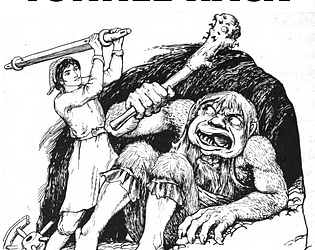
There's a pretty big weapon table, but not a lot of actual strategic depth to which one to pick. Basically, which of small, medium, or large do you want? Which one best fits the price/weight you can afford? Did you pick a Troll at character creation, allowing you to wield larger-than-large weapons? It's fine if that's not what the system is about, but in that case you can signal that it's not what the system is about by making this table, like, 8 entries at most. (Also, a Javelin is completely identical to a dagger, but it deals d6 instead of d3.)
A monster in Tunnel Hack consists of literally one number. This Monster Rating is the monster's HP and every single stat, and how you derive the number of damage dice it rolls. So as you deal damage to it, it'll get weaker.
I always appreciate a system that does away with the need for multiple rolls to make an attack. In this game, attacking just does straight damage. Armor reduces incoming damage by its value, to a minimum of 1. This is a deadly system.
I would need to do some tests to see that the mass combat rule is actually faster. Since only one side ever takes damage, and that damage is determined by the difference in combined damage rolls of each side and then distributed evenly across all participants, two large armies of similar offensive capabilities may actually be more survivable under this rule. It would definitely be faster in fights with with a power disparity, but also extraordinarily safe, so one may wish to forbid a party from using this rule if one wishes to keep PC mortality high. Or just throw a lot of ranged units at them as they ignore this rule almost completely.