A downloadable game.
Like an underdog lawyer, Justicar is a crafty and clever system that does so much with so little, nudging everyone in the right direction to weave an intricate and memorable case.
I consider Justicar a spiritual cousin to Blades in the Dark: both systems empower players to roleplay as smart characters in complex scenarios without overburdening them. Whereas Blades uses its Flashbacks to let players weave Oceans Eleven heists without pre-planning, Justicar uses the interplay of witness questioning to develop a tangled story without placing authorship on any one player. Played right, everyone at the table can contribute to the expanding web of intrigue and clues without feeling like a frantic GM prepping last-minute.
The game's mechanics are simple, diceless, and statless. They're nicely designed to guide freeform roleplaying and improv, rather than acting as a framework of possible action (see social combat systems like Burning Wheel's "Duel of Wits"). While I don't believe it's explicitly stated, I interpreted the character "Moves" to function like PBtA Moves: if you "activate" a Move, you have to do it in the fiction; if you do something in the fiction that corresponds to a Move, you have to "activate" it. Personally I found this to be an ideal setup for injecting mechanics into freeform roleplaying.
As a small note, the "balance" of connections and exhibits felt solid. Too many would be overwhelming, too few wouldn't leave enough room to improv. There were a few that never got explored in the game I ran, but I suspect with repeat sessions players will "grow into" the game and tie together more of the available pieces. The use of Miro as a game board was simple, visually-pleasing, and easily-organized.
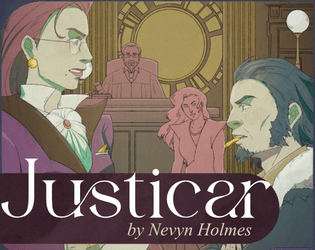
There are only a few gripes I can levy against the game. Most are small: the PDF resolution is a tad low and doesn't let the stylish artwork and typography pop as much as it should, and there are a handful of typos and inconsistent capitalizations. The only major rules confusion came from the Epiphany Clocks: the section where they're introduced states that "When a player's Epiphany Clock is filled, they get to reveal a truth about the case". During the Verdict however, the game also states that "Each player with a filled Epiphany Clock declares a final truth about the outcome of the case". The similar wording here makes it unclear whether a filled Epiphany Clock allows a player to declare a truth twice, or just once. The Clocks are a powerful way to shift the story, so more clarity here would be appreciated.
It would also be nice to see a bit more guidance on how to play out some of the fictionalized elements of the game's narrative structure of a court case. E.g. cases taking place very quickly, true culprits being arrested during the case even though they're not on trial, and other "Ace Attorney-isms". The game generally assumes these as a default and doesn't spotlight them beyond the general blurb about romanticized courtroom drama at the beginning. I could see these elements causing some confusion for players who have less background experience with the genre, or who enjoy somewhat more realistic courtroom dramas.
While it's not a complaint, I would love to just see more of this game. After creating colorful characters and a web of connections between them, my group was hooked and immediately wanted more before we even started the case. Unfortunately, Justicar is only designed for one-shots, so continuing our story with a new case involves a bit of fiddling. While I appreciate a game that knows when to wrap it up, I'd be lying if I said I didn't want the game's help with expanding our tangled crime web into a series of connected cases in the style of Ace Attorney.
Overall, Justicar is a fabulous system that points players in the right direction, then humbly steps into the background and lets human creativity take the wheel. There are scant few TTRPGS that focus on courtroom drama, but Nevyn Holmes and team have shown that there is potential for excellent games within the niche.