Indie game storeFree gamesFun gamesHorror games
Game developmentAssetsComics
SalesBundles
Jobs
TagsGame Engines

UGgame

7
Posts
7
Topics
A member registered Jul 06, 2025 · View creator page →

Creator of

Recent community posts

She had come.

Bluebrand—the Sword Saint, the strongest warrior on the continent.

No declarations. No banners. Yet countless warriors followed her without command. She stood before the Great Rift, black hair dancing in the wind. The fog parted before her like silk before a blade.

And then, she stepped into the labyrinth.

(Stage 30 Boss: The Sword Saint. Skill 1: Phantom Step Slash—teleports to nearest target and unleashes an AOE strike; Skill 2: Crescent Arc—basic attacks have a chance to become sweeping area attacks.)

No one knew if she felt fear, or tension. She moved like still water—silent, unshaken. But the moment she entered, the entire structure shuddered.

The Gatekeeper awakened.

Not in alarm. Not in defense.

But in resonance—an ancient battlefield instinct reawakened after centuries of silence.

His mind was still fractured, his voice long lost. But he knew: this one was different.

She was a warrior.


The Sword Saint drew her blade.

First strike. The entire frontline of towering monsters collapsed in a thunderous blast, wind shrieking through the corridors like bone-white lightning.

Second strike. An ambushing flank crumbled into smoke, the creatures dissolving back into raw magic.

Third strike. A circular shockwave obliterated two converging legions, leaving behind a stillness—the eye of a storm.

She did not rage. She did not scream.

She was cleansing—efficient, measured, effortless.

And those who had followed her were just the same. Calm, disciplined, loyal not to a nation, but to the aura of the Sword Saint herself.

They had not come to conquer the labyrinth.

They came because they chose to fight.

And deep within the labyrinth, the Gatekeeper felt it.

He saw her swordplay—not with eyes, but through the vibrations of magic, the pulses in the air, the harmonics of her movement.

He had once studied battle the same way.

“Strong.”

“Focused.”

“Huh... I feel like fighting.”

And in that moment, the labyrinth answered him.

His presence manifested.

No longer directing from afar, he pulled his will from the labyrinth and forged it into a body—a vessel woven from memory, instinct, and magic.

A figure forged from war.

(Manifestation Mode: When energy is full, the player may grip the summoned sword to enter battle directly as a hero unit. Gameplay shifts to action mode; left hand controls formation.)

He descended into the center of the battlefield. Mist billowed behind him like a tattered cloak.

No face. No eyes. Only a sword—one that felt like it had always belonged in his hand.

He was no longer just the guardian.

He was the Arcane Sentinel.


In a single moment, Bluebrand felt a chill crawl down her spine.

What was this?

A figure clad in black, faceless, surrounded by swords that spun like orbiting stars.

She slashed.

Blocked—by floating blades.

The very air trembled, but he didn’t even flinch.

She shifted forms: leap, dive, spin—three consecutive strikes, meteor-fast.

Still blocked.

For the first time in her life, she felt powerless.

What is this thing?

Every sword strikes like a beast.

What kind of fighting style is this?

This wasn’t a duel of technique.

She was facing a being beyond her understanding.


The Gatekeeper bore no malice.

He simply raised a hand.

A distorted wave of magic tore across the field, dividing it in two—her warriors behind, herself alone.

He had no name. No voice. No reason.

But something inside him still recalled this ancient rhythm.

This is called “battle.”

He swung his sword—energy ripped the air.

He raised his hand—gales of blades scattered like dragons in the wind.

He was the labyrinth.

And she, for all her might, stood beneath a falling waterfall of steel and silence.
The Order of the White Night was nearly annihilated.

Clad in the Empire’s finest rune-forged armor, hardened by countless campaigns, feared across borders—they bore the codename White Night.

The day they marched, the skies above the Great Rift were choked with stormclouds, but the knights held no fear. They scoffed at myths of monsters and curses. They believed in strength, in discipline, and in the sharpness of the blade.

They entered the labyrinth in formation. Sector by sector, they advanced. Traps were laid, scouts deployed, contingencies mapped with textbook precision.

But what they faced was no mindless swarm.

Their enemy had become one with the labyrinth. The labyrinth served as his eyes, the monsters his hands—even though memory, language, and humanity had long since left him.

Still, he fought.

He did not think; he was.

His body, his magic, his mind—all had been absorbed into the architecture of the labyrinth. Every pulse of every creature, every shifting hall and breathing wall, was an extension of his will.

And with it, his instincts as a general—honed in the blood of past wars—reawakened like wildfire.

The White Night Knights lost not to strength, but to strategy.

Ambushes. Pincer attacks. Feints and flanks.

The monsters advanced not like beasts, but like soldiers—an army of darkness commanded by an unseen will, terrifying in its precision. Worse still, they seemed endless.

When tactics failed, numbers failed too.

No matter how elite, how disciplined, how courageous—they could not defeat an immortal, inexhaustible legion.

Two thousand knights marched into the labyrinth. Only a few dozen crawled out, dragging the shattered body of their commander.

And then, on the way home, they met a figure on the road.

A flash of flame.

The entire White Night Order was wiped out.


The Imperial Council could no longer sit idle.

They had first dismissed the problem as a magical anomaly, perhaps a minor breach in a forgotten seal. But this was different.

The Order of the White Night was no ordinary force. They were the best.

And now they were gone.

Panic consumed the chambers of power.

What if the creatures crossed the Rift?

What if the enemy could attack, not just defend?

What if something truly intelligent lurked inside that labyrinth?

Doubt became fear. Fear turned to pressure. No longer did they speak of "clearing monsters." They began to ask:

“If they come, can we hold?”

At last, someone spoke a name. A name not uttered in decades, yet known by all:

“Summon the Sword Saint.”


Sword Saint was no title. It was a recognition—one earned by so few that all of the continent could name them on one hand.

And of those few, one stood above the rest:

A former borderland drifter, now known only as Bluebrand.

She had once split the Desert Dragon in half with a single strike. Once stood alone against an army of thousands.

She owed no allegiance to the Empire. She answered to no law. But she did owe the Council a debt.

Long ago, when dynasties fell and the old Empire died, the Council had granted clemency to her bloodline.

Now, the debt was called in.

A messenger rode through storm and shadow to deliver the sealed request.

She gave no reply. But at dawn the next day, she stood silently at the edge of the Great Rift.

No armor. It would only slow her swing.

Just a single longsword strapped to her back, dull and unassuming.

She said nothing.

Only turned to the councilor who awaited her, and asked in a soft voice:

“Is it strong?”

The man answered truthfully:

“The White Night Order was annihilated.”

She nodded. Tied her hair into a ponytail.

And walked into the labyrinth.

The king's personal campaign ended in failure.

He had taken only a handful of bodyguards and a small troop of knights—not from arrogance, but from cowardice. He dared not let the Council know he'd gone hunting on his own.

The labyrinth offered no mercy.

At first the march into the Great Rift seemed calm; everyone assumed the expedition would go smoothly. The moment they crossed into the labyrinth, everything flipped. Under a coordinated onslaught, the king’s force had no capacity to fight back.

They were not crushed so much as driven out.

More precisely: spared.

The general—who had long since forgotten words—stood deep in the Control Room and watched the battle unfold.

He could not read the forged phrase “restoration bequest,” nor grasp the motives of these strangers.

Yet some vague, ancient instinct frozen in his blood told him one thing: he did not want to kill.

So he did not hunt the fleeing king.

That mercy planted the seed of catastrophe.

The king returned to the capital battered and terrified.

He did not retreat into defeat. If anything, he grew more certain than ever:

There was something enormous hidden in the labyrinth.

The monsters had acted with order, with restraint; they had even halted when he lay near death—this did not look like uncontrolled violence. It looked like protection. Protection of something supremely important.

“They were executing a mission.”

“That matches what the decree described.”

That decree had been forged by the demon-occupied mage.

Now lie and fact overlapped perfectly.

A carefully constructed falsehood, by the general’s clemency, had become “proof.”

The king wasted no time.

He leaned on the Council.

“The number of creatures in the labyrinth is rising.”

“If we do not strike first, our lands will be threatened.”

“This is a matter of national security.”

He spoke little of treasure, repeating instead the danger the monsters posed.

the Council never truly cared about truth. For them, whether monsters existed or whether treasure lay hidden was irrelevant. What mattered was whether a military campaign could pull nobles into line, crush dissent, and fatten the coffers.

So the kingdom’s First Order—the Order of the White Night—was mobilized.

An elite mixed force, capable of independent operations, answering only to the Council’s command. Years of peace had left them restless.

(Stage 20 Boss: Commander of the White Night. Skill 1: Heavy Armor—reduces incoming damage proportionally to skill level; Skill 2: Riposte—immediately strikes back at attacker when hit.)

This meant the operation would leave no room for restraint.

Worse, they believed they fought for the Empire’s honor and would not yield. That conviction made the nameless guardian show no mercy.

The labyrinth sank into slaughter once more. The Great Rift ignited with iron and flame.

Far from the battlefield, in the hush of the Council chamber archives, the mild-faced, taciturn mage quietly drew a single old expense slip from the files and consigned it to ash.

the Abyss’s will sat at the heart of the kingdom itself.

Two centuries passed. The kingdom that once ruled the land was long gone, replaced by a new empire rising from the ruins. New castles rose, new laws were written, and even the Forbidden Zone was rechristened with a simpler name: the Great Rift.

No one spoke of the old war anymore. No one remembered the general who sacrificed himself to the labyrinth to keep the world from falling apart.

Until one stormy night, when a young sorcerer dared to perform a forbidden rite—the Rite of Beyond, a spell meant to commune with a being from another plane.

The risk was immense. If fortune smiled, the caster might gain profound knowledge. But the danger lay in not knowing who—or what—might answer. And that night, the sorcerer’s call reached the Abyss.

Worse still, the Abyss answered.

In that instant, his mind shattered like thin ice, pierced by a will not of this world. It was no mere monster, no wandering spirit. It was something else—something that could only be named demon.

The sorcerer was not tempted, nor possessed. He was replaced.

The new “him” spoke in the same voice, walked the same streets, smiled the same smile. He studied magic with uncanny zeal, his talents growing at a terrifying pace. Soon he stood in the royal court, serving as an advisor, admired by all. But the true sorcerer’s soul had long since sunk into the Abyss. What walked among men now was a demon wrapped in human skin.

At first, the demon was merely bored. He meant only to toy with the foolish mortal who had dared call to the Abyss. He would play for a while, then leave. But to his surprise, upon entering this world he felt something extraordinary—unclaimed, unguarded magic. A node of pure power. The kind every abyssal creature coveted beyond reason.

He scoured the records of the old kingdom and uncovered the truth: the young general, the sealed labyrinth, the imprisoned source of magic. He realized that if he could quietly claim the node before other demons discovered it, his strength would swell beyond imagining.

For mankind, the node was disaster. For a demon, it was a feast.

So he made his move.

He erased the evidence. Royal archives were altered. The war was rewritten into a harmless tale of “wealth transfer and secret storage.” He forged a false royal decree claiming that the old kingdom had hidden away its treasures and weapons in the labyrinth as a legacy for its heirs.

He placed this false will in the hands of the new king.

The king, young and ambitious, was shackled by the power of the Council. He longed for independence, for expansion, for a golden age that was his alone.

The promise of “lost treasure” was the perfect key.

But he knew such wealth could not flow into the state’s coffers. To seize it for himself, he gathered only his closest confidants and a handpicked company of royal knights, and set off in secret for the Great Rift—long forgotten, long silent.

They thought they were unlocking the secrets of a fallen dynasty.

They did not know that by entering, they risked turning their own dynasty into history.

For the Rift still had a guardian.

A guardian who no longer spoke. A guardian who no longer remembered the meaning of words.

He felt the intruders step onto the sealed ground.

He did not recognize them.

He did not understand them.

Only one judgment remained:

Intruders.

And so, for the first time in two hundred years, he loosed the labyrinth’s monsters.

But they did not pour out in chaos. They moved like soldiers—organized, disciplined, with intent. He reactivated the defenses of the sealed zone, recalled the legions he had long since tamed. Though memory had abandoned him, instinct reassembled the battlefield. He commanded as he once did in life. Only now, his soldiers were not men—they were monsters.

The labyrinth awoke. Howls and steel clashed in the echoing dark, and the ground shook beneath the march of claws.

(Stage Ten Boss: The King. Skill 1: Summon Royal Guard—calls 3 heavy infantry, 2 mages, and 1 elite warrior. Cooldown: 10 seconds.)

The king’s knights were no ordinary soldiers. They were elite, the pride of the Empire. But they were not facing mere elites.

They faced a commander who had spent two centuries sharpening his art within the labyrinth—leading an army that did not sleep, did not fear, and could never be exhausted.

The Great Rift once more drowned in blood and silence. The world remembered the labyrinth.

But none knew the truth: it all began with a demon’s whisper.

Time slipped away. In the dim labyrinth, only the monsters remained—alongside the general who had long since merged with its essence.

Year One. The seal held strong. Year Five. The creatures thinned out, the outer halls fell quiet again. Year Ten. The world began to forget. The land was drawn in gray on imperial maps, marked as a Forbidden Zone—a place of whispers, no longer of fear.

Year Forty. A few still remembered.

The general’s old comrades from the final battle would sometimes come. They could not enter, but they pitched tents by the entrance, bringing smoked meat and strong drink. They sat by the fire, laughing and raising their cups toward the sealed abyss, as if he sat among them still.

Some would whisper: “The general can hear us, right?” Others would shout with a grin: “You’re still here! We haven’t forgotten you!”

They spoke of the new emperor’s coronation, of children born, of their own aging bones and retired swords. They spoke of losing strength, yet never losing the memory of that last desperate stand.

The general never answered. Yet the faint glow within the seal never faded. He was still there.

Year Fifty.

An old woman arrived at the glow. Frail and bent, guided by the hands of her children, she stood for a long while before finally raising her trembling hand in salute.

She was his lieutenant.

She spoke no words—she knew none would come back. She left only one line:

“Forgive me, commander. I may never come again. But the world will not forget you.”

Then she turned and left that land forever.

Year One Hundred. No one came anymore.

The Empire had survived its war against the monsters, but at terrible cost. Dynasties rose and fell, cities split and reformed, maps were redrawn. The labyrinth became myth, then faded even from myth, until only a broken landmark and a misread name remained.

But the general endured.

He did not die. Bound to the source of magic, his body never aged, not even a fingernail broken. But his mind—that fragile, finite human vessel—was never made to bear eternity.

It began to unravel.

Memories wore away like carvings on stone, washed by endless rain. First his name. Then the faces of family, the voices of comrades, the farewell of his lieutenant. All turned to ash, stripped away in the dark, silent years.

Only the mission remained.

But he no longer remembered who he was.

One day, in a rare moment of clarity, he panicked at how much he had lost. He tried to write, to record—but when he pressed his finger to the stone floor, he realized he had forgotten how.

Letters were broken fragments in his mind, a puzzle with missing pieces. Even the concept of “language” had slipped beyond his reach.

Language—the bridge between people.

But it had been far too long since he had spoken a word, or heard one in return. The bridge collapsed from disuse.

Instead, he clawed at the walls. With nails, with stones, with shards of bone, he scratched symbols into the labyrinth. At first, he tried to carve letters. Then they became lines. Finally, shapes.

And what frightened him most was that he no longer even felt afraid.

He did not know if the drawings meant anything. He only remembered one truth:

No one must enter here.

He no longer recalled why. He no longer questioned. He only knew it was necessary.

Through uncounted years, he turned to study the monsters. No longer fighting, but observing. He poured fragments of magic into the echoes of “battle” still lodged in his memory, fashioning weapons and tactics for the creatures. They mirrored the armies he once commanded. And slowly, the work of controlling the monsters became the whole of his existence.

He became a machine—a tactical system of the labyrinth.

Without language, without memory, he moved with perfect calm and precision. All intruders were threats. He carved the command into the stone:

“No one must enter here.”

The labyrinth was once more a deathtrap.

But this time, it was not wild magic spilling into the world. It was the will of a nameless watcher—who had forgotten himself, yet remembered his duty.

And deep within the seal, the faint glow still burned.

In the three hundred forty-fifth year of the Empire, the earth tore open, leaving behind a rift that would never close.

From that abyss did not come fire or molten rock, but something far stranger—a labyrinth without reason or form. It had no fixed entrance, no definable end. From its shifting corridors, creatures of nightmare poured forth, crawling from the mist like a tide that devoured fields, poisoned rivers, and corroded human hearts.

Panic seized the Empire. Soldiers, knights, and priests were hurled into the rift, wave after wave, vanishing like moths consumed in flame. None returned.

Their only legacy was a bitter truth: the more forces they sent, the more monsters appeared.

Then came the last day, when the final trumpet sounded and the last legion marched.

At their head stood a young officer.

He was barely thirty, a man of humble rank, unmarried, his sword not yet inscribed with its full markings. Though gifted in both command and blade, his blunt honesty had earned him only resentment and obscurity. Yet when the Empire’s finest had all fallen, when the chain of command lay shattered, fate thrust its burden into his hands. He carried it not as an honor, but as a sentence.

He knew this was a journey from which he would not return.

His plan was simple and final: the legion would fight and die to hold the line, while he alone would slip into the labyrinth’s heart. If the labyrinth had anything resembling a core—a “heart”—then someone had to plunge their hand into it, no matter what horrors waited to tear him apart.

The battle began.

Steel clashed against claws at the labyrinth’s threshold, the first steps awash with fire and blood. Cloaked in the shadow of that chaos, the officer entered alone.

Inside, the labyrinth was endless. Silent. Unforgiving. The walls shifted like living flesh, corridors grew and twisted as though the labyrinth itself breathed. Step by step, guided only by instinct, luck, and perhaps something greater, he pressed on—until, impossibly, he reached the core.

He had faced hundreds of creatures and glimpsed landscapes that did not belong to this world. Yet what truly unsettled him was not the monsters, but himself.

His wounds knit faster than they should. His senses sharpened to an uncanny degree. At times, he could even hear the pulsing rhythm of magic within the stone itself.

The labyrinth was changing him.

It was not corrosion, nor mere possession, but something deeper—a remaking.

The magic was rebuilding his body, rewriting him piece by piece, stripping him away from the realm of “human.” His strength grew, but the cost was identity itself.

Would he ever return? Would he still deserve the name “man”?

At last, he stood before the chamber he would one day call the “Control Room.”

It was vast, hollow, and cold—like the abandoned nexus of some forgotten god.

No monarch awaited him there, no dark master ruling the horde. Only a single node of pure, suspended magic.

He struck at it without hesitation, but his blows meant nothing. Light cannot be cut. Shadows cannot be slain. The wind does not bleed.

And then he saw the truth.

The monsters were not summoned.

They were natural.

Like sunlight birthing heat and shadow, raw magic birthed monsters whenever it settled. The labyrinth was nothing but sunlight concentrated into a single burning beam. The node had drawn too much magic, and that was why the world now drowned in horrors.

He stood still for a long time before the swirling core of runes.

No miracle. No hope.

Only a choice.

“If it cannot be destroyed…”

He understood now. He was no longer the officer who had stepped into the labyrinth. The magic had already fused with him, transforming him into something new—something capable of bearing its weight.

It was a curse, but also a gift. Where others had only perished, he had been given a chance.

He would use it.

He unclasped his insignia, sent his final words to his lieutenant—“Don’t come for me.” Then, reaching out with steady hands, he offered himself to the labyrinth’s “heart.”

Flesh burned in the torrent of magic. Thought dissolved into fragments of sigils. His very being expanded, stretched thin, then reformed into something vast.

He became the labyrinth. Not its master, but its vessel.

The surge quieted. The magic that once spilled into the world was now absorbed, digested, held within him. No more creatures crawled from the rift.

So long as no one disturbed this balance, the world outside could know peace again.

The labyrinth fell silent.

And he was bound to an eternity without time, without light, without speech.

A curse with but one name:

Endless solitude.

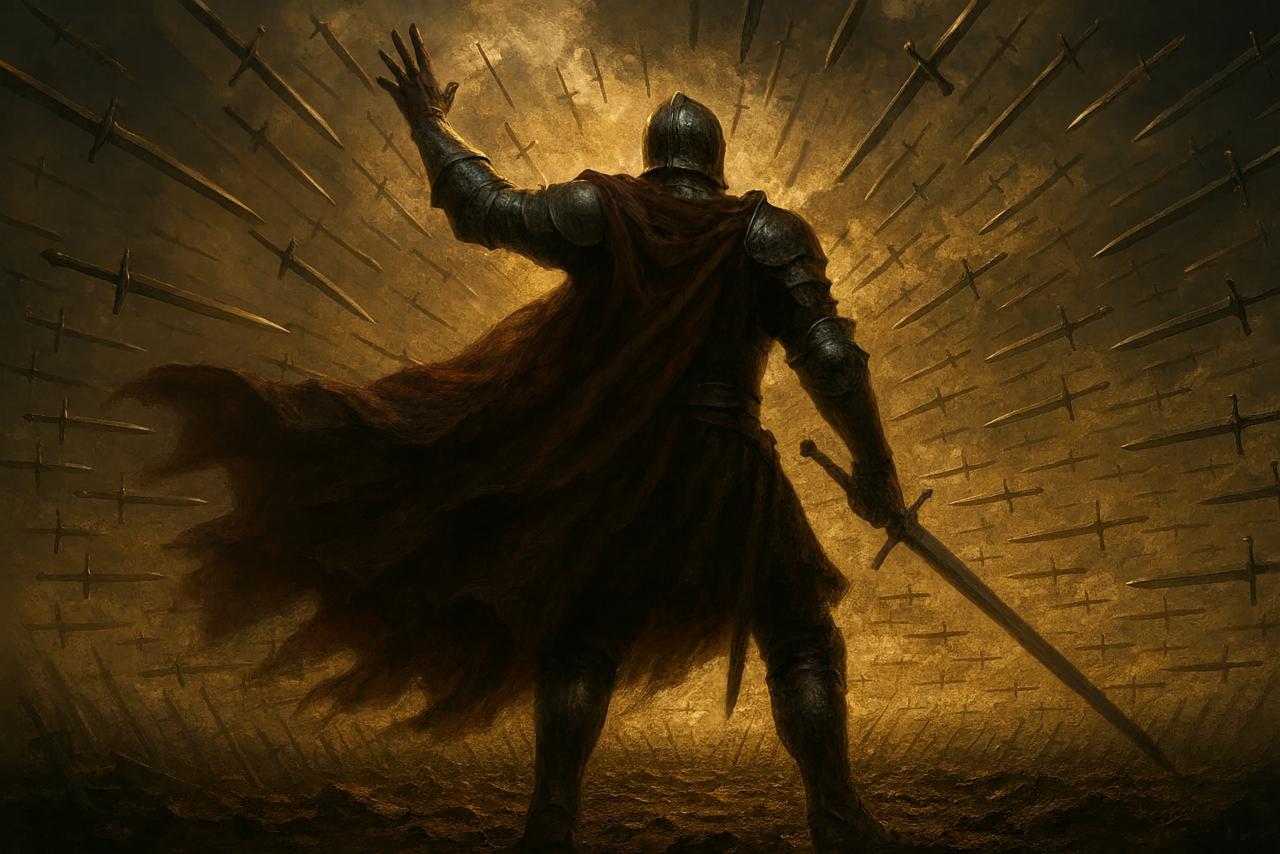
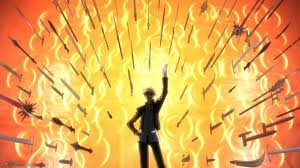
Hello everyone! I originally made a VR auto chess game, and its biggest feature was that the player could enter the battlefield as the hero unit, taking full advantage of VR’s immersive experience. But later I felt that just jumping in and swinging a sword was too ordinary,I wanted to give the protagonist something more exciting. For a while I couldn’t find the right inspiration, until I remembered Gilgamesh’s Gate of Babylon

: the image of countless weapons rushing forward at just a wave of the hand was simply too cool, and it perfectly matched the kind of superpower I had in mind. That became the spark for creating a brand-new gameplay mode.

In this new mode, players can lift their left hand in different directions to transform weapon formations. (Check out the video for details!) My plan is to build out this new mode as a core part of the game, with its story connecting back to the auto chess mode, set in the timeline before the events of auto chess.

I’ve now completed the first weapon: the sword. Its defining trait is balance—its modes include melee, ranged, wide-area attacks, and defense, all integrated into the main game mode. I’ve released a demo version for standalone VR headsets, so anyone interested is welcome to give it a try. If you’re a Meta Quest user, you can find the demo directly in the Meta Store by searching for The Daily Adventurer. When players activate the Advent Mode and enter the battlefield, they’ll be able to use sword formation control.

I’ve also designed several other weapons: the halberd, with powerful linear strikes but limited area coverage; the warhammer, extremely strong in close combat but with all of its attack range concentrated in front; the staff, which wields various kinds of magic but consumes a lot of energy and lacks basic attacks; and the grimoire, which continuously fires bullets but without piercing capability. Each weapon is controlled through left-hand movements, similar to the sword formation system shown in the video, and development is currently ongoing. The full version is planned to feature six weapons and nine stages. The stages will play similarly to Vampire Survivors, with swarms of monsters to fight, and each stage ending with a boss battle that tests the player’s growth and strategy

https://uggame.itch.io/the-daily-adventurer