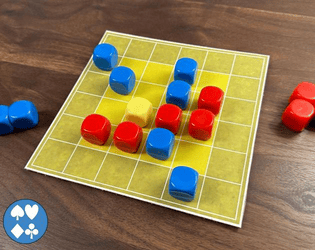
Happy to see it released!
Riffle Shuffle & Roll
Creator of
Recent community posts
You are discovering my game's secrets! You will be the first Grandmaster of Hoppsi. =^)
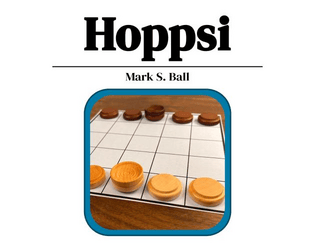
I have been playing many games against a computer opponent, and I discovered the blunder of the captain opening move! Moving two pieces on the same side to open is also a mistake if your opponent quickly exploits it! I have also discovered that you cannot be afraid to bring your captain into play because it is good at controlling the center as along as you do not set it up to be captured by accident.
You must be willing to sacrifice your runners in order to get your captain into the open for a breach.
You are also right about how a Total Wipeout (meaning capturing all the runners and the captain) is impossible due to the rules. In fact, just getting a regular wipeout (capture all the runners) will require great skill or great blunder!
One thing I have started looking at is to make the board 5 squares wide and 6 squares tall in order to improve the number of possible opening moves. This is a double edge sword because it might improve the game, but I move away from a somewhat standard board. I have tried 7x7, 8x8 and 5x7 with different piece counts, but none of them feel right. There is an elegance in using the 5x5 and 5 pieces.... but a 5x6 might better serve the game.
Thank you for sharing the video! The game looks great with Tak pieces. I realized last night that the game is easily playable with checkers as long as they are two sided (one side plain, one side with a crown or a design). Each runner would start the game with the plain side up. Once your runner hits your opponent's home row, it is flipped over to the design side. This means it is now heading the other direction. Once you hit your own home row again, the piece is flipped back so the plain side is showing. For the captain, simply stack two checkers and treat it as one piece. I bring this up because I am working on how to do a simple production of the game, and checkers pieces are easily attainable. BUT the game would look much more unique and perhaps more elegant with special pieces. Your Tak setup makes me want to produce special pieces (perhaps isosceles triangles, and a circle for the captain).
Right now, there are three ways to win the round, and they are all worth different points. Capturing your opponent's captain gets you 1 point. Breaching your opponent's home row with your captain gets you 2 points. A wipeout, capturing all of your opponent's pieces is worth 3 points. The wipeout happens so rarely, that it might actually be worth an "automatic win" as far as the match points go.
As far as making the longest multi-capture the mandatory choice... I will start testing that idea! It makes sense for a game that is so focused on setting up traps like Hoppsi. My first priority was finding balance between the mandatory rules and player choice to make the game feel as open as possible on the small board. Leaning into the forced trap setting might be the more enjoyable choice though.
I will start testing this week. Thank you again! = )
Oh that is awesome! I have started looking for a Tak set on Ebay. I might pick one up soon. If you don't mind, I'd like to add your picture to the BoardGameGeek page once it is active.
For your question, the rule is currently: If you have more than one capture option on your turn, you may choose which to take. Thank you for pointing this out! I have amended the capture section to say the following:
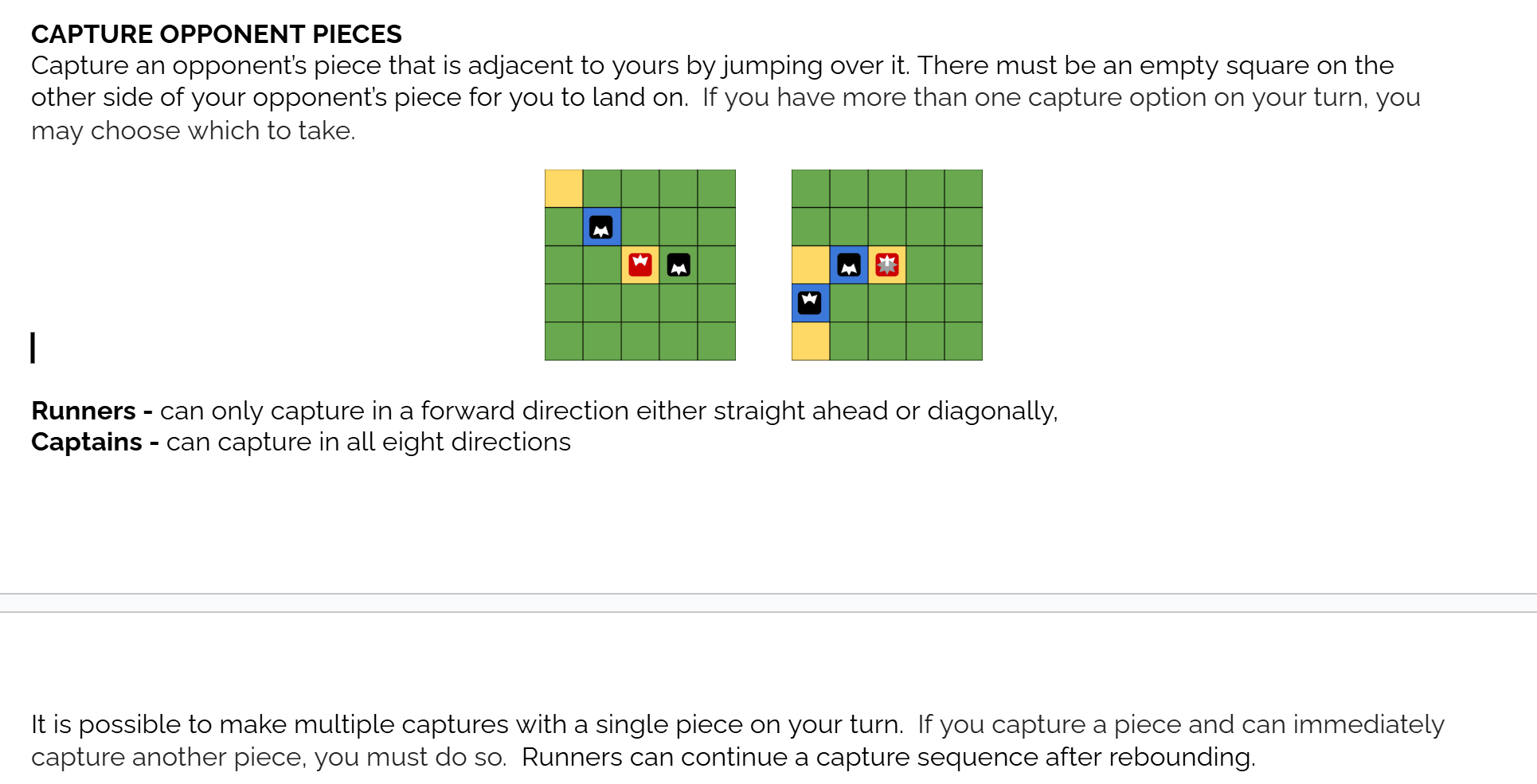
I will also add an image to illustrate continuing a multi-capture after rebounding ASAP.
Thank you so much for the feedback! I am so happy to hear you are enjoying the game. ALSO, I do like the idea of a colored home row for each player. In my mind, Hoppsi is very much a field game of tag!
The Python testing was interesting. I do not know anything about coding, so I have been leaning on Gemini for help. Honestly, it has been a major hassle because I have to constantly check to make sure Gemini understands the rules of the game. I was running really long simulations for hours just to realize the rules were wrong. I really need to learn what the code means and how it works, but I am just getting started.
I just switched to Lua for Pico-8, and now I can check the code by actually playing a computer opponent. I can understand Lua a little more, so I think I am going to lean into that language and start studying.
You are exactly right about the scoring being swingy based on skill level. Spot on. Highest score after four rounds seems intuitively correct to me (each player gets to go first two times in a game. If tied at the end of the fourth round choose who goes first at random. BUT, I would still like to at least explore the option of having a "first to x points" win objective. You mentioned in a previous post that the AI is able to see 8 turns into the future. Are you able to limit that to only 1, 2, or 3 turns into the future so we could see data for a more human-like skill level? It seems to me that most people will only be able to see 1 or 2 turns into the future because they don't know what decision the opposite player will make. If we can get game data with that in mind, we might be able to get a more realistic number for how many points makes sense.
If the game does end up just being played for X number of rounds, the data for how many cards are left would not be necessary, but it would still be really fun to see.
I love seeing this sort of data! Are you able to determine how many cards are remaining uncollapsed once a player wins in your simulations? I’d like to know the range and average.
I would like to develop a score system based on how many cards remain face up. The player earns one point for each card face up when they win. Play rounds until a player reaches x score (alternating who goes first as you suggest!)
You can play Sentinel's web implementation right here: https://sentinel65.github.io/Collapsi_AI_BASE64_en.html
It is good. =^)
I am seeing some personal preferences when it comes to how the game begins. Another fun idea a number of people have shared is to replace the starting cards with numbers and allow the players to pick where they begin the game. I included this in the PDF as a rule variation. I don't replace the numbers though. Instead, the rules state that the jacks begin the game collapsed.
I am happy to see there is balance. I made the change to provide focus for the opening rules. I felt the game was too open in the beginning and gave players a sense of what exactly am I trying to do right now? I wanted the setup and first moves to be a simple as possible. Thank you for taking the time to run the simulations!
Thank you for taking the time to do this. Just so you know, multiplayer is a shorter way to say multiple players meaning two or more. Single player means one player and sometimes the term "solo" is used to describe a game for one player. Again, I want to emphasize that I am very happy you have put so much effort into the online implementation of Collapsi! It has been awesome to play.
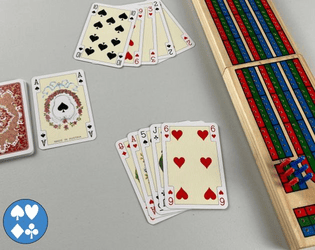
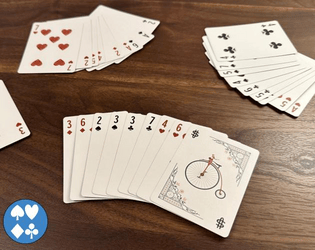
The rule book has been updated since 6/30/2025. The deck of cards used for the 4x4 grid and the 6x6 grid was also changed to include Jacks rather than jokers (since most people have four jacks on hand, and not every deck has jokers). You can download the pdf for the rule book on the game's main Itch page. Here is the setup from the rule book:
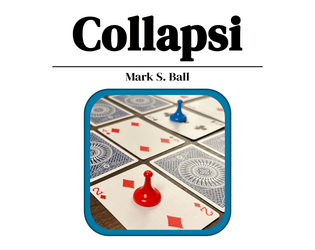
Player 1 goes first. The number of spaces you must move is determined by the number on your starting card. A starting card is the card on which you begin your turn. On your first turn, your starting card is a jack which allows you to move one space. After you complete your move, flip your starting card face down. That card has collapsed, and it can no longer be passed through or landed on. From your second turn on, you must move a number of spaces equal to your starting card’s number. If your starting card is a 2, you must move two spaces. If it is a 3, you must move three spaces and so on. Your starting card will collapse every turn.
I am done with rule updates for the multiplayer game (meaning 2 or more players), so this is what stands. =^)
Regarding the solo game, I have removed it from the rule book entirely until I can get some more data regarding what works and what doesn't.
My cousin helped me with the solver that used the older rule set, and he generated unsolvable and solvable puzzles, but I have not seen the data. I fear my rule change that makes every board possible also makes the puzzle far too easy. I'm leaning towards scrapping the solo version altogether.
Is there any way you could email me, so we can streamline this conversation a bit? My email is marksball@gmail.com
In regard to your app, when I play the multiplayer game, it is not beginning correctly. From the starting joker, I can move to any card on the board. The updated rules state that you must move from the joker to an adjacent card. The starting joker is essentially a 1 now. I think you said the app plays that way, but it's not doing that for me. When playing under all of the multiplayer modes, the piece can be moved to any card on the board from the starting joker.
I have been working with a solving program for a few months (with the rule that from the joker you can go to any card in the grid). Trust me, these puzzles can be solved as long as there is a 1 that can access the exit joker. =^)
The solver has not been changed to account for the potential rule change that the player must move to an adjacent card from the starting joker.
Also, could you help me out with the solo game? I would like to know if there are any unsolvable puzzles when the first move is limited to a card that is adjacent to the starting joker( just like the multiplayer game), even if is it on the edge and can reach other cards through wrapping. I have only played and tested that you can move to any card on the grid. I have not been able to gather data about this new way to start (the same rules as the multiplayer game now).
That is correct! Again, I apologize for the miscommunication on my end. I've received quite a few comments about how the game ends, so I need to get a new video up ASAP.
This was actually the last thing I changed about the solo game. Before, I was planning on telling people that the puzzle must have an ace that can access the exit joker. That meant the player would have to identify the problem and fix it, and I did not like that solution. So, I changed the rules to make it a smoother game. Now I just need to communicate that better!
I’m afraid you are misunderstanding the rules (which is my fault). Every board is solvable. I will have a better video soon. I know I did not do a good job explaining.
You do not need an Ace beside the exit joker. Think of the exit joker as a door. All you need to be able to do is pass through the door, so any number will work.


