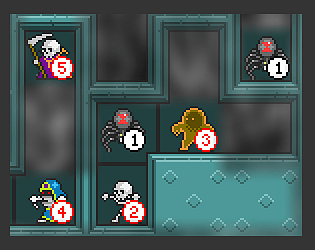
that's deliberate, but there is a way to get out. rot13: Qb lbh ernyyl jnag gb uryc gurfr wrexf znxr zber ebobg-tubfgf (nffhzvat gurl pbhyq rire npghnyyl envfr rabhtu zbarl gb qb vg)? Znlor gurer'f fbzrguvat lbh pbhyq qb gb fcvgr gurz vafgrnq bs chggvat ba gur fubj gurl jnag. Gur oyheo gb gung yriry zragvbaf gung gurl arrq gb nibvq n "gbgny flfgrz snvyher".
puleo
Creator of
Recent community posts
I really enjoyed this game -- it has a very amusing premise and the puzzles are quite fun (although I can't quite figure out how to beat level 8).
I am also realizing now that I play it and notice its early submission time that I may have subconsciously taken some mechanical inspiration from this game for a part of mine. I'll add a note to that effect on its landing page; I hope that you do not mind!
I played through the first few levels of this and enjoyed it, although once the rules started getting more complex (which for me was somewhere around level 5 iirc) I found myself wishing a bit that it would save progress between sessions so that I could peck away at a puzzle for a bit and then come back to it later without having to keep a tab open for it.
it's also interesting to me that clearly not all the rules are self-inverse in the sense that clicking the same square twice will cancel itself out. you seem confident that the game cannot get itself into a state where an actual reset is required, so I take that to mean that each move *can* be reversed by some other sequence of moves, but I find myself wondering how you guarantee that.
(also, there's a part of me that wants both the all-white and the all-black states to be win states, given that you're always starting with a non-monochromatic state anyway, but perhaps for some rules it's much easier to get to one than it is to the other, especially given the asymmetry mentioned above.)
I doubt that I will complete this, but it's definitely an interesting and thought-provoking game to play around with!
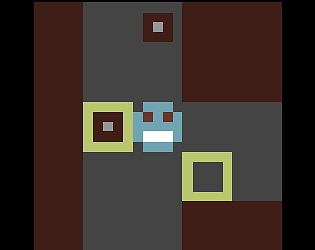
Fun Fact: The original kernel of inspiration for this game was actually the robots that did cleanup work at Three Mile Island. If I'd gone further in that direction then probably the game that resulted would have been a lot less cynical than this ended up being. But pretty quickly I wanted the player character to be transparent so that the arrow buttons would be visible behind them, which meant I decided they should be a ghost, and the rest of the game kind of fell out of that.
I would also argue that this game is on-theme if you stretch a bit, not that it particularly matters considering that the theme is optional anyway. But I'd argue that the circuit board the player character is trapped in constitutes a "locked room" and, maybe more abstractly, the room that the robot is in is also "locked" from one level to the next.
it may interest you to know that there is now a WIP cart available for an expanded version of this game: https://www.lexaloffle.com/bbs/?tid=157612
right now the WIP is still very much in its infancy, but it's at least feature-comparable to the jam version of the game, and I think it looks and controls much nicer
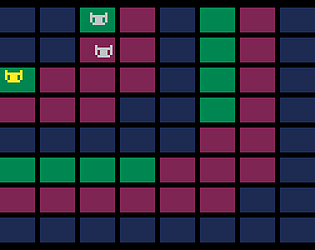
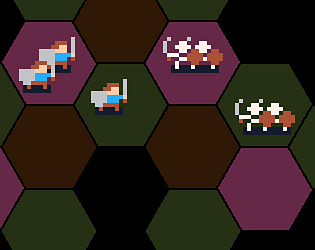
Hey, thanks for playing the game! I chose the initial position of the game so that the first player was guaranteed to have a winning strategy, but also the computer player does have perfect play if the player hands it a winning position. The colors of the squares are significant to the winning strategy: for example, you might try convincing yourself that any position where all knights are on blue squares is a position that loses for the player to move.
(In slightly more mathematical terms, if you think of the moves that push a knight off-board as not actually being available, then this is a normal-play impartial game, so it's Nim in disguise.)
That was my experience as well when I was trying to figure this out on paper before I built the webgame! Under optional-burn rules the different ranks can't really interfere with each other in any meaningful way so you can analyze them pretty much independent of each other. But with the mandatory burn rule, suddenly burning a Jack can mean that, e.g., the Ace next to it no longer has a neighbor available to burn.
At some point I might write up my analysis of the game in a dev log, but for now I'll say that I do think there's still a nice theoretical solution for working out which positions are winning positions. (Writing the whole thing up now and posting it feels a bit like it'd just be spoiling the game right out of the gate for anyone who wants to grapple with it for a while.)