

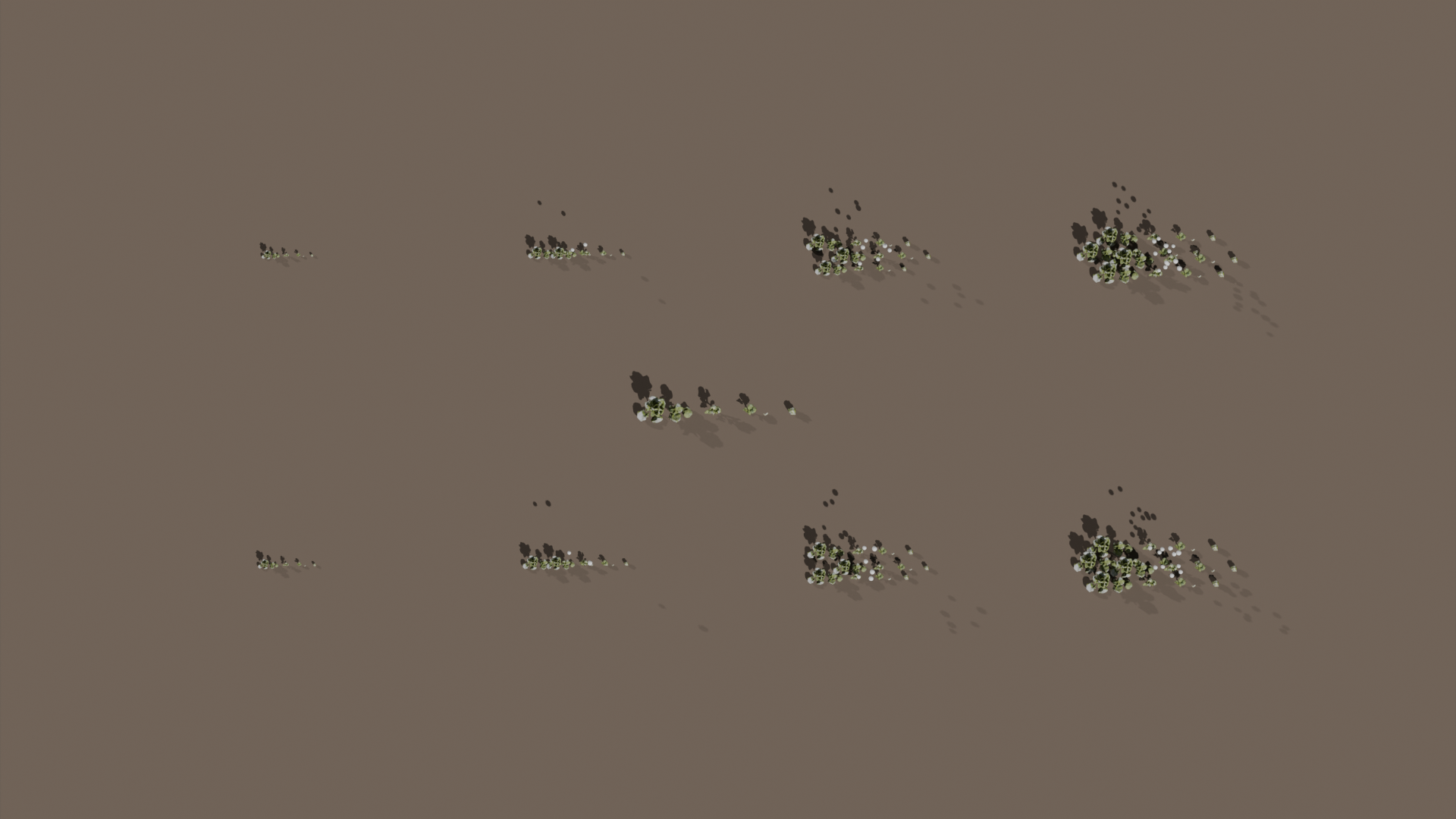
 Some of the cotton plants in their various stages.
A member registered Jun 20, 2021
Recent community posts
itch.io Community » Game Development » Devlogs · Created a new topic Cognition Devlog #1: Better Late Than Never
Cognition Devlog #1: Better Late Than Never
I know I’m a little late starting a devlog for Cognition, but here goes.
I’ve already been working on this game for quite a while. It started as a procedural 3D maze experiment, but—as often happens when I begin asking “what else could this do?”—it grew into something much larger.
Cognition is now a first person psychological maze adventure being developed in Godot with C#. It combines exploration, environmental puzzles, survival, crafting, strange changing spaces, and a few systems that I probably made much more complicated than they needed to be.
That last part is fairly normal for me.
The central idea is that the player is exploring a world they do not fully understand. There are several large labyrinths, but they are not just flat corridors where the challenge is finding the exit. They extend upward and downward, contain water, hidden routes and handcrafted puzzle rooms, and can change as the game progresses.
A lot of the experience is built around learning how the world behaves. I want players to pay attention, test ideas and gradually become better at reading the environment. The game will not explain everything immediately, and some of the things players initially assume may turn out to be wrong.
So, What Have I Actually Built?
At this point, Cognition is much more than an idea, but it is still a prototype rather than a finished game.
The procedural maze generator is working. It can create a large, connected, three dimensional labyrinth with loops, dead ends, vertical paths and designated locations for handcrafted rooms. The system also checks whether the important areas are actually reachable, because a procedurally generated maze is not very useful if it quietly traps the player behind impossible geometry.
The game currently generates multiple maze regions, although the first one is receiving most of the attention right now. The later regions exist structurally, but they still need their own stronger visual identities and gameplay.
I have also built a system for inserting handcrafted puzzle rooms into the generated maze. Each room is its own Godot scene with its own environment and logic. The maze handles getting the player into the room, remembering where they came from, tracking completion and returning them to the correct place afterward.
Several prototype rooms are already functioning. They are not final, and some of them will probably be replaced entirely, but they have proven that the room system works.
That is important because I eventually want other developers to be able to create rooms without needing to understand the entire game.
The Maze Can Change
One of the major systems already working is the ability to rebuild the maze during play.
The player’s important progress can remain intact while the routes around them change. Familiar paths may disappear, new ones may open and navigation becomes less about memorizing one permanent map.
Getting this to work has been a challenge. A changing maze can be interesting, but it can also become frustrating very quickly if it makes every previous decision feel meaningless.
The goal is for the player’s surroundings to change while the things they have learned remain valuable.
That idea has become one of the most important parts of Cognition.
Movement, Exploration and Survival
The player controller currently supports normal first person movement along with jumping, swimming, underwater movement and climbing.
There are also health and survival systems, world interaction, inventory, gathering, crafting, farming, fishing and storage.
Most of those systems work, but many of them still look and feel like prototype systems. The inventory is a good example. The backend can already manage a hotbar, backpack storage, containers, stacked items, durability, spoilage and saved inventory state.
It works, but it does not yet feel like the final inventory I want players to use.
That is a recurring theme in the project right now. A surprising amount of Cognition exists technically. The next step is making those pieces feel like they belong to the same polished game.
Procedural Plants
I am also developing a procedural plant generation system.
The idea is to create more varied plant life without building every individual plant as a completely separate static model. The underlying framework is taking shape, but runtime growth and the authoring tools still need more work.
Some existing plants will remain handcrafted where that makes sense. The procedural system is meant to expand the world, not replace everything that already works.
This is one of those features that began as a fairly simple thought and then opened the door to a much larger system.
I have a habit of doing that.
Recording the Game From the Inside
Another system I am excited about is the cinematic replay tool.
Cognition can record information from a play session and then replay that session through an independent camera. The foundation is already working, including saved camera passes and replay information.
The main reason I built it was to make it easier to capture trailers and development footage from real gameplay. Instead of trying to play the same sequence perfectly several times for different camera angles, I can record it once and then film it afterward.
It may eventually have other uses inside the game, but for now the immediate goal is to use it to create a real teaser from the vertical slice.
The replay character still needs better animation and presentation, so there is more work to do before that happens.
Creatures and Other Moving Problems
There is also an early creature behavior framework in place.
The current system supports wandering, aggression, feeding, trust and persistent behavior. Like several other areas of the game, the logic is further along than the presentation.
The final models, animations, sound and behavior still need substantial work.
For now, I am trying not to disappear into creature development before the first section of the game is ready. It would be very easy to spend months improving one creature while the rest of the game waits patiently in the corner.
What Is Still Missing?
A lot.
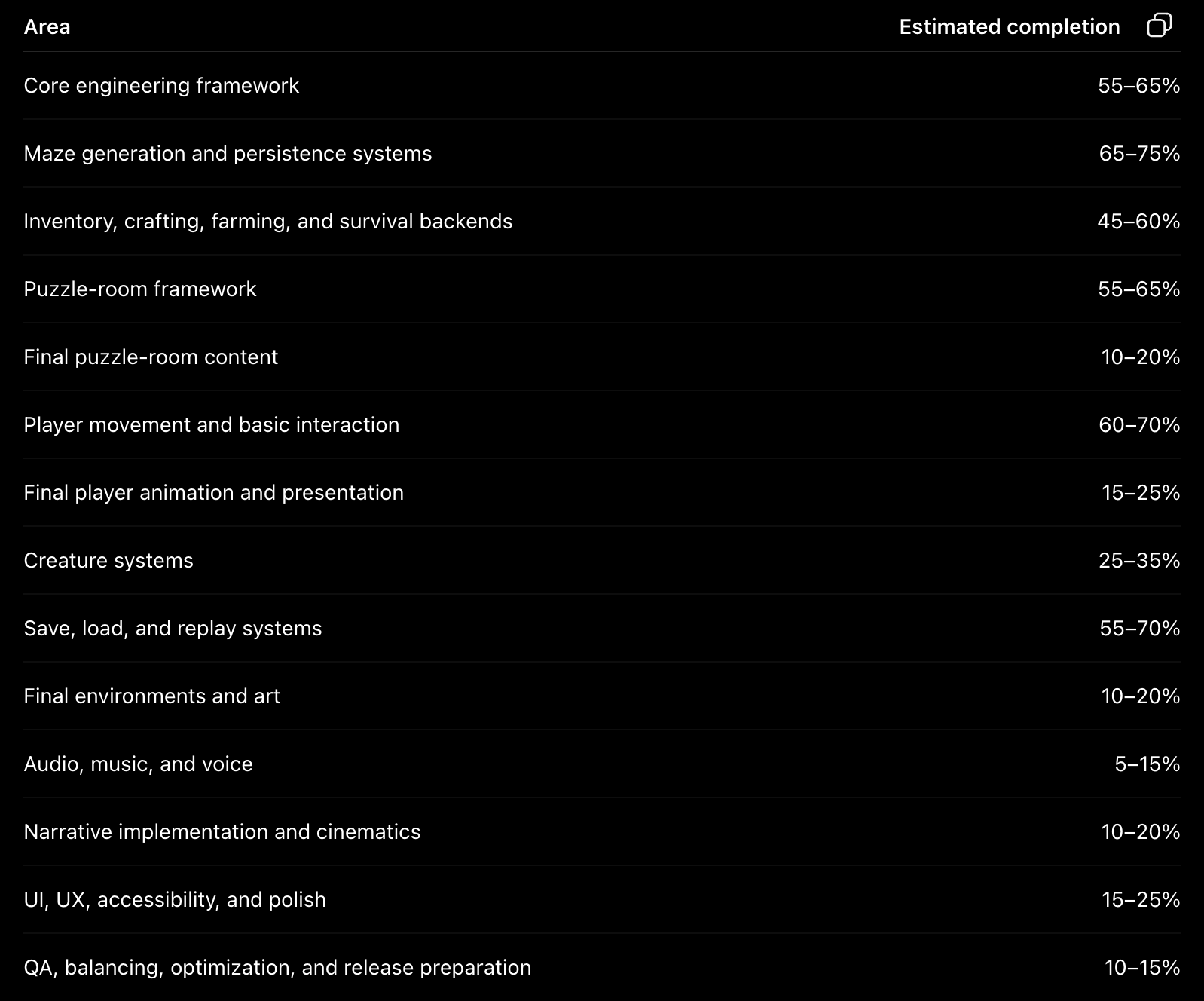
The current project has a strong technical foundation, but there is still a huge difference between a collection of functioning systems and a polished game.
The puzzle rooms need final designs and artwork. The inventory needs a much better interface. The player needs a complete animation system. The creatures need final presentation. The environments need more cohesive art, lighting and sound. The user interface needs polish, and the project needs much more testing.
Audio is still early. Accessibility needs proper attention. Performance needs to be tested on more hardware. The save system works, but unusual combinations of game states still need to be abused until they break.
At this stage, adding more features is not the most useful thing I can do.
The game needs focus.
The Plan From Here
The immediate goal is to finish a polished vertical slice built around the opening area and the first major maze.
That section needs to show what Cognition actually is rather than simply showing that its systems function.
The player should be able to enter the world, explore, learn the basic interaction language, solve several meaningful puzzle rooms, use the survival and crafting systems, experience the maze changing and reach a satisfying stopping point that hints at what comes next.
Before I expand the rest of the game, I need one section that feels complete.
The first part of that process is stabilizing the foundation. I am cleaning up the boundaries between systems, expanding the automated tests and making sure changes in one area do not quietly break something somewhere else.
After that, the focus will shift toward presentation. Movement, animation, sound, lighting, environment art, puzzle feedback and interface design all need to come together.
Once the vertical slice is stable, I plan to use the cinematic replay system to produce a short teaser using actual gameplay. That will also give me something meaningful to show potential players, collaborators and funding partners.
The Puzzle Room Development Kit
One of the reasons the puzzle rooms are being built as independent scenes is that I would like other Godot developers to be able to create rooms for Cognition.
The plan is to prepare a development package containing the player controller, the basic interaction systems, an example room and the technical requirements needed to connect a new room to the game.
A developer would not need the entire Cognition codebase. They would only need enough of the framework to build and test one polished room.
I am also considering holding a Godot only puzzle room game jam once that package is ready.
Participants would build an original room using the supplied framework. The strongest rooms could be selected for inclusion in the commercial game, with the top five room creators receiving profit sharing agreements.
There may also be additional team selected awards for things such as puzzle design, atmosphere, environmental storytelling, technical execution, original mechanics, accessibility, player controller improvements and other useful additions.
Participants would be allowed to use the supplied controller exactly as it is, but they could also improve it or add features needed by their room.
A room may not be selected as one of the top five and still contain a controller improvement or gameplay feature that we would want to use.
There would be no upfront payment. Nothing would be incorporated into the commercial game without a separate written agreement covering credit, ownership or licensing, permitted changes and profit sharing.
This part of the project is not ready to launch yet, but I am interested in hearing from Godot developers who might want to participate when it is.
Why Start Writing About It Now?
Because Cognition is finally at a point where there is something real to document.
There is a working maze. There are functioning puzzle rooms. The player can explore, gather resources, craft, farm, save progress and interact with systems that affect the wider world. The game can even record its own gameplay and replay it through a cinematic camera.
It is not finished, and I am not going to pretend it is.
Some systems will be rebuilt. Some ideas will be cut. Some things that sound great on paper will probably turn out to be terrible once someone actually plays them.
That is part of making a game.
From here on, I plan to share individual pieces of the development process as they improve. That may include maze generation, puzzle rooms, inventory, animation, procedural plants, environment work, cinematic replay and eventually the preparation for the puzzle room jam.
There is still an enormous amount of work ahead, but Cognition has moved beyond being an idea.
Now I need to turn it into the game I know it can become.
The mind is the deepest maze. What will you awaken?