Indie game storeFree gamesFun gamesHorror games
Game developmentAssetsComics
SalesBundles
Jobs
TagsGame Engines

Kinayla

104
Posts
25
Topics
127
Followers
465
Following
A member registered Apr 04, 2020 · View creator page →

Creator of

Recent community posts

Je trouve que c'est un angle de vue vraiment intéressant de construire tout le jeu autour des relations entre les personnages. J'aime beaucoup cette idée de faire tourner les mêmes conflits sous différents masques, dans des univers complètement différents, tout en conservant les mêmes émotions. Je trouve le concept à la fois original et très poétique.

En revanche, j'aurais aimé voir une étape permettant de mettre davantage en lumière l'évolution des relations. Par exemple, un temps de débrief (en personnage ou hors personnage), ou un système invitant progressivement les joueurs à résoudre certains conflits internes ou externes au fil des scènes. Je me demande aussi comment doser le nombre de conflits à explorer selon le nombre de joueurs, afin que chacun ait l'occasion de voir évoluer les relations qui lui tiennent le plus à cœur.

En tout cas, je trouve l'idée vraiment très belle. C'est un jeu qui donne envie d'explorer les personnages et leurs émotions plutôt que de chercher à "gagner", et c'est quelque chose que l'on voit assez rarement.

yes. Je vais pouvoir le lire et te mettre un petit retour sur la pge projet. Noublies pas de remplir une description. 😉

J'aime beaucoup le concept de cette téléréalité basée sur le masque que l'on renvoie aux autres et sur le principe du fake it until you make it. Je trouve que les ingrédients sont très bien intégrés au cœur du système.

Il y a pas mal de mécaniques, et j'avoue avoir parfois eu un peu de mal à suivre les règles, notamment avec les différents seuils puis le jet d'Aura. Le résumé en fin de document aide heureusement à remettre tout ça en ordre. Je pense malgré tout que quelques exemples complets de résolution seraient très utiles dans une version post-jam.

Concernant la progression, j'ai également mis un peu de temps à comprendre qu'on parlait de la valeur réelle de la spécialisation qui progresse petit à petit jusqu'à rattraper la valeur "fake". En revanche, lorsqu'une spécialisation a un grand écart, par exemple 4 en fake et 0 en réel, la plage de Fake It devient très importante. J'imagine que c'est volontaire, notamment pour les joueurs qui souhaitent interpréter des personnages davantage imposteurs que véritables experts.

En tout cas, j'ai trouvé le concept vraiment amusant et très divertissant. C'est un jeu qui donne immédiatement envie de voir les situations improbables dans lesquelles les personnages vont devoir sauver les apparences. 😊

Avant tout, je trouve ça vraiment chouette de jouer, pour une fois, quelque chose d'aussi peu utilisé que des gargouilles. C'est une excellente idée, et j'ai beaucoup aimé cette proposition.

J'ai aussi beaucoup apprécié la mécanique où chaque résultat inférieur au précédent permet de relancer le dé et d'accumuler davantage de réussites. Je la trouve très élégante, et j'aime particulièrement le fait qu'une suite décroissante puisse former un Rythme. En revanche, je me suis demandé si seules les suites consécutives comme 5-4-3 comptaient comme un rythme, ou si une suite comme 6-4-2 ou 5-3-1 fonctionnait également.

J'ai été un peu désarçonnée par la longue introduction. Je me demandais quand la partie jeu de rôle allait réellement commencer. L'univers est agréable à lire, mais je pense qu'on pourrait arriver un peu plus rapidement au scénario et à la mise en situation des joueurs.

Je ne suis pas certaine non plus d'avoir bien compris le fonctionnement des cœurs d'obsidienne. Si les humains les ont volés, comment les gargouilles survivantes peuvent-elles encore vivre et se déplacer ? Possèdent-elles encore leur propre cœur et seuls ceux destinés aux nouvelles gargouilles ont-ils été dérobés ? Une petite clarification sur ce point aiderait à mieux comprendre l'univers.

Enfin, comme les gargouilles sont des personnages assez inhabituels en jeu de rôle, j'aimerais beaucoup voir quelques accroches de scénarios ou pistes d'aventure dans une version post-jam. Je pense que cela aiderait à imaginer plus facilement une campagne. Et par simple curiosité : pourquoi avoir choisi des gargouilles ? J'aime beaucoup cette idée et je serais curieuse de connaître l'inspiration derrière ce choix.

I'm quite curious about the prompt you use. Don't forget to explain the use of AI in the game for generating masks. Didn't see credits, inspirations or license also. ;)

I really like the idea of offering a small RPG that works as a briefing or debriefing tool alongside another game, while also being playable on its own. I also enjoyed the use of a standard deck of cards and the themes explored through the prompts.

That said, I felt the Kitchen ingredients were a little less present than in some other entries. The four categories work well, but I feel they could almost have been given different names without changing how the game plays.

Even if the ingredients didn't feel quite as deeply woven into the experience for me, I think the concept itself is excellent. The title is particularly well chosen, and I can easily imagine using this both as a solo journaling exercise or as a group debrief after a campaign.

If you expand the game after the jam, I'd love to see a few complete examples with four players. Seeing how different rounds evolve, how players build on each other's stories, and how the different prompts interact would make it even easier to imagine the experience at the table.

le jeu n'est pas accessible. Merci de le mettre en ligne ou je devrais retirer cette soumission.

I really liked the illustrations. They're simple but full of charm, and I love the idea of combining Masks with dance to turn conflicts into something much more peaceful than traditional combat. It's a fun and original take on both ingredients.

I also enjoyed character creation, although I wasn't entirely sure whether it's intentional that a character can start with 0 in one attribute.

I found the rules a little difficult to follow at first. I eventually understood that the game mainly uses a d20, while the d6 is only used to determine who starts the dance, but I think reordering the rules (core rolls → dance → masks, for example) would make everything much easier to understand.

The Rhythm mechanic is really interesting, but I had a hard time picturing an actual duel. Are the players dancing one against one, or as teams against NPCs? A short example of play would probably answer most of those questions.

I also found myself wondering what happens between the dance duels. I understand that kingdoms settle major disputes this way, but what motivates the player characters to keep travelling and dancing? One idea that came to mind is that they could be champions hired by villages, nobles or kingdoms to resolve conflicts on their behalf. That would naturally create adventures leading up to each duel and make a campaign easier to imagine.

Finally, I wondered if especially creative descriptions of dance moves could be rewarded somehow. I immediately imagined players improvising their choreography before rolling, and encouraging that kind of narration sounds like it could be a lot of fun.

I think the concept has a lot of potential, and I'd love to see it expanded after the jam. It also reminded me a little of another Kitchen entry, Rhyme-Rhyme-Retribution, which explores Rhythm in a different way and might provide some interesting inspiration.

I really like the concept. It feels like a great run-die-repeat game, but one where each expedition can leave something behind through relics and masks. Even if the characters don't survive, the world keeps moving forward and future generations inherit what came before.

One thing I wasn't quite sure about is the setting. The mountain is described as the source of the scourge and the perpetual cold, yet it also seems to be the only place where humanity can realistically fight back. I found myself wondering how the surrounding villages are still able to survive. Personally, I think making that situation a little clearer would strengthen the worldbuilding. Maybe this really is humanity's last safe bastion, or perhaps the expeditions are searching for a legendary place where life still flourishes, with sunlight, crops and a warmer climate. Those were the kinds of stories I started imagining while reading.

I also really enjoyed the idea that people can become monsters. It gave me a bit of a Japanese dark fantasy or horror vibe. The injury system is clever too: a wound is manageable the first time, but receiving the same injury again makes it permanent. I think that's a really elegant way of creating long-term consequences and memorable characters. Character creation was another highlight for me—I especially liked how your past and inherited mask immediately give each adventurer some personality.

If you decide to expand the game after the jam, I'd love to see a few one-shot or campaign hooks, along with examples of obstacles or expeditions for the GM. I think they'd make it much easier to jump into the setting.

And by the way, I really liked the sketches. They're simple, but they do a great job of helping me picture the world and the adventure. 😊

I really like how you used Rhythm through the drums, the songs, and the ritual itself. I also enjoyed the use of the masks as ritual tools rather than simple disguises.

I never would have imagined a TTRPG built around performing a ritual to bring back a Great Moth, but I genuinely found the concept fascinating. The different choices of masks and drums also seem like a nice way to vary each character's role and approach.

My main difficulty was understanding how a campaign is meant to flow in practice. I couldn't quite picture how one session transitions into the next, how long a Moon event is expected to last, or how the adventures and the ritual alternate over time. Since some Moon events sound like they could become full adventures on their own, I also wondered how you keep the ritual moving forward if the group spends several sessions exploring a single event.

I also wasn't sure how the game scales with different player counts. The ritual revolves around the Seven Drummers, but I couldn't figure out whether the players are meant to portray all seven, whether the remaining drummers become NPCs, or if there's another intended approach.

Finally, I think the handwritten font fits the atmosphere really well for the titles, but I found it just a little difficult to read at times.

Have you had the chance to playtest it yet? I'd love to hear how a typical session unfolds. I think even a short example of play or an actual play would make it much easier to picture how everything comes together.

Well, first of all, I absolutely love the artwork, and I'm so glad a couple of goofballs like you took part in the jam. 😄

I absolutely love the whole concept of the hive and the Queen. It feels like a framework for so many different kinds of adventures. I can already imagine players finding creative uses for their traits—for example, if you're a honey maker, why not use your honey to glue your opponents to the ground during a fight?

The system seems simple but flexible, and I really like that. I don't know if you've had the chance to playtest it yet, but I'd love to hear what worked well and what surprised you during play.

I also have the feeling that reaching the second molt is going to be surprisingly emotional. Saying goodbye to a character you've watched grow sounds bittersweet... but at the same time, I think I'd really enjoy guiding the next generation and seeing my little bug's legacy live on through their successor. I love that idea. 🐞

I really liked how naturally Rhythm was woven into the game alongside Echo and Molt. The repeated sequence of movements becomes both a rhythm and an echo of Wyrm's life, and when that sequence finally breaks, it marks another major turning point in their journey.

I especially love the idea that every forgotten movement isn't simply a player making a mistake, but represents Wyrm losing something important and being forced to move forward. That's a really elegant way to connect the mechanics to the story.

Have you had the chance to playtest it yet? I'm pretty sure I'd start forgetting the sequence once it reached ten or fifteen moves! 😄 I'd be really curious to know how long the sequence usually gets during play and how players experienced that part of the game.

I absolutely love how ridiculous and fun the whole concept is. A heist carried out by bird-people who can barely communicate with each other is such a wonderfully chaotic idea. I'd love to know how you came up with it! 😊

I also like the collaborative map creation. Having the players build the foundations of the location before the GM assembles everything into the final map is a really clever approach. I also appreciate that each location is clearly described. I could even imagine those descriptions being printed on the back of each map card.

I enjoyed the way loot values are randomized with a simple table, but my favorite mechanic is definitely learning and replacing words during the heist. Choosing whether to replace a word to communicate better—or simply adapt to the situation—is a brilliant idea.

From what I understand, the game sits somewhere between cooperative and competitive play, and I really like that balance.

Have you had the chance to playtest it yet? I'd be very curious to hear how it went. I also think an actual play or a short play report would make it much easier to picture how the limited vocabulary works in practice and help GMs get the game to the table.

I absolutely loved this! I'd really like to see more RPGs inspired by African mythology and folklore. We have so many games rooted in European settings, and I think there's so much richness to discover elsewhere. Reading your game reminded me of a friend of mine, who sadly passed away earlier this year, whose dream was to create games inspired by African cultures and myths.

I really enjoyed the three-token mechanic. Having the protagonist fully narrate the outcome with three matching tokens, or share the narration with the Mask when they're mixed, is a clever idea. I wasn't familiar with Mancala before reading your game, but now I'm curious to learn more.

I also love the mask illustrations! Did you create them yourself? They almost make me want to print them and color them. 😊

The whole game feels like a folktale told around a campfire, with rhythm becoming part of both the storytelling and the tension. I don't speak Italian very well, so I used AI to help me understand the rules before writing this feedback in English. Are you planning to translate the game into other languages? I'd love to see more people discover it.

Have you had the chance to playtest it yet? I'd love to hear how it felt around the table.

I found this a really interesting take on the theme. It's another "die, change, continue" kind of game, but here the focus is entirely on transformation rather than simply coming back to life.

I especially like that the game takes place between two states of being. The whole pilgrimage feels like an in-between space where you gradually Molt, leaving your old self behind, until you're finally ready to wear a Mask and embrace a new identity. I think that's a very strong symbolic use of both ingredients.

I also enjoyed the idea that each chamber presents a completely different kind of trial. It makes the process of creating your new self feel much more personal than simply overcoming physical obstacles.

I'm curious: have you had the chance to playtest it yet? I'd love to know what kinds of bodies, identities, or Masks emerged during play. 😊

I found the concept really interesting. The dreamlike world immediately caught my attention, and I really liked the idea of death not being the end, but another step in the journey.

I could clearly see how Echo and Molt are woven into the game. One question I had, though, concerns the Flames. When a character dies after having crossed out all three Flames, they return with two new ones. But what happens if they die after only crossing out one Flame? Do they come back with the remaining Flames refreshed, or do they always create two entirely new Flames?

I also liked the parallel between the characters' rebirths and the Dragon's ever-molting feathers. Although I have to admit it also made me think a little of a phoenix! 😊

Finally, I found myself wondering what a full session feels like in play. With characters dying and returning so often, I'm very curious about the overall pace of the game and how the story evolves over time. I'd genuinely love to see this game played.

Thank you for your submission! I don't know if it's just me, but some of the visuals seem cropped, almost as if something went wrong during the export or image generation.

I really like the idea of inheriting a house that never stops changing. The floor plan is simple but works really well with the game's mechanics, and just reading it, I could already imagine the atmosphere of this solo horror RPG.

I also enjoyed the way Rhythm, Echo, and Molt come together. The routine of walking through the house again and again, watching it evolve while creating echoes of your previous passages, creates a very evocative experience.

I think it's a lovely concept. My biggest wish would simply be to have a version that's easier to read. The images feel quite compressed and difficult to make out. I think many of the visual elements could probably be recreated directly in Canva or Affinity Publisher while keeping the same atmosphere and making the booklet much clearer to read.

I really like the visual design of the booklet. Despite the atmosphere, I found it very easy to read and use. It's quick to generate both Log 1 and Log 2 from the cards you draw, and I also appreciated the little nod to the 1100-word limit by making the eulogy exactly 1100 words.

I think Echoes is a particularly clever choice as the main ingredient, with the digital logs acting as the last echoes left behind by the dead. I also really liked the use of Masks through the idea of veils, death masks, and funerary imagery. Knowing your intention for Rhythm as the call-and-response structure between the two logs makes a lot of sense too. I have to admit Molt feels a little more subtle, but I did spot it in the prompt tables.

This isn't usually the kind of horror game I naturally gravitate towards, but I found the two-log structure so original that it genuinely made me want to give it a try one day. I think it's a really creative premise, and one that fits the 1100-word format surprisingly well.

I really enjoyed this little zine. I love the concept of gradually rediscovering the different facets of your Granny's personality through the objects she left behind. The echoes of memories, the music, and the subtle emotional transformation they awaken in you come together beautifully.

It's such a simple game, yet it carries a lot of emotion. I found it gentle, heartfelt, and very easy to connect with.

This is a wonderful little game. If anything, my only "complaint" is that I wanted more! 😊 I could easily imagine opening many more than just three boxes, discovering new keepsakes and new memories. By the end, I was left wanting to continue exploring Granny's story and everything she left behind.

J'ai beaucoup aimé lire ce jeu. Le concept m'a tout de suite plu, même si j'ai eu un peu plus de mal à imaginer concrètement comment se déroule une scène autour de la table.

J'aurais aimé être un peu plus accompagné dans la création de la légende du Héros, mais aussi dans celle des personnages. Quelques exemples de situations, ou même un mini-scénario de départ, aideraient peut-être à lancer plus facilement une première partie. J'imagine cependant que cela est surtout lié à la contrainte des 1100 mots.

En revanche, je pense que le jeu a un énorme potentiel. J'aime beaucoup l'idée de revêtir un des Masques du Héros — même lorsqu'il ne s'agit pas d'un masque physique — et de voir peu à peu son influence, sa volonté et sa légende s'exprimer à travers les personnages. C'est une très belle façon d'utiliser l'ingrédient Masque.

J'ai également beaucoup aimé le thème central du jeu : vivre dans l'ombre d'une figure légendaire, puis chercher à s'en émanciper pour écrire sa propre histoire. Je trouve que c'est une métaphore très juste, qui fait écho à des expériences que beaucoup d'entre nous peuvent vivre, même en dehors d'un univers de fantasy. Cela rend le propos du jeu particulièrement touchant.

Félicitations pour cette très belle proposition !

That's such a wonderful reference! I didn't know that ecdysis was the biological term for an insect's molt. I learned something new thanks to your game.

I also absolutely love the visual design. It immediately puts you in the dark atmosphere of being an assassin, while the rules remain surprisingly easy to read and understand.

The system itself is really elegant, and I think I'll have to give it a try soon. I especially like how your character constantly evolves by gaining, losing, or even borrowing traits and skills from the people they encounter. It makes the journey toward revenge feel like a journey of self-discovery as much as one of vengeance.

Congratulations on a really clever design!

¡Me encantó el concepto del juego! Aún más porque toma inspiración de referencias culturales nahuas y mesoamericanas en lugar de recurrir a una fantasía genérica. Eso le da una identidad muy propia.

También me gustaron mucho las tres características principales: Arte, Cuerpo y Nahual. Me parecen mucho más originales que los atributos clásicos de muchos juegos de rol y refuerzan muy bien el tema del juego. Los arquetipos y los nahuales ya ofrecen bastante variedad, aunque me encantaría ver todavía más ejemplos en una versión más larga. Siento que hay muchísimas posibilidades por explorar.

¡Las tablas para generar aventuras me encantaron! Cerré los ojos y obtuve: kobolds taqueros que secuestraron a todas las mascotas del barrio para que todo el mundo baile hasta desmayarse y olvide sus penas. 😂 Me dieron muchísimas ganas de dirigir esa aventura. Aunque debo admitir que crear un sindicato también me parece un objetivo de campaña fantástico.

Finalmente, me gustó mucho la idea de que los protagonistas sean artistas que utilizan su arte, sus tradiciones y sus nahuales para proteger a su comunidad frente a amenazas absurdas y fantásticas. Me parece una propuesta muy original y con mucha personalidad. ¡Felicidades por el juego!

I really enjoyed reading this. The metaphor of the cicada's life cycle as a personal awakening is beautiful, and I found the writing very evocative. The progression from hibernation, to Molting, to finally screaming and flying creates a powerful emotional rhythm.

That said, I found myself a little unsure about how to actually play it. The opening questions gave me a direction, but afterwards the game became more of a guided narration, and I wasn't always sure what I, as the player, was expected to do.

I think I would have loved a little more interaction with the process. For example, writing down memories from the last thirteen years, reflecting on who I was before I "fell asleep," or exploring how rediscovering those forgotten parts of myself changes the person I am today. I wanted to engage more actively with the transformation instead of only reading it.

Still, I think it's a beautiful and thoughtful piece, and I really appreciated the way you used the cicada's Molt as a metaphor for personal growth.

I absolutely love the visual design and layout of the book. It's not particularly printer-friendly, and I found myself focusing on only a few pages at a time, but the text is airy enough to remain comfortable to read. I also really liked the step-by-step structure of the core rules—I never felt lost while reading.

I immediately recognized both Mask and Molt as central ingredients.

I also looked up the meaning of Binyüz just to make sure I understood the reference correctly. Knowing that it literally means "a thousand faces" makes the concept even better. I love that little cultural reference—it fits the game perfectly.

The core idea of playing as the Mask rather than the host is one of my favorite parts of the game. Controlling another being, slowly draining their essence to grow stronger, and eventually Molting into a new host creates a really interesting progression. It gives the game a strong identity and makes the Mask feel like the true protagonist.

I also appreciated how streamlined the mechanics are. The contest system is easy to grasp, combat stays simple, and the alchemy rules add a nice layer of customization without making the game feel heavy. Everything feels focused on getting the adventure started quickly.

Overall, I really enjoyed reading it. It feels like a solid foundation for a dark fantasy world.

Hi everyone,

Tomorrow, the 1100 Words TTRPG Kitchen 2026 comes to an end.

Whether you've already submitted your game or you're still putting the finishing touches on it, I just wanted to send one last message to cheer you on.

A game doesn't have to be perfect to be worth sharing. Every finished game is something to be proud of, and I can't wait to discover what you've all created. ❤️

⏰ Final deadline

The jam closes tomorrow at 12:00 PM (Paris time).

If your game is ready before then, simply submit it through the jam page as usual.

🍽️ Late submissions

Life happens.

If you're incredibly close to finishing but miss the deadline, I can still accept a small number of late submissions.

This year I'll be using itch.io's new late submission feature.

Because I'll be away with family on Sunday, I'll review late submission requests starting Monday.

If you'd like to request one:

  • publish your game on itch.io;
  • send me the link to your game page (Discord, the Community forum);
  • I'll send you a private late-submission link if your project qualifies.

Please don't submit using another account or another workaround. The private link is the official way itch.io now handles late submissions.

This option is intended for games that simply needed a little more time—not for projects that are still in an early stage.

Most importantly, if you think you'll only need another day or two...

Finish it.

I'd much rather receive a late game than see a wonderful project abandoned forever.

Good luck for this final stretch, and thank you for making this year's Kitchen such a warm and inspiring place.

See you very soon for the feast. 🍽️

Kinayla

PS : Curious how late submissions work on itch.io? Here's the official explanation: https://itch.io/updates/enhancing-jams-late-submissions-and-entry-editor

¡Gracias por tu respuesta! De verdad, es un placer hablar contigo. 😊

Estoy practicando mi español, pero a veces utilizo un poco de ayuda con la traducción cuando no estoy segura de entender alguna expresión o de cómo decir lo que quiero expresar

Ahora mismo estoy probando una nueva maqueta para los playsets. La idea es que una carta represente a un habitante y que el palo determine el aspecto de su personalidad que el jugador descubre en ese encuentro. Otra carta representaría un lugar junto con una actividad o algo que está ocurriendo allí.

Creo que voy a mantener las cuatro interacciones, pero en lugar de asignarlas de antemano al personaje, cada habitante tendrá las cuatro disponibles. El jugador elegirá la que mejor encaje con la escena y la marcará para que no pueda volver a utilizarla con esa persona durante el resto de la partida.

También estoy pensando en una pequeña regla: si el habitante y el lugar tienen el mismo número, pero de palos diferentes, el jugador podría combinar dos aspectos de la personalidad en esa escena. Me gusta la idea porque hace que algunos encuentros sean un poco más especiales sin complicar demasiado el sistema.

¡Y me encanta tu idea de sacar dos personajes de vez en cuando! Yo imaginaba que cada encuentro servía principalmente para fortalecer el vínculo con un personaje concreto, pero que otros habitantes del pueblo podían aparecer de forma natural en la misma escena, aunque no fueran el centro de la conversación. Creo que eso puede dar lugar a momentos muy bonitos.

Ahora mismo el playset está tomando forma con cuatro partes: un pequeño resumen de las reglas, la lista de habitantes, la lista de lugares y una sección para ir anotando todos los encuentros, como si fuera un diario de las vacaciones y de los recuerdos que hemos ido creando.

¡Muchas gracias por haberlo probado y por tomarte el tiempo de contarme cómo fue la partida! 😊 Me alegra muchísimo saber que te divertiste y que las escenas funcionaron bien incluso imaginándolas sin escribir durante la partida.

Me gusta mucho tu propuesta de sacar una carta para definir el lugar junto con una actividad o algo que esté ocurriendo en el momento del encuentro. Creo que ayuda mucho a entrar rápidamente en la escena.

Para los personajes, había pensado que se podría añadir información como el nombre, la profesión o algún pequeño detalle, pero tampoco quería definirlos demasiado para dejar espacio a la imaginación del jugador. En cambio, me gusta mucho la idea de descubrir distintos aspectos de su personalidad según el palo de la carta. Creo que eso les da más profundidad sin cerrarlos por completo.

Una pregunta: ¿mantuviste también las interacciones originales (conocer, descubrir, compartir y confiar) o las cambiaste durante la partida?

Tu idea me ha hecho darle muchas vueltas al sistema. Ahora mismo me imagino un playset con una carta para la persona (su nombre, un rasgo de personalidad según el palo y quizá algún pequeño detalle) y otra carta para el lugar y la actividad que está ocurriendo allí. En un primer momento pensé en asociar cada interacción a una personalidad concreta, pero cuanto más lo pienso, más me gusta otra posibilidad: que cada personaje tenga las cuatro interacciones disponibles y que el jugador elija cuál encaja mejor con esa escena, marcándola para no volver a usarla con esa persona durante la partida. Creo que eso daría mucha más libertad y haría que cada relación evolucionara de una forma distinta.

De todas formas, ya me has dado bastante en qué pensar. 😊 Creo que tengo una buena base para trabajar a partir de tu idea. El verdadero reto ahora será diseñar playsets que sean fáciles de usar y de imprimir. Me gustaría que incluyeran un pequeño recordatorio de las reglas, algunas ilustraciones y que todo pudiera caber en dos hojas impresas por las dos caras, con 13 personajes y 13 lugares. ¡Va a ser un buen ejercicio de diseño!

Y sí, coincido contigo en que tener varios playsets (costa, campo, lago, montaña, etc.) haría que el juego fuera mucho más accesible desde el primer momento. Incluso podrían incluir pequeños eventos especiales para dar variedad. 😊

Thank you so much for reading it! It really means a lot to me. 😊

Funny enough, I never planned to write this game. It actually started as a simple example I was giving another Kitchen participant to illustrate the Molt ingredient, and it slowly grew into a complete game.

The music also came later. I wanted players to experience memories not only through words, but also through sounds and rhythms, almost like a small sensory experience.

I haven't had the chance to playtest it yet—I have the same problem as you when it comes to finding people who enjoy this kind of narrative game! I really hope it finds its audience.

I already have ideas for a longer post-jam version, but for now I'm happy to let the game live a little and see how people react to it. 😊

Please don't be too hard on yourself. 😊

The goal isn't to create a perfect game in 1100 words. It's a very challenging word limit (and even more so in some languages!), so it's completely normal to have ideas that don't quite fit or things you only realize after people have played or read the game.

What I really encourage is exactly what you're planning to do: revisit the game after the jam. I see the 1100-word version as the core of the design—the strongest foundation. Once that foundation is solid, you can expand it with examples, clarifications, lore, player aids, or anything else that makes the experience even smoother.

About the layout, I don't actually think the reading order is the main issue. For me, it was more about visual comfort. There are a lot of strong contrasts, several different fonts, and many elements competing for my attention at the same time. My eyes weren't always sure where to focus next. I completely understand the temptation—I have exactly the same tendency! 😄 But I've learned to limit myself to one or two fonts because it makes reading much more comfortable.

If you get feedback from other designers, I'd be curious to know whether they had a similar experience. Even someone without dyslexia, ADHD, or any reading difficulties might find the layout a little visually demanding. I think a few small adjustments could make your game much easier to read without losing its personality.

I'm really looking forward to seeing the post-jam version. I think your game already has a lot of interesting ideas, and those additions will only make them shine even more. 😊

I really hope you do! 😊

The whole idea behind the 1100-word limit is to encourage designers to focus on the core of their game. Once those foundations are solid, it's much easier to build a bigger, richer version afterward.

If I'd allowed 6,000 words from the start, the games would probably have been more detailed, but they also would have included a lot more unnecessary material. I really like seeing designers distill their ideas first, then expand them after the jam if they want to.

So I'm genuinely looking forward to seeing what you do with this game after the jam. I think it has a lot of potential! 😊

I think it's going to be too complicated.

Affinity converts all the text into curves, and Canva generates lots of tiny images that combine the text, headings, and illustrations, so editing them individually would take forever.

I think the easiest solution would be for me to write the text in French and send it to you instead.

By the way, I couldn't find any way to contact you from your itch.io page. Do you happen to have a Discord, Bluesky, or another social media account? 😊

You definitely made the right call by not forcing Molt into the game. The jam only requires two ingredients, so using three well is already a great achievement. 😊

I also realized I hadn't understood one thing: I wasn't talking about the solo journaling option. What confused me was that I hadn't realized each player portrays another player's rival. At first, I thought everyone was simply competing against each other.

My suggestions about random tables were really just ideas to push the TV show atmosphere even further. I'd love to co-create the show before the first match: coming up with ridiculous stage names, absurd prizes, fake sponsors... Players could even fill in a few blank d6 tables together before the game starts and then roll on them during play. Imagine winning 30 free meals at the galaxy's weirdest fast-food chain or a luxury one-day vacation. The more ridiculous, the better! 😄

And about the illustration: I genuinely loved that you drew it yourself. It immediately sold me on the game's atmosphere—and honestly, you draw much better than I do! 😊

If you ever decide to expand the game after the jam, I'd be really curious to see where you take it. I genuinely think it has the potential to become a fantastic humorous party RPG. And if you ever decide to translate it, I'd be happy to help a little.

Thank you so much for taking the time to explain everything!

It makes a lot more sense now. I really like the idea that the Echoes are benevolent remnants of people still attached to artifacts, and that Harmonizers must resonate with them to safely recover those relics. That's a really evocative concept, and I think it will come across much more clearly once you expand that part of the lore.

The Challenge Pool explanation also cleared up my confusion immediately. I think a gameplay example will make it click for future readers.

I'm really looking forward to reading the post-jam version. I think the foundations are already very strong, and with a few more examples and a little more lore, it will be even easier to immerse yourself in your world.

Thanks again, and good luck with the post-jam update! 😊

I absolutely love the idea of settling grudges through dance instead of fighting. It's such a fun and original concept! I can already imagine choosing a song and turning it into a parody about whatever ridiculous argument brought the contestants here. 😄

I also really like the two meters. Having to choose between impressing the audience (Hype) or earning points through your performance (Score) is a clever idea.

I could clearly identify Masks and Rhythm, and I interpreted Echoes as the grudge that keeps bringing the contestants back together. However, I wasn't quite sure where Molt came into play. I'd be curious to hear your interpretation of that ingredient.

I did have a little trouble understanding how a session flows, especially regarding the number of players and how it plays without a GM.

I'd honestly love to see a slightly expanded version with examples of funny (or terrible!) grudges, random sponsor or prize tables, and maybe even a little interlude where players actually perform the commercials. I think it would lean even further into the over-the-top TV show atmosphere. 😄

One last thing: I really love the illustration. Is it yours? It immediately drew me into the game's vibe and perfectly captures the atmosphere.

First of all, I have to say that your PDF is wonderfully organized. Everything is clean, well spaced, and easy to follow. It was genuinely a pleasure to read.

I really like the way you integrated the ingredients. Masks as a psychic way of hiding yourself from the Phantoms feels really clever, almost like a supernatural stealth ability. I also love the exploration loop and discovering what you'll encounter through the 2d6 tables. It makes me want to keep exploring the planet.

I'm not entirely convinced that having your spirit torn from your body is what I naturally imagine as a Molt, but I do appreciate the wordplay and how it fits the world's history.

I did have two small questions while reading. I had a little trouble understanding the Challenge Pool mechanic. A short example of play would probably make it click right away.

I was also a little unsure about the purpose of harmonizing with the Echoes. I understand that you're recovering relics from a lost civilization, but I'd have loved a little more explanation about what harmonizing actually represents in the fiction and why Harmonizers are uniquely able to do it.

Overall, I really enjoyed reading it. It has a great sci-fi atmosphere. 😊

Thank you for creating this little game! I really enjoyed the idea of using the four jam ingredients through the suits of a standard deck of cards. I thought that was a clever way to integrate them into the game.

I did have a few questions while reading, though.

I wasn't always sure how the GM is meant to narrate the card draws. I understand that each suit represents one of the ingredients, but I found it difficult to picture how that translates into the story during play. An example of a check and how the drawn card changes the narration would have helped me a lot.

I also wasn't completely sure how Exhaustion works. From what I understood, players start by rolling for their Exhaustion, but after that, when exactly do they lose points? Is it after every failed check, every scene, or something else?

I really like the map and the short room descriptions. They're simple but very evocative and immediately create the atmosphere. I was a little confused by the scale, though. There are only seven key locations, but the temple feels enormous. I wasn't sure whether those were meant to be the only rooms or just the important points within a much larger dungeon.

I'd also love to see a future version with an example of play. I think seeing a short scene from beginning to end would make it much easier to understand the flow of the game.

Finally, I found myself wondering about the temple itself. Since the suits influence the narrative through Rhythm, Molt, Echoes, and Masks, is there some kind of magic or supernatural force within the temple causing those memories, transformations, and impulses? Or are those simply narrative prompts for the players? I was curious because the temple feels mysterious, and I wondered if there was more to its nature than meets the eye.

Congratulations on creating this game! I really enjoyed discovering its world and atmosphere. Even though the illustrations are AI-generated, they work really well together and give the game a strong visual identity.

I also really like the idea of Echoes as memories and skills inherited from previous Hosts. That's a clever interpretation of the ingredient. I also enjoyed the resource management and the idea that Stress represents the Host resisting the Rider's control rather than the Rider's emotions.

I did have a few questions while reading, though:

  • I wasn't quite sure why the Host regaining control of their body is considered a Molt. I may have missed the intended interpretation, but that connection wasn't immediately clear to me.
  • I struggled a bit with the PDF layout. There are many different fonts and text styles, and I often wasn't sure where to focus my eyes. A more consistent layout—or even a plain-text version for accessibility—would make it much easier to read.
  • Finally, I found it difficult to picture how a session actually flows. I understand the setting and the different resources, but I wasn't always sure what a typical scene looks like in play. A short example of play would probably help me a lot.

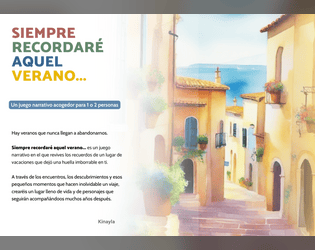
Jaja, yo también diseño los juegos que me gustaría encontrar como jugadora. 😄 De hecho, ahora mismo tengo muchas ganas de jugar a Siempre recordaré aquel verano.

Lo que comentas me recordó a un juego francés de Un Petit JdR 2021, Revivre au hameau (algún día me gustaría traducirlo al inglés y al español). En ese juego, el grupo crea un pequeño pueblo y luego va narrando escenas que ocurren allí entre personnas que volvieron al pueblo y los habitantes. Fue el primer juego que me hizo pensar en crear playsets temáticos para ayudar a empezar una partida.

Así que no creo que sea solo una preferencia tuya. 😊 También me gustan los juegos que, de vez en cuando, te ayudan a entrar en la historia sin tener que imaginarlo todo desde cero.

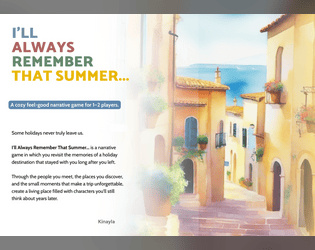
Para este juego ya tengo algunas ideas: playsets según el lugar, cartas de personajes con información básica adaptada al entorno... Incluso me los imagino ilustrados con acuarelas, aunque eso queda un poco fuera de mis habilidades. 😄

Pero primero quiero dejar que el juego viva su primera vida, ver cómo lo juega la gente y recoger sus impresiones. Después ya pensaré en añadir más material.

¡Muchas gracias! Me alegra mucho que te haya gustado el juego, sobre todo porque sigo tu página de itch.io desde hace tiempo.

Disfruté tanto creando este juego que ahora mismo estoy pensando en jugar una o dos partidas para escribir un ejemplo de partida y ayudar a quienes quieran probarlo.

El juego se puede jugar perfectamente tal como está, pero quizá algún día añada algunas ideas de playsets para los lugares, los personajes, etc. Antes de eso, me gustaría conocer las experiencias de quienes lo jueguen.

Si algún día lo pruebas, ¡me encantaría saber cómo fue la partida!

¿De verdad? ¡Qué coincidencia! Estuve ocho meses en Argentina, la mayor parte del tiempo en Buenos Aires.


Hace mucho que no practico español, así que escribo primero en español, luego uso ChatGPT para mejorar el texto y, si tengo dudas, busco el vocabulario que me falta.


También probaré tu aplicación cuando tenga un momento. ¡Parece muy útil para los juegos de journaling!


No encontré ningún enlace a tus redes sociales en tu página de itch.io. ¿Tienes alguna? Me encantaría seguir charlando y compartir ideas fuera de las jams.