

On Sale: GamesAssetsToolsTabletopComics
Indie game storeFree gamesFun gamesHorror games
Game developmentAssetsComics
SalesBundles
Jobs
TagsGame Engines

JadeLombax

127
Posts
63
Followers
1
Following
A member registered May 06, 2020 · View creator page →

Creator of

Recent community posts

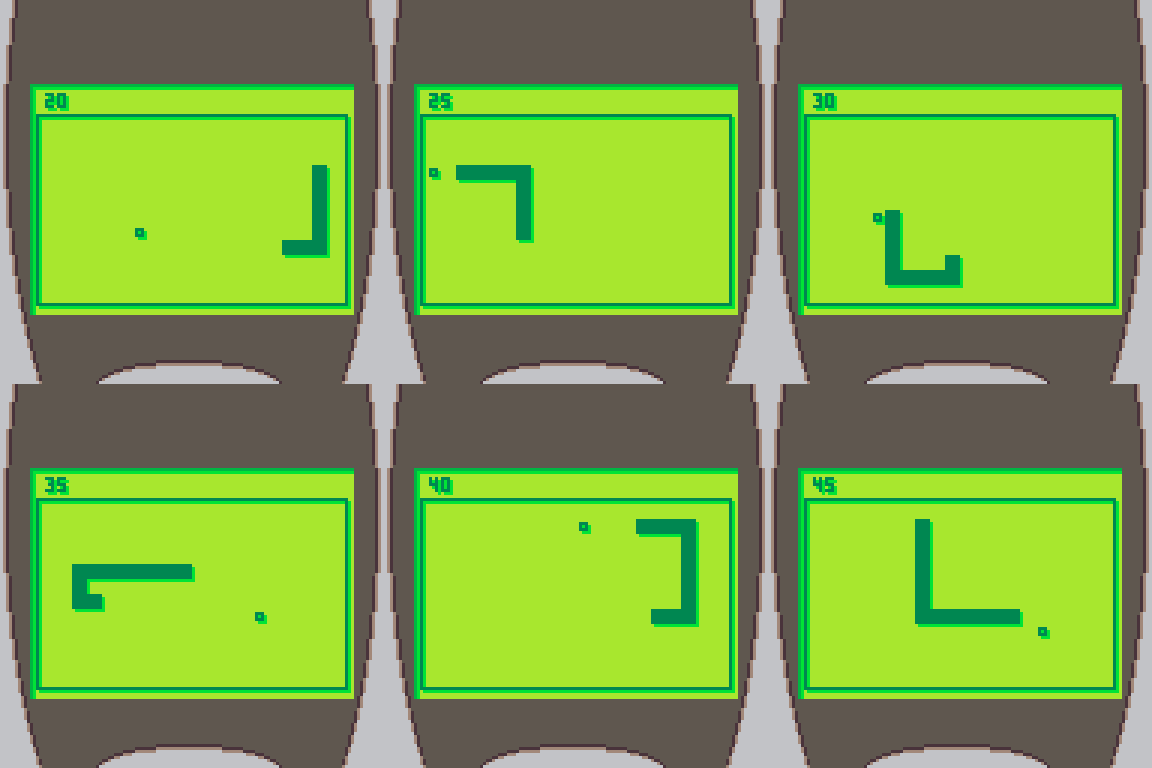
Thanks, glad you enjoyed it! The platforming on the last level is trickier, partially to make up for the fact that the flying enemies would be too easy otherwise. Thankfully there were just enough bytes to cram the level data in.

Thanks. =)

Thanks! I wasn't sure I'd even be able to fit levels worth playing into 20 bytes or so, so the fact that you enjoyed it is great to hear. 🙂

(1 edit)

Thanks, and sorry again for the hassle.

The level design and testing phase was only in the last couple of days, so it might need a little tweaking. Was planning to have more time for that, but had to create and debug a level editor program or revisions would have been a nightmare. The part that seems crazy even to me is that all the level data, including enemy placement, takes just 65 characters , and the second level, the simplest, only takes 16. o_O

Just uploaded a screenshot. Sorry about the hold up.

I'll have one in a few hours, once I get off work. I spaced out and thought the deadline was tomorrow, and was going to finish up tonight. Need to trim about 35 more bytes. 😵‍💫

Thank you, glad to hear you're enjoying it. 🙂

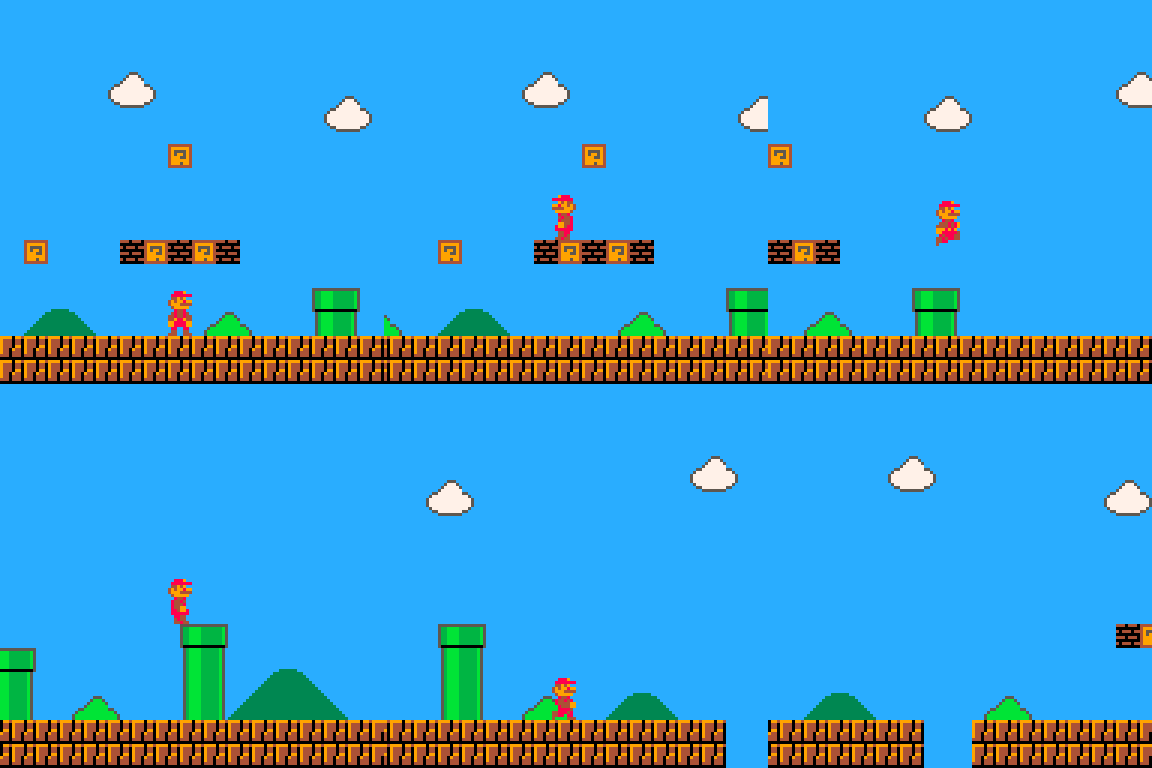
Well, I had to use lots of hacks and simplifications to get it working. It's only 1KB, so there wasn't space to tweak the physics to work exactly like the original.

Just added a link in the game description.

Thanks,🙂

I'm glad the little workarounds I came up with seem to work well enough. The single bullet was just a way of saving space vs having another group of table entries to cycle through, and the 'homing attack waves' are just an increasing spawn probability with distance traveled, and an x position that changes by distance to the player's ship/96. 

I was originally stuck on the random generation because the background needed srand(), but that meant no random enemy spawning without creating a list of values to draw from at startup. I hit on using another srand() call with the distance traveled as the seed, which gives random spawns that are the same every session, and saved around 30 bytes. I'm thinking about doing a writeup for this and/or my 550-char Space Invaders, maybe some of the strategies I found will help somebody fit their regular-size games into Pico-8 better.

Well, I'll look into converting it. It's right at the token and compressed size limits, so hopefully that doesn't present any issues.

(1 edit)

Hmm, that's not something I'm familiar with. I googled it and there seem to be tutorials about doing that, how is a .exe different from having the .p8.png file?

Thanks, I had to heavily exploit P8SCII to shave off every extra byte, and also hope the hacky parts didn't cause problems (like the fact you only have one bullet).😉

I've had some ideas for a more substantial shmup for a while, but I'm not a fan of super-difficult games and am more interested in the aesthetics and atmosphere, and haven't been sure if people would be interested in that. Guess I'll have to do some experiments.

(2 edits)

Thank you. I've been playing around with ideas for a shmup for a while, but I'm not a super difficult shooter fan and I'm honestly more interested in the whole feeling of traveling into space. I think I'm going to work on some non-size-limited experiments.

(1 edit)

Thanks. It's very simple, but I tried to add some polish and make it look as nice as I could. P8SCII codes are very useful, but they're very cryptic and fiddly.

(4 edits)

This is pretty neat, I second the request for a scoring system. I looked over the code and managed to shrink it by around 40 chars by changing the drawing functions and using a couple shorthand methods, is that enough to let you add one?


q={}r=rnd::z::x=20y=20h=0v=0g=0m=0::_::l=line?'⁶1⁶cc'

memset(27136,17,⧗)for i=30,45do

l(0,i,75-i,i,4+i%2)end

x+=h*g

y+=v*g

v+=g/9f=.88+sgn(40-y)/9h*=f

v*=f

if btnp()>0do

if(g<1)h=1+r()

g=1v-=1.5end

if(r()<.03)add(q,{x=-4,y=60+r(60),c=r(5)})

d=4for o in all(q)do?'|³d●',o.x-4,o.y-2,o.c+8

o.x+=r()if d>abs(o.x-x)+abs(o.y-y)do

o.x=x+1o.y=y

d=0end

if(o.y<40)del(q,o)end

m=max(m,y)circ(x,y,1,7)l(11,29,20,20)l(x,min(40,y),5)l(x,y)

if(m>40and y<40)goto z

goto _

Well thank you very much, that was very nice of you. There was a bit of paperwork to fill out, but it was well worth it to say that I technically made some money from a game I developed. =)

Thank you, I'm glad to hear that you enjoyed it. It was mainly an exercise in trying to fit a little explorable game world in as little program space as possible, just a kilobyte. I just make little games as a hobby and I've never been paid anything for them. I went through and set up some things, though, and if you wanted to donate a bit, that would be very cool.

Good time! The physics are a bit different from the original, but glad to hear they're working consistently.

(2 edits)

Thanks 🙂, 

I saw your walkthrough, glad to see no new game-breaking bugs popped up.

To answer your question, I had to develop  systems and techniques to cram a lot of information and logic into a tiny space, since despite much being faster than an NES, Pico-8's game carts can only be a tiny 32 kilobytes, while many NES games were hundreds of kilobytes. If you look at the other games I've posted on Itch, you'll see they're all 1KB or less. That's been due to a combination of finding optimization an interesting challenge, and also that severe size constraints really help to limit scope. For this project in particular, I used a system I built that greatly compresses level maps by storing them as placeable objects instead of individual tiles. If you're interested, you can check it out here: https://www.lexaloffle.com/bbs/?tid=42848

I am planning to work on more games that are bigger than a kilobyte, I'm actually currently working on a Pico-8 version of the original Mega Man. Like SMB, it's helping me learn a lot. I think I can get it to fit in a Pico-8 cart without significant cuts, though it'll take a while to finish.

Thank you,🙂

It was nearly finished in early '24, but I wasn't sure about releasing for a while. I guess the timing was appropriate.

Thanks, I've had some playtesters and put out a few updates. There might be some small bugs yet, but the major issues seem to have been fixed.

(1 edit)

Thanks,🙂

I tend to use 60fps in pico-8 by default, as it helps smooth out the chunky low-res motion and stuttering. I realized the original game was 30fps and tried to switch to that, but even with tweaking values, everything felt sluggish, so I just stuck with 60.

(2 edits)

Oh, okay, I thought you meant commented, long-form code. Here's a link to the code from the cart. I'm especially proud of the combined map decompression/autotiling system in about 100 chars at the beginning. ;)

https://pico-8-edu.com/c=AHB4YQkpBABPcc5oa-Bzy0Bel8v-tzaA-ZMUBjJ8isIifo8DzWV4Fe...

(1 edit)

Thanks,

There's actually no separate source code, as I code all my tiny projects in compressed form by hand. I guess that's terrible practice, but I'm not a software dev, and it lets me better monitor and control the size.

I'd be happy to answer any questions or explain things if the code's too cryptic, though.

(2 edits)

Thank you, I'm flattered.😊

When I was little kid, I remember my oldest brother slowly typing in lengthy programs from magazines on our old computer, usually to be rather underwhelmed with a primitive game that held our attention for a few minutes. Guess I'm fascinated by the idea of fitting something surprising and complex inside a tiny space.

Uploaded a new version, managed to fix some of the wall jump inconsistencies and made the destructible blocks look (very slightly) different.

(5 edits)

I agree it's a bit unpolished in some spots. I'm hoping to make a more fully fleshed-out version sometime that adds and refines a lot of things. As it is, I had to cram like crazy to fit the whole thing in 1 kilobyte.  That's less than 1% the size of the original NES Metroid. Those are good points, though, I'll see if I can free up enough space to tweak them.

You should be able to go down at the same screen where you start climbing to reach the double jump, then head left and jump over the barrier you couldn't before.

(2 edits)

As always, thank you for being a kind and gracious host. =)

I found a hybrid system for the map that seems to work pretty well: deliberate design elements laid on top of procedural generation. I'm calling the little robot K5, as it's the last part of his serial number.  Initially was going to call him Gizmo, but it didn't really fit with the more realistic tone I was going for. Speaking of naming, my initial name for the game was MapDroid, do you think that's a bit too on-the-nose for a non-size-restricted version?

As for the power cell, I believe only 2 are truly hidden, I'd recommend searching the depths of the red crystal area, or around the waterfall. ;)

Thank you! I've never heard of that game before, I'll have to check it out. Also haven't encountered that glitch before or heard about it from others, though as some of the logic is a bit hacky, that's not too surprising. I'll see if I can replicate it and figure out what's happening.

This is a legitimately fun, cool little game. Nice job! As the fellow maker of a game with a googly-eyed colored-sphere protagonist, I approve of your easy-to-animate strategy ;)

Thank you very much, that's high praise coming from someone with your coding savvy.

There's definitely some procedural generation smoke and mirrors, but it's a video game, what it looks like is kinda the whole thing. Glad to hear people are legitimately liking how the game plays. It's my first-ever shot at a Metroidvania, so that's encouraging for potential future projects.

(1 edit)

Thank you, glad to hear you're enjoying it!

I might have to shatter the illusion a bit, but there's actually not very much map detail stored. The world is made up of just 35 rectangle and oval shapes drawn to the screen and copied to map memory. The trick is that the shapes are drawn over 64 cel-like room shapes composed of several hundred randomly-drawn black rectangles. I hit on this after initially trying pure procedural generation, which was too chaotic. Combining random detail with specifically-designed features seems to give most of the effect of storing a lot more information, though you have to work with what's there. It's kinda like looking for faces on a textured ceiling. =)

(2 edits)

Thank you, looks like you got a good time! I would have liked to include at least some sound effects, but even that would have eaten up space fast.  I'd like to make a more fleshed-out, non-size-limited version of this at some point, I just have to work at limiting my scope (a big reason I started size-coding in the first place).

Oh also, they're technically power cells (yeah, I know they're squares, but Metroid gets away with it. ; )

I'm glad you enjoyed it. I have to say my intention wasn't to be evil, more that I only had 12 total collectibles, and if I handed them all out in a straightforward way, the game would basically have zero longevity or replayability. If i'd really wanted to be evil, I could have included some blind pitfalls (including ones  of that drop you out of the whole map), or made pits you could fall down and not get out of. =P Also, while the destructible walls aren't marked, they don't have any crystals on them, as you can't destroy those.

What you're saying about the double jump (or as I like to think of it, 'jump jets') makes sense. I didn't have any space for explanation (I mean, the game's title doubles as an explanation of your objective) but I had hoped the deep pit you have to climb out of in the green quadrant would help players come to grips with it.

Thank you, having the game stand on its own merits regardless of file size was my goal. I'm realizing the time in seconds is pretty awkward, but couldn't fit proper formatting. As it is, the title logo and time display are part of the same print command. And yes, they are green squares, they're supposed to be metroid-style power cells. =P

Glad you liked it enough to finish! My goal was to make a decent small game, even if not considering the file size. Sorry about the time in seconds, proper minute: second formatting would have eaten up way too many bytes. o_O

(2 edits)

Nice job on the graphics and sound, and coming up with smart simplifications! The 97 seconds remaining submission is kind of the cherry on top. =) Was thinking about a demake of Dig-Dug or Frogger, and had made a little test, but my project took too much time for that. Glad to see somebody made one.

(1 edit)

Thanks, 

I've just been practicing the digital equivalent of jumping up and down on a suitcase to cram 'em in as tight as they'll go. ;) This one was tricky. I had a good base from my last entry, but as I've found when encoding sprite and map data in custom, highly-compressed form, things can get very temperamental.

Thanks for letting me know about the glitch, didn't have a lot of time for playtesting. I uploaded a fixed version. It appears I had failed to update a number from 21 to 22...