
Indie game storeFree gamesFun gamesHorror games
Game developmentAssetsComics
SalesBundles
Jobs
TagsGame Engines

iria-1342

10
Posts
2
Topics
1
Followers
A member registered 14 days ago

Recent community posts

Hi, and thank you for the interest in my project. Looking at your work, it is quite professional looking and well crafted! I'm still a bit of a ways off from a playable demo (maybe a couple weeks) but I would be glad to discuss design ideas (e.g. things that don't work, things that need more implementation, and just plain cool concepts). The art assets and stuff will come at a much later time if I decide to go all-in and sell the product or just keep it a fun hobby-game.

I'm a 100% amateur that is doing this as a self-funded hobby with zero expectation of return on investment, and while I'm always in favor of paying compensation for work, I don't have any plans to hire consultants or designers at this time. The art assets, music, sound, and UI screens might be in the cards for hiring outside work in the future, but I'll need to weigh my options. If you just want to chat about my game and ideas for fun, I would be happy to do so.

By day I'm a computational specialist (background in applied math) working at a laboratory on particle physics and other related electromagnetic software with AI integration, so that's what pays the bills and I can only work on this project as a hobby part time.

As a big fan of legacy RTS games (e.g. Starcraft, Command & Conquer, etc.) and wanting to use my expertise of physics, math, and computer science for gaming, I wanted to try my hand at bringing my original concept to life with the help of Claude Code (more on this later). As I alluded to in another thread, came up with a concept for a novel game mechanic that ties into the real-time strategy in a new way - the delayed-time strategy!

While there are some games out there that use finite communication speed as a game mechanic (e.g. NEBULOUS: Fleet Command uses delayed radar effects), the game I'm building has a very unique spin on it. Enter the world of Echolumination (my first video game), a "simple"-looking 2D RTS game with two speeds of information: sound speed and light speed, but in the fictional atmosphere (with an absurdly high index of refraction), light speed is only one tenth of the speed of sound! Note, this does not imply any relativistic effects (time dialation, length contraction, etc.) since causality is not slowed down.

What this means the entire map has a true state that the players cannot see but rather each player gets a perception field of the state of the game determined by the speed of light (which is sloooow in this game) instead of fog of war. So you see distant units, buildings, spells, etc. effects in the past (with further objects, further in the past). However, your units can relay information they see back to you at the speed of sound which is much faster. Thus as you move your units around, you will see the world around fast-forward in time as you explore - it won't rewind if you leave the field of view (instead it stays frozen as an image until a fresher image is available).

Because of this sound communication channel instead of light, units also respond with latency the further they are from a command center - and they will appear to not start to move until later as well due to the round-trip sound delay. But don't worry, there are abilities in the game that can speed things up (e.g. abilities and such that can communicate faster in some situations). I also am building a vast array of special abilities that are unique to this type of game which can mess with your opponent's ability to control their units, hide objects from light (or sound), and more. But because it's grounded in classic RTS gameplay, I will also include a number of more conventional unit types and mechanics.

Here is a schematic image of the concept in space-time diagrams:
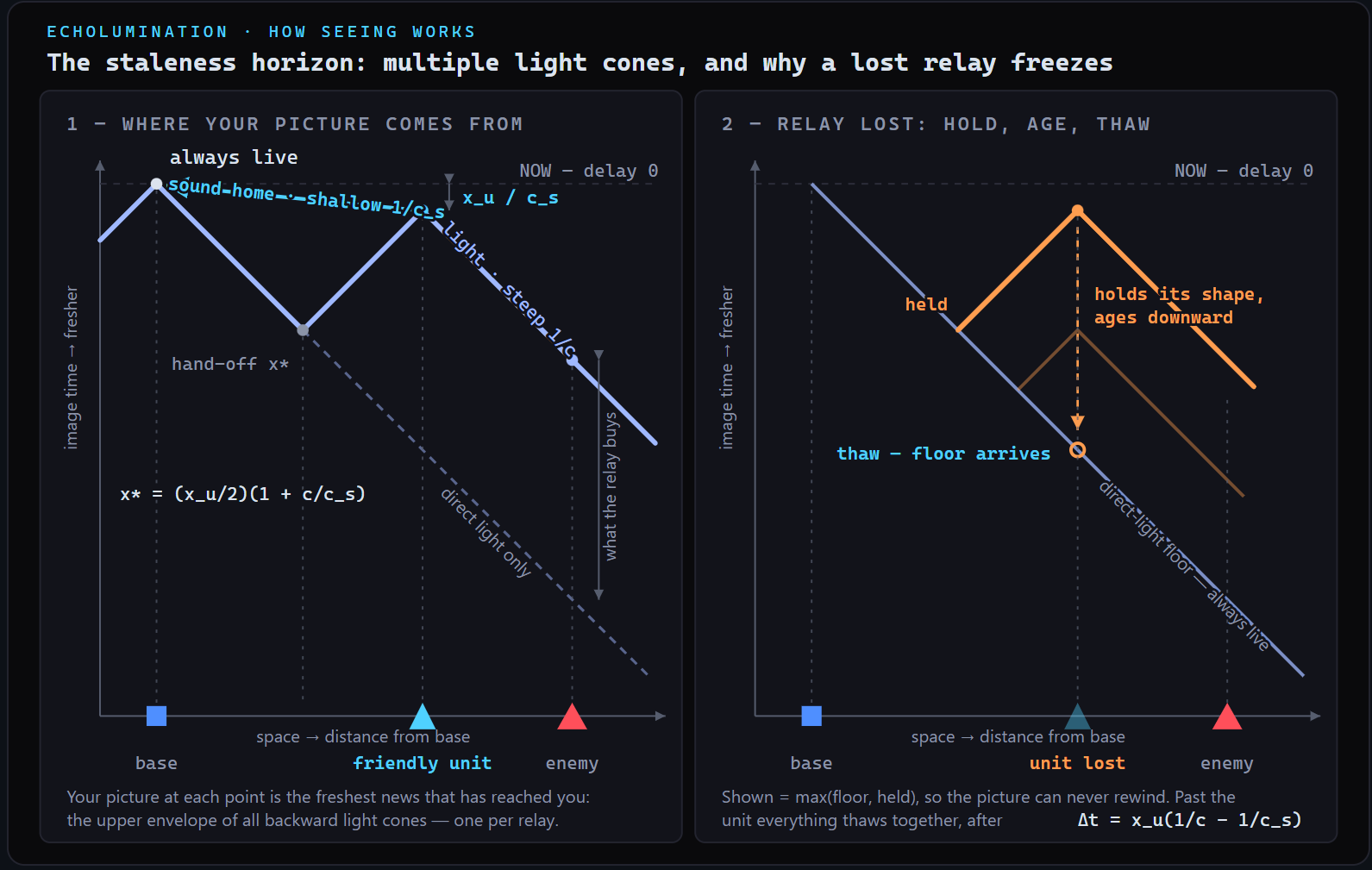
Your perceived view of the battlefield is the minimum delay over all information channels (i.e. all units/structures with speed of sound delays). Each player will have a vastly different view and dead units stay visible until you see them die (you might see events unfold in a different order than another player).

However, due to the unique nature of how this game has to operate, I was unable to come up with a good way to build this dynamic sound/light delay rendering effect into an existing game engine and had to develop one on my own with Claude (which it works great). The key ingredient is a history ring buffer that each unit/structure/entity has with multiple points for each which then use bilinear interpolation to calculate the perception delay for the entire unit (yes, due to slow light speed effects, you get crazy lensing effects possible like stretching and distorting). Furthermore, to add another wrench to the works, objects which exceed the speed of light in a medium can have multiple images - some of which appear to move backwards! This is also built-into the renderer with a complicated backward light-cone solver which tries to find all solutions where world lines of the entities intersect backward light-cones (fancy-speak for the proper rendering calculations).

Because of the large memory footprint in storing temporal data in a large history ring buffer per entity per vertex, I am strictly keeping this game 2D for now (while the principle is possible in 3D as well, it might be too memory-intsive to store 4D data for every unit)!

So where am I in the project? I started 3 weeks ago but I already built the engine, pathfinding systems, a simplistic UI (incl. minimap, unit editors, options), most units/buildings/effects and the key concepts. I am now working on other abilities as well as testing interactions. This was all done with Claude Code (Fable for planning and Opus/Sonnet for coding) - while this game is AI-coded (at my careful direction), the assets will be 100% human-made (art/music/sound/etc.). The game currently is using very simple graphics (polygon shapes for all the units/structures/effects) and there is no sound added yet (but it will be tied into the same delayed-perception engine). Multiplayer will be a long-term goal since that will require a lot more effort.

I am planning on finishing an alpha build of the game in the near future (few weeks) but then must decide how to move onwards with assets (e.g. using a pre-made set of assets or hiring artists). If this is something that is interesting to you and would like to discuss mechnics, or art ideas, let me know! I'm a new user to itch.io and felt that this big post should probably be best suited for the general discussion (since I haven't added the game to a project here yet - so no dev log yet). There is no release for the game yet, so it's still a concept discussion.

Thanks for reading my first gaming project introduction! If you have questions, comments, or other ideas, feel free to let me know :)

Thanks for the tips. I am using ClaudeCode exclusively for the coding in a neat way. I'm the architect with all the design choices, Fable is the foreman/civil engineer, and Opus/Sonnet are the contruction workers. It has been a good workflow so far and everything seems to work since after every few milestones, I do a play-test and report my findings (bugs, suggestions, ideas). Then I make a new batch of milestones based on the feedback and continue onwards. I do use my computational background to suggest certain algorithms or ways to implment ideas but often times Fable already knows of the method first and proposes it! I haven't encountered anything as of yet that wasn't solved with Fable and the other agents (maybe my prompting was careful enough). And I know the code works correctly because of my direct playtesting (I know exactly what certain effects should look like due to my physics background).

Since I'm committing to not using generative AI assets beyond simple shapes/textures/etc. the UI is minimalistic but functional and there is no sound implemented yet. While it is entirely written by AI (in typescript for playing in a browser), it runs quite well and can be adapted as needed (e.g. I added debug menus, unit parameter editors, runtime metrics, etc.).

My game is strictly 2D-only due to the computational complexity behind the game mechanic (which I'll share soon in a different post) and while C++ is an option for faster execution, this isn't needed anytime soon. But thanks for sharing your experience with AI tools.

Okay thanks for the warnings! I'll keep that in mind. Yes, I'm using AI but only for bringing my creative ideas to life as a tool. I agree that it's ambitious but it's something I don't plan to release anytime soon since I totally agree it's a lot of work!

As for progamming, I am a computational scientist and have extensive experience with Python, C++, MATLAB among other languages. I am well versed in computer science terms and game theory concepts. I have deployed other projects (non-game-related) via GitHub for work so I'm not new to software development. For the parts I don't know, I use my gaming knowledge and ask people; however, being able to google algorithms for things helps a lot (e.g. flow fields vs A* for pathfinding efficiency).

Also, I should add the game is 100% not for profit. I am doing this with my personal funds as a hobby.

Okay, thanks for the additional information. I did extensively research various RTS games and the closest to mine in terms of strange mechanics would be maybe Achron or Nebulous Fleet Command. Again, I realize that building a game from an existing back-end engine is the ideal goal. But my project requires a special form of game state mechanics that requires storing space-time state vectors for every single vertex in the game! All the common RTS back-ends are fundamentally incompatible because of how the game state is represented.

I'll make a separate post soon to discuss the concept and where I am so far, but I was the one that came up with the concept and implementation strategy, not the AI. The AI is handling the boiler-plate coding and will help with the Godot integration. The art assets are minimal for now (no generative AI art/sound/music to be used) - just basic shapes and colors.

And thanks for the video and suggestions. As for the "why RTS" and not say a tower defense, well it won't be as interesting with my concept. My concept revolves around motion, strategy, and positioning to get to appreciate the special effects to their fullest.

I understand that AI can very commonly convince us of things that it doesn't find right away as "novel". I'm well aware of amateur mathematicians being convinced that they invented something amazing only to find it was known for hundreds of years in professional circles! I have indeed searched of similar concepts myself but I could not find anything close to the idea. And the reason for the entire engine rework for a "2D RTS" is that such engines are insufficient for my concept which "technically" is computed in 3D albeit using ring buffers and complex math optics. Basically every RTS engine out there functions in the same way, a unified map "state" that everything interacts with, what players see is what players interact with. It's all happening live on the same map (with some fog-of-war to hide stuff). My twist comes from replacing the fog of war with something far more complicated.

I'll probably share the concept in another topic since this topic was more about the AI sentiment regardingg AI coding (not related to AI art/music/sound assets). As for whether my game concept is "fun" is another question as well, but I am sure it will be unique.

Unfortunately, I dont have the time to go full into game development. So I'm relying on Claude Code but with careful prompts. My goal is to make my idea come to life but if it's a good game in the end, I'll polish it with real assets made by real people (the backend is AI dev code). And yes, I truely believe my concept is novel but I don't want to spill the beans just yet.

I will eventually use Godot on the front end though. But thank you for your honest answers everyone.

Hi, I'm a new developer working on making my first video game. I am planning on creating a very unique game spin-off an existing game genre (RTS) with mechanics that have never been implemented in any game before (I checked extensively). I originally wanted to build my unique game engine idea into an existing RTS strategy game code like OpenRA but it's too fundamentally different would be actually less work to build the entire game from scratch (per my discussions with Claude Code Fable).

Thus to actually bring my unique game concept to life, I am employing heavy use of Claude Code over many coding sessions to build the entire engine from scratch! Not even a powerful map editor like for SC2 would be able to implement my idea. However, because of the ambitious size of developing such a thing, I think the goal will be a minimal 2D RTS-type game with the unique mechanics.

So my question is: do people generally accept AI-coded games? or are they often ignored/disregarded as slop regardless of the merits?

I know there is a lot of backlash against generative AI and I agree protections must be in place to keep humans in the loop of game creation. If I ever make this game more fancy, I will seek assistance in the form of content creators for art assets, sounds, music, etc. But I'm doing allo the back-end-development with Claude Code. The end result won't be an "AI slop" game since I am directly managing the progress - but I worry that I will be labeled as such since I'll need to flag my game as "AI generated".

I won't go into the specifics of the game mechanics or why I consider it a new-type of RTS game (possibly sub-genre) now, but trust me when I say it's very unique and uses some advanced physics concepts. For reference, I have an extensive background in computational physics (my PhD is applied math) and my day job is a computational scientist at a lab. But my passion for video games is lifelong and I recently have started using Claude Code at work and have since transitioned to also buying a personal subscription for my own projects.

I'm thinking of hosting it once I have a working alpha version for feedback and ideas. I also want to look into how to protect my work (not planning on copywriting but I'll probably keep my github private).

Any other tips for new developers like myself who are using Claude Code for the entire programming effort, but plan on using humans for all assets (music, sound, art)?