Hello! It depends on your game's perspective, but you could use paths and draw the shadows vertices in the room.
Foxy Of Jungle
Creator of
Recent community posts
Hello!
This is the Debug UI that Post-Processing FX uses to test effects in-game when you call ppfx_debug_show; Previously it was included in the PPFX folder, but because I used the same UI in my other libraries, maintaining a different version in each project was chaotic, so now you only need to import CyberUI if you need the debug UI, which is actually optional - it will not crash if you don't import it (this also makes the PPFX .yymps file less bloated).
This also means that you only need to import CyberUI package once, if you have my other libraries.
No, not on Discord. I usually include tutorials on my website, but to be honest, there's no secret to how this effect works; it's basically a shader_set (the shader does 90% of the effect), surface drawing, and uniforms. At this point, you'd probably be adapting it to your specific project, and that's usually what the user handles.
Hello, zDeath!
The object that comes with it attempts to simulate the PPFX renderer in a very basic way; that's essentially what this statement means. Actually, you can use the object that comes with it, but if you need to mix it with other effects you have, you may need to modify the GML code.
Thanks ^^
Hello, 7acques!
A CRT effect is in the works, but I don't have a estimated completion date, as it's currently experimental. I would really like to create a very complete and efficient effect that pleasantly simulates a CRT monitor, but I'm still studying ways to do that, since most of the CRT effects I see on the internet are kinda strange to look at in practice for a long time ^^'
Thank you very much!
Hello, danila!
Because the GUI isn't a surface and is drawn on top of the application_surface, and you're using the application_surface as an input surface for PPFX, it doesn't include the GUI. The only easy way would be to draw the UI inside the application_surface. You can try doing this in the Draw End event, using a camera with orthographic projection (2D camera).
Hello Anathamatika,
Of course, there is a full documentation with a Getting Started guide, which explains how to use it.
You can also see the .yyz example project with real usage examples.
I hope this helps :)
Hello sully,
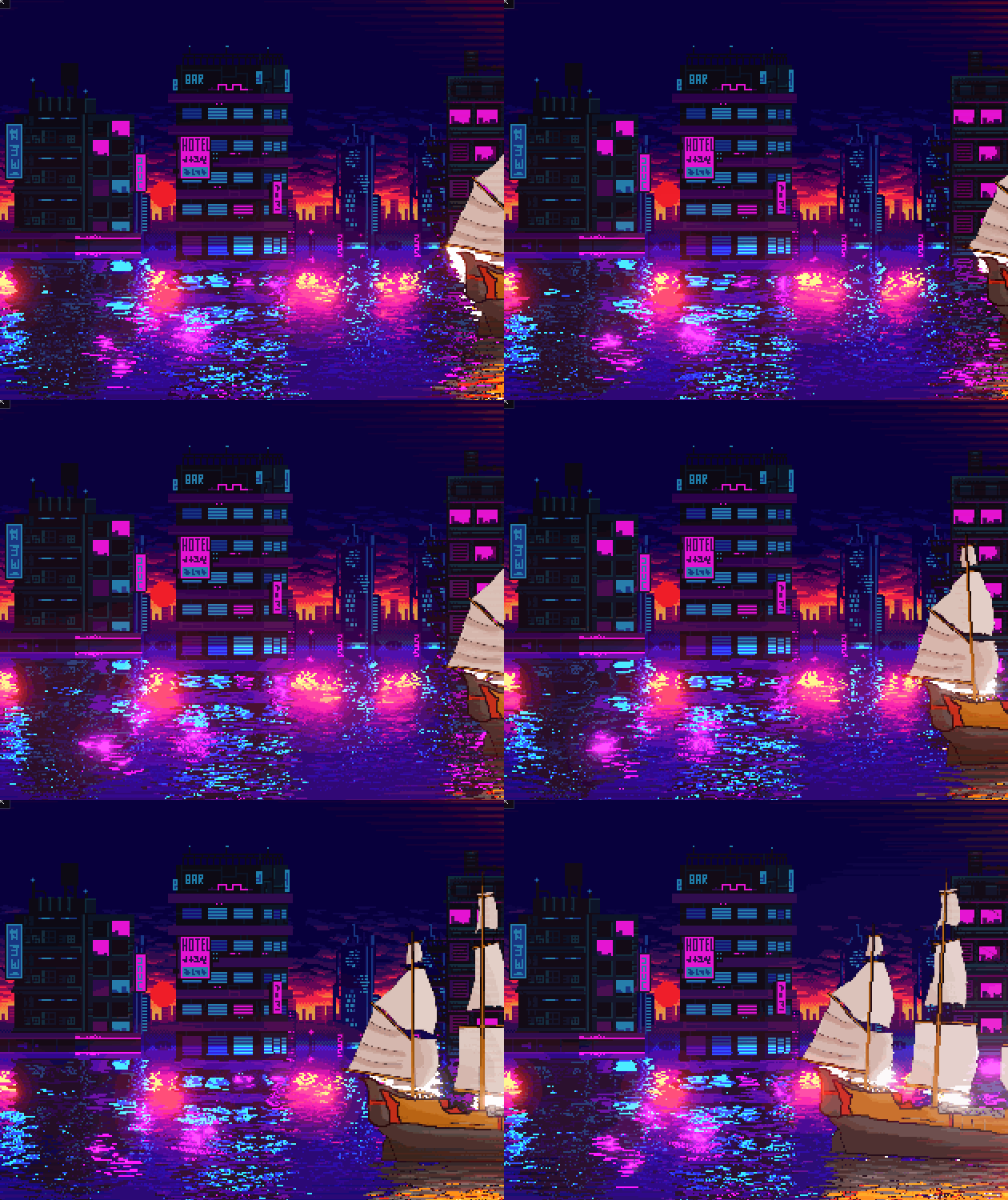
Yes, it's possible: The first room in the demo is more or less an example of this: the background is illuminated, and the interior is dark with lights. You can add a Direct Light of any color (like white - for a neautral color) in the background to illuminate the exterior environment, with the depth of light below the depth of the "dark area". Ideally, the dark area will need occluders/shadows for walls to block internal light from passing out, like below (shadows are optional):

The Discord server link is on my Itch.io
Hello, sully!
I'm happy to help with any questions through my Discord server, which is on Itch.io. There's also a Getting Started guide that will help you add Crystal to your game.
To make you comfortable: I'm one of the developers who best understands how graphics work in GameMaker, so you can rest assured.
Crystal was designed with pixel art in mind as well, so depending on what you've done, it should be compatible. But if you're interested, I have another library called Rezol that handles pixel-perfect from the box and works well with Crystal as well.
Lights compensation works similarly to intensity, but it multiplies after blending (basically an exposure control). Oh yes, the default "lights compensation" is 3. I was going to change it to 1 and even wrote it in the documentation, but at the last minute I went back to 3 because I realized that this could cause confusion like "my lights got weak in this update" ^^'.
That's an interesting observation; I believe it must be due to the mathematical equation of blending, but basically, the lights are "multiplicatively additive" in the scene, so perhaps that explains the behavior.
No problem, thanks for the kindness =]
Hello, Brittle Lizard!
Yes, for this to work, the ambient light intensity usually needs to be above 0 (so you can see the darkness area), and you need to set the intensity of the lights to 1 (default) using .SetLightsIntensity() and .SetLightsCompensation(). It might also be helpful to change the global blending type of the lights if desired.
Thanks for the feedback :D
I completely understand that the price may seem high, depending on each person's needs and budget. It is priced based on the amount of content, the problems that it solves, the technical quality, the long-term support (you also receive free updates), and the unique features you won't find elsewhere.
That being said, I really appreciate you taking the time to check it out, and I'm always open to suggestions on how to make it even better ^^
Hello!
Everything in the demo is included when you obtain the Crystal, except for the Post-Processing FX for the bloom effect, as it was the only way to demonstrate the emissive materials working with glow ^^
Thank you for your kind words! I hope you enjoy it :D