

Awesome once again! I cant help but think of how the two types of levels are essentially the same when observed as pure graphs, replace the numbers with verticies, and the edge between the two numbers is the edge between two numbers.
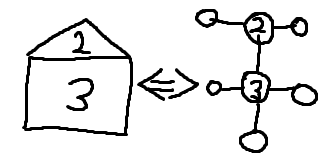
Also, it would be fun to see a sandbox style level editor with switchable views between two level types, or with moveable nodes in general.
A very tall ask, but would physics simulation be possible? Turning every edge into a spring while mapping the outside edges on a circle or any other closed shape, and seeing how graph turns out in the end. This might help with seeing some patterns, like how -2- with 4 connections is always a pattern of 1010, as sometimes some node configurations dont feel the same as they count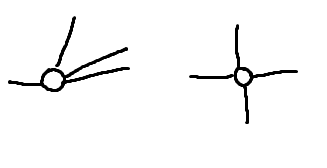 (Basically how the node on the right is much more intuitively 4 connection than the node on the left)
Thanks, and thanks for the suggestions! I was indeed thinking of dual graphs when designing the rules so good catch there :) Now, one place where I think this breaks is in levels with both kinds of clues (last level in this demo). If I modify your example a bit you could do something like this, where on the right the 2-line crossing the two edges means both of them are lit. There probably will be such "cut clues" in later levels but it might be quite difficult to cleanly generate them for dual graphs.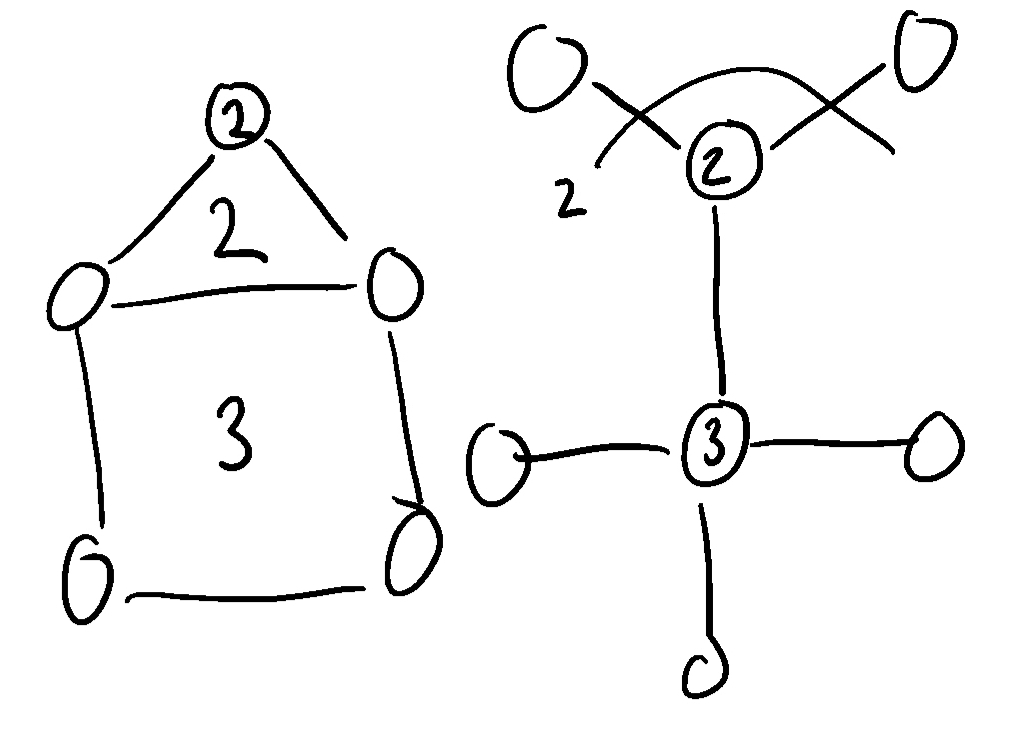
These "cut clues" also make the spring idea more difficult to implement since you'd have to bend the cut lines so that they cross the correct edges. It's unfortunate because I really liked the idea of being able to switch between the arrangement needed for the image and a different arrangement more suitable for solving :|
Oh, didnt finish the demo at the time of writing the comment, my hands were just itching to point that out)
Now that I finishedthe demo, I think that dual type levels are technically still the same, if we make a big bounding box as one big node, right? N-blule2 connections are saved. (This is what I meant by mapping the graph onto a shape, we can map all the edges that touch the outside world on a single shape.) If we go completelety into nodes only territory, we can do the third version, where we have several connections going into the same node.
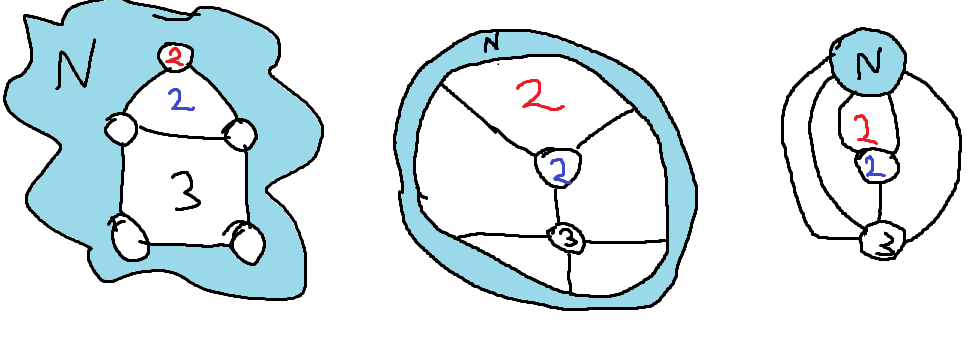
This also handles the {x} and -x- patterns and 'hanging' nodes surprisingly well, color and number coded all edges and verticies. The 1, 3, 5 and 7 blobs on the middle and right image arent nodes, they are A into A connections. (That's what a hanging node technically is, it seperates A and A planes on the left image.) Conversion is much more neat if converted into a middle version, with an all encompassing outer shell, but the rightmost one is technically proper version to do this.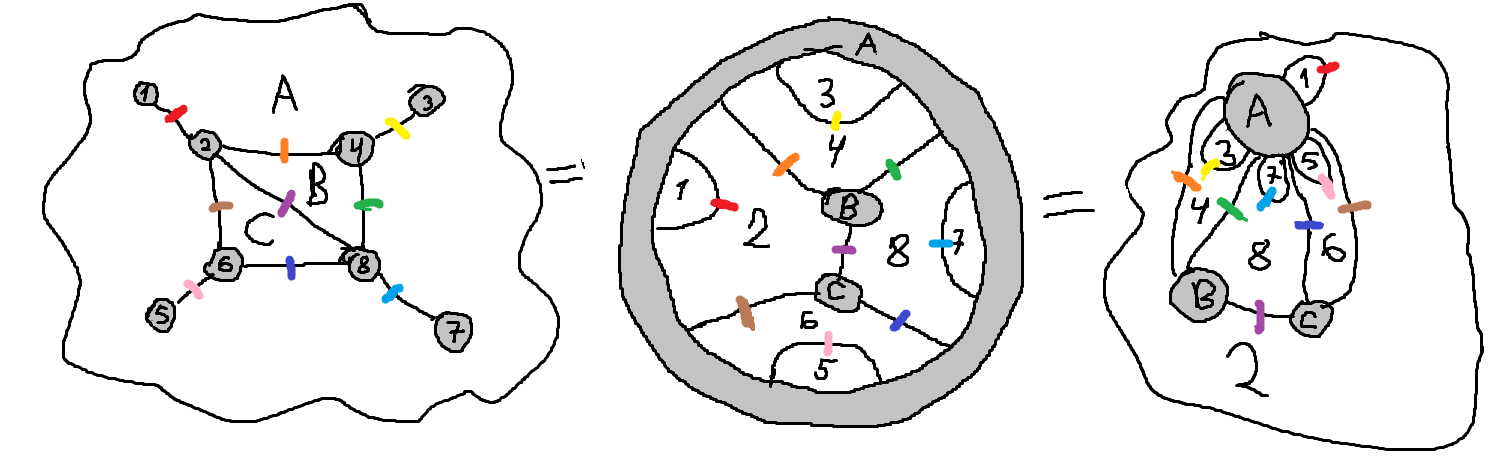
Would this whimsical nonsense work, or am I missing anything?
I think that's the proper way to go between a graph and its dual, so in theory it works. But for this game there are a couple problems. First, currently the game only allows simple graphs (no loops or parallel edges), so for example you could only have one N-3 connection in your first example.
Even if we'd allow non-simple graphs, the second challenge would be layouting. You might have to connect far away vertices (the N-3 connections go around the whole graph), so making the final graph clean could be difficult. I'm sure algorithms for this exist but sounds like a lot of work for this game.
So, cool idea but maybe it has to be a separate project :) Maybe a game where one graph shows some clues and the dual shows other clues and you have to switch between them to solve it.
Haha, I understand that this is an engine limitatin, thanks for even entertaining a possibility of such an idea) I love dabbling in theoreticals