A browser game made in HTML5.
Rating a work when you know the author is always tricky. Not because I'm worried my feelings will necessarily get in the way, but it can be hard to judge in a vacuum, I know the creator and their style, I have insights to the creation process, and while I believe pink's work is often strong enough that I would have put the pieces together myself, I can't be 100% sure.
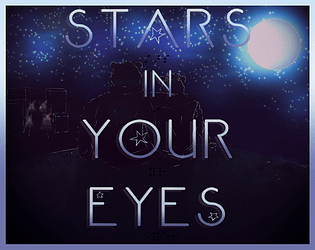
Sequels are tricky. In a world where the corporate creative climate seems to be bereft of any original ideas beyond remakes, remasters, and unnecessary followups, the indie scene is often a breath of fresh air when it comes to new and exciting content. I personally am not opposed to following up a story. I am a firm believer that your piece does not have to end with the denouement. I don't know that Stars in Your Eyes was begging for a sequel, but it certainly isn't hurt by one. Clearly the author still had something to say with these characters, that was important saying. Though truthfully, Silent Star Symphony feels less like a sequel, and more like a part two. It's the rest of the statement, the end of the refrain. It finishes the ideas set up in the first half, and holds your hands to tell you that yes, it'll be okay.
Admittedly this means I will be talking about these two pieces as a singular work instead of just the sequel.
It's interesting, it actually reminds me a fair bit of the key musical piece of the work, Luna. Fraught with a dour and intense opening, the song is filled with ominous and tumultuous lows. It is a struggle. It becomes slow, and pensive, voices drop in and out. But around the 3 minute mark the song almost restarts, it becomes lighter, airy, the octave raises, and the low tones recede. This plays even better into Luna (Hayou's Version), which starts in this lighter tone, and fills in with a cheerier and more upbeat, more optimistic tone. Still in the background are these grounded, deep strikes. Still life is hard, still there is struggle, still Luna is dead. But there are still so many moments of meaning. There are so many stars that still shine down. There is so much love and life ahead. It also pairs perfectly with a lot of the symbolism and mirrored environments between the games themselves. The most stand out moment is in the church, and the concert hall. This is Luca's real altar to Luna, a place of worship for him, that he has been violently divorced from. A place that ends up just as alien as a church that held a funeral he didn't attend, still charged with the static energy of all the people who were once there.
Looking at it from an objective (and unfair lens) Luna, both the song and the character, is less of a presence of a person and more of a plot device. Her life, and death, sets up the rest of the plot. Hayou and Luca can have their meet cute because Luca doesn't want to step into the dead name funeral of the love he feels responsible for the death of, and so he can run away with Hayou. However, she is such a strong presence in Luca's life and his mannerisms and motivations that one of my few criticisms is that I think the vn risks not understanding that it's done a good job at showing she is so much more than that. At her grave, by himself, while Luca mourns her and reaches the conclusion that she'd want him to live a long, happy, messy life, we get Luna telling him just that. I don't think we need that. We know that what the two of them had was something truly beautiful, and special. We know that Luna is a beautiful and empathetic person, someone so amazing that even though Luca knows that no one is perfect, he lacks any other words to describe her than as such. It's sweet having her whisper "I love fat bitches" in his ear, but I think that statement stands without having it spelled out to us.
Speaking of "perfect" and "fat bitches" this is maybe the other flaw of the vn. Luca is a bit of a manic pixie dream girl. I say girl not because I'm gender armchair diagnosing Luca but because it represents a specific path of the archetype of someone who crashes into your life in a way that's eccentric, widens your world view, and often empowers you in both romantic and sexual ways. If you want a manic pixie dream boy, that's the guy on the Hallmark channel that teaches you it's okay to abandon your career in paris and instead stay on the farm or whatever. Point being Luca is a bit of a deconstruction of this One Dimensional Female Lead trope because the real reason he's crashing into things is because he's bad at driving he's got an avoidant streak a mild wide and finds it easier to face the issues of other people than his own. He is a disaster (affectionate) and while he's got a lot of help to give Hayou, he also needs a lot of patience and support himself. The weird kind of downside is that Hayou is perfect. Beyond wandering into oncoming traffic as the start of the Meet Cute which feels retrospectively wildly out of character when he's so often careful and self conscious about everything else, Hayou doesn't have much in the way of flaws. We get to see him rage out in the first game, but his violence never feels like it's concerning or even remotely close to being dangerous to anyone else. I'm struggling to put my finger on the exact words, but there's a difference between Hayou doing some minor vandalism because the government treats him as subhuman vs. say, Leo Alvarez acting as the apex predator of drywall. Maybe Hayou is flawed in that he struggles to stand up for himself, but as we see in the second part, and in his story about his dnd group, he's surrounded by people who are more than willing to back him up.
I do wonder, and this is my insider knowledge speaking, if maybe this struggle was supposed to be demonstrated with Hayou and his mother, before being changed to the two of them having nothing but love and care between them. Definitely better for the story! But beyond the limitations that come with being disabled, Hayou ends up being a bit larger than life himself, even though we get his self doubts and concerns during his pov. And no, I don't count sparing your trans disabled bestie's feelings by not telling her you hate panettone as a flaw.
Still, that's all me reaching to find things to complain about. Like the first game, the level of accessibility is phenomenal. A stand out moment to me is the programming to make the use of emojis palatable to voice text use. The evolution of art and music is gorgeous. And Pink's snappy dialogue and sense of humor shines through while still maintaining distinct voices between the two characters. It really reads the way that vocabulary and dialect between people tend to blend together when they spend a lot of time together, without it seeming like they're all one suicide joke away from actually doing it. In fact general lack of suicide jokes at all! I think it maintains that sense of hope and optimism that was such a strong presence in the first part. Sometimes things suck, but we go on, and we live and love and sometimes we may lose. We may fall, and fall hard. But despite everything, at the end of the day, we still win out.