

We need more drawing ttrpg like that. Thanks you ! PS: i play mostly solo, ttrpg would be interested to have your thoughts on a solo hack...
yannsbi
16
Posts
7
Following
A member registered Nov 22, 2024
Recent community posts
As always, what an exciting proposition !
However.. I'm confused about the tunnel rule. Does the crossword grid itself need to have a continuous white-square path between the ENTRY (top-left) and the EXIT (bottom-right), or can the path be created only by the answers you fill in? In other words, if the grid is split by black squares and those two corners aren't connected, is that grid invalid or still playable?
Example: 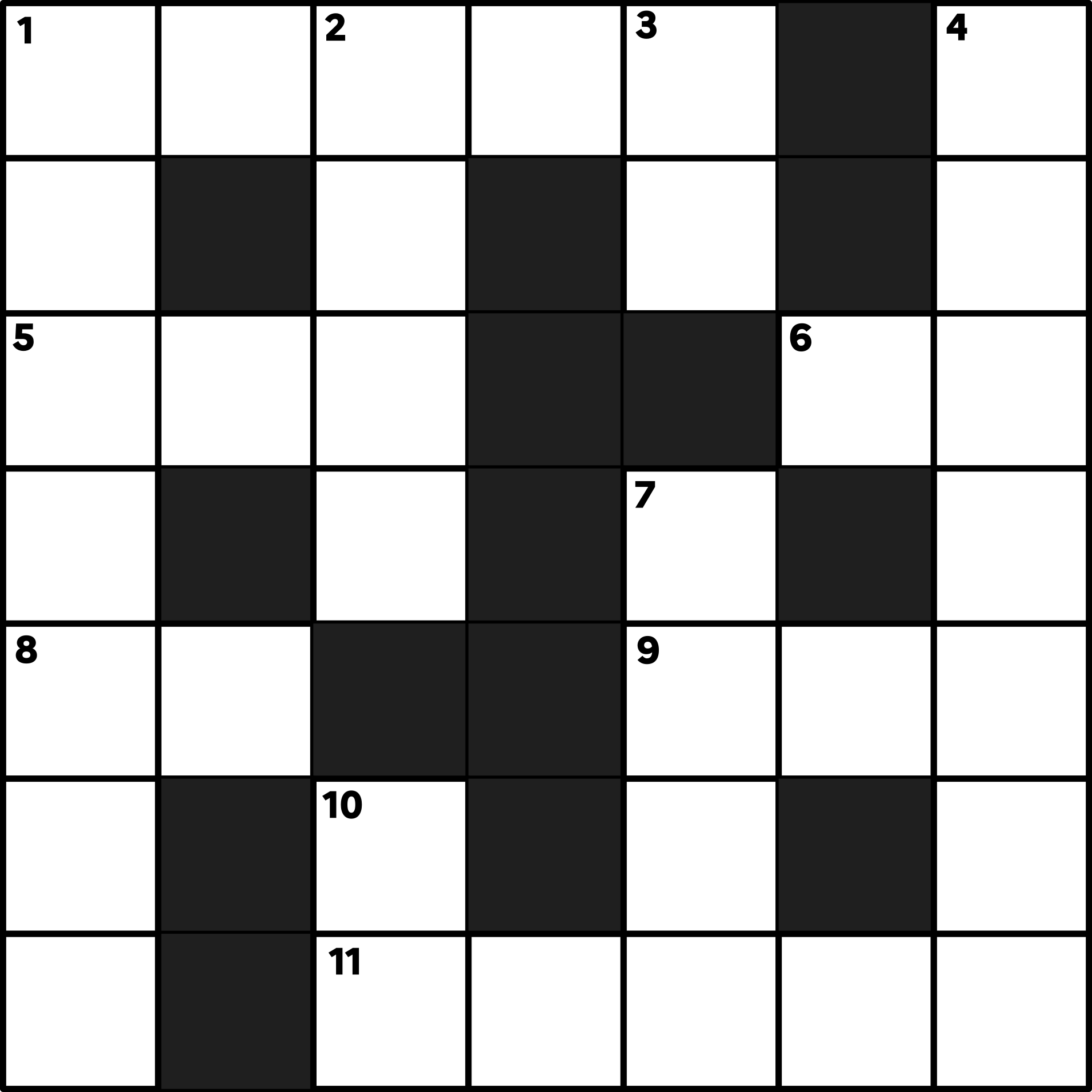
I naturally roll an oracle whenever I meet a hazard, just to keep it as a real moment of uncertainty. I’ll ask something simple like “Do we pass through smoothly?” and let the oracle shape what happens.
With a Yes/No And-But oracle, the plain “Yes” result has the same 1-in-6 chance as the 10+ outcome in the ATW action roll. But because I also treat “Extreme Yes” as a smooth continuation with a bonus, that gives me two chances in six for things to go well. The remaining results usually mean we still move forward, but with some kind of twist or complication. So the odds feel more balanced: there’s a small chance of everything going perfectly, a decent chance of complications, and a clear possibility for mundane scenes to surprise me.
That keeps minor hazards lively in situations where ATW normally wouldn’t require any roll at all. It also helps me feel that even simple moments can shift the story a little, which is something I enjoy.
I also tend to use a couple of likely/unlikely steps, inspired by other oracle tools. For example, "Dark" and "Choppy water" might count as two steps “Highly Unlikely” (–3 on a d12), while the "Sailor" trait brings it back toward one step “Unlikely” (–2). It’s just a modest way I play the game, but it lets the fiction influence the odds naturally without making any outcome certain.
Hi,
I was really hyped to try Against the Wind. The vibe of the game is great, artworks stunning, and the Book of Tables is incredibly rich for building a world and filling it with life. I also enjoy how simple the 5d6 resource system is. It keeps things tight, clear, and easy to track. After setting everything up, I jumped into play right away.
But once I got into the action roll, I started running into trouble. I beleve I understand the intent: rolling isn’t a skill check, it’s a choice to open the moment to uncertainty and complications. If I don’t want the story disrupted, I simply don’t roll. If I do want uncertainty, I roll.
But the odds behind that choice feel difficult. With the target being 10+ on 2d6, the chance of reaching that level without spending resources is extremely low. So rolling almost always means: “I expect/want this moment to be complicated,” because the default unassisted outcome is almost guaranteed to bring issues and drain resources. In practice, I guess most players will only roll in scenes where the difficulty matches what they’d treat as a “hard DC” in other games: moments where trouble already feels likely. That means there’s no surprise in trivial moments unless I choose to create it, and a chosen twist... isn’t really a twist anymore.
This also affects the behaviour of hazards. The drifting net and damaged road I encountered in the early scenes cease to be a hazard unless they are linked to an already loaded scene. If I don't expect the risk, I don't roll the dice, and nothing happens. If I roll the dice, I force chaos into something that should seem simple. Hazards thus become either color elements of the setting or chaos, closer to the tone of Aendvari's I Hate Mondays, where most of actions are a mess but without the comedic aspect that game embraces.
The result is that surprise fades outside of the big crossroads.
Since rolling is optional, I only roll where I expect trouble.
When I expect things to stay calm, I never touch the dice.
So I end up choosing where drama appears, rather than discovering it through play.
But stories often shift in small moments.
Even ordinary scenes can spark new directions when something minor goes wrong at the wrong time. History itself had moments like this: a king dying by hitting a low branch during a hunt, changing an entire kingdom. These abrupt turns matter because they aren’t planned.
In Against the Wind instead of being surprised, I’m steering the trouble. At that point, the dice feel less like a source of tension and more like a confirmation of drama I already expected
I’d love to hear your thoughts on this.
I had a great time with this game.
At first I honestly worried I wouldn’t be able to shape anything meaningful out of all the random elements the tables threw at me. But once I started using “oracle questions” to interrogate each scene, everything snapped into focus. The story gradually built itself, clue by clue, and the whole investigation became surprisingly gripping.
If anyone’s hesitating because they feel intimidated by randomness: don’t.
Asking small questions and following the answers is where the fun really begins. I ended up with a session that felt both chaotic and strangely coherent in the best possible way. Loved it!
Below is the actual play of my run, written up like a local newspaper article, in case you’re curious how a session might unfold:
Finchwood’s quiet routines took a curious turn yesterday when Beca, a well-liked diner waitress and amateur birdwatcher, raised the alarm about the sudden disappearance of Esther, her favorite regular and a clerk at Town Hall.
What began as a simple concern turned into a trail of strange scenes around town.
First clue: Esther’s coffee, waffle, and even her car were left untouched at the diner. A tote bag inside the vehicle held a flyer for a bookshop reading but Esther was nowhere near the event. Witnesses next spotted her rushing toward the Pharmacy, where a sudden flood forced everyone out. Powdered sugar traces on the shutoff valve suggested someone had staged a distraction to slip away.
From there, the search grew stranger.
A cluster of dogs outside the library hid a trained fox, of all things.
At the barbershop, a Town Hall employee nervously flashed a signet ring with an unfamiliar emblem.
A lost fake ID, a threatening letter, and later a dusty journal dropped by a man fleeing through Town Hall’s back corridor all pointed to a shadowy group working inside the building.
Meanwhile, farmers protesting across town revealed they’d been coerced by a printed blackmail note. Esther, who worked at Town Hall, had written her own notes on the same official paper ; notes addressed to the local church, describing what she had uncovered and how she escaped through the Pharmacy diversion.
The breakthrough came when Beca located these handwritten notes inside a car parked near the Funeral Home, along with someone quietly watching her through tinted windows.
By the end of the day, sources close to the investigation confirmed that Esther is safe, sheltered by contacts who received her warning.
The Town Hall employee tied to the emblem, the fox incident, the lock-in attempt, and the blackmail is now under scrutiny, thanks to Beca’s persistence and her ability to see meaning where others saw chaos.
Finchwood residents commend Beca for her quick thinking, steady nerves, and the unlikely role she played in unraveling one of the oddest days the town has seen in years.
Hi there!
I tried A Lonely Road during a lunch break. I drifted into a nap and the dream formed around floating cities. I rode a tall pedal powered boat bike.
At the first stop I reached a tight cluster of small boats. A merchant at the center shouted about some miracle mix and aimed his pitch at anyone who looked uncertain. People noticed me right away because of my height. They urged me to try the mix. I backed away, lost balance, and fell into the water. It felt clumsy rather than dramatic.
While I tried to get my bearings, I heard someone say they were recording the moment. A boom mic hovered toward me.
The next stop grew from that moment. A boat home floated closer. The owner used the boom mic like a tool to pull me aboard. He said he was gathering field recordings and asked if he could follow me. I said yes. He handed me a cassette filled with sounds from the rescue. My tallbike had not drifted far and he guided me back to it.
We continued toward an old floating university. A group of science folks greeted us as if we were expected. They held cups of choco milk and chatted about odd projects. They showed how dead spiders could act as tiny mechanical tools. They talked about licking rocks to reveal textures. They explained how flattery can briefly raise a sense of specialness.
Something in their energy reminded me of a teacher I once had. Same spark around strange ideas. They gave us posters about their work.
The last stop was a new art fair. Each piece looked intentionally weak. A potato with a fork. A broken umbrella titled Weather Permitting. A shoelace glued to cardboard called Knot Bad. A dirty sponge named Absorb This.
My companion tried recording the scene but seemed unsure what to capture. Nothing there carried any interest. The scene went flat and I woke up.
Back at my desk I told a coworker about the dream. They said the floating cities showed that my mind wanted height. The tallbike meant I was searching for a better view. The charlatan was, in their words, my fear of easy answers. Falling into the water was a reset. The boom-mic rescue was my “creative voice catching me.”
They claimed the science crowd represented ideas I keep ignoring.
The dull art fair, they said, was a sign that my mind refuses anything that feels empty.
They ended by saying the whole dream was me preparing for a shift.
I didn’t argue.
I just kept the log.
Thanks to the creator of A Lonely Road. The game turned a short nap into a small trip that stayed with me.
I’m thinking about maybe submitting something for the jam if I can figure out a solid structure for it.
I’ve got an idea brewing for a musical game where you actually compose music as part of the gameplay like, your actions or choices directly create a melody or musical phrase. It’s definitely a bit niche, and might lean on some basic music knowledge (or at least willingness to experiment with sound), but I think it could be something really fun and different.
Still playing around with how it could work in practice ( maybe using dice for interval jumps, or chords as world responses to melody) ... We’ll see! 😅
Looking forward to seeing your suggestions!
Hey! Your Jam is dope. Just tossing out a few game seeds for anyone looking for ideas the kind of gentle, outdoorsy games I’d love to see more as a player.
I really like the idea of leaving home with a simple instruction that turns walking or riding into play. It could be something like: don’t come back until you’ve photographed ten church doors, or found objects in rainbow order. Maybe you start with a haiku and try to rebuild it from found words in the street. Or make accidental poetry by framing strange combinations of signage and text.
Tiny wanderer by npckc does something lovely with scale: you roll a prompt like “yellow tower” and look for something that could match, but from the point of view of a 5cm-tall traveler. That change of perspective could connect well with mapping from other standpoints too,; like imagining the city as a wheelchair user and ask players to mark the obstacles on the map.
I also like the idea of drawing a straight line on a map, trying to follow it, and writing something in a notebook about resistance every time you encounter an obstacle.
I’d also love to see games that respond to more than sight, where smell or sound trigger movement, or where you pay attention to natural vs constructed spaces. What animals do you encounter in the city? What traces of humans appear when you’re out in the wild? One game could simply be mapping those inversions.
Harry Josephine Giles has shared some great ideas for hikers and city walkers, small, clever games that don’t need much but change how you move and see. I’d love to see more experiments in that spirit.
I’d also love to see hacks that take tabletop games out into the world... storytelling games reimagined as walking rituals. My dream would be a Wanderhome hack played through quiet movement and observation, wandering as a form of worldbuilding.
If anything here sparks something, would love to test it!
It's a really refreshing game concept, thank you for sharing it. Here are some ideas for development: a sensitive map of the path leading to the different places, perhaps with surprising conventions as map legends; if it's a game about building a better community, perhaps also consider a more political layer, for example about marginality, where we indicate how emancipatory or alienating places are for the people who cross our path (as in the work of artists such as Larissa Fassler). Maybe this is off topic, but it just came to me, so I'll put it here! Well done again!
The Hidden Isle - Free Preview comments · Replied to causacreations in The Hidden Isle - Free Preview comments
Thanks for the comment! I really love what you’ve done with this skill test system—it’s brilliant. I’ve actually been using it in my solo UVG campaign, though I’ve adapted it slightly based on your ideas.
I like to use the meaning of the winning card or hand to set the tone of the outcome—especially when I’m using an illustrated deck like the Rider-Waite.
Optionally, I draw a card from the court or major arcana decks to flavor the result.
Alternatively, I include 5–10 court or major arcana cards in the skill test deck as wild cards. These can trigger unexpected events during tests—either positive or negative—depending on the hand. The impact is usually stronger if it’s a major arcana card.
Thanks again for the inspiration—your system has really added a lot to my sessions!
Thank you for sharing this overview of your tarot-based game. It's inspiring.
I have several questions:
Is the number of cards the challenger can have in his hand capped? I understand it's limited to 5 with free+ skills+virtue/burden?
For the Seer's hand, is it 4+3?
So the maximum confrontation is 5 vs 7?
Do you have a probability table to compare with other systems?
Thank you!
Hi I spent a really good time playing your game. Here is my actual play:
The Squiggleton Gazette
“Subway closed: there's a new god in town"
By Correspondent Flit Parchment
Squiggleton, our city renowned for its whimsical chaos, has a new and rather cosmic claim to fame: the Grumpy Belly Button Dusty Bunny Black Hole of the Subway or GBBDBBHS! Once a peculiar deity of pranks and sneezes, it has transformed into a monumental force, reshaping both our public transit system and local folklore.
A Cosmic Origin in the Most Mundane Place
What began as a seemingly ordinary (if bizarre) day for Jigg Whimsy, local repairman and eccentric, has become the stuff of legend. Reports indicate that the GBBDBBHS was first discovered as a grumpy dust bunny living in Jigg’s belly button. Known then simply as GBBDB, this pint-sized deity was as mischievous as it was mysterious, delighting in spreading sneezes and stardust.
Jigg, unwittingly the Godling’s caretaker, reportedly bonded with the entity as it explored life beyond its linty origins. However, the Godling’s ambitions grew along with its size, eventually leaping from Jigg’s hoodie and setting off on a journey of self-discovery in Squiggleton’s subway system.
---
The Subway Becomes a Cosmic Gateway
The Godling’s playful antics escalated during its time in the subway, where it absorbed dust, debris, and eventually the very essence of its surroundings. What started as harmless pranks turned into something far more profound—and, to some, terrifying. Witnesses described the subway entrances beginning to warp, pulling in matter and even light, as GBBDB evolved into its current form: a black hole-like deity.
Local resident and amateur historian Poffle Dewfluff recounts, “It’s like the subway became its personal belly button—drawing in everything around it. The trains don’t run anymore because, well, they’re inside it now.”
---
Jigg’s Mysterious Absorption
Eyewitness accounts suggest Jigg reappeared briefly near the GBBDBBHS before being absorbed into its expanding cosmic essence. While many feared for his life, some theorize that Jigg continues to exist within the entity, acting as a tempering force. Rumors of a faint, chuckling voice emanating from the subway entrances persist, often accompanied by a strange feeling of nostalgia.
“He’s still part of it,” says Clacko Mirth, a self-proclaimed GBBDBBHS worshipper. “Like a guardian angel… if angels were lint-covered and smelled faintly of ozone.”
---
A New Mythos Emerges
The GBBDBBHS is now revered as both a god of transformation and a force of cosmic justice. Pilgrims leave offerings of lint and stardust at the abandoned subway entrances, hoping for blessings or redemption. At the same time, it’s become a cautionary tale for Squiggleton’s grumpier residents, often invoked to scare misbehaving children: “Keep up, or I’ll feed you to the Subway Monster!”
Despite these dramatic shifts, one figure remains blissfully unaware of it all: Dave, a local gamer so engrossed in his tabletop rulebooks that he has yet to notice the city’s newest deity.
---
The Legacy of GBBDBBHS
What began as a belly-button curiosity has become a monumental fixture in Squiggleton’s chaotic world. The GBBDBBHS serves as a reminder of the power of ambition, the beauty of connection, and the ever-present whimsy of our city. As for Jigg and his repair shop, they may be gone in a physical sense, but their essence lives on—forever swirling in the cosmic dust of the Subway Monster.
Editor’s Note: The Gazette does not recommend approaching the subway entrances without proper protective gear or a deep sense of existential humility.