Indie game storeFree gamesFun gamesHorror games
Game developmentAssetsComics
SalesBundles
Jobs
TagsGame Engines

Simonides

31
Posts
25
Followers
7
Following
A member registered May 23, 2025 · View creator page →

Creator of

Recent community posts

I'm rather enamored by the memory manipulation, especially the first bit with the disappearing extra scouts was nice, and having the PCs regroup each "phase" does allow a clear step in tension. It also makes a convenient narrative justification for keeping the game running smoothly, and I think it works here. Ditto for books and screens, keeps the ball rolling for a one-shot, but feels creepy and scary.

The horror feels horrific, and the whole of the adventure seems like a good one shot!

Okay this is so cool, a simple time table game, immediately clear what the idea is. Good thematical use of the single player no gm as well, I like it.

As a physical prop, having the longshoremen, both pull list and the locations as "cards" during  gameplay would be helpful – and having visual indicators for fragile, cold storage and unstable cargo – there's existing symbols for these, with useful visual shorthand. 

It could also make it easier accidentally to treat the longshoremen as game pieces, having them as... game pieces. But all this would make it easier to track how the day progresses, add a feeling of reality and a sense of space, to a degree.

But currently I feel the information I would need to refer to multiple times does not stand out as much as I would like. Maybe they don't have to be cards, but some way of presenting the information in a way that's easy to spot and reference to.

Having a party of "clones" is a really fun way to set up a solo scenario! I like it. Good use of the constraints, feels inspired. 

Bookkeeping suggestion: It may be easier to track "time to QWD explosion", rather than hours spent and the time limit, both of which can change. Basically, starting the count from 20 and counting down when time is spent or when the limit moves up. (Sounds like a task for the d20!) But it's a good system. Hard to say how hard making it out in time is, seems like time is plentiful? But can't really say without playing or computing. It still adds a tension, I like it.

Using the checkboxes is nice bit of 

But feels like a solid one shot!

Having a party of "clones" is a really fun way to set up a solo scenario! I like it. Good use of the constraints, feels inspired. 

Bookkeeping suggestion: It may be easier to track "time to QWD explosion", rather than hours spent and the time limit, both of which can change. Basically, starting the count from 20 and counting down when time is spent or when the limit moves up. (Sounds like a task for the d20!) But it's a good system. Hard to say how hard making it out in time is, seems like time is plentiful? But can't really say without playing or computing. It still adds a tension, I like it.

Using the checkboxes is nice bit of 

But feels like a solid one shot!

Okay this is part of an absolutely lovely package, the novel, the ruleset, and the scenario. Beyond cool!

The scenario itself seems solid, though I'm not that familiar with Lancer, but from what I gather! Cool moments, especially the beginning, a lot more personal stakes. And a fun interpretation of the theme! Super nice.

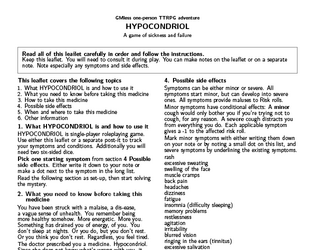
My favourite bit was garlic breath from detox messing up your Sway rolls, such a nice touch. Ditto for all the side effects. 

Visually this is beyond gorgeous, I just have no words, such a nice color cohesion and all the small touches. 

The scenario itself is really nice and simple, but I was confused by it being at the end of the document, going through the tables first – this would be less of an issue in print, I assume.

I would need some hints on as to how to give hints on the correct tuned compound. After thinking it through I know understand the individual compounds and their combinations. But this could even work as a light puzzle element, having some way to gain bits of information on the compound, and then working out what combination works. Of course puzzles are a preference question.

I love the descriptions, the rooms are short and evocative, the focuses are interesting and varied, the obstacles are weird and fun.

Altogether I really get the feel of the sense of a fever dream of an adventure, dazed, reality slipping until death. The distancing effect created by the nonstandard player/character narration helps this. This also feels like a good match for random generation, of course. 

This makes good use of the panic system, and the modifications to it seem great.

I'm a bit worried about battle, as in does the character have weapons? You can find some, but they seem quite rare.

Also, as a player I might require a bit more handholding with the rooms, in general. Are they mainly fluff? Of course in rpgs nothing is just fluff. But to guide the mentality of interaction with them. This of course is in conflict with the distancing language of the rules text, to a degree.

But a cool, cohesive peace of work, a fun take on random generation of adventures. 

I really like the flowchart room map – though the readability thereof could be improved. Maybe having corridors plotted out and doors marked? It's a bit unclear what the connective tissue between each room is. But it still being in three columns is really nice.

I like how constrained this is, it's a clear in-and-out. At the same time, this feels like it's unlikely this would challenge the characters? The failing all SAN saves would add... 3d5 stress, so 9 stress? With average SAN saves,  maybe 6 stress. Though as a part of longer campaign the gain from a quick oneshot would be meaningful, of course. All to say, might want to add a panic save and some more stress, maybe. 

But overall, a great way to add substance to the body mods, expanding that part of rules beyond "you can buy them." Useful and usable. 

I really like the flowchart room map – though the readability thereof could be improved. Maybe having corridors plotted out and doors marked? It's a bit unclear what the connective tissue between each room is. But it still being in three columns is really nice.

I like how constrained this is, it's a clear in-and-out. At the same time, this feels like it's unlikely this would challenge the characters? The failing all SAN saves would add... 3d5 stress, so 9 stress? With average SAN saves,  maybe 6 stress. Though as a part of longer campaign the gain from a quick oneshot would be meaningful, of course. All to say, might want to add a panic save and some more stress, maybe. 

But overall, a great way to add substance to the body mods, expanding that part of rules beyond "you can buy them." Useful and usable. 

I really like the flowchart room map – though the readability thereof could be improved. Maybe having corridors plotted out and doors marked? It's a bit unclear what the connective tissue between each room is. But it still being in three columns is really nice.

I like how constrained this is, it's a clear in-and-out. At the same time, this feels like it's unlikely this would challenge the characters? The failing all SAN saves would add... 3d5 stress, so 9 stress? With average SAN saves,  maybe 6 stress. Though as a part of longer campaign the gain from a quick oneshot would be meaningful, of course. All to say, might want to add a panic save and some more stress, maybe. 

But overall, a great way to add substance to the body mods, expanding that part of rules beyond "you can buy them." Useful and usable. 

Reading it through, it produces a nice idea of an outline for an adventure – this is great, having this read this once I'm confident I could run this without other prep. (Ofc hav

While it is statless, I would appreciate ideas for what is likely to be a challenge, regardless of the system. To have an idea of the shape of challenges. But this is also a weird thing to ask in some way.

Seeding the other Roslov adventures in is such a nice touch, I like that a lot!

Absolutely lovely, so much character in the premise and the illustrations. A professional level of polish, a straightforward premise – there could be some more meat on the hooks, but in all honesty I would expect the players to be on board to have an adventure.

The core exploration is solid, I love especially the ghosts being unable to cross water, and having the river in the middle of the island.

Also a great reference, love the adaptation of the ideas. Super cool work all around!

Had to reread the Self-diagnosis myself, and indeed, it's now more inspirational than instructive. Also actually referring to the self-diagnose elsewhere could be a solution, stating that the expected process right out at the start.  Thanks for the feedback!

Thanks, really happy to hear that it seems like an effective intro! It was surprisingly tricky trying to decide how much the rules can be simplified while still being useful as an introduction. I remember myself struggling initially as a GM with the Brindlewood Bay mysteriy sheets, their shape is so different from an "adventure module" it was initially hard to parse the session from the sheet.

Excellent point about establishing consequences beforehand, I could clarify the process a bit more.

I love the look, the visuals are clean, read well to me.  It's making great use of the ASCII conventions, love it. As an innovation, I do enjoy the labeling setup, though I realize it's not as easy to use. But I do like the feel of it, it creates a roguelike ascii-charm to it. Likewise, the use of the smiley face for a corpse is such a nice touch.

Also the complication table being split based on powered/non-powered, but only partially, is a cool solution, I like it.

There seems to be a number of minor layout bugs, I'll point them out just for fixing:

  • Power-section has a sentence cut off, wires leading to the engines...
  • The HEAD statblock covers the Android adjutant entry partially
  • "Adjust to fit session time" box feels like its too big/too close to the text around it
  • Forward airlock is missing the symbol / key. Or I don't know which airlock is the forward airlock? Maybe I'm just missing something.

I think the module would benefit from a "Warden: This is what has happened here" section. It's not terribly clear to me, though I can collect it from the monster and the heads collected.

Okay yeah the math makes sense now! And I'm guessing the apparent threat works to make for tense moments, actually. As in seeing one party member just faint will put the pressure on the rest.

Thanks for the clarification, it seems more harsh than it is, which is good!

Ah I actually  missed the rolls only happening on opening doors actually – and that the doors staying open means no more random encounters in those rooms, makes sense now. That also alleviates the issue quite a bit.

Thank you for the thorough answer!

Love the printable layout! It works really well without colors, love it. I actually prefer it personally to the screen version, it's so pretty– though the screen version does work beautifully in full screen.

The screen version seems to have weirdly too high contrast for me? Or the pure white letters end up being relatively so bright they are actually a bit hard to read. This may be screen-dependent, on less bright screens contrast is a good thing. But still an awesome addition to have both versions.

The map being embedded between the two columns works really well here, stylish! Also liking the background, it's not 

Flow-wise, is three different encounters a bit on the low side, if I'm reading correctly an encounter is rolled for each room? Also vent oxygen seems really punishing, capable of ending the adventure early quick. But actually playing this might show otherwise. Of course code red provides three more? Maybe it's fine, hard to say without running it.

I really like the rooms and the loop, it's an effective flow, good stuff. I also enjoy the idea of roleplaying the code red escalation, along the lines of "Please don't touch the key card, or else." 

  1. Dog
  2. An epilogue
  3. RNG manipulation 

No worries, you are spot on! The pi is redundant.

I used to have it as 

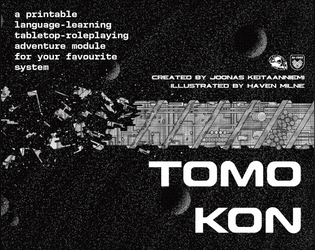
sewi pi tomo kon // sewi pi tomo ni

And then did not use either, figured it would be fine without clarifier – but left the pi. I remember thinking about it, and still leaving it in. My mistake! Should update it, good catch!

And thanks for the encouragement! I'm really excited by this idea, looking to keep honing it and expanding on it beyond this first encounter. 

Thank you for the feedback and comment!

Yeah the concept would work for any language, basically! From game design perspective it's a big puzzle, instead of clues you then sprinkle around the vocabulary.

But this idea of a linguistic dungeon is why I got into RPG design, I will continue work on this concept! Toki Pona is a nice one to work with, since the vocabulary is both small and initially unintuitive. 

I think there's room for improvement in the layout, there's a cool idea in there, but somehow it could be better supported.

Hey this is super cool! Praise:

  • The enemy variety is actually interesting, all the factions are sufficiently different. Good collection. 
  • "Just use bears" as a guidance for system-agnostic stats is great – is this common or an innovation? I've heard of it for making up an encounter on the fly, but maybe not as an agnosticism tool.
  • Space vikings is a super strong two-word pitch, and the funeral pyre with literal valkyries does live up to it. Very metal.

This is so lovely! A neat, easy-to-use design, and it's generic enough to drop in anywhere. Love the clean layout, beautiful. 

One perplexed question: When rolling a 6 on capacity, 'a kiosk', are simply all the items in both of the two categories stocked? I'm a bit confused about the instruction to roll for 10 items, as the instructions state to reroll duplicates. But I may be misunderstanding this.

A fun fact, rolling to get all 10 possible results on a d10 takes an average of 30 rolls, when rerolling duplicates.

Being fair, the primary theme usage is quite minimal in the published version. The theme was bigger part of the original plan, but scoping the project made it just an oddity at the end of the adventure.

I love the concept, the moon being torn apart by gravity is such a raw concept, and a impressively hard sci-fi execution of it. Also cool how the NPCs have their own little goals, which quickly become secondary to survival. Great stuff.

Hiya all,

  1. I'm Joonas, I go by Simonides here ^
  2. This is my first time in this jam – I'm jamming to practice this thing :) Second jam in total, just finished with the first one.
  3. I'm currently reading and loving Pale Fire by Vladimir Nabokov. The metafiction aspect is really exciting – but not sure how that translates to one-page ttrpg's, yet!
  4. I want to practice layout work, and I now have a fun idea for a unique resolution mechanism – I also want to incorporate the theme as a creative constraint – let's see how these fit together on a single page.

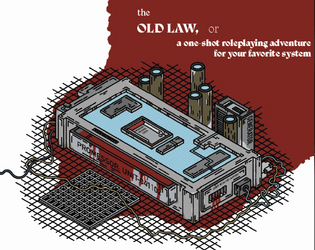
The light red map as backdrop for text is an amazing technology! Is this a new innovation or have I just not seen it used before? In any case, super cool.

Thanks! I added the extra twist to subvert the story of the source material a bit, to challenge the authority: Being a mean snitch (like Simonides) is uncool, but maybe the real problem is the existence of a guy who just gets to decide octogenarians are illegal :P

Thanks for the quick answer!

Yeah last-minute work seems to be a theme. But system-agnostic is definitely doable.

But thanks for the clear guidance, I'll check out the server!

Hiya,  a quick clarification question on Mothership third party publishing guideline:
In a Reddit post you mentioned that the "Triptech approach" to not declare compatibility until you get approval is an option -- but seemingly the guidance by Triptech was to instead not publish until approval, and then sneak-edit the submission after approval.

But as the deadline draws close, is the guidance to edit (potential) Mothership submissions to be system-agnostic for the time being, or will there be a similar sneak-editing system as for TripTech?