

Really fun game. It's satisfying to upgrade the coaster to get further in the game.
Romma
Creator of
Recent community posts
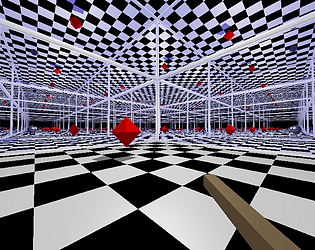
Thank you for playing. Glad you liked it. During the stream you were wondering how the game was drawn. Essentially the entire game is drawn using a raymarching technique called sphere tracing. All the geometry in the room is represented as a signed distance field (SDF); a sort of function which tells the distance between a point and a surface. This function is then repeated infinitely and flipped after each room length to mirror the other rooms. Here is a fantastic article on the subject if you want to know more https://iquilezles.org/articles/sdfrepetition/.
Nice to see another submission where someone made their own game engine. Unfortunately you seem to have forgotten to supply the dynamic library for GLEW, however the game works fine after I pasted it to the game directory. (If anyone wants to try the game the glew32.dll can be found in here https://glew.sourceforge.net/). Unfortunately I'm not quite sure how to play the game, but I appreciate the effort.
This is a really cool idea with a lot of potential. It's fun to do an almost complete circle and then time it to the enemies jumps. Maybe the salt could stay on the ground for a bit longer before dissolving in order to encourage hitting more enemies with a single big salt circle. Also I like that the mechanic also has interesting movement potential by launching you in the air.
Thank you for playing my game. Glad you liked the mirror mechanics. One of the challenges during the development was making the player characters model only using simple primitives like spheres and boxes that could be drawn into the sphere traced reflections. I ended up going for a fairly minimalistic look in order to keep things simple.
This is probably my favorite from all the games I've tried.
I really like how all aspects of the game from the piling backlog of math problems to the ambience and presentation work so well in harmony to reinforce this stressful feeling of dread.
I'm not sure if it was intentional that I could just fill the table with the order cards in order to avoid losing, but I feel it kinda added to the feeling of stress seeing the massive pile of cards on the table and having to try to solve them at the same time.
Damn great work.
Yes it is indeed inspired by the backrooms concept. One of the reasons for creating this little experiment was to test how the implementation for a procedural floor plan generator would work as I'm planning to use this for another upcoming dream themed project. The Jam having the "Roll the dice" theme happened to be a nice coincidence and pushed me to finally tackle this thing.
Hey thanks for trying my game.
As I think of dice as basically random number generators, the game is set in a completely randomly generated building. The original idea had you collect a couple of macguffins and escape while a monster thingy was looking for you however I ran out of time to implement any of that actual gameplay and decided to release it as is. At the moment this little prototype only creates a 100m x 100m random building you can walk around in.