

I’ve been thinking about how difficult it is to talk about certain dynamics without either minimizing them or over-explaining them.
There are situations that don’t feel dramatic while they’re happening. They feel ordinary. Sometimes even justified. And it’s only later, when you try to explain them to someone else , or even to yourself, that something doesn’t quite translate. It can start to sound exaggerated, or vague, or like you’re projecting meaning onto things that were probably neutral.
I think that’s part of why I’m drawn to subtlety, even though it’s risky. The moment something is explained too clearly, it becomes easier to dismiss. It stops feeling like something you’re inside of and starts feeling like something being described from the outside.
While working on this prototype, I noticed that every time I tried to guide the player’s interpretation too much, the experience felt wrong to me. Not because the interpretation itself was incorrect, but because deciding it on the player’s behalf removed the tension I was interested in. I don’t really want the player to understand what’s happening in a clean or immediate way. I want them to sit with it, the way you often do in real life.
One decision that came out of this was choosing not to label emotions at all. There’s no “you feel anxious” or “this makes you uncomfortable.” That would probably make the experience clearer. It would also make it easier. But it would also decide something I don’t want to decide. I’m more interested in whether small things can carry meaning on their own: pauses, repetition, interruptions.
Here’s a short moment from the prototype:
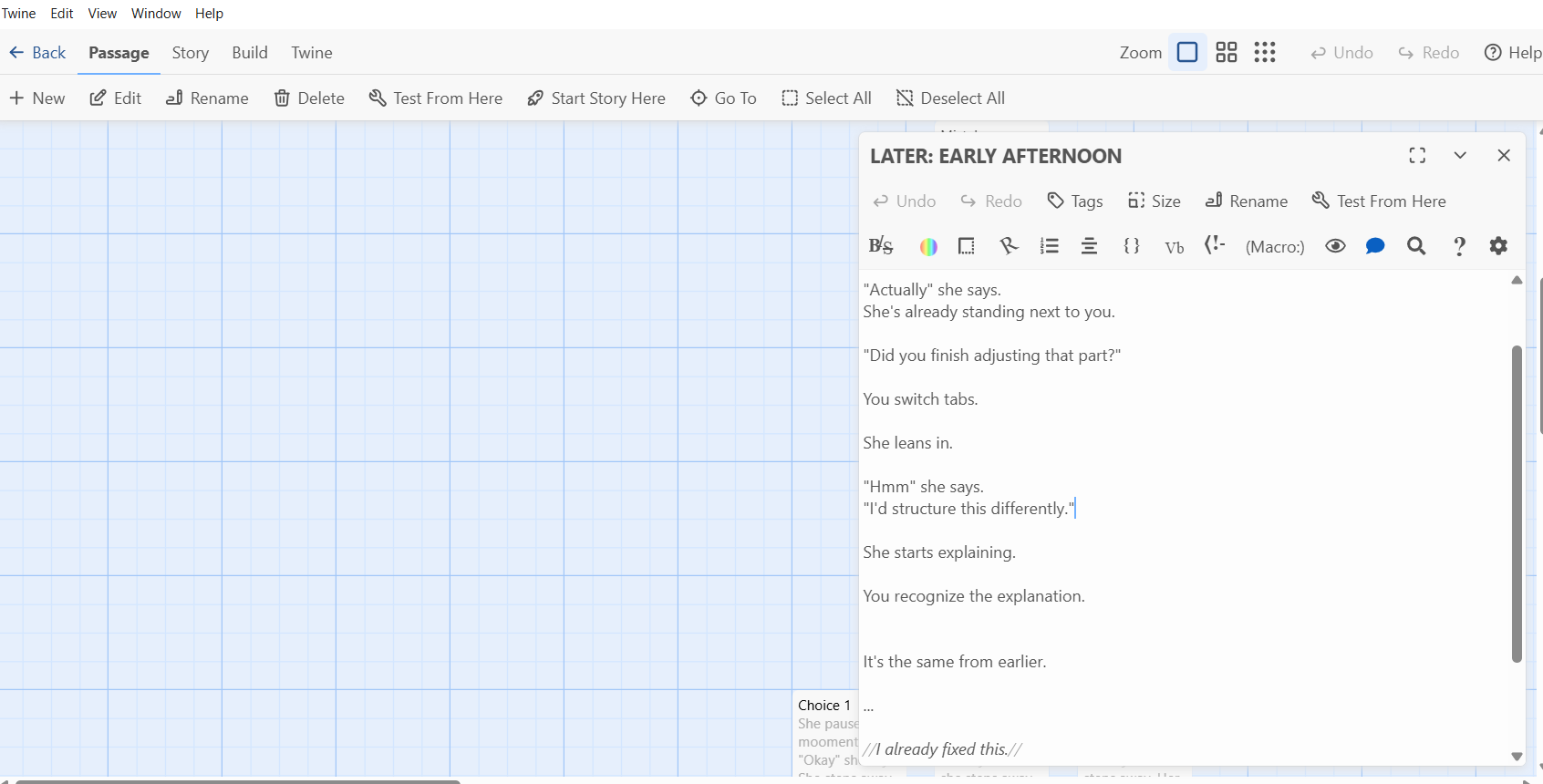
Nothing explicitly bad is happening here. There’s no confrontation. No raised voice. But for some people, this kind of moment might already feel familiar in a very specific way.
When it comes to choice, I’ve been trying to avoid the idea that there’s a correct response hidden somewhere. Each option is something that could make sense, depending on what the character is trying to protect in that moment: keeping things smooth, maintaining dignity, avoiding further scrutiny. What interests me isn’t the immediate outcome of the choice, but how these small decisions quietly shape both the external dynamic and the character’s internal state over time.
What I’m still unsure about is where subtlety stops being legible. How much can you leave unsaid before the experience becomes empty rather than open? How do you make space for interpretation without turning ambiguity into avoidance?
I don’t really have answers yet. I’m still testing this, scene by scene, and paying attention to what feels honest and what doesn’t.