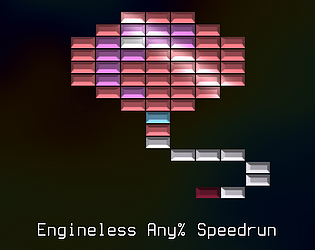
It is possible to collect a shrimp and die to spikes at the same time (might be same frame?).
It is possible to touch a smileyface, and not receive a double-jump reset. This might be because the bird turns into a shrimp at the same time the smileyface is touched. (this seems possibly intentional).
You can bounce off the floor/spikes as a red shrimp, collect a honey walnut shrimp, then land to collect the shrimp. Epic.
The "last three shrimp" is truly amazing level design. 
purist
Creator of
Recent community posts
I am the person who, at the Indie Games Expo, said "I will be the first to win this game (by creating a "2048" block)".
Solution video:
Chaoshi 2048 strategy guide:
- If the first prediction is not "anti-vax", restart the game. Continue to restart until you roll "anti-vax" on the first prediction.
- If given any pair of choices that is not a point modifier in the first ~4 rounds, e.g: "Mcwalbucks + Burj Khalifa II" or "Mcwalbucks + Chatgpt", restart the game. Generally speaking, picking any of those three is game-losing.
- Picking any non-point-modifying or non-turn-reducing event (particularly early in the game) is game-losing, and there is almost no opportunity for player skill to overcome awful event rolls e.g: a (round 1) "Mcwalbucks or Burj Khalifa II" (round 2) "Mcwalbucks or Chatgpt" game.
General commentary:
Is the name of this game intentionally supposed to be "超市" (supermarket)?
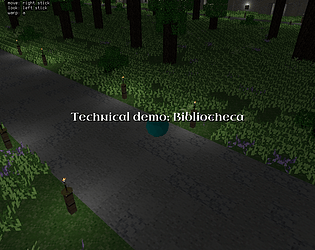
bibliotheca.love is only compatible with Love2D 12.0, and will not run on prior versions. Download official Love2D 12.0 builds from the Love2D Github (must be logged in to Github to use these links):
- Love2D 12.0 for Windows
- Love2D 12.0 for Linux
- (bibliotheca.love is not compatible with macOS)
Detailed technical commentary is also published on the project page.
Though I expect this won't affect most people: the game UI is not visible if you try to run this game on anything narrower than a 16:9 -aspect monitor, which is presumably what this game was developed on. If you are using a 3:2 or 4:3 monitor, resize the browser window to approximately 16:9, then refresh the page.
I like the game concept.
Game controller is required. Keyboard/mouse is ignored completely. Sony DualShock 4 is recommended, and is tested on both Linux and Windows. Other controllers may be usable, but will not have correct button/axis mappings.
Wow, this is a cool way to package a game: a self-contained HTML+CSS+Javascript file.
I'm not able to progress beyond "finish getting ready", as there's nothing to click there:
I also poked around in the .html, it seems there exists only "StoryStart", "Clue1", and "Ready1" in tw-storydata. It's also cool that progress appears to be saved in Session Storage.
Is this the "twine" entry that was also shown off at the in-person event on October 26th?
It looks like I am able to move in a "square" pattern both clockwise and counterclockwise--or at least the icon suggests I could. How do I pick the not-default direction?
As a psuedo-realtime game, the current control scheme feels clunky. There are certain moves I feel should be legal that I don't understand why I can't move that way.
The mouse picking feels a bit unituitive. It's unclear which tiles I could pick, so I find myself frequently helplessly waving the mouse around until the yellow boxes appear.
I think it would be nice if the "possible tiles you could pick" were highlighted in addition to the current "this is the path you would take if you clicked here" highlighting.
Often a direction icon is shown (particularly the "move in a straight line" icon), but the movement is nevertheless rejected.
I felt completing the first level felt "grindy" mostly due to the clunky control scheme.

I like the tutorial level music.
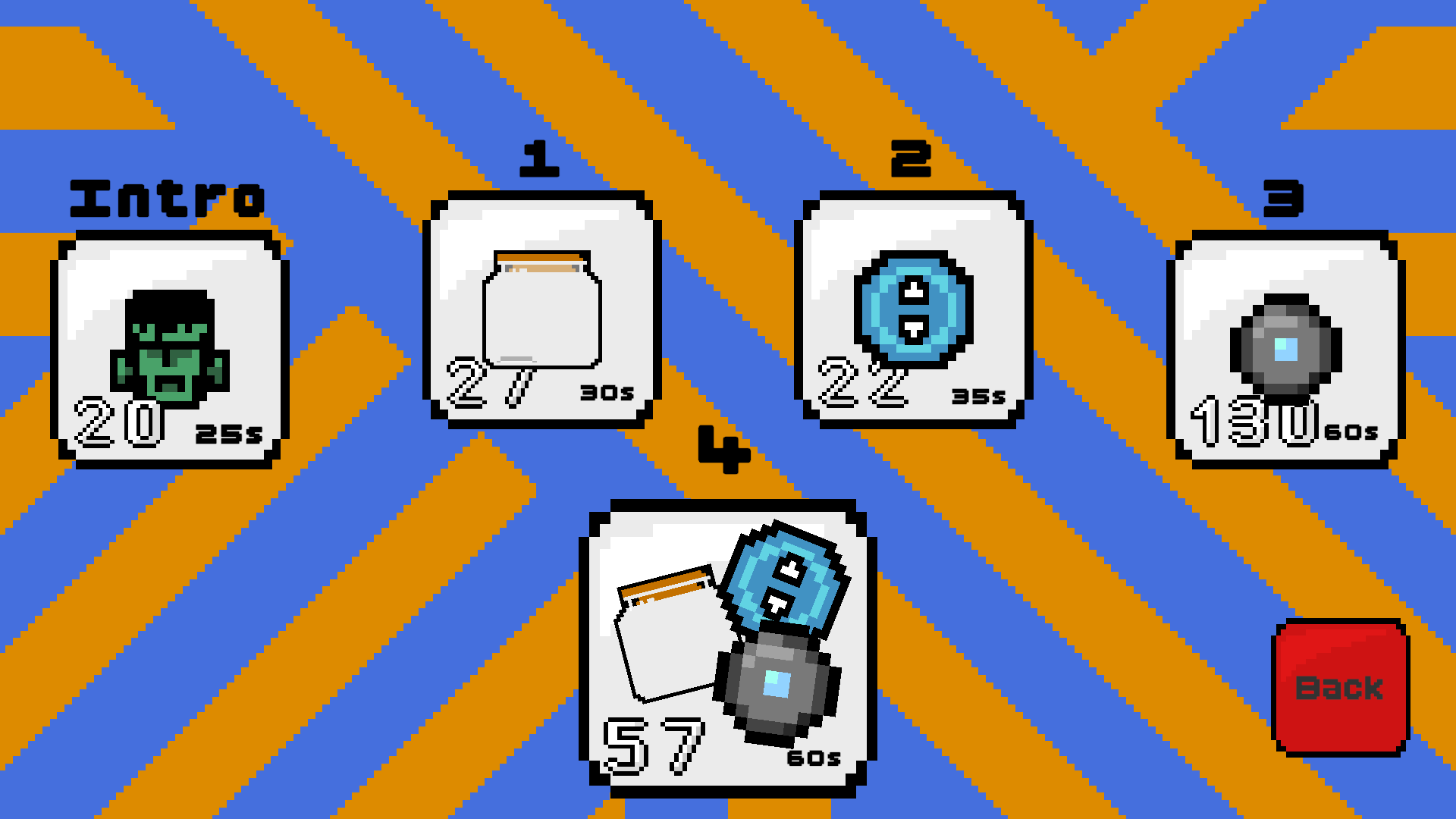
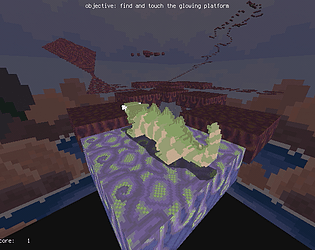
All screenshots are Radeon R500 framebuffer captures. The videos are DVI captures of the R500 video output.
Detailed technical commentary is published on the project blog. Complete source code is also published (all graphics-producing code is in the drm directory).
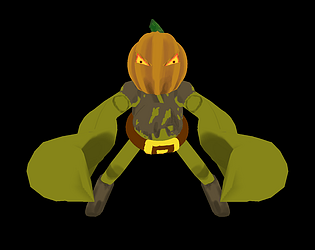
The "pumpkin man" model was drawn by slippyice in his first 3 days of learning how to use Blender.
> Is it a possibility to have it load xm files from the folder in gdemu or something in future
Another game jam entry, https://purist.itch.io/dreamcast-jvm, does work this way, loading Java class files from the iso9660 filesystem. I just didn't bother to implement it for the XM player. Yes, it's definitely possible.
> so close to having a music scene for dreamcast
I think this would be interesting, but perhaps (even despite my own efforts), there's still a lot of work that could be done:
- AICA has hardware volume envelope generators, but the XM musicians I worked with for this jam were timid to use them, because there currently isn't good tooling to simulate them in an artist-friendly way.
- Similarly, AICA also has pitch and amplitude LFOs
- AICA also has a hardware low pass filter.
I think a properly min-maxed collections of sampled instruments for Dreamcast would make very liberal use of all of these features--with good tools, it would allow musicians to greatly reduce the storage requirements (in bytes) for a given desired instrument, while still producing a satisfactory sound.
Even more under-utilized is the AICA DSP, which can produce arbitrary real-time audio effects at "zero cost" to the performance of the rest of the Dreamcast application. Per channel effects could include but are not limited to:
- surround
- reverb
- reflection
- echo/delay
- chorus
- distortion
Etc...
I think to properly unleash the potential of the AICA, one would need to create a complete "DAW" specifically for the AICA, to expose all of these effects in an artist-friendly way.
Many XM features are not supported, and there are several limitations.
There is not really an "intended workflow" at the moment beyond just "build the demo for the game jam submission". Currently, you'd need to rebuild the entire project from source to change which .xm files are included, with minor edits to the source code.
If you have a .xm file you'd like me to try to play with this software, I'd be happy to make a build for you (possibly with spontaneous newly-developed XM features if I notice your .xm file depends on something I didn't implement yet).
Unhandled Exception - uncaught exception: { message : "Unable to find any instance for object index '0' name 'SkMailghoul'", longMessage : "Unable to find any instance for object index '0' name 'SkMailghoul'", stacktrace : [ "function _W2("Unable to find any instance for object index '0' name 'SkMailghoul'") ","function(0) ","function _8e1([instance], [instance], 0) ","function gml_Script_EffectTypesAfterDeath([instance], [instance], "head2", "bone") ","function gml_Script_Die([instance], [instance], [unknown]) ","function gml_Script_KillPawns([instance], [instance]) ","function gml_Object_oTurnController_Step_0([instance], [instance]) ","function(769, 0, [instance], [instance]) ","function(769, 0, [instance], [instance]) ","function(769, 0) ","function _yp3() ","function _4p3() ","function _Ao3(746145.8) " ], script : "", line : -1 } in file https://html-classic.itch.zone/html/10815431/html5game/HalloweenArmyNewVersion.js?cachebust=1426072972 at line 2207
Sincerely, I was a bit over-focused on the "qualifiers" and forgot that "theme" also exists. However, I'm not certain whether I would have done much different even with conscious knowledge that theme implementation is slightly preferred.
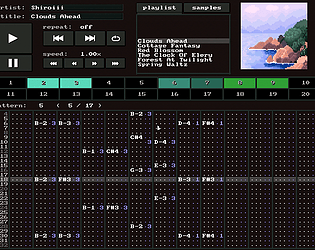
Both Cai and Shiroiii did excellent work composing everything from scratch within two weeks. Neither of them were particularly familiar with XM authoring tools prior to the jam, and learned during the jam. Cai used a FastTracker 2 clone, and Shiroiii used MilkyTracker.
Both composers mentioned that the most difficult part of their work was in creating the instruments. All instrument sounds were created during the jam as well. A reflection of an AICA hardware limitation, I set a restriction that sample data must be "less than or equal to 65535 bytes in length per sample". This in turn (as a reflection of constraint difficulty) influenced both composers to design mostly non-looping and/or "percussive" instruments, because creating perfect loops of "real" instruments both with a small number of samples and without specialized AICA-specific "DAW" tooling is quite difficult.
I played the Windows version in Wine on Linux. I also tested the Browser version on Firefox while investigating sound issues.
I spent a solid 5 minutes trying to progress past the first dialog, until I realized I needed to push "E" to advance the dialog. It would be better to indicate this somewhere on-screen.
I couldn't progress past the first area. Then I watched the first few seconds of the walk-through video and realized I didn't read the "I need to bring my umbrella and floatie" dialog. I then restarted the game, because I had previously pushed the floaty into the water while aimlessly walking around. It would be nice if you could get a hint from your friends that you need to move these, as they are unresponsive at this stage.
The pickup radius for shells could be increased. If you are directly on top of a shell, you can't pick it up.
I arrived in dream world: wow this is incredibly detailed.
I looked at the walkthrough to get the "number" puzzle; I would have never solved that myself.
I then solved the leaf puzzle myself.
I discovered what to do with the knife myself.
I discovered how to get the hammer myself, and while trying to put the hammer down discovered what to do with it.
I discovered what to do with the pearl myself
I discovered what to do with the fish myself
I discovered that there are two ways that you can view the fruit puzzle stickers, and I was viewing them the wrong way.
I departed the dream dimension.
The "number" puzzle was the most difficult, by far.
Are those Beach Independence Day fireworks, or is that a coincidence?
Overall: I gave this game my highest average rating between all rating categories, compared to all other games in this Jam.
Fun: I was not having fun to start with, but I warmed up to the game after I started a few puzzles.
90s: the art and general rendering fits, however the realtime shadows and rigid body physics are a bit too fancy for 1990s hardware. I don't think it would affect the game to remove those, and otherwise this would run on Sega Saturn if you wished. It would be a delightful port.
Visuals: throwing the rice to xiebalba was fun. You really made the unshaded art style work well.
Sound: the volume slider appears to have several bugs. It you change the volume prior to starting the first beach scene, then re-open the menu, the previous volume setting is not shown. The volume setting does not appear to work at all in Dream World.
I played the Linux version on Linux.
I did not progress past the second level, because I found the jump too difficult, and retrying requires walking the entire level from the beginning. I did retry several times.
Overall: interesting platforming concept. It was not clear how to activate the sand boy mode, but it seems it's a combination of jump and E.
Fun: there's a lot of walking in the second level. Feels a bit unfinished.
90s: I played every other game in this Jam before saying this, but this is actually the least "90s" out of all of the submissions. The art is absolutely beautiful, but it's too fancy for the capabilities of 1990s hardware. I also dislike the screen filter.
Visuals: I'm amazed at how smooth the character animation looks.
I played the Browser version on Firefox.
Overall: very simple game
Fun: I appreciate the effort you put in to this.
90s: I could go either way on this. Certainly it would run on 1990s video game hardware.
Visuals: I liked how the popsicles spin. Where's the ice cream?
Sound: I enjoyed the chill saxophone groove. It looks like this might have been created by a non-jam artist. Were there really no jam composers you could have worked with?
I really liked this game, played all of the levels until I looped back to level 1.
Level 8 is easily the most difficult of all of the levels, due to the precision jump.
What was "stomp" supposed to be used for?
Overall: getting started with the game is a little rough. I appreciate the "H" menu, which I referred to frequently as I started playing the game. It was not explained to me that I needed to move the mouse in order to place sand.
Fun: building sand bridges was quite interesting. I'm sure there are many ways to expand on this concept by adding special per-level restrictions for placing sand, or different types of sand.
90s: this game could absolutely run on a Sega Saturn.
Visuals: the volcano was an interesting and unexpected surprise. The art style was consistent through most of the game. Some of the UI could be polished.
Sound: nice sound effects.
I played the Windows version in Wine on Linux.
I did not read "how to play", and I immediately regretted it. I restarted the game and read.
I found I could not defeat the enemy ninjas, so I ran past them.
Eventually, I fell through the world, and this condition was not detected.
Overall: Fighting games are very difficult to make, and this shows off why that is. The punches and kicks are unsatisfying and are difficult to land. The enemy ninjas feel much more powerful and numerous than you. It looks like a bit of a grind to go through the game, based on the number of enemy ninjas I saw in the first few areas.
Fun: defeated zero ninjas
90s: This might be able to run on certain powerful 90s arcade machines or a Dreamcast
Visuals: It is very clear that a lot of work went in to creating the environments. It's a shame that being able to enjoy the environments is obstructed by the poorly tuned fixed camera system.
I think you should continue to try to make a better fixed camera system. This is more work than manual control, because it of course requires extensive testing, and probably no shortage of deep understanding of quaternion rotation magics in order to execute the way you appear to have wanted this to work.
Sound: I liked the soundtrack--fit the game well.
I played the browser version in Firefox.
I found it was too difficult to collect the hearts, as the pink dragonfly appears to have more agility than the blue dragonfly.
I like the camera math.
Overall: did not acquire dragonfly girlfriend
Fun: I liked how I can splash the pond water
90s: it appears this is a 320x240 rendering. I don't think Sega Saturn could deal with this game, particularly due to how detailed the background/bushes/grass are. Dreamcast should have no issue rendering this though. I appreciate the lack of screen filter effects.
Visuals: The art direction on this game is absolutely fantastic. I enjoyed the style consistency between the pieces of the scenery.
Sound: I like the synth instruments. The "beep" sound effect could use some volume envelope adjustment to make it a bit more pleasant.