Heh! I appreciate the vote of confidence! Years of playing with a (wonderful) min/maxing friend who could squeeze every possible bonus out of the proverbial rock have probably got me overthinking this. I just like to "get it right" or "as intended by the game itself," you know?
Being able to stack applicable Specialisms into a single dice roll does make that particular character (or foe) a juggernaut in certain circumstances.
Then again, if their Specialisms are stacking in a narrow set of circumstances, it likely means that character is very narrowly focused ("You had one job! One!") and - while they shine (or are terrifying) in that one type of situation - they're less capable in other activities.
That amazing gunslinger who stacks their selected Specialisms "Quick Draw" and "Dead Eye" in single rolls during a gunfight is going to be an absolute terror, but quite less impressive when trying to bluff at poker or sweet talk the saloon girl, having put all their Specialisms in one basket, so to speak.
So I guess I've talked myself into allowing multiple Specialisms in a single roll - but is that the "right" call? Cheers!
Ooh that is terrific! I'll especially be on the lookout for the reanimated Beyond Fear.
Quick "rulesy" question: can Specialisms be stacked for a single dice action? Or must only one Specialism be chosen to add to a roll? Example: if a character has the Specialisms "computer science" and "security" - can they add both of those Specialisms to a single roll to hack a computer? Or do they pick only one of them to add to the roll? Another example: a character has the Specialisms "tell lies" and "disguise" - could they add both of them to a single roll to bluff past a sentry, or must they select a single Specialism ("tell lies" OR "disguise") to add to a single roll?
Fantastic! Thank you Scott! Time for me to take these 15th Anniversary rules, the USR supplement "Beyond Fear," and get my local crew together for some Lovecraftian cosmic horror mysteries and adventures!
I love USR and I love the original edition rules, so this is a welcome surprise! I just purchased this title at "the other rpg vendor site" as I saw it there first, but figured I'd cover all my bases and make my request here too: Any chance for a singles page style layout for printing? The landscape style is not my favorite for printing. Having it printable as single pages would rock! Thanks for considering!
I have a quick clarification regarding the PTSD skill system and difficulty numbers.
The text states that a player must "beat the target number" (4 for Easy, 5 for Medium, and 6 for Hard). Since the game uses six-sided dice and looks for the single highest number, this created a bit of mathematical confusion for me regarding "Hard" problems.
Could you clarify which of the following is intended?
"Meet or Beat": The player succeeds if they roll a number equal to or higher than the target. (In this case, a 6 succeeds on a Hard problem).
Strictly "Beat": The player must roll higher than the target. This would mean a Hard difficulty (6) is impossible to succeed at unless a character has a Specialty to reduce the difficulty to a 5.
If it is strictly "beat," is this intended as a "hard gate" to ensure only Specialists can tackle Hard problems?
Hi Ian - sorry to be a bit of a pest, but I’m still lobbying for a single-page version of Strange Aeons! The spread format is tricky for printing, and single pages would fit perfectly into report protectors. If I knew how to reformat it myself I’d save you the trouble, but it’s a bit outside my wheelhouse. Thanks again for the great game!
Thank you Alexandre! Sorry for all the postings but I am glad I understand it correctly. I sincerely appreciate your help! You write terrific games and are a favorite in my local group. Between us, we own and/or have played many of your games. They are great stuff!
I am sorry to keep asking, but I am still a bit unclear and I want to ensure I fully grasp how permanent Sanity loss affects both current totals and maximum caps. Could you confirm if the following example is correct?
Scenario: William (Starting Sanity: 10 | Max Cap: 20)
The Loss: William learns a spell (-1 Permanent SAN) and sees a ghost (-3 temporary SAN).
Current SAN is now 6.
Recovery: He rests and rolls a 6 for recovery.
Result: His SAN returns to 9 (not 10), because his "base" was reduced by the permanent loss. His Max Cap is now 19.
Advancement: He spends XP to "Gain 2 SP."
Result: His new current SAN total becomes 11. His Max Cap remains 19.
My Interpretation: Permanent Sanity loss acts as a reduction to the starting "floor" and "ceiling" of the character's Sanity, effectively shifting all future calculations down by that amount.
Does this match the intended game mechanics, or am I missing a nuance?
Hi Alexandre - just so I fully understand: if my character permanently loses 2 Sanity Points - thus reducing his maximum Sanity score from 20 to 18 - I could still choose the "Gain 2 Sanity Points" option during the Character Advancement phase and restore my maximum Sanity from 18 back up to 20, correct?
Thanks, Ian! I tried converting it myself into single page layout for my personal use, but I lack the technical skills to manipulate a PDF in that fashion.
Hi Alexandre - when a character permanently loses Sanity points (for example, when learning spells), how is that permanent Sanity point loss applied? Does that mean that their maximum potential Sanity points are 20 minus permanent Sanity point loss? Or does it mean that their current maximum Sanity points are lowered, while leaving the door open to them gradually attaining up to 20 maximum Sanity points?
I am really enjoying your video series on Eldritch Instinct! It’s a fascinating peek behind the curtain as to your design choices, the games that you explored before creating Eldritch Instinct, and related matters. Great stuff!
How does leveling up work in the game? The game rules detail some new character abilities at “level up,” but doesn’t say when leveling up actually happens. I like how hit points stay low - they are not one of the listed abilities that increases with leveling up. This keeps characters human-level vulnerable, as befitting the genre. Even an experienced adventurer in Cthulhu tales should be susceptible to a knife blade or a bullet. But yeah, a bit more detail about leveling up - like when it is supposed to happen - would be welcome.
You’ve really got a terrific game in the works, here! One thought: do you need both Intellect and Presence attributes? Why not condense to just Presence? I think Presence could handle all the things both attributes are supposed to do in the game, streamlines things, and (pleasingly) matches the same four attributes featured in the original Mork Borg: Strength, Toughness, Agility, and Presence.
Question: How does the "Trusty Pistol" work (an option for the Pugilist class). It says:
"Retired military: You get a Trusty Pistol (You can add +2 to
Defense Tests to roll 2d10 on Shooting checks instead of 1d20).
Why are you rolling Defense with the Trusty Pistol? And I'm not sure how 2d10 would be any different or better than rolling 1d20. So this feature is very confusing. As written, I can't figure out what benefit it is supposed to confer.
This looks like a really great game! Would it be possible to have a portrait orientation “singles” layout instead of the landscape layout with two book pages on each side of a sheet? The portrait “singles” layout will make it easier to print and read like a regular book.
Hello! This game looks amazing! I just downloaded it and am devouring its contents. Looks like a fantastic blend of solid Cairn/Into the Odd mechanics and Lovecraftian cosmic horror ... right up my alley! Very excited to get this to my local gaming table!
Just circling back around to say what a great genre expansion this is for Cairn! It’s a wonderful pairing of Lovecraftian lore and Cairn gameplay! Well done!
Hi Alexandre - may I ask a rules question? When attacking, let's say I am using a knife and my melee skill is 60%. Since it is a small knife, that means I am using the lowest die to count as damage. I roll a thirty-nine, a successful hit. For damage, would that be nine points of damage (since one die is a "thirty" and the other die is a "nine"), or would that be three points of damage (in this instance counting the "thirty" die as a "3" and the other die as a "9"). Which is correct?
A YouTube flip-through of the game would be great. It would show off the actual features of the game, a sense of the mechanics. It doesn't have to be anything fancy...literally just flip through the book and narrate what you think is special about Whitechapel Occult Society. It would get people excited about what is between the covers! Thank you for considering! - Brian C. mograg@hotmail.com
As a longtime Call of Cthulhu enthusiast, I am intrigued by Whitechapel Occult Society but would like to learn more about the game before I decide whether or not to purchase a print or digital copy (the Community Copies are all sold out). From the few pages I have seen online, it looks a bit like Call of Cthulhu crossed with Mork Borg (which is a cool idea and aesthetic), but I can't get a sense of the game mechanics, how "fragile" player-characters may be in the world, is there a Sanity mechanic, things like that. Is there anywhere one can get a more full preview of the book, enough to get a sense of the game mechanics, player-character options, etc.? Thanks for reading and I hope for a response. With appreciation, - Brian C., mograg@hotmail.com
Hi Jason! Another huge fan of your games, here. Just voicing encouragement and anticipation, hoping that your revised version of Agents of the O.D.D. will drop at some near future point. No pressure, of course! Whenever you deem the stars are right for its appearance. Thanks for all you do and the wonders you create!
Hey this is a great game! I am so pleased to see an English language edition. I have a question: the skills section does not list detection skills such as spot hidden, perception, listen, etc. Is this an intentional omission? If so, how to player-characters detect hidden or obscure clues? Does the Hierophant just give them those clues by fiat? Also wondering: do Hit Points and Sanity Points recover?
Absolutely love The Roaring Age! Jack Edward has created a wonderful work that brings you all you need to run classic Cthulhu adventures with Liminal Horror, done with concision, clarity, and panache. Top shelf stuff!


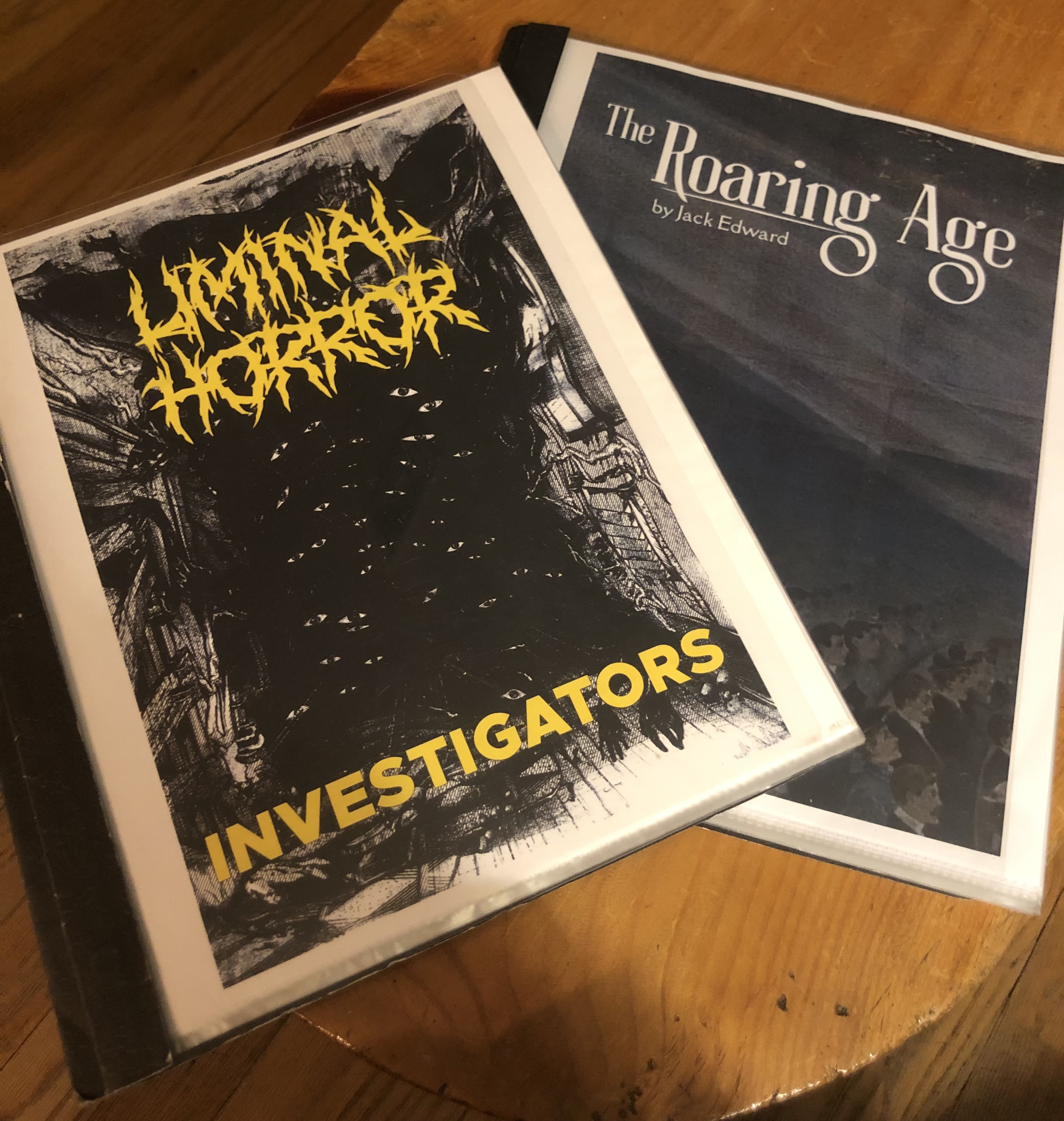 Absolutely love The Roaring Age! Jack Edward has created a wonderful work that brings you all you need to run classic Cthulhu adventures with Liminal Horror, done with concision, clarity, and panache. Top shelf stuff!