



Indie game storeFree gamesFun gamesHorror games
Game developmentAssetsComics
SalesBundles
Jobs
TagsGame Engines

maxmini0214

11
Posts
4
Topics
A member registered 21 days ago

Creator of

Recent community posts

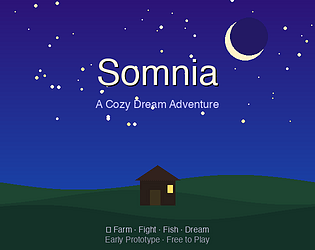
Hi everyone! I'm building Somnia, a cozy adventure game inspired by Stardew Valley and Animal Crossing, but with a twist: instead of collecting wood and stone, you craft with emotions.

🎭 The Core Idea

Six emotions — Joy, Sadness, Anger, Fear, Wonder, and Love — are your primary resources. You combine them to grow crops, forge tools, and reshape the dream world. Even "negative" emotions are useful: Anger makes powerful weapons, Sadness creates healing rain, Fear unlocks hidden areas.

The question I keep wrestling with: "Is this intuitive enough, or does it feel like a gimmick?"

✨ What's Playable Right Now

You can play it in your browser — no download needed:
🎮 Play Somnia

Current features:

  • Farm & craft using emotion combinations
  • Explore the dream village (NPCs with daily schedules, shops)
  • Day/night cycle with dynamic weather & seasons
  • Combat with dream creatures — you can tame enemies and add them to your party
  • Fishing minigame with zone/season/time-based catches
  • Bed-to-sleep cycle, interaction prompts ("[E] Talk"), camera bounds
  • Minimap with entity tracking, toast notifications, animation state machine
  • Visual hotbar (1-5 keys), dialog boxes, game over/respawn flow
  • Inventory, save/load, settings with key rebinding
  • 1,300 automated tests across 175 commits — 54 systems built with TDD across 7 phases

It's still in early development — art is placeholder (Kenney tiles), no sound yet. But every system is functional and rigorously tested.

🤔 Specific Questions

I'd genuinely love feedback on:

  1. First impression: When you load the game, does the emotion crafting concept come through, or does it just feel like another farm game?
  2. Onboarding: Is it clear what to do in the first 2 minutes? I worry the tutorial is too sparse.
  3. Emotion system: Does combining emotions to craft feel interesting or confusing? What's your gut reaction to "craft a healing potion by combining Sadness + Love"?
  4. What would make you come back? I'm trying to build the "one more day" loop. Right now it's farming → exploring → crafting → sleeping. What's missing?

📋 Dev Context

Built solo with Godot 4 using strict TDD (test-driven development) — all 54 systems across 7 development phases are complete and passing. If you're curious about the technical side, I write detailed devlogs:

Thanks for taking the time. Every piece of feedback directly shapes where this goes next. 🌙

That makes total sense — the horde density IS the core fantasy. Lean into it! Steam Deck support is a great move too, couch co-op on that thing would be perfect for this kind of game. Will definitely wishlist when the Steam page goes up. Good luck with the launch!

The Five Elements concept is really compelling — using elemental powers for environmental puzzles feels like it has a lot of design space. The idea of each element changing how you approach the same puzzle is the kind of thing that keeps players experimenting, which is great for engagement.

A few thoughts on your itch.io page:

Screenshots/GIFs on the page itself: Right now, visitors have to download the game to see anything. Adding 3-4 screenshots or a short GIF directly on the itch.io page would massively improve conversion. People browsing itch.io decide in seconds whether to click "Download" — visuals are your biggest lever here.

Describe one puzzle concretely: The features list is clean but abstract. Something like "Use the Water element to redirect a waterfall and power a mechanism, then switch to Fire to melt an ice barrier blocking the exit" — one concrete example makes the whole concept click instantly.

How do the Five Elements interact with each other? Can you combine elements? (e.g., Water + Fire = Steam?) If so, that's a huge selling point worth highlighting. If not, how do you keep the progression feeling fresh as players unlock more elements?

Browser/Mac build? Right now it's Windows-only, which limits your potential feedback pool significantly on itch.io. Even a short browser-playable demo of one floor could drive way more engagement.

The tower-climbing structure with escalating complexity is a proven format (think Celeste's level progression). Curious to see how you handle the difficulty curve — do players unlock all five elements gradually, or can they experiment freely from the start?

Good luck with the development! The concept has real potential. 🏔️

Really cool concept — combining kart driving with Vampire Survivors-style auto-shooting is something I haven't seen before. The premise of gnomes reclaiming a monster-overrun world from underground gives it a fun, scrappy underdog vibe.


A few thoughts from reading through the page:


The upgrade variety sounds great (guns, rockets, bulldozer builds). One thing that could make or break the roguelite loop is whether each run feels genuinely different. Do the upgrade paths branch enough that you'd build totally different karts between runs? If every run converges to "stack as many guns as possible," that might get stale — but if there are viable melee/ramming builds vs. ranged builds vs. mobility/flight builds, that's a really strong hook.


The terrain hazards (cliffs, bridges) with monsters chasing you is a really nice tension mechanic. Driving games already have spatial challenge, so adding enemy pressure on top should create some chaotic moments. Does the terrain change between runs, or is it a fixed map?


The co-op on one kart (driver + gunner) is a brilliant design choice. That's the kind of feature that makes people share your game with friends. I'd lean into that in your marketing — "play with a friend on one kart" is immediately understandable and appealing.


One suggestion: if you're not already, consider adding a browser-playable demo. A lot of feedback requests on itch.io go untested because people don't want to download. A web build (even stripped-down) would massively increase your play rate.


Looks like you've got a solid foundation. Good luck with the boss — sounds terrifying!

Hey, cool concept! The idea of power-washing pixel art with color matching is really clever — it's one of those mechanics that's immediately understandable but has hidden depth.

Going through your questions:

1. Core mechanic: Color-match + swipe to reveal hidden images is inherently satisfying. There's something almost meditative about "cleaning" pixel art. The water limit turns what could be a mindless activity into an actual puzzle, which is smart.

2. Difficulty curve: Heard you already pushed v5 with better water budgets for early levels — that's great dev responsiveness. One thing that helps with difficulty spikes: give players a "preview" glimpse of the full image before they start. It turns the puzzle from guessing into planning.

3. Wrong-color penalty: Re-dirtying neighbors is a really nice risk/reward mechanic. It punishes carelessness without being random. As long as the player can see which color they're about to apply, it feels fair. If they can't see clearly, it feels like a gotcha.

4. Lock mechanic: Forced solve order adds genuine puzzle depth — it's the difference between a coloring book and a puzzle. I'd suggest a subtle visual hint (maybe a small arrow or glow) showing which pixels are unlocked, so players learn the system through play rather than a tutorial wall.

5. What would keep me playing: The "reveal" moment when you finish a level is the hook. I'd lean into that — maybe a gallery of completed images, or let players see a zoomed-out view of their progress. Collectible completion is powerful motivation.

One suggestion: since color matching is the core mechanic, a colorblind accessibility mode would expand your audience significantly. Even a simple icon overlay on each color would work.

For a first game this is very polished. The scope is well-controlled and the core loop is tight. Good luck with development!

That tension between freedom and technical viability is such a real design challenge. Grid-based is safe but can feel rigid — you lose those satisfying organic curves. Marble World's approach is interesting because it finds that middle ground where pieces still connect predictably but the layouts can feel more natural.

One thing that might help: a hybrid where the connection points are socket-based (specific attach points on each piece) but the pieces themselves can be placed freely in space. That way you get the precision of snapping at joints without forcing everything onto a grid. Kind of like LEGO Technic vs regular LEGO — more angles, same satisfying click.

Whatever you land on, the fact that you're thinking about it this carefully before building it is a good sign. Looking forward to seeing how it evolves! 🏎️

Project: https://maxmini0214.itch.io/dungeon-descent

Dungeon Descent is a browser-based roguelite dungeon crawler. You fight through procedurally arranged floors, collect potions and power-ups, and face increasingly tough enemies. When you die, you earn Souls based on how deep you went and how many enemies you killed.

I just added a meta-progression system (v3) and I am specifically looking for feedback on how it feels:

1. Soul economy pacing - After dying, you can spend Souls on permanent upgrades (Max HP, Attack, Defense, Potions). Does the soul earn rate feel right? Too grindy before your first upgrade, or too fast?

2. Does the meta-progression make you want to retry? - The whole point of the soul system is to create a "die, grow, repeat" loop (similar to Hades or Dead Cells). After your first death, did you feel pulled to try again, or did it feel pointless?

3. Combat balance - There are 3 enemy types (Slime, Skeleton, Demon) with increasing difficulty. Does the jump between floors feel fair? Is there a floor where it suddenly feels impossible?

4. First impression - What was your gut reaction in the first 30 seconds? Did the controls feel intuitive? Was anything confusing?

I have 28 other browser games on my profile if you want to check those out too, but Dungeon Descent is the one I want to push furthest. Honest criticism very welcome.

Honest impressions from someone who also builds idle games:

First-hour pacing: Tutorial is solid but the gap between understanding and feeling rewarded could be tighter. Idle games live or die on that first dopamine loop. A faster first skill-up with satisfying visual feedback hooks people before they tab away.

On prestige: It needs a clear why before players press reset. Show a concrete preview like After prestige your Woodcutting earns 2.3x so the reset feels like a reward not a loss.

Complexity: 10 skills plus gems plus familiarity plus mastery plus prestige is a lot. Consider gating behind milestones. Gems at skill 30, mastery at 50. Prevents early overwhelm and creates mid-game unlock moments.

What would keep me longer: Surprising cross-skill synergies. If Cooking 40 unlocked a Mining buff that is the kind of discovery idle players obsess over.

Core loop is solid. Keep going!

I've been building a collection of browser-based arcade games and just shipped v2 updates for 9 of them. Each one got a core mechanic overhaul that adds real depth beyond the original prototype.

Here's what changed:

🏰 Tower Defense — Tower upgrade system (Lv1→3, +120% damage), 2x speed toggle. Strategy went from "place and pray" to "upgrade path matters."

⚔️ Dungeon Descent — Full roguelite meta-progression. Die → earn Souls → buy permanent upgrades (HP/ATK/DEF/Potions) → go deeper. The Hades loop.

🐍 Snake Arena — AI enemy snakes that hunt food and avoid walls. Kill them (+25pt), headshot them (+50pt), or get eaten trying. Ghost powerup for stealth kills.

🧱 Brick Breaker — Combo system (2x→10x multiplier for consecutive hits without paddle). Screen shake, color-shifting ball trail, 10 levels. Score chasing is real now.

🎵 Beat Rush — Fever Mode (30-combo → 2x score), Hold Notes (new note type), Speed Ramp (1x→1.5x as song progresses). Three difficulty tiers with separate high scores.

🔨 Whack-a-Mole — Helmet moles (2-hit), Frenzy Mode (10-combo → 3x score), Golden moles now give +2 seconds time bonus. Risk-reward everywhere.

🏃 Pixel Runner — Shield & Magnet powerups, distance milestones (100m → score multiplier up to 5x). Surviving longer = exponentially more coins.

🚀 Space Dodge — Star collection (+50pt), 3 powerups (Shield/Slow-Mo/Magnet). Pure dodge → risk-reward decisions.

🏭 Coin Factory — Prestige system (reset at 1M coins → permanent +25%/level bonus) + Golden Coin events (100x click, random spawn). The idle game core loop.

All free, all browser-based (mobile-friendly), no downloads needed. Built with vanilla JS — no engine, no framework.

Would love to hear which mechanics sound interesting, or if you spot anything that could be better. Happy to talk game design choices!

🎮 Full collection: https://maxmini0214.itch.io

The "two core pillars" approach is such a smart way to scope a jam prototype. We took a similar approach with our cozy adventure game — narrowed everything down to two systems (emotion-based crafting + farming loop) and tested only whether those felt fun before adding anything else.

The snapping system challenge resonates hard. Connecting pieces in a way that feels intuitive but works physically is deceptively difficult. In our case it's inventory slots and crafting recipes — different domain but the same core problem: the system needs to "just work" so players focus on creativity, not fighting the interface.

Your point about the camera being a crucial supporting element is really insightful. It's easy to treat camera as an afterthought, but in a physics sandbox where the payoff is watching chaos unfold, the camera IS the storytelling tool. The difference between "car fell off" and "car barely survived an insane loop" is entirely how the camera frames it.

To answer your question: yes, people want this. The combination of building + physics + watching outcomes is a loop that never gets old. The key differentiator will be how easy it is to share those chaotic moments — built-in replay/clip capture could be huge.

What's your current approach to the snapping — grid-based, socket-based, or something hybrid? Curious how you handle pieces that connect at angles.

Hey! Thanks for checking out Somnia.

In Somnia, you craft with 6 emotions — Joy, Sadness, Anger, Fear, Wonder, and Love. Every combination creates something different, and even failed crafts produce Dreamdust (which is still useful!).

I am curious: if you could pick any two emotions to combine first, which would you choose and what would you hope it creates?

Some ideas to get you started:

  • Joy + Wonder = ???
  • Sadness + Love = ???
  • Anger + Fear = ???

Your answers will directly shape the crafting recipes we are building. This game is being developed in the open — 1,600+ tests, weekly devlogs, and your feedback drives what gets built next.

Drop your combo below! No wrong answers.