

About
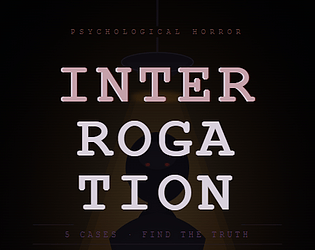
INTERROGATION is a text-based psychological horror game built in Python with Pygame. It puts you alone in a dark interrogation room with a suspect. You have a flashlight, a notebook, and a partner officer waiting outside the door. That's it. The pressure builds every second — while you stay silent, the suspect draws closer. Your goal: ask the right questions, catch the lies, and close the case before it's too late.
The game's visual style is noir brutalist — a monochrome aesthetic, monospaced font, scanlines, and glitch effects that evoke the feel of an old CRT monitor. Atmospheric music plays throughout.
Gameplay
The core loop revolves around two opposing forces: distance and the flashlight.
The suspect creeps toward you slowly but relentlessly. The further the interrogation progresses, the more aggressive his behavior becomes. The only thing holding him back is a light shone directly in his face. While the flashlight is on, distance increases. The moment you lower it, he starts closing in again.
But the flashlight isn't unlimited. The battery drains while in use and recharges slowly in the dark, forcing you into a constant balancing act: use it now, or save the charge for later.
Meanwhile, you're running the interrogation:
- Ask a question — the next question from your prepared list. The suspect answers, and his response appears letter by letter on screen, like a visual novel. Some answers contain contradictions with the evidence.
- Ask the officer — your partner outside the door passes along the next piece of evidence: CCTV data, forensic results, witness statements. This is how you catch the suspect in a lie.
- Notebook — open a full log of every question and answer from the current interrogation at any time, so you don't lose track.
A case is closed when you've asked enough questions and caught enough contradictions. If you run out of questions without enough evidence, you've failed the interrogation. If the distance drops to zero, you're dead.
5 Cases
Each case is a self-contained story with its own suspect, motive, and set of evidence. Difficulty scales linearly — new mechanics are introduced one at a time, never letting you settle in.
Case 1 — Warehouse
A murder near an abandoned warehouse on Rechnaya Street. The suspect swears he was home all night and called his mother. GPS records, phone carrier logs, and security cameras say otherwise. The introductory case — only baseline mechanics, no additional threats.
Case 2 — Arson
A deliberate office fire. The victim was a colleague who had been about to go to the police. The suspect cites an alibi at a bar that had been closed for renovations two days before the crime. This case introduces the battery mechanic: the flashlight is now limited by charge.
Case 3 — Abduction
A missing child. The last person to see him was a family neighbor who had been "helping with the kid" for five years. GPS logs a 40-minute stop at the suspect's dacha. Fresh tracks and a child's cup were found there. On top of the battery, this case adds the lunge mechanic: at any moment, if the flashlight is off, the suspect may charge forward without warning.
Case 4 — Poison
A poisoning at a banquet — two people in intensive care. A cook fired two months ago under a public scandal insists he only prepared salads and left before the banquet started. His apron carries traces of the same poison found in the victims' blood. This case adds interference: the screen begins to flicker, and during severe episodes, controls are inverted — the question and officer keys swap.
Case 5 — Mirror
A serial killer. All victims were his former patients. He's a psychologist. He knows who you are. In the interrogation room he neither denies nor confesses — he asks questions back. The final case introduces the doppelganger mechanic: two silhouettes appear on screen, and you must choose which one to shine your light on before pressing a key. The real suspect periodically switches places with the decoy.
Play here - https://kerri-irrek.itch.io/interrogation

 Вы
Вы