

Hello,
We are Hwantastic Games, an indie game development studio embarking on a brand-new journey.
Phew, this is such a nerve-wracking moment—releasing a PC game to the public!
For the past ten years, I've worked on board game development. Now, as I prepare to release my first PC game, I wanted to take a moment to introduce my creation to fellow game developers.
The Background: A Long Journey in Game Development
I’ve been making games as a side hustle for a very long time. The game industry as a whole is relatively young compared to other fields, and Korea is no exception. Early in my career, instead of joining the large, stable companies most people preferred, I chose the path of game development—and with that choice came constant anxiety. The fear of not knowing how long I’d be able to make a living in this industry followed me throughout my career.
For many Koreans of my generation, game studios were viewed as places with lower salaries than major corporations, but offering the dream of a massive jackpot. As I gained real-world experience, I realized that was largely an illusion. Huge success usually belonged to a small handful of founders, while regular employees remained just employees.
Faced with this reality, I always strived to create my own games outside of work. After finishing my day job, I’d gather with like-minded colleagues to build "our" games. In my early 30s, that side project actually grew into a full-fledged company. However, our studio—built around Facebook platform games—failed to adapt to the rapid shift toward mobile gaming and shut down after less than three years.
After that, I returned to employment, but I never wanted to stop creating games. Part of it was lingering career anxiety, but looking back, I think I'm simply someone who cannot live without creating.
I wanted to team up with people to make games again, but as my close colleagues entered their mid-30s, energy for side projects naturally waned. Right around that time, a new coworker introduced me to modern board games, and I was completely captivated. There it was: a medium where I could design and publish complete games all on my own.
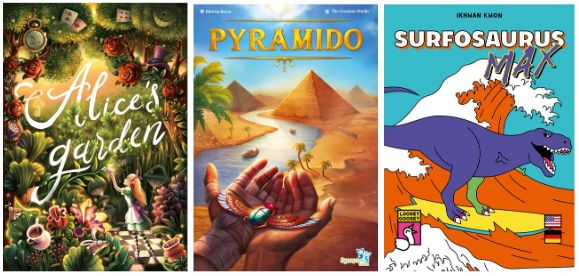
Over the next decade, I consistently designed board games as a side hustle and published around 10 titles. The greatest charm of board game design was taking my core ideas, collaborating with various teams, and bringing diverse creations to life. Knowing that people in countries I had never even visited were enjoying games built on my ideas was magical. My favorite hobby became collecting every language edition of the games I released.
[Released Board Games of Mine]
Discovering "Vibe Coding" & Early Trial & Error
While ten published titles is a respectable milestone, I was never fully satisfied because I hadn't created a major hit yet.
Then, in the spring of this year, I stumbled upon "Vibe Coding" (AI-assisted software development).
Wow! Suddenly, a world opened up where I could build video games entirely on my own. At first, it didn't feel real. I started by automating routine tasks at my day job to get comfortable with the tools.
As I grew more adept, I gained complete confidence: If there’s something I want to create, implementation won't be a barrier.
Naturally, excitement took over. The next question was: What should I make?
When designing board games, you test various ideas with playtest groups. During playtests, if testers say, "This feels like it would work better as a single-player game" or "This would work better on PC," it’s usually considered a failing mark for a commercial board game.
However, to me at that time, those comments felt like new opportunities.
Attempt #1: Mobile Puzzle Game (May)
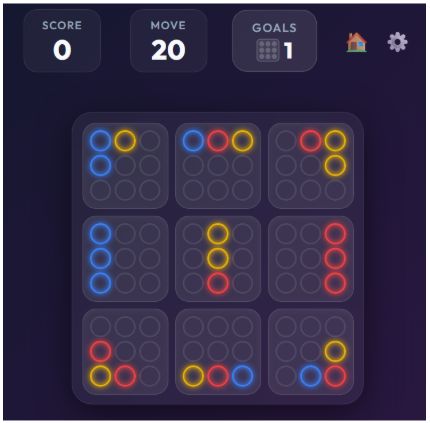
When one of my puzzle board game prototypes received that exact feedback, I decided to pivot and build it as a mobile game. It was certainly easier to prototype digitally than managing physical board game components. I worked on it for about two weeks in early May before shelving it. I had hoped to build a casual mobile puzzle game akin to Candy Crush Saga, but realized the core puzzle mechanics were simply too difficult for mobile players. I learned that while digital tools make implementation easier, they cannot magically override the inherent complexity of a game's design.
[Remnants of dead ideas]
Attempt #2: Word Association Game
Next, I tried a word-association game. Inspired by a similar concept I saw, I thought adapting the genre would make it more accessible. Mid-development, however, I discovered a very similar game had already been released.
Finding the Spark: Balatro meets The Crew
Even as failed prototypes accumulated, I kept a running list of video game ideas I wanted to try. Some were too ambitious for a first project, while others lacked a solid structural framework.
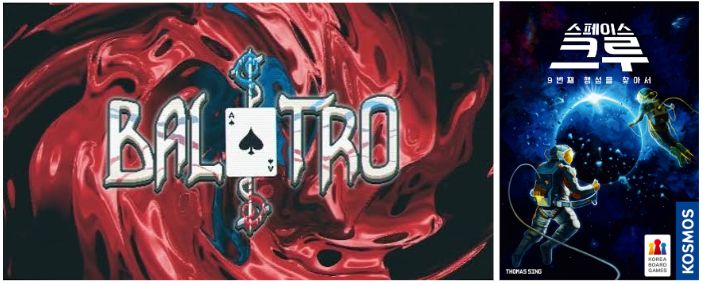
When I first encountered Vibe Coding, the game that fascinated me most was Balatro. I loved how a simple card game could deliver such deep, replayable gameplay. Before the two attempts mentioned above, my original idea was actually to digitize Mighty (a popular Korean 5-player trick-taking card game). However, I realized Mighty alone couldn't provide enough content volume to justify a standalone commercial purchase, so I abandoned it before starting.
After two failed coding attempts, I revisited my idea list. When designing board games, I naturally lean toward competitive games because I personally enjoy playing them more. Creating cooperative board games is notoriously difficult—you have to design artificial obstacles that trigger at precise moments without feeling tedious to manage manually.
In video games, however, since the core experience is single-player, cooperative mechanisms are actually an advantage.
I began reflecting on cooperative card games I knew well. The one that immediately stood out in the card genre—similar to Balatro—was The Crew. I realized that adapting mission structures from The Crew into a single-player card game could create a genuinely fun experience.
Developing Hearts Extreme (June)
In June, I began bringing this concept to life. The core design framework was:
- Trick-taking mechanics (inspired by The Crew): Players complete specific trick-taking objectives.
- Card variety & Unlocks (inspired by Balatro): Diverse card decks with progressive content unlocks upon completing missions.
For a long time, I wanted to incorporate deck-building mechanics like Balatro, but implementing full deck-building in this format proved overly complex. I accepted that it wouldn't be a dopamine-fueled combo engine like Balatro, so I focused on designing rich level variety instead:
- Winning a target number of tricks
- Capturing specific cards in a trick
- Capturing target suit/rank cards
- Avoiding specific cards
- Predicting exact trick win counts (bidding)
- Capturing specific cards while successfully predicting win counts
- Achieving consecutive prediction streak successes
With these objective types, a single deck could offer varied puzzle challenges. Furthermore, by crafting standard playing card decks alongside homage decks inspired by famous trick-taking games and custom thematic decks, the content volume would be well suited for a full PC release.
Core Identity: Open-Hand Trick-Taking
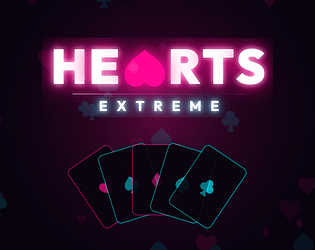
I named the project Hearts Extreme from day one. In Korea, trick-taking board games are often viewed as niche or difficult because players aren't familiar with the genre. In the West, however, trick-taking is widely known, and Hearts is a classic household title. I wanted the name to signal that this is a single-player trick-taking game based on Hearts.
I tested several mobile Hearts games. Most featured team-based play, which I felt wouldn't translate well into a premium PC game—losing because of an AI partner's questionable moves leads to frustration.
Therefore, for the 1-player experience, Level 1 set a straightforward objective: hit the target number of trick wins.
While implementing this, the game's defining feature was born.
In traditional trick-taking games, players play with hidden hands. But in Hearts Extreme, you can see all NPC hands!
Initially, I intended open hands only for Level 1 as a tutorial setup. But after playtesting for just a few minutes, it became immediately clear: Open hands had to apply to every level and become the game's core identity!
While it looks like a traditional card game, seeing all hands transforms it into a tactical puzzle experience. That unique twist gave the game a distinct identity worthy of a commercial PC release. After multiple iterations, I had finally arrived at a concept worth publishing.
Polishing & Release Preparation (July)
Development progressed smoothly throughout June. Since the game lacked a Balatro-style scaling power curve (where player decks and obstacles scale indefinitely), I designed a Ranked / Leaderboard Mode as the ultimate endgame content for player competition and replayability.
By late June, I made structural adjustments. Originally, every level consisted of 5 equal stages. However, higher-level mechanics (like consecutive prediction streaks) didn't fit a 5-stage format within a 5-life system. I trimmed Levels 6 and 7, consolidating their best ideas into Level 5 for a tighter, more cohesive progression.
At this point, release felt truly tangible:
- Registered a Steam Developer Account
- Founded the company & completed legal business registration
- Secured our official website domain name
Around July, as project complexity grew, I switched from Google Antigravity to Claude Code. The upgrade made a noticeable difference, especially in diagnosing subtle edge-case bugs. (Not sponsored, but I highly recommend Claude Code to anyone exploring Vibe Coding!)
Try the Demo & Wishlist!
I am currently looking for playtesters to get as much feedback as possible!
🎮 Play the Free Demo on itch.io:
👉 https://hwantasticgames.itch.io/hearts-extreme
⭐ Wishlist on Steam:
👉 https://store.steampowered.com/app/5015250/Hearts_Extreme/
Thank you so much for reading. I'll continue sharing dev logs as we move closer to full release!
Hwantastic Games