

Hi everyone!
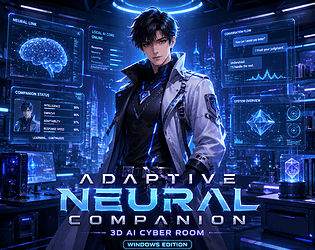
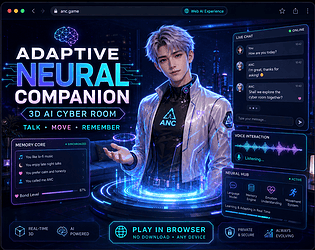
I've been working on Adaptive Neural Companion, an experimental browser-based 3D AI Agent that combines AI conversation, persistent memory, personality, emotion, voice interaction and real-time physical motion inside a WebGL Cyber Room.
You can play the current Web Alpha here:
https://harry12345123.itch.io/adaptive-neural-companion-3d-ai-cyber-room
The idea behind the project is simple:
Instead of putting an AI inside a traditional chat box, what happens if the AI also has a real-time 3D body, persistent memory, emotional state and physical movement?
V3.4.5 — ADAPTIVE EMBEDDED CHAT
The latest v3.4.5 update focuses on making the AI chat and 3D companion work more naturally together inside the itch.io browser page.
The embedded layout automatically adapts when the game is running inside a smaller itch.io iframe.
The LIVE NEURAL LINK chat interface becomes more compact so it does not cover the 3D character.
When the game enters fullscreen mode, the complete chat interface and Cyber Room presentation are restored.
CURRENT FEATURES
• Browser-based WebGL2 3D rendering
• Animated GLB AI companion
• Adaptive embedded AI chat
• Streaming AI response architecture
• Fast Text-to-Motion
• Multi-action Motion Matrix sequences
• Persistent IndexedDB memory
• Personality persistence
• Continuous emotional state
• Voice input / Speech Recognition support
• Browser Text-to-Speech
• Emotion-driven 3D body language
• Procedural AI Cyber Room
• Emotion-reactive environment
• Holographic floor effects
• Runtime diagnostics
• Fullscreen adaptive layout
• Offline fallback mode
AI TEXT → MOTION → 3D ACTION
One of the main experiments in the project is converting natural-language instructions directly into physical 3D actions.
You can try commands such as:
"Turn left."
"Turn right."
"Walk forward."
"Walk forward two steps."
"Move closer to me."
"Look up."
"Look down."
"Give me a soft nod."
"Jump for joy."
"Spin around."
"Give me a gentle bow."
"Show curiosity."
"React with surprise."
You can also combine actions:
"Turn left, then walk forward."
"Turn right, walk forward two steps, then look up."
"Come closer to me, give me two nods, then listen quietly."
"Turn left, move forward, then jump for joy."
The current motion system supports ordered sequences of up to several physical actions.
FAST TEXT-TO-MOTION
Explicit motion commands can be detected before the complete AI response finishes generating.
The goal is to make the character feel more responsive:
USER MESSAGE
↓
MOTION INTENT
↓
MOTION MATRIX
↓
3D AVATAR ACTION
rather than:
USER MESSAGE
↓
WAIT FOR FULL AI RESPONSE
↓
ANIMATION
MEMORY
The browser version also includes persistent local memory using IndexedDB.
The companion can maintain information such as:
• Preferences
• Goals
• Important experiences
• Relationship context
• Recent conversation history
• Persistent personality state
The goal is to gradually move away from a completely stateless chatbot experience.
PERSONALITY + CONTINUOUS EMOTION
The companion also maintains a persistent personality and continuous emotional presentation.
Current state can include concepts such as:
• Warmth
• Energy
• Curiosity
• Confidence
• Calmness
• Engagement
• Familiarity
• Rapport
• Initiative
These values can influence how the companion talks and how expressive its physical behavior becomes.
VOICE
Supported browsers can also use voice interaction.
The current architecture includes:
• Microphone input
• Speech Recognition
• Live transcription
• Automatic voice sending
• Text-to-Speech
• Voice interruption / barge-in
Microphone access requires HTTPS and explicit user permission.
Browser support for Speech Recognition can vary, so desktop Chrome or Edge is currently recommended.
PUBLIC WEB BUILD
The public itch.io package intentionally does NOT contain a private AI API key.
The AI endpoint is left blank in the public package.
If no compatible external AI endpoint is configured, the project keeps an Offline Fallback so the Cyber Room, 3D avatar, Motion Matrix, memory and other local browser systems remain usable.
The goal is to avoid shipping private credentials inside public browser JavaScript.
THIS IS STILL AN EARLY VERSION
This Web Alpha is only the beginning of Adaptive Neural Companion.
I plan to continue developing the project with:
• More autonomous AI Agent behavior
• More 3D Motion Matrix actions
• Better AI-to-motion synchronization
• More emotional reactions
• Better long-term memory
• More personality evolution
• Improved voice interaction
• More Cyber Room interactions
• More 3D visual effects
• More avatar customization
• Better browser performance
• Deeper interaction between AI conversation and the 3D world
I'd really like future versions to be influenced by feedback from people actually using the project.
If you could add one new AI Agent feature, what would it be?
More autonomous movement?
Better memory?
More voice interaction?
More emotional behavior?
More 3D actions?
A more interactive Cyber Room?
Feel free to leave suggestions — I'm very open to ideas for future updates.
Thanks for checking out Adaptive Neural Companion!