

On Sale: GamesAssetsToolsTabletopComics
Indie game storeFree gamesFun gamesHorror games
Game developmentAssetsComics
SalesBundles
Jobs
TagsGame Engines

foxster

53
Posts
45
Followers
A member registered Sep 07, 2021 · View creator page →

Creator of

Recent community posts

Hi klxtwn,

Thank you for your comments.  You could be missing the Windows media player classic.  Here's how to check and install it.

Windows Media Player can be installed as an optional feature in Windows 10 and Windows 11. In Windows 10, you can find it by going to Settings > Apps > Apps & features > Manage optional features > Add a feature and selecting Windows Media Player. In Windows 11, the process is similar: go to Settings > Apps > Optional features, then click View features and select Windows Media Player.

Detailed Steps:

  1. Open Settings: Click on the Start button and then select the Settings icon. 
  2. Navigate to Apps: In Settings, click on Apps. 
  3. Access Apps & features (Windows 10) or Optional features (Windows 11): 
  4. In Windows 10, select Apps & features then Manage optional features. 
  5. In Windows 11, select Optional features. 
  6. Add a feature:
    1. In Windows 10, click on Add a feature. 
    2. In Windows 11, click on View features next to Add an optional feature. 
  7. Select Windows Media Player: Find Windows Media Player in the list of optional features and select it. 
  8. Install: Click on the Install button (Windows 10) or the checkbox next to the feature (Windows 11) and then click Install.

You can also watch these videos to learn how to install Windows Media Player in Windows 11:

Hello,

From your inquiry, it appears that the MSP 11 platform isn't installed on your system, but the older Windows Speech Recognition (WSR) is.  If you're getting much better results with dictation using Win + H, you may want to install MSP 11 and try it (see more info here).

I have also noticed over the course of development a slight decline in recognition performance, due to several factors - and honestly Windows recognition can be very finicky.  I am currently working on modifications that improve the overall recognition reliability and reduce differences between WSR and MSP11 performance.  I highly recommend you check back to get the new update in a couple of weeks to see if it makes a difference for you.  Plus I'm adding in support for some of the new features released in BMS 4.38.

Hello Prime_Epilogue!  Unfortunately I don't think you'll have a lot of luck with base libraries from the community yet.  FoxVox hasn't really been promoted much by users outside of Falcon BMS.  Setting up an initial basic library is really not too hard though, and you can expand it over time from there.  Hopefully there will be some more traction gained in the future.

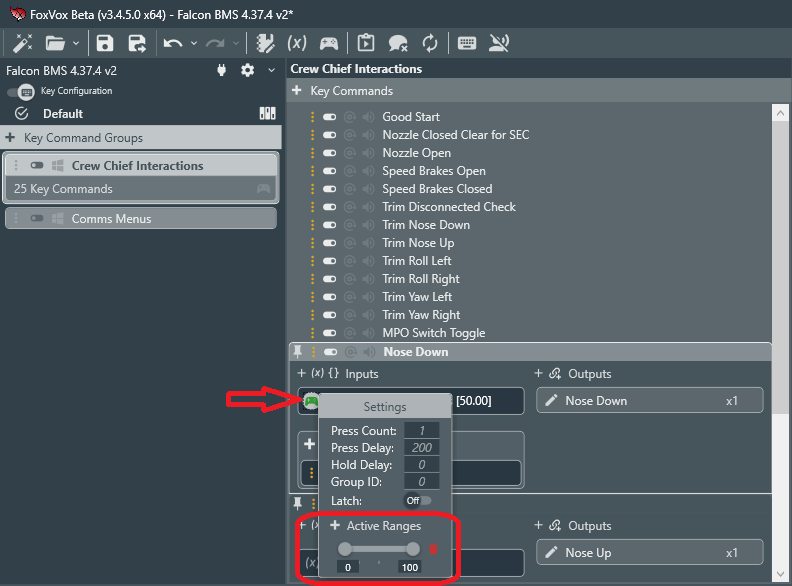
From a hardware standpoint, nose down and nose up are on the same axis, just half on one side, half on the other.  The FoxVox Parser plugin automatically uses the range 0-45% for one side, and 65-100% for the other by default, leaving a small 10% dead-band in the middle (It may actually be 20%...I don't recall offhand).

I'm not familiar with the TM TARGET HID device, but you can manually set the desired axis range within FoxVox by clicking the controller button next to it and setting whatever range you want it to be.

For this command on the VCC, although the input is analog, it is working as a discrete on/off switch - toggling on and off as the axis enters and leaves the specified range.

Thanks for your report.  That is really strange...I have seen the voice recognition come back with garbly-goop before, but only when using my laptop built-in mic which was picking up fan noise while I was speaking (and I think it also may have happened while running multiple instances of FoxVox at the same time).  Odd that you say the "," is consistent, though, as I've only ever seen it on rare un-repeatable occasions.  I will keep an eye out for any information on what might be happening.  Please look into your microphone's recording clarity as well, just in case there is any issue there - perhaps go through the windows speech training one or two times as well.

To send controller output instead of keyboard keys you'll need to install vJoy and enable it within FoxVox.  Feel free to join the Discord server for more community support:  https://discord.gg/vc37eJ4Bsp

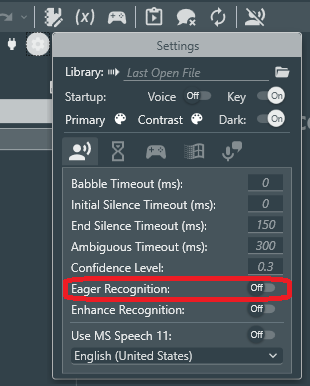
If you're using short single phrase commands like that, you might try experimenting with the Eager Recognition setting which is designed for speeding up commands for that kind of game.  It will fire off a command the instant it recognizes a match when it's on without waiting for the entire phrase to complete.
Thanks Wiley, that's very cool.  No worries about donating...sharing your video showing your first working command is thanks enough!  I hope you have fun creating many more possibilities with FoxVox.

Currently no.  I am looking into a potential free alternative engine first, primarily to support Linux, before considering any paid engine support.  I don't make anything doing this, aside from the few kindly donations, and I don't particularly feel like promoting someone who does, but we'll see in the future.  Aside from voice control, there are those using it for other functionality such as a replacement for JoyToKey and Joystick Gremlin as well, so although perhaps not for you, there is value in it for others.

Just letting you know, this latest update to v3.0 will support doing what you wanted to do here.

(1 edit)

Thank you, and interesting suggestion.  I suppose I could provide program access to speech recognition functions to openly support alternative engines.  I'll give this some consideration for the future.

All commands are working, but you may not be meeting the criteria.  Try "Tower request visual approach" for example.  You are free to make adjustments as desired to change the phrases as well.  It's designed to be very easy to customize commands to the way you like them, but be sure to watch the basic tutorial first.  Play around with an empty library file from scratch to quickly get a feel for it, then make alterations once it's comfortable.

(1 edit)

Sorry, but no.  The problem is that the speech recognition is a major part of this app and is only freely provided by Microsoft Windows platform.  There are other speech platforms but they typically require online processing and charge fees, which I won't support.  It is built on the .net core platform for portability, but its reliance on these MS components limits it.  There are some open source SR engine initiatives out there so perhaps in the future, but don't hold your breath - it might be a while.

edit: There is the Kaldi SR engine which I can possibly work with in the future found here: https://github.com/kaldi-asr/kaldi

I have a friend who thought this might be from Ready Or Not...if so he has been working on a FoxVox library for this game.  Jump onto my discord server and I can you on touch with him for more help.

Sorry for the delay - I've been away for a bit.

I suppose then every every Voice key command string is just a command is just a single phrase you say all at once.

Yes - this is correct.  This is intrinsic to how speech recognition works.  It isn't a word by word operation as phonetics are quite different than written speech.

I was hoping that the software, just by the design interface, would able to single out anyone one of the commands and just excute that.

If it worked this way as you suggest, there would be no way to add flexibility to a single voice command with alternate words or phrases, and no way to distinguish which outputs to produce.

To do what you want, if I understand it, you do indeed need to have them as independent commands since both the input (spoken phrase) and the output for each is different for each one.  This is exactly what they were designed for though, so it should be fine.

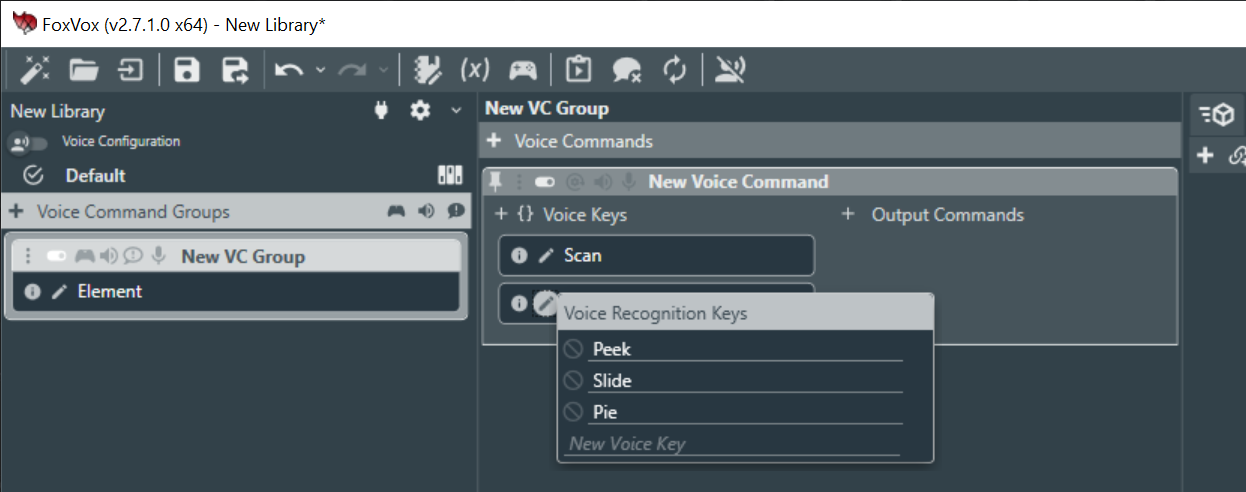
Are the outputs really supposed to be the same for Scan 1, 2 & 3?  If not, then they have to be on separate commands.  If so, then I think maybe this is what you're after?  This allows for any of these phrases to work:

"Element Scan Peek"

"Element Scan Slide"

"Element Scan Pie"

I'm sorry if I'm misunderstanding you...

Yes, it does, but you need to understand the rules.  First, key order doesn't matter - it's just for your convenience.  Second, each key must be fulfilled by a word or phrase on the command in order for it to execute.   BUT...you can put the same word on multiple keys and that doesn't mean you need to say it twice.

Example:

If you want to be able to say three things, "Element Scan Slide", "Element Scan Pie", "Element Scan Peek":

Create Voice group "Element"

Create Voice Command with two keys

Key #1:  "Scan"

Key #2: "Slide", "Pie", "Peek"

This will require saying "Element" to get on the voice group, "Scan" to fulfill Key #1, and either "Slide", "Pie", or "Peek" to fulfill Key #2.  If you add "Scan" to Key #2 also, then you can say "Element Scan ...(whatever else)"  and it will be fulfilled as the word "Scan" fulfills both Key #1 and Key #2.

If this still doesn't help you, let me know the exact phrases you want to say to execute the command and I'll try to provide a solution.

Yes, it does.  You must group it correctly on the command depending on how you want it to work - as an alternative or additional phrase.  This is explained best in the basic tutorial video;  https://youtu.be/0Aqbf5IWd1w

(1 edit)

I'll look into it to see if there is a timing issue or something going on.

One thing to consider is it may be sending the keypresses too quickly causing one or two not to register.   You can test that by setting a value for Key Delay under the library settings (cog wheel icon to the right of the library name in the upper left).  Set it to a value of something like 10 or 20 ms and see if that helps.

It can/does handle long phrases but there are some things to watch out for, particularly with a phrase as long as the one you show. First, watch out for pauses that trigger a stop in the speech processing (particularly at 'Good day'). Speech processing processes one phrase at a time so if it is split into 2, then each one processes independently.  This leads into the second issue - FoxVox works by a command word followed by special key words.  In the default library the phrase must start with "Ground" to activate the Ground command group, then include the word taxi (and not include "back" or "ramp").  From your example, you would have to add "Gunsan" to the ground command group to be successful or make "Ground" a wildcard by adding an asterisk "*" behind it (meaning it doesn't have to be the first word spoken and can come anywhere in the phrase).  Making it a wildcard would have negative repercussions however as "Ground" is used in other key phrases for wingman, i.e. "Two, datalink ground target" or "Two, weapons free air to ground".  These commands wouldn't be executed properly because the ATC Ground command group would be activated instead of the Wingman group due to the wildcard and its earlier position in the list.  I may do a revision to prioritize keywords found at the beginning of the phrase over wildcards first, but currently that's not how it works.

So from this, you need to be sure that the processed phrase is found.  I experimented with your wording a bit and found that adding both "Taxi*" and "Departure*" as wildcards to the ATC Ground command group seemed to work best.  I also added "Departure" as an optional word on the Request Taxi command and as a blocked word to the Request Taxi Back to Ramp command to help prevent an accidental misfire. Doing this seemed to give the best results regardless of pauses being present or not.  I just had to focus on making sure "Taxi" and/or "Departure" was understood properly. Also, remember when testing and troubleshooting, be sure to enable the enhanced log to see what is being tracked as you speak.  I also think I can possibly make some enhancements with really long phrases that might help in the underlying engine...I'll experiment more for the next update.

I need to see about opening a channel on discord - good suggestion.  There's not many people using FoxVox currently, but who knows, might be more in the future.

Thanks, and yes, that's a good suggestion since things have become a bit more sophisticated than just voice recognition.  On my todo list.

(1 edit)

Just to confirm, you can switch between voice and key configurations at the upper left (just below the library name) and you must enable key recognition as shown here:

Just so you are aware, voice commands can only be triggered by voice, however key commands will trigger based on not only key input but also trigger on conditions, which is why they reside there for the VCC.  If you have enabled key commands and everything is triggering but you still don't hear anything, check to see if you have windows media player installed or disabled.  They will also play if an alternative player has been set up in Windows, but you may experience issues there if they can't open through the Windows shell command.

Edit:  Also make sure the VCC files which contain the audio files are present in the subfolder with the library...sometimes it's the little things that can get overlooked.

Let me know if the latest v2.4.0.2 makes any difference.  Hopefully it helps!

Hi there, glad to see your desire to be creative with the app.  I'm not sure how well it will function for how you intend to use it, but certainly give it a try.  As for the error you report, this is a strange one.  The app is basically saying it is failing to find any qualified speech recognition modules on your system.  What language is your Windows installed with?  Can you check if there are any sub folders found in the following location:

Windows install path (default C:)\Windows\Speech\Engines\SR

For default English US for example there will be a folder call 'en-US'.

If you are finding at least one folder there, the issue may be due to a permissions error in the MS System.Speech module accessing the registry.  In that case, installing the app with the installer and possibly running it as an administrator could potentially solve the issue.  If there aren't any, then you don't have any recognition engines installed and you'll need to install one here:

Select the Start  button, then select Settings  > Time & Language > Speech

Please be aware:

  • Speech Recognition is available only for the following languages: English (United States, United Kingdom, Canada, India, and Australia), French, German, Japanese, Mandarin (Chinese Simplified and Chinese Traditional), and Spanish.

There are new languages supported using the MS Speech Platform 11 but FoxVox does not have those implemented currently.

I will add in some additional error handling to detect this issue more gracefully, but see if you can investigate what I suggested to try and solve it.

Really strange, but glad it's working.  I run neither as administrator and they work fine.  Perhaps your BMS installed in a protected location like 'Program Files'?

Ok, that is helpful information and I will take a look into performance with the next upcoming release.

Interesting.  The key recognition disabled rules out output overload.  Are you running any virpil control software at the same time?  Without key recognition running FoxVox is only passively monitoring input which shouldn't cause any lag.

This sounds like an issue with output overload which happens when every tiny movement of the analog stick causes the output to fire, which can quickly overwhelm the system.  If you remove/disable the slider binding does everything else work OK?  It would be good to narrow down the culprit.  Also, just to check, does the system bog down or have any problem when you move the axis while the Key Recognition is disabled (keyboard button second to last in the toolbar)?

I'll look into it. Can you explain how you are settling it up so I can duplicate it? 

Welcome back to BMS...glad you like the app!  One thing that comes to mind is make sure that in the settings (little cog wheel icon by library name) you allow any process (by not having any assigned) or include it in the allowed process list.  I'm not sure this is the issue though, as you say the built in ones are working.  Make sure the command window shows that the voice command is being activated/recognized, and make sure the outputs are defined properly.  If you can detail a specific question, I'll be glad to help either here or in the BMS forum.

Regards, Foxster

Thanks Mistral.  I must confess, these have been resolved already and are part of the next release, but it's been slow in coming due to the intricate and complex addition of supporting variables on inputs.  This is part of the next phase to prepare for full dynamic integration with BMS (and potentially other apps).  In the future, hopefully by BMS v4.38, FoxVox will automatically utilize callsigns, detect which seats are human vs AI, automatically set PTT to match UHF and VHF assigned buttons, and use direct callbacks rather than menu assignments for all comms.  It will also auto-bind brakes, flight controls, and buttons used by the Virtual Crew Chief which are set in BMS.  There's a lot of work going into this and all of it will make FoxVox more versatile in the end.  In the meantime, thank you for pointing out these issues - please continue to do so, and thanks for your patience.  Look for the next update releasing soon!

This is already underway...and where it's headed soon.  The library will automatically integrate with BMS bindings, call signs, etc.

I'm looking into this further, but for now make sure that the Windows speech recognition is set to match the same language selected in FoxVox, and also make sure the Windows UI is set to the same language also.

I will be fixing/improving this area soon as other's have reported the same issue and it really shouldn't be as quirky as it is.

Try the new update and see if it fixes your issue. 

Well, I think the cross section of users is pretty small, so you alone probably make up a fair portion.  It's not hard to add and won't compromise existing functionality, so I suppose I'll do it.  I'm sure you won't be the only one with the issue.  Glad you found and fixed it.  If you like the app, be sure to pick up the next version coming out soon.

Good to know - thanks for sharing your issue here. When you play a sound from an output command, you have the option of disabling the internal (wmp) player and have it play with through the associated shell extension which would in your case launch vlc and play it that way. The downside is it needs to launch the app through the Windows shell (meaning the file extension must be associated in Windows with vlc).  Unfortunately this is currently only available on sounds played through an output. Based on your feedback I'm considering adding a global setting that will disable wmp and play all sounds through the Windows shell. I could also have it detect and set it automatically if wmp is not installed on the system.  This might fix your situation...any thoughts?

Ah, yes, it does rely on media player in some cases. It didn't originally but I revised it to support other media types besides wav.

Yes wav files are fine, as are other formats.  What you're doing should work fine.  If you're using headphones be sure other computer sounds aren't muted and are coming through...just to be sure it's not something simple overlooked.  I've never had anyone else report this so far and it works fine for me.  Very unusual.

Hmmm, shouldn't require admin rights or anything special.  Are you setting it to play on key recognition or using an output with a play file in it?  I'll run some tests before launching the next update (very soon & it's a good one).

Ok, I've posted an update to attempt to fix the issue.  Unfortunately I don't have any hardware to test, so I'm relying on you to let me know if it resolves the issue.  Also, I've added in a feature with the Push-to-Talk settings that let you specify 'Any Key' to allow any of the bound keys to activate PTT rather than all.   Let me know how it goes!