
Indie game storeFree gamesFun gamesHorror games
Game developmentAssetsComics
SalesBundles
Jobs
TagsGame Engines

Double Star Games

2
Posts
2
Topics
3
Followers
3
Following
A member registered Feb 09, 2026 · View creator page →

Creator of

Recent community posts

https://youtu.be/CIeFI9TP6fk

https://double-star-games.itch.io/feryl

In 1996, Steve Grand built _Creatures_ — virtual animals with neural network brains and programmed biochemistry. Their behavior emerged from the inside out. In the thirty years since, virtual companions moved toward scripted animation and cloud-connected models — creatures that look alive but are driven from the outside in.  

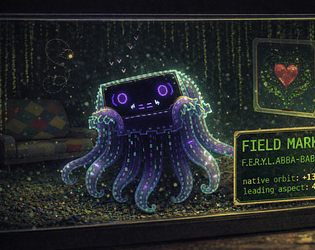
The inside-out line that Grand once began went quiet. Feryl picks up that thread. In the spirit of Creatures: small, smart, interactive AI that lives locally — on your device or your desktop. It is a compact, biomimetic build made of integer neural networks, small learning systems, and emergent simulations. Each instance is its own phenomenon.  

When you run Feryl, your specific Feryl originates on device. It has its own internal dynamics, origin state, and tendencies.  

When you close it, that particular pattern is gone.  

Feryl is local to your device, but Feryl is also local to its world. It looks at its world — its rock, its fly, the glass, your voice — and explores what draws its attention. Over time, its internal state begins to shape its future. What it notices, what it approaches, how long it lingers — these become weighted by how its dynamic system has processed past interactions. Experience carves a path.  

To zoom into the center of Feryl's dynamic system would show you a map of coupled oscillators, energy cells, and over eleven thousand addressable locations. This system is how Feryl observes its own behavior — auto-observation of its own signals. Everything Feryl hears or sees is fed into this dynamic system. Your voice. The mirror. The fly. Each input injects energy. Oscillations stretch. Tensions build and release. Over time, Feryl processes that energy and relaxes back toward equilibrium — but never along exactly the same path.     

Feryl's internal states include Focus, Wander, and Keyed — measures of attention and engagement. These allow Feryl to express itself. We didn't have to create scripts or behavior trees. Feryl drives by its own internal readings.  

Its structure is biomimetic, inspired by a four-phase respiratory cycle. No two Feryls are alike because no two origin states are alike. In a life-like way, Feryl's dynamic system never fully comes to rest. It has movement, and an algorithm for a stochastic respiration pattern.  

Feryl is very small. A few megabytes. Native C and C++. Deterministic integer math. Everything happens locally, privately, inside the structure of the creature itself.  

If you enable the mic, your voice becomes part of Feryl's inner world — heard through its own VAD, folded into the oscillations of its dynamic system, and gradually echoed back as accents that emerge from interaction rather than code.

Double Star Games LLC
Portals:  That Never Repeat

What we made

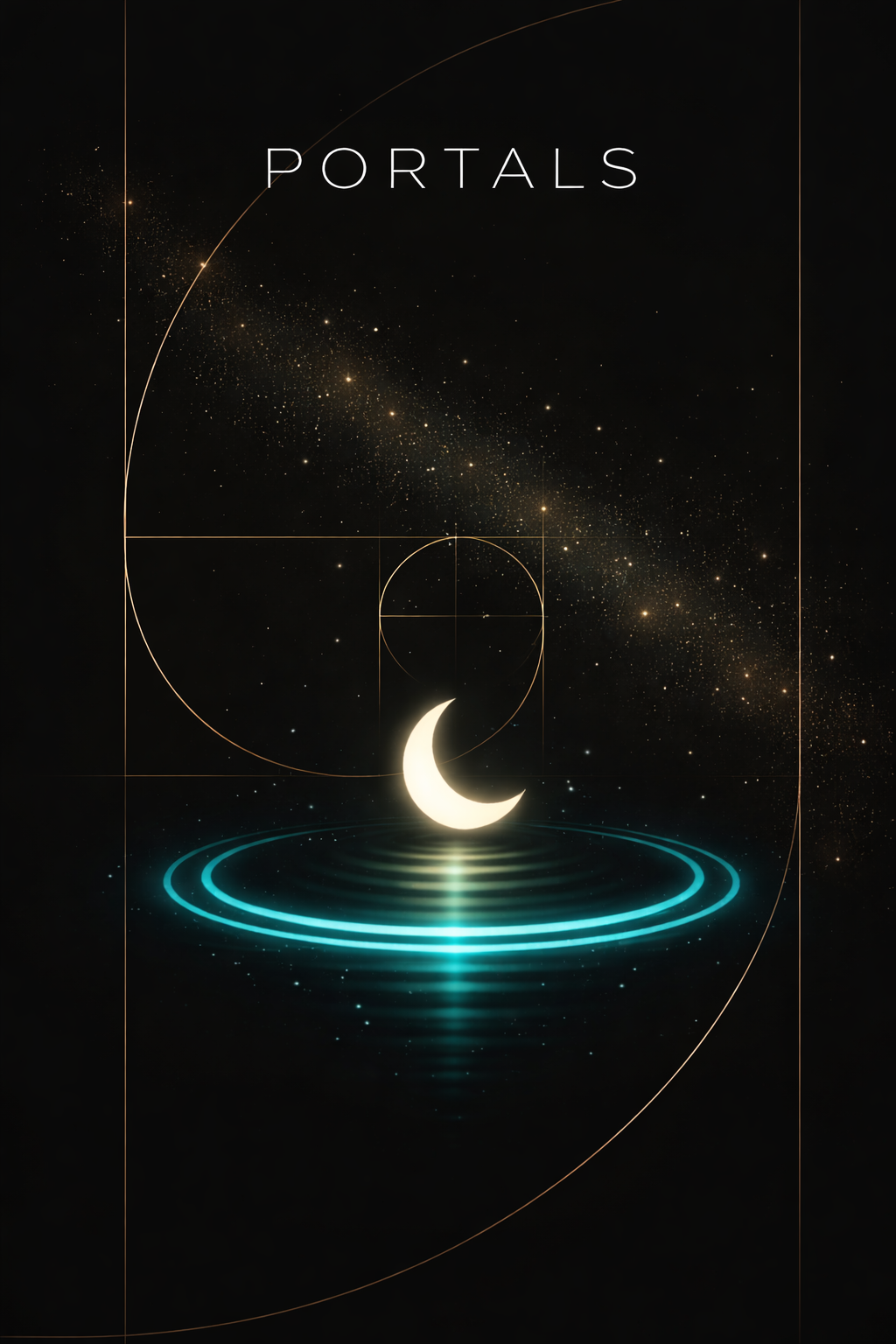
Portals are small ambient programs that can take you to another place. I wish for them to bring anyone any bit of peace.  Portals  live on your desktop or device. Each one is a 360×582 pixel window — a buildable golden ratio — that runs forever. Water drops fall into dark water. Things glow.  You watch for a while, forget you were doing something else, come back to it.

They're native C/C++ programs, 52–60 KB each, with no dependencies beyond SDL2. No frameworks, no runtime, no GPU shaders, no network, no telemetry. A single executable that does one thing until you close it.

We kept calling them portals because they feel alive in a way we didn't fully expect — their stochasticity makes them like going somewhere in nature, they have space to them, and rhythms that elegantly shift and never settle. They're not screensavers, though I'm reluctant to close mine. They'll never ever loop. More on that below.

The four Portals

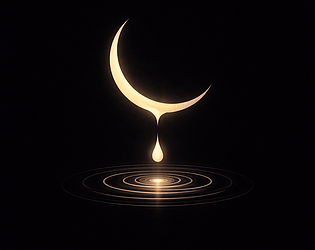
Water Heart Cave — A ceramic bowl underground. Drops fall into a water harp. The sound is the point: each drop rings through 14 resonant modes with ceramic decay, colored by the shape of the container and the soil above. You essentially hear the underground in the echo.

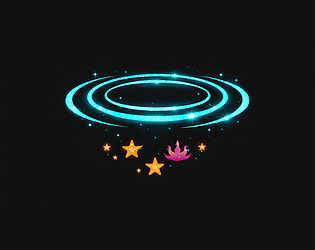
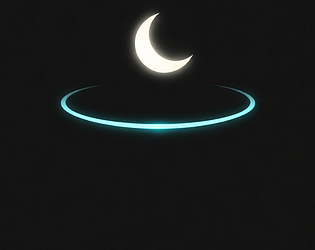
Cenote — You're looking down through an elliptic cave opening into deep water. A warm crescent moon floats as a Gaussian reflection. When drops hit, radial rings of bio-luminescent blue-green expand outward, then fade to black. Just the moon remains. Lumen — A reflected eclipsed moon blurred on a watery surface. Underneath, a genuine 2D wave simulation on a 48×48 grid. Wave fronts propagate, reflect off cave walls, squeeze through the waist of the two eyed shape, and interfere with each other — dance with each other- constructively, destructively, the way real waves do. Bio-luminescence fires  in this simulation where the velocity gradient spikes. The light has to earn its presence every frame against an unconditional 0.90 fade. Darkness always stills eventually.   Tidepool — A night time rock pool on a shore. You can hear and feel the tide-breath.  Starfish and anemones rest on the pool floor under dark water. When the liquid moon drops on the surface, the tilted elliptical ripples expand and insinuate  multiple surface depths — you're looking across near the rim, not straight down. The ripple ring clears the water and the life in the pool is aglow beneath.  The water darkens into stillness. The ocean breath is a rhythm that never quite repeats.

Why they never repeat

Most ambient software loops. Even the good stuff — after two or three cycles your brain maps the pattern and stops paying attention. We wanted something your brain couldn't map.

Drop timing is drawn from a log-normal distribution. Median interval is about 7 seconds, but each one is drawn fresh — you might get 1.5 seconds, you might get 30. Layered on top, the tidal breath runs its own independent stochastic clock at a median of 12 seconds. It modulates the drop rate, the audio gain, the water level, the edge glow. Two independent random processes interfering with each other produce emergent behavior at a third timescale. Sometimes the pool rushes with rapid drops during a swell. Sometimes it goes nearly still.

We ran it for one hour — 216,000 frames, 158 million audio samples — and verified: no repeating patterns, no audio clipping, no float errors. Your brain keeps trying to predict what comes next, and it keeps being slightly wrong. We think that's where the relaxation comes from.

The audio engine

The entire audio path runs in Q16.16 fixed-point integer math. No floats anywhere. Every multiply is `(int64_t)a * b >> 16`, every addition saturates. We chose this not out of nostalgia but because fixed-point has deterministic overflow behavior — without any denormals,  NaN, nor infinity. The math does exactly what's written, on every platform, every time.

The DSP is built from small C structs that each do one thing: a bubble oscillator (chirped sine, 4ms decay), a cavity resonator (4 biquad bandpass modes), a pool filter (lowpass at 3500 Hz), a Schroeder reverb (4 parallel combs with LP-damped feedback and 2 allpass diffusers), and an ocean breath generator (filtered noise shaped by a stochastic envelope). They stack in series: bubble → cavity → filter → reverb → gain → int16 output.

The whole DSP engine is about 1,300 lines of C.

I am Dana, I work as an NCSD, a Non Coding Software Developer at DoubleStar Games next to my co founder Patrick who is an engineer of 40 years.  Thanks for taking the time to read this and check out our Portals.  I'll enjoy going deeper into the wave physics and the tidal pool binary as I go foward in future devlogs.  

We, as DoubleStar,  live for making tiny tech that respects your time and space and we also live for biomimetic building by putting Nature into our code  in the most unexpected ways.      

https://double-star-games.itch.io/portal-moondrop-tidepool

https://double-star-games.itch.io/portal-moondrop-lumen

https://double-star-games.itch.io/portal-moondrop-cenote

https://double-star-games.itch.io/moondrop-water-harp-cave