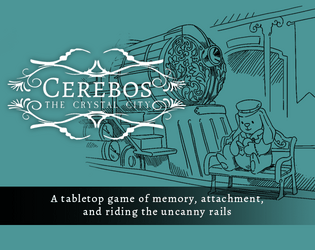
The Conductor is a sort of shared playbook that determines what genre a given journey occupies, furnishing a set of global "moves" that any player can activate. They're also a character who functions as a sort of GMPC if a GM is present, but one isn't required. Cerebos can be played GMless just fine, with the caveat that careful information management is needed, because there are certain facts each player doesn't know about their own character; in GMless play, you'll need to arrange for every other player to know your character's secret info without actually learning it yourself, which can be logistically tricky if the group is large.
David J Prokopetz
Creator of
Recent community posts
In order:
- The Form and Expression slots are actually labelled as such, though the text of those labels could probably standard to be darker.
- The document's built-in metrics are for an 11"x8.5" page, or US letter in landscape format; the central division is to make it foldable for easy transport. You could do them two to a page, but you'd need to write awfully carefully; we have an internal rule against making write-in spots on print-and-play props less than 10mm tall because a lot of people just plain can't write that small.
- This sheet is built on the assumption that you're using tokens to track Obstinacy as recommended in the game's introduction. There's probably enough space to write it in at the bottom of the Rebellious Arts box if you wanted to track it on paper, though.
- Long-form Expressions could easily take up a quarter of the page all by themselves; that's one of the things that will be left for the extended character sheet.
As far as I can tell, you successfully submitted it. In fact, you published and submitted two separate (but seemingly identical) copies of it:
https://hollowclam.itch.io/wells-of-the-forgotten
Please double-check that you're not using the old link from before this morning's minor update. The current URL is https://penguinking.com/eat-god/eat-god-0.5.1-generator.html (the old one will have 0.5.0 in it instead).
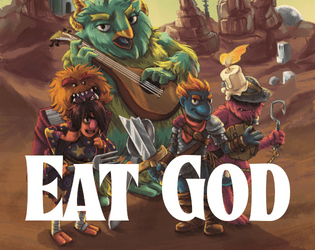
Worked examples of how to come up with Expressions for one's Forms didn't make it into the current draft because the list of Forms is still in flux, but I thought I'd toss a few potential examples here in case anyone would find that helpful:
Bottomless Belly
- Indulgent – You encourage people to try new experiences, culinary or otherwise.
- Refined – That you can eat literally anything does not oblige you to be indiscriminate; perish forbid!
Firm Flesh
- Patient – You've got all the time in the world.
- Stubborn – You're hard-headed in more ways than one.
Hundred-Handed
- Self-reliant – Who needs a helping hand when you've so many of your own?
- Absent-minded – Sometimes the left hand really doesn't know what the right hand is doing.
Primordial Power (Fire)
- Hot-blooded – Your feelings burn as hot as your flesh.
- Fatalist – The flame that burns brightest burns briefest, and oh, you've burned so very bright.
Prismatic Pelt
- Forthright – There's no sense being coy about your feelings when you literally wear them on your sleeve.
- Unassuming – You prefer to fade into the background, both literally and metaphorically.
Superior Sense (Hearing and Touch)
- Busybody – Oh, you know it's really none of your business, but you couldn't help but overhear...
- Paranoid – Can anybody else hear that? How can they not hear that?
If anyone would like to offer their own take on examples Expressions, either for these Forms or any of the thirty-ish others in the current draft which I haven't covered here, feel free!
Glad you approve! In the interest of full disclosure, the idea of "each player character has dominion over one specific fictional conceit" as a magic system was admittedly cribbed from Tales from the Floating Vagabond (though TftFV's version is themed around 1980s action movie tropes rather than Looney Tunes sight gags).
There will be examples of play eventually. The "early access" tag isn't just for show – it's genuinely a work in progress at this point, with substantial changes to the core mechanics from version to version, and writing worked examples of play too early in development is a great way to end up with a game where the examples are talking about a completely different version of the game than the accompanying rules text.
You know, I think I've figured out why so many folks are having trouble with the Sun Path/Moon Path switch puzzle: there exists a completely reasonable interpretation of the puzzle whereby the little goat dude who tells you the solution is lying to you.
He says, I quote: "Didja know the Sun Path and the Moon Path are mirror images of each other?"
If that was actually the case, supposing that the fixed switches were in the following positions:
A: / \ \ / \ / \
... then one might expect the solution to be:
B: / \ / \ / / \
Except it's not. The *actual* solution is:
C: \ / \ / \ \ /
(I just verified this against my own save file, which is where I got sequences A and C from.)
As we see here, only the order of the switches is inverted in the true solution. The problem is that the way the goat dude phrases the hint has two equally plausible but mutually exclusive interpretations: a visual mirroring, such that the solution is a literal mirror image of original sequence, as in solution B; and a semantic mirroring, such that the symbols that comprise the solution are put in reverse order, as in solution C.
I'm guessing the reason folks are running into a wall is that B is the more intuitive interpretation for a lot of people.