Indie game storeFree gamesFun gamesHorror games
Game developmentAssetsComics
SalesBundles
Jobs
TagsGame Engines

Black Fox

8
Posts
1
Topics
6
Followers
1
Following
A member registered Feb 04, 2024 · View creator page →

Creator of

Recent community posts

Yeah, and you’re 100% right to be cynical about that.

After seeing it happen often enough, it stops feeling like bad luck and starts feeling like a pattern. A lot of creators get so locked into their own vision that they stop paying attention to the people who were actually connecting with it in the first place. Then when people push back, it gets written off as negativity, “haters,” or people not understanding the direction. Most of the time, that ends exactly how you’d expect.

Potential on its own means nothing if the people behind it stop listening, overreach, or drift away from what made the thing interesting in the first place.

And being in my mid-to-late 40s myself, I get that mindset more than a lot of younger devs probably do. Once you’ve been around long enough, you stop getting dazzled by big promises and shiny ideas on their own. You start looking at consistency, follow-through, and whether someone actually understands why people connected with the project to begin with. Age gives you less patience for nonsense, but it also gives you a better eye for what usually goes wrong.

I think that’s also why so many more generic projects survive. They play it safe, stay easier to manage, and avoid taking too many risks. But the trade-off is that they also don’t leave much of an impression. The more unique projects hit harder because they actually try to do something memorable — but that also means they need a steadier hand behind them.

That’s why I think people who stick around, comment, point things out, and react honestly matter more than some devs realise. Not every suggestion should be followed blindly, obviously, but shutting that out completely is usually how good ideas end up disappearing up their own arse.

For me, I’d rather build something that keeps its identity while still staying grounded in what actually resonates with people. That gives a project a far better chance than vanishing into “trust me, I know better” mode and hoping for the best.

So yeah, I fully get why you feel like that. When you’ve seen enough promising stuff mishandled, dropped, or turned into something safer and duller, it’s hard not to expect the worst. And honestly, after enough years watching the same pattern repeat, that kind of skepticism isn’t negativity — it’s experience.

I get that completely, and I honestly agree with you.

A lot of the projects people find most interesting are usually the more ambitious ones, but that’s also exactly where things can go wrong. Bigger storylines, more mechanics, more branching, more depth — it all sounds great, until the scope starts fighting back and the dev realises they may have built something too big to handle.

I feel that myself with my own project. I’ve got loads of ideas, but I do have to stop and ask whether they actually fit the game, whether they make sense to anyone else, or whether it’s just me getting carried away because I’m too deep in it. That can be a real danger, even with “just” a visual novel, but even there, story structure, routes, variables, mechanics, UI, art, all of it adds up fast.

And yeah, when people are supporting through Patreon or similar, I completely understand why that frustration gets even stronger. It’s one thing to lose interest in a project as a reader or player, but if you’ve actually backed it and believed in it, only for it to stall out, that’s a different level of disappointment.

And like you said, the really annoying part is that it’s often the more unique, riskier, more interesting projects that fall away, while safer or more generic ones are the ones that manage to survive.

It’s something I’ve noticed for years in the indie scene. A developer appears with a great concept, impressive art, maybe even a playable demo. People get excited. There’s buzz. Then slowly the updates fade, the momentum dies, and eventually the project disappears.

It’s easy to assume they just lost interest. But after watching this cycle repeat since the mid-2010s boom of itch.io and Unity accessibility, I don’t think it’s that simple.

Game development is heavy. It’s long-term. It’s unpaid work layered on top of real life. Burnout creeps in. Scope expands. The market is overcrowded. Discoverability is brutal. And the truth most people don’t say out loud: the odds of making real money are slim.

Most projects don’t fail because the developers are lazy. They fail because finishing something this demanding requires a level of stubborn consistency that’s hard to sustain.

As a player, it’s frustrating to watch promising ideas vanish. You start to hesitate before getting invested in anything new.

Maybe that’s why I’ve approached my own project differently.

It’s not built around trends or fast returns. It started as something personal — a father-son project, thousands of miles apart but connected through building something together. Four years later, it’s still going. Financially? It’s basically a loss so far. One person paid $5. I’ve put in around £250. That’s fine.

Because I’m not doing it for the payout.

I enjoy the process. The building. The problem-solving. Watching it slowly become real. If it earns something eventually, great. If it doesn’t, I’ll still have finished what I started.

And honestly, finishing feels rare enough these days.

In a space full of abandoned prototypes and “coming soon” pages that never arrive, simply shipping something — even small, even imperfect — feels like the real achievement.

It’s something I’ve noticed for years in the indie scene. A developer appears with a great concept, impressive art, maybe even a playable demo. People get excited. There’s buzz. Then slowly the updates fade, the momentum dies, and eventually the project disappears.

It’s easy to assume they just lost interest. But after watching this cycle repeat since the mid-2010s boom of itch.io and Unity accessibility, I don’t think it’s that simple.

Game development is heavy. It’s long-term. It’s unpaid work layered on top of real life. Burnout creeps in. Scope expands. The market is overcrowded. Discoverability is brutal. And the truth most people don’t say out loud: the odds of making real money are slim.

Most projects don’t fail because the developers are lazy. They fail because finishing something this demanding requires a level of stubborn consistency that’s hard to sustain.

As a player, it’s frustrating to watch promising ideas vanish. You start to hesitate before getting invested in anything new.

Maybe that’s why I’ve approached my own project differently.

It’s not built around trends or fast returns. It started as something personal — a father-son project, thousands of miles apart but connected through building something together. Four years later, it’s still going. Financially? It’s basically a loss so far. One person paid $5. I’ve put in around £250. That’s fine.

Because I’m not doing it for the payout.

I enjoy the process. The building. The problem-solving. Watching it slowly become real. If it earns something eventually, great. If it doesn’t, I’ll still have finished what I started.

And honestly, finishing feels rare enough these days.

In a space full of abandoned prototypes and “coming soon” pages that never arrive, simply shipping something — even small, even imperfect — feels like the real achievement.

It’s something I’ve noticed for years in the indie scene. A developer appears with a great concept, impressive art, maybe even a playable demo. People get excited. There’s buzz. Then slowly the updates fade, the momentum dies, and eventually the project disappears.

It’s easy to assume they just lost interest. But after watching this cycle repeat since the mid-2010s boom of itch.io and Unity accessibility, I don’t think it’s that simple.

Game development is heavy. It’s long-term. It’s unpaid work layered on top of real life. Burnout creeps in. Scope expands. The market is overcrowded. Discoverability is brutal. And the truth most people don’t say out loud: the odds of making real money are slim.

Most projects don’t fail because the developers are lazy. They fail because finishing something this demanding requires a level of stubborn consistency that’s hard to sustain.

As a player, it’s frustrating to watch promising ideas vanish. You start to hesitate before getting invested in anything new.

Maybe that’s why I’ve approached my own project differently.

It’s not built around trends or fast returns. It started as something personal — a father-son project, thousands of miles apart but connected through building something together. Four years later, it’s still going. Financially? It’s basically a loss so far. One person paid $5. I’ve put in around £250. That’s fine.

Because I’m not doing it for the payout.

I enjoy the process. The building. The problem-solving. Watching it slowly become real. If it earns something eventually, great. If it doesn’t, I’ll still have finished what I started.

And honestly, finishing feels rare enough these days.

In a space full of abandoned prototypes and “coming soon” pages that never arrive, simply shipping something — even small, even imperfect — feels like the real achievement.

(1 edit)

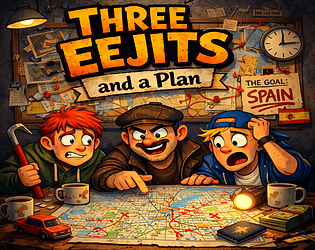
The project is officially in development.

Some plans are simple.
Some plans are clever.
And then there’s Egon’s plan.

Development is underway on a retro 60s/70s-inspired heist adventure filled with dry humor, bold schemes, and perfectly timed chaos.

The first playable version is coming soon.

Click here

Expect:

  • New locations inspired by classic Danish settings
  • The first elaborate heist sequences
  • Sharper, tighter plan-and-execute gameplay
  • And beautifully controlled chaos from start to finish

Egon has another “foolproof” plan. Benny is ready to drive. Kjeld is… deeply concerned.

Stay tuned. Because this time, it just might work.


PLEASE IT WILL BE MORE THAN HELPFUL IF YOU COULD LEAVE A COMMENT WHAT YOU THINK ABOUT THE IDEA OF A GAME!


(2 edits)

Thanks for your praise. Thanks for letting me know, try this link invite. Hope this works!

Next update is planned within the next three weeks.